On the slideHow hypnotherapy helps calm automatic reactions and restore inner safety.
Episode 3 · Slide 1
Releasing Emotional Triggers
Episode 3 · Slide 1
Let me tell you about a moment you already know by heart.
You’re fine. Genuinely fine. Coffee’s good, the morning’s ordinary — and then someone uses a certain tone of voice, or you see a certain name light up your phone, or a car cuts you off, and in the space of a single heartbeat you are not fine. Your chest goes tight. Heat climbs your neck. Something inside you slams a door or throws a punch or simply goes cold and far away. And the worst part isn’t even the feeling. It’s the bewilderment that follows: where did THAT come from? It wasn’t even a big deal. What is wrong with me?
Nothing is wrong with you. I need you to hear that before we take another step. You just met a trigger — and a trigger is not a character flaw. It’s an old alarm, wired long ago, doing exactly what it was built to do.
Look at our woman at the water’s edge, the mountains catching fire with sunrise behind her. The caption beneath her tells you precisely where we’re headed: how hypnotherapy helps calm automatic reactions and restore inner safety.
Two chapters ago we found the iceberg. Last chapter we learned the old programs can be rewritten. Now we get specific and personal, because nothing exposes those hidden programs faster than a trigger. A trigger is the moment the ninety-five percent below the waterline suddenly grabs the wheel — and you, the thinking, reasonable you, get shoved into the passenger seat to watch yourself do something you swore you wouldn’t do again.
This chapter is about getting back behind the wheel. Not by force — we learned that doesn’t work — but by understanding the alarm, thanking it, and gently teaching your whole system that the danger it’s bracing for is already over.
You don’t have to be at the mercy of your reactions for one more decade. Take my hand. Let’s go quiet the alarm together.

On the slideA trigger is a fast emotional or physical reaction connected to an older memory, fear, or protective pattern: sudden emotional intensity · body tension or shutdown · old fear in a new moment · a response that feels bigger than the situation.
Episode 3 · Slide 2
What Is an Emotional Trigger?
Episode 3 · Slide 2
Let’s name the thing clearly, because you can’t calm what you can’t see. The slide defines it plainly: a trigger is a fast emotional or physical reaction connected to an older memory, fear, or protective pattern.
Read that last part again: connected to an older memory. That’s the whole mystery solved right there. The reaction feels too big for the moment because it isn’t actually about the moment. The present-day event just rang an old bell, and your nervous system came running with a bucket of water for a fire that burned out twenty years ago.
Look at the four signs on the slide, and see if you recognize yourself in any of them — most of us recognize ourselves in all four.
Sudden emotional intensity. Zero to a hundred in a heartbeat. One second you’re calm, the next you’re flooded with rage or grief or panic that seems to come out of nowhere. It didn’t come from nowhere. It came from then.
Body tension or shutdown. Your shoulders climb, your jaw locks, your stomach knots — or you go the other way and just… disappear. Numb. Flat. Gone behind your own eyes. Both are the body’s ancient survival switches flipping without your permission.
Old fear in a new moment. A perfectly safe situation suddenly feels dangerous, and you can’t explain why. A raised voice, a closed door, a particular silence — and a much younger version of you is suddenly running the show, reacting to a threat that lives in the past.
A response that feels bigger than the situation. And afterward, the shame: why did I overreact? It was nothing. But it was never nothing to the part of you that got triggered. To that part, it was the same old danger, all over again.
Look at the woman in the image — the golden light flaring at her chest and her mind, the body lit up like a circuit board. That’s a trigger, made visible. It’s electrical. It’s fast. It happens in the body before the mind has a say.
And here’s the reframe that changes everything, the one we’ll build the rest of this chapter on: a trigger isn’t you being broken or dramatic or “too much.” It’s a faithful old alarm system, still wired to a danger that has passed, still trying with everything it has to keep you safe. It deserves your compassion, not your contempt. And once you understand it, you can finally, gently, turn it down.

On the slideThey reveal where the nervous system still expects danger. “The reaction is information.”
Episode 3 · Slide 3
Triggers Are Messages, Not Enemies
Episode 3 · Slide 3
Here’s the iceberg once more, but flipped upside down in the dark water — and that inversion is the whole point of this slide. Your trigger is the tip you can see; the reason for it lives deep below, glowing faintly in the blue. And the gold line at the bottom reframes your entire relationship with it: “The reaction is information.”
We tend to treat our triggers like enemies. We’re ashamed of them. We try to white-knuckle them down, hide them, apologize for them, swear they’ll never happen again. We declare war on our own alarm system — and then we lose that war, every time, and feel worse for losing it.
But what if your trigger isn’t the enemy? What if it’s a messenger — a slightly frantic, over-caffeinated messenger, sure, but one carrying genuinely useful news?
The slide says it exactly: triggers reveal where the nervous system still expects danger. Think about what a gift that actually is. You can’t heal a wound you can’t locate. And a trigger does something remarkable — it lights up the exact spot, like a flare over dark water, and says: here. The old fear still lives here. This is where the work is.
Imagine treating it that way. Instead of “ugh, I lost it again, what is wrong with me” — imagine, the next time it happens, a quieter, curious voice: “interesting. Something in me still expects danger here. What is it trying to tell me?”
That single shift — from enemy to messenger, from shame to curiosity — changes the whole game. Because the moment you stop fighting the alarm and start listening to it, two things happen. First, the alarm gets quieter, the way any frightened thing calms when it finally feels heard instead of attacked. And second, it hands you the map. It shows you precisely where the old danger is stored, so you know exactly where to bring the healing.
Your reactions have been trying to talk to you for years. This chapter, we finally stop shouting them down — and start listening to what they’ve been so desperate to say.
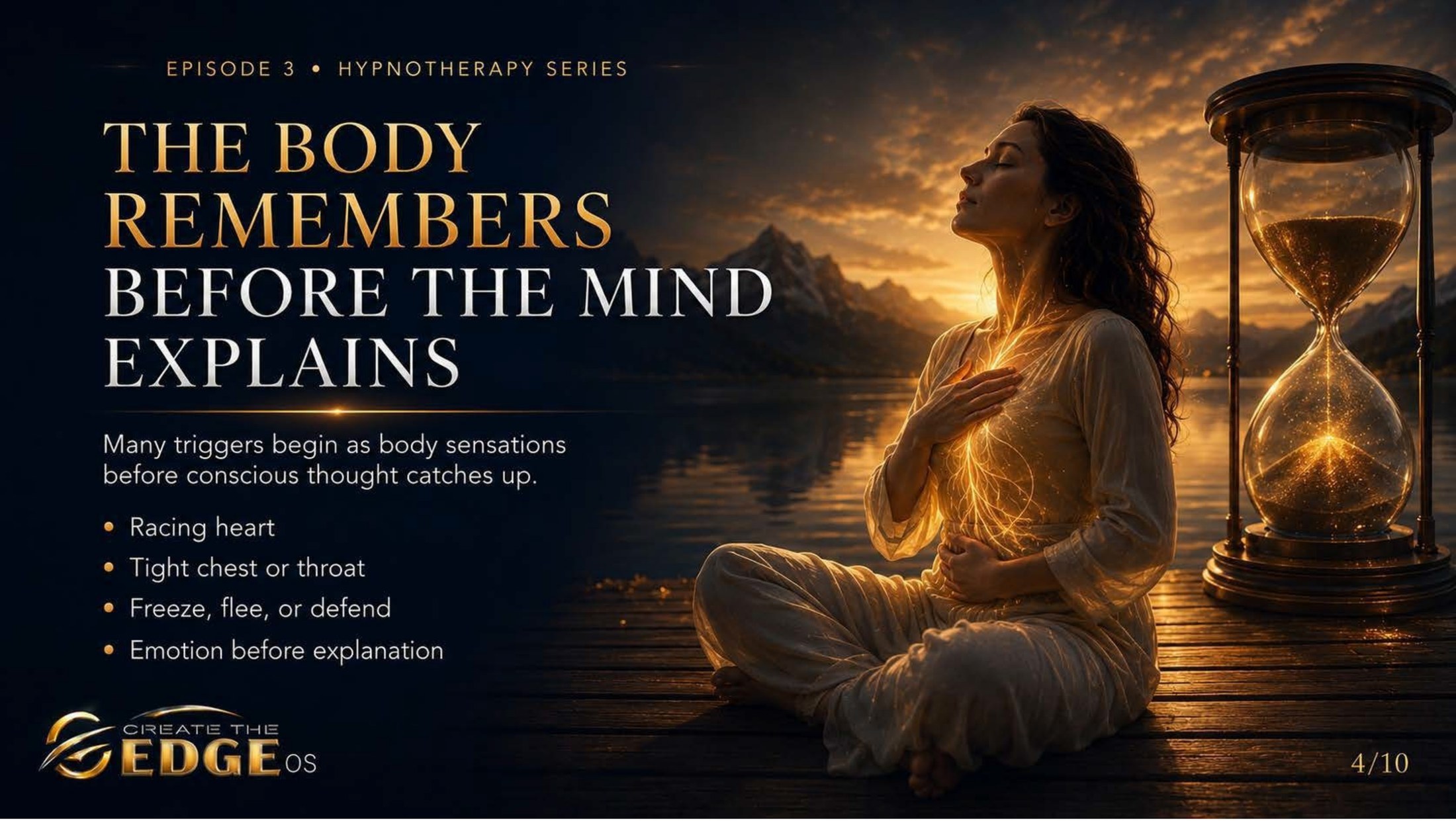
On the slideMany triggers begin as body sensations before conscious thought catches up: racing heart · tight chest or throat · freeze, flee, or defend · emotion before explanation.
Episode 3 · Slide 4
The Body Remembers Before the Mind Explains
Episode 3 · Slide 4
If you’ve ever scolded yourself with “why can’t I just think my way out of this,” this slide is the answer, and it lets you off a hook you’ve been hanging on for years. The body remembers before the mind explains.
Look at the four signs listed: racing heart, tight chest or throat, freeze-flee-or-defend, and — the key one — emotion before explanation. That ordering isn’t poetic. It’s literal. When a trigger fires, your body reacts first, often a full second or two before your thinking mind even knows what happened. The heart is already pounding before the thought “oh, that reminded me of…” ever arrives.
This is why willpower keeps failing you, and it’s not your fault. You’ve been trying to win a footrace that the body started before you heard the gun. By the time the calm, reasonable, thinking part of you shows up with its clipboard and its good advice, the alarm has already gone off and the body is already three steps into the old reaction. You’re not weak. You’re just late — because thought is always late to a trigger.
Look at the woman in the image, hand pressed to her heart, golden light threading through her chest, the great hourglass beside her. That posture — hand to heart — is exactly right, because the body is where this lives, and the body is where the healing has to land. You cannot talk a racing heart into stillness with a logical argument. The heart doesn’t speak that language.
But here’s the hope inside this hard truth, and it’s enormous: if the body learned the alarm, the body can learn safety. The same channel that got wired toward danger can be gently rewired toward calm. We don’t do it with arguments and lectures — the body ignores those. We do it the way the body actually learns: through breath, through sensation, through repeated, felt experiences of safety, delivered in that relaxed and open state where the deep system is finally listening.
So stop trying to think your way out of a feeling that started in your chest. That was never going to work, and now you know why. We’re going to work where the trigger actually lives — in the body — and we’re going to teach it, slowly and kindly, what safe feels like again.
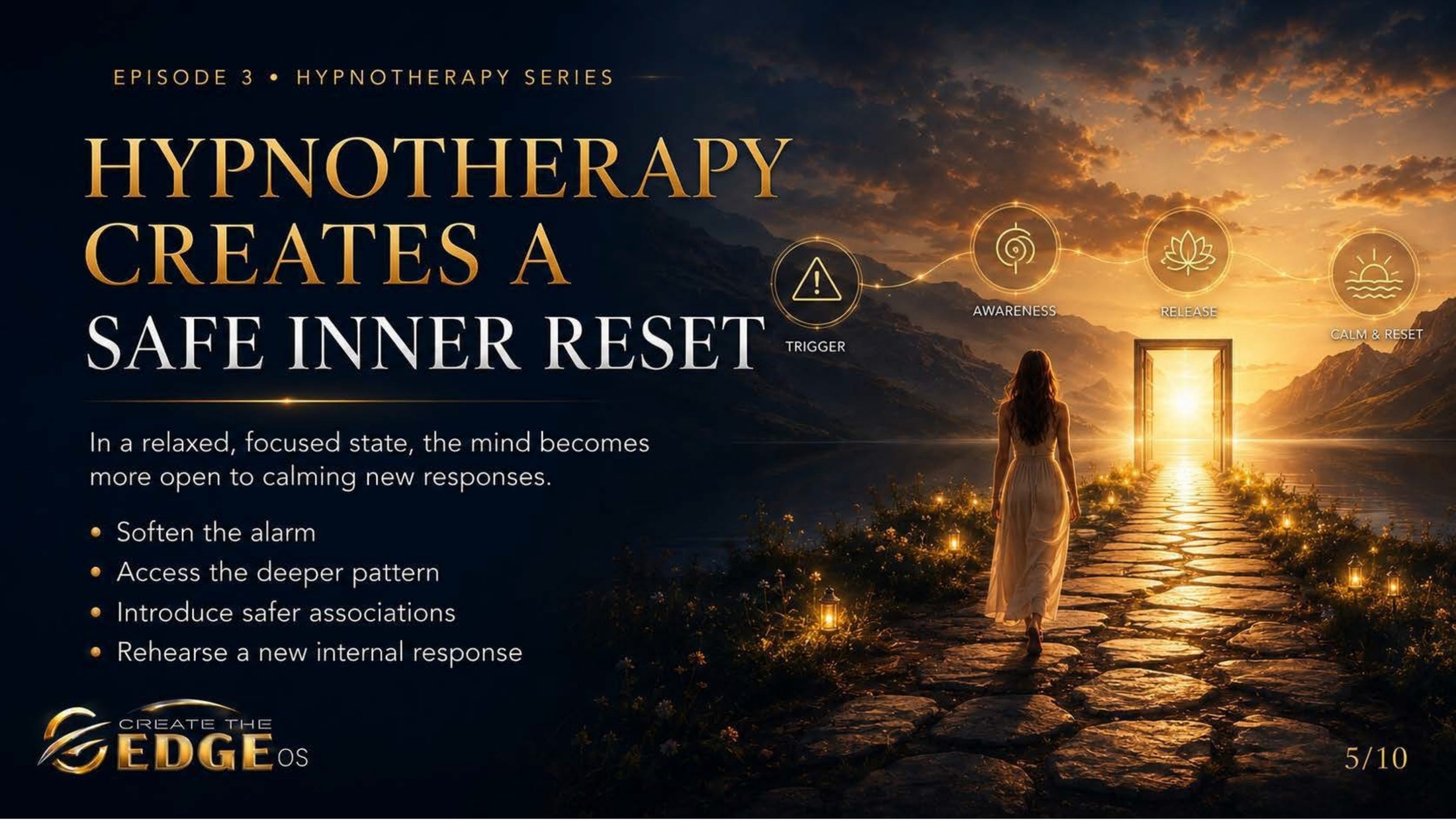
On the slideIn a relaxed, focused state, the mind becomes more open to calming new responses. Trigger → Awareness → Release → Calm & Reset. Soften the alarm · access the deeper pattern · introduce safer associations · rehearse a new internal response.
Episode 3 · Slide 5
Hypnotherapy Creates a Safe Inner Reset
Episode 3 · Slide 5
So how do we actually reach the alarm and turn it down? Look at the path of glowing circles across the top of this image — Trigger, Awareness, Release, Calm & Reset — and the woman walking the lantern-lit path toward an open, golden door. That’s the route. Four steps from hijacked to free. Let me walk them with you.
One: Soften the alarm. The alarm can’t be reasoned with while it’s screaming, so first we lower the volume. We slow the breath, ease the body, and signal to the nervous system that, right now, in this moment, there is no danger. The guard stands down. Only then can we get close enough to work.
Two: Access the deeper pattern. In that calm, focused state, we follow the flare down to where the old fear is stored — the original moment the alarm got wired. We don’t go there to relive the pain. We go there the way you’d return to a childhood home as an adult: to look around with grown-up eyes and finally understand what that frightened young one couldn’t.
Three: Introduce safer associations. This is the reset itself. The old wiring says this situation = danger. Gently, in that open state, we lay down new wiring: this situation is actually safe now. That was then. I survived. It’s over. We don’t erase the memory — we change what it’s connected to, so the bell stops ringing the alarm.
Four: Rehearse a new internal response. And then we practice. In vivid imagination, we walk you through the old triggering situation — but this time you stay calm, steady, grounded. We run that new movie until the nervous system files it as familiar, until “staying calm here” stops being a terrifying first and becomes a well-worn path.
Soften. Access. Replace. Rehearse. Notice this is the same gentle architecture from the last chapter, now aimed specifically at the alarm. And notice what it isn’t: it isn’t forcing yourself to “stay calm,” which never works, because you can’t white-knuckle a nervous system into peace. It’s the opposite — it’s a true reset, down at the level where the alarm was set in the first place.
The door at the end of that lantern-lit path is open, and the light is warm. The alarm doesn’t have to run your life. It can be turned down — safely, kindly, from the inside.
On the slideThe goal is not to suppress emotion, but to respond with more choice and steadiness. “Calm creates options.”
Episode 3 · Slide 6
From Reaction to Regulation
Episode 3 · Slide 6
I have to clear up a dangerous misunderstanding right now, because a lot of people get this exactly backward and end up worse off. Look at the gold line on this image: “Calm creates options.” And read the slide carefully: the goal is not to suppress emotion, but to respond with more choice and steadiness.
We are not trying to make you numb. Let me say that louder for the people in the back who’ve been taught that healing means never feeling anything inconvenient again. The goal of this work is not a flat, beige, emotionless you who never gets angry, never cries, never feels the full electric range of being alive. That’s not regulation. That’s suppression — and suppression is just a trigger you’re sitting on. It always, always comes back, usually at the worst possible moment, with interest.
There’s a world of difference between reaction and regulation, and it’s worth understanding in your bones.
Reaction is the hijack — the alarm fires, the body takes over, and you do the thing before you choose it. The drink, the text you regret, the words you can’t unsay, the door slammed before your hand knew it was moving. Reaction has no gap. Reaction has no choice. You’re a passenger.
Regulation doesn’t mean the emotion disappears. It means the emotion arrives — fully, honestly — and you’re still steady enough to choose what you do with it. The anger comes, and you feel it, and you don’t have to throw it. The grief comes, and you let it move through you, and you don’t have to drown in it. That’s not less feeling. In a way it’s more — because you’re no longer too overwhelmed to actually experience your own life.
Look at her on the mountaintop, arms wide, fully present to a feeling so big it would have flattened her before. She isn’t suppressing a thing. She’s regulated — steady enough to hold the whole magnificent intensity of the moment and still choose how she meets it.
That’s the goal. Not a smaller emotional life — a bigger one you can actually steer. Calm doesn’t shrink your feelings. Calm creates the space in which you finally get to choose. And choice, as we keep discovering together, is the whole entire point.

On the slideHypnotherapy can support trigger patterns connected to emotion, identity, and daily behavior: people pleasing and fear of rejection · stress loops and overreaction · shame, criticism, and self-protection · avoidance, shutdown, and emotional overwhelm.
Episode 3 · Slide 7
Common Patterns We Can Soften
Episode 3 · Slide 7
Let’s get specific, because triggers aren’t abstract — they wear very particular, very recognizable faces in a real life. Look at the four scenes in this image: a woman releasing into the dawn, another journaling by candlelight, a third with her hands on her heart and belly, a fourth walking through a gate toward the sun. Four people, four patterns. See which one knocks on your door.
People pleasing and fear of rejection. This is the one who says yes when every cell says no. Who reads a room for the faintest sign of disapproval and contorts to fix it. Whose nervous system learned, long ago, that other people’s displeasure was dangerous — so keeping everyone happy became a survival job that never clocks out. Exhausting, isn’t it? It can be softened.
Stress loops and overreaction. This is the one stuck on a hair-trigger — where a small frustration detonates like a large one, where the body never quite comes down from high alert, where you’re always one minor inconvenience away from the edge. The loop feels permanent. It isn’t. The alarm can be reset.
Shame, criticism, and self-protection. This is the one with the brutal inner critic — the voice that narrates every mistake in someone else’s cruel tone (sometimes a tone you remember from a very specific room, a very specific person). Shame makes us build walls, hide, armor up. We can soften the trigger underneath, and let the walls come down a little.
Avoidance, shutdown, and emotional overwhelm. This is the one who goes numb, who scrolls or sleeps or disappears, who shuts the whole system down when feeling gets to be too much. That shutdown was once protection — a way to survive an overwhelm too big for a small person to hold. As an adult, with support, you can build the capacity to stay present instead.
Read the line that ties them together: these patterns live in emotion, identity, and daily behavior. They’re not random quirks. They’re old protective strategies, each one once brilliant, each one now ready to be gently retired.
And here’s the encouraging truth, the same one that keeps proving itself: you usually don’t have to dismantle all four. Most people find that one of these is the master pattern — the deepest groove, the oldest alarm. Soften that one, and you’ll feel the others ease too. You are not a hopeless tangle. You are a person with a few well-worn patterns that are finally ready to change.
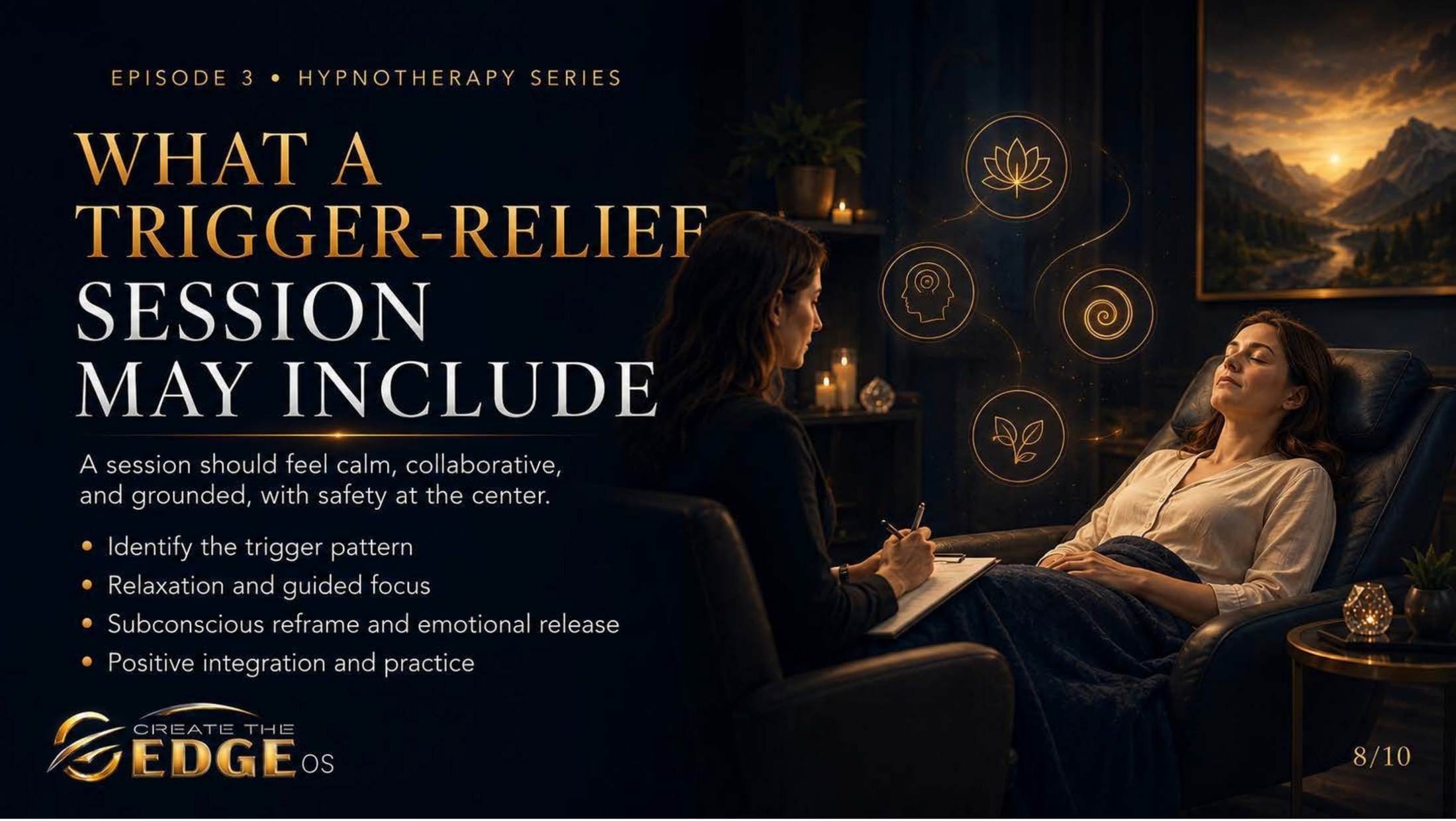
On the slideA session should feel calm, collaborative, and grounded, with safety at the center: identify the trigger pattern · relaxation and guided focus · subconscious reframe and emotional release · positive integration and practice.
Episode 3 · Slide 8
What a Trigger-Relief Session May Include
Episode 3 · Slide 8
Let me walk you into the room again, because knowing the shape of it makes the whole thing safer. Look at the image — the soft light, the reclined ease of one woman, the grounded attention of the other, mountains glowing in the window. The slide names the feeling we build for above all else: calm, collaborative, and grounded, with safety at the center. Safety isn’t a nice bonus here. It’s the foundation everything else stands on. Here’s how a trigger-relief session tends to unfold.
Identify the trigger pattern. We start by gently mapping it together. What sets it off? What happens in your body? When might this alarm first have been installed? You’re the expert on your own experience — I’m just the guide helping you see the pattern clearly, often for the first time.
Relaxation and guided focus. Then we soften the alarm — that first essential step. My voice guides you down into the calm, focused state where the deep system finally feels safe enough to open. We never rush this. The whole method depends on your body actually feeling safe, so we take whatever time that requires.
Subconscious reframe and emotional release. Here, in that open state, we revisit the old pattern with adult eyes and lay down the safer associations. Sometimes there’s an emotional release — a few tears, a long exhale, the quiet letting-go of something carried far too long. That release is not a crisis. It’s the body finally setting down a weight. It’s welcome here.
Positive integration and practice. And we close by integrating the new response — rehearsing the calm, grounding the reset, making sure you can carry it out of the room and into the moment that used to undo you. We don’t just open something and leave it open; we settle the new pattern in.
Through every step, you stay calm, collaborative, grounded — and safe. You’re never sent somewhere alone. You’re never forced through a door that isn’t ready. This is gentle work, done with you, at your pace, with your safety as the single non-negotiable at the center of it all.
That’s the room. There’s nothing in it to fear — and a great deal of relief waiting in it for you.
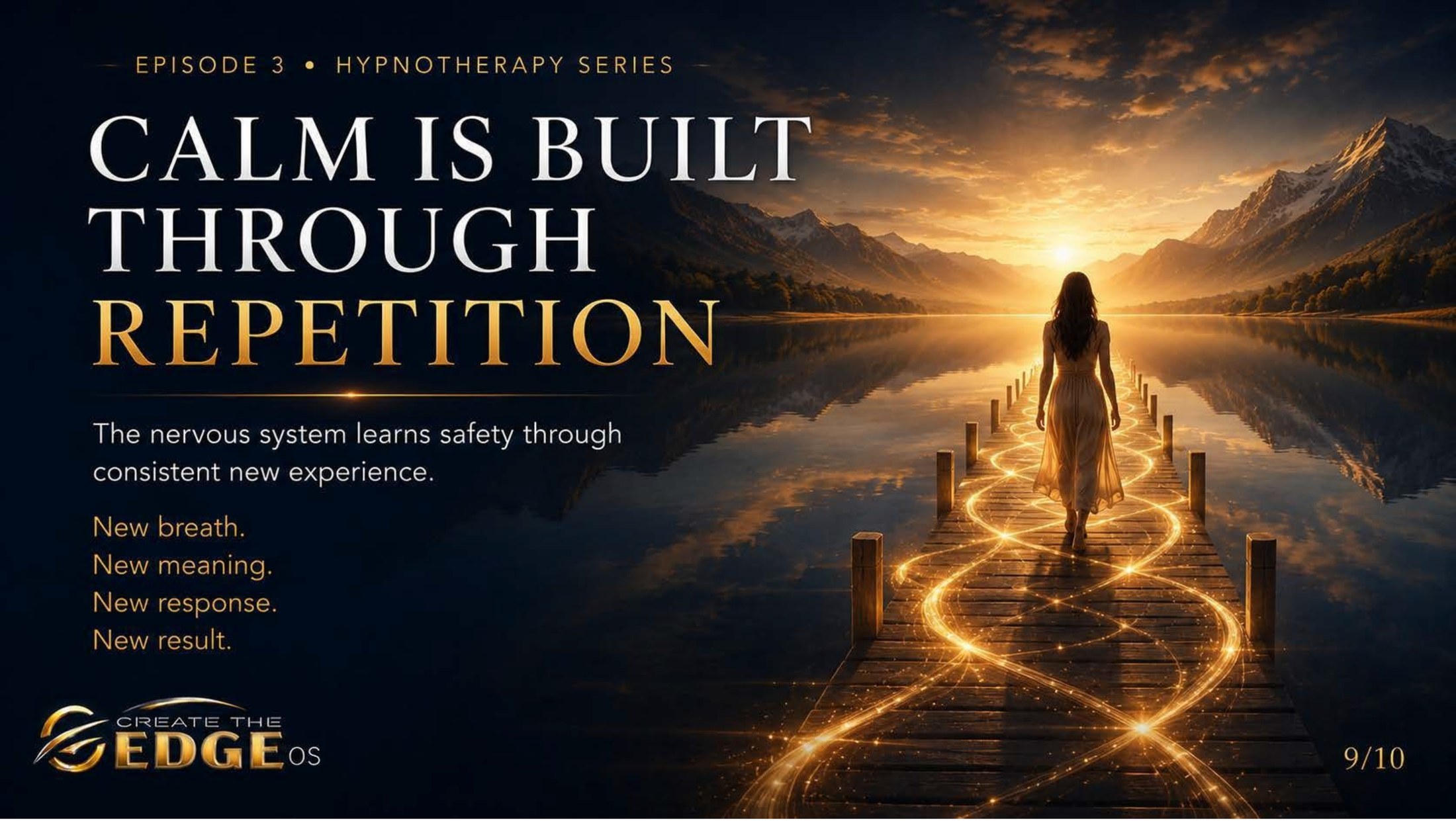
On the slideThe nervous system learns safety through consistent new experience. New breath. New meaning. New response. New result.
Episode 3 · Slide 9
Calm Is Built Through Repetition
Episode 3 · Slide 9
Here she is on the golden dock again — but look at the path beneath her this time. It doesn’t run straight. It winds, a glowing serpentine of light curving its way toward the sunrise. And that winding is honest, because the path to calm is rarely a straight line. It loops, it doubles back, it climbs and dips. But every curve of it glows, because every step is building something. Calm is built through repetition.
I won’t sell you a fantasy. Your nervous system did not learn its alarms in a single afternoon, and it will not unlearn them in one either. It learned them the way it learns everything — through repeated experience — and that’s exactly how it will learn safety: through consistent new experience. One calm breath at a time. One safe moment stacked on another.
Look at the four steps glowing on the left, and notice they’re the same shape as the new reality we built last chapter, now tuned to the body: New breath. New meaning. New response. New result.
It begins with a new breath — the most ordinary, available tool you own, and the fastest message of safety you can send your own nervous system. Before the thought, before the story, just… a different breath.
The breath makes room for a new meaning — the moment you can finally tell your body “this is uncomfortable, but it is not dangerous.” The bell still rings, but it stops meaning fire.
The new meaning allows a new response — you pause where you used to react, you stay where you used to flee, you breathe where you used to brace. Tiny the first time. Easier the tenth.
And the new response, repeated, delivers a new result — a nervous system that has quietly learned the world is safer than it once believed, because you showed it, over and over, with your own consistent experience.
So be patient and gentle with yourself on the days the old alarm still fires. Of course it does — it’s a faithful old system that protected you for years; it doesn’t retire overnight. You don’t need it to be perfect. You only need to keep walking the new, winding, glowing path — a little more often than the old one. Every single repetition is teaching your deepest self that it is finally, truly safe. And that lesson, repeated, is how a life changes.
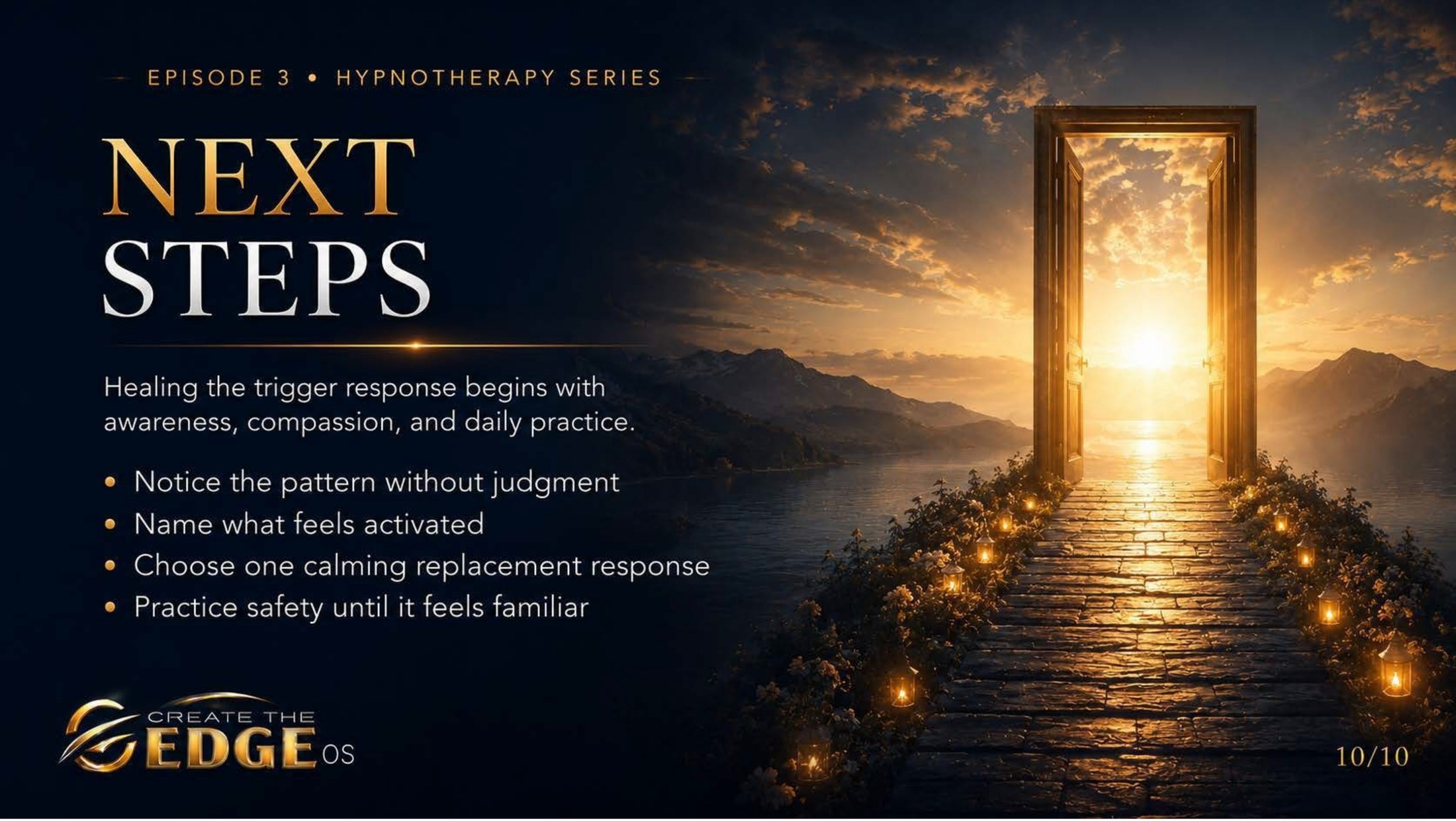
On the slideHealing the trigger response begins with awareness, compassion, and daily practice: notice the pattern without judgment · name what feels activated · choose one calming replacement response · practice safety until it feels familiar.
Episode 3 · Slide 10
Next Steps
Episode 3 · Slide 10
There’s the open golden door again, the lantern-lit path of stones leading toward the light. And the four steps through it are waiting for you to take right now, in the workbook at the bottom of this page. Look at the word that anchors this whole slide — right between awareness and daily practice sits the one most people skip: compassion. Hold onto that. Let’s walk the steps.
One: Notice the pattern without judgment. Read those last three words again — without judgment. This is everything. The moment you catch a trigger firing, the old habit is to pile on shame: there I go again, what’s wrong with me. But shame is just another alarm, and it keeps the whole system braced. So instead, you become a gentle scientist: “ah — there’s the pattern. Interesting.” Curiosity, not contempt. Noticing is the entire beginning.
Two: Name what feels activated. Then you name it, in the body and the heart. “My chest is tight. I feel small. I feel that old fear of being rejected.” Naming a trigger does something almost magical — it moves the experience from the screaming alarm-center of the brain up to the part that can observe and choose. You can’t calm what you won’t name. So name it, kindly, out loud if you can.
Three: Choose one calming replacement response. Now, the new wiring. What’s one small, calming thing you’ll do instead of the old reaction? One slow breath. A hand on your heart. A single true sentence: “This is uncomfortable, but I am safe right now.” Just one. Specific, gentle, repeatable.
Four: Practice safety until it feels familiar. And then — repetition, the faithful friend. You practice the new response again and again, not waiting for the perfect calm day, but precisely in the ordinary triggered moments, until “safe” slowly stops feeling foreign and starts feeling like home. Until the new path is more worn than the old one.
Notice. Name. Choose. Practice — all of it wrapped in compassion, all of it built one day at a time. Not one heroic leap. A thousand small, kind returns.
The door is open and the light is golden and warm. But a door only matters if you walk through it. So let’s take the first step right now — not someday, not when you feel ready, but here, in your own handwriting, in the workbook below.
Your alarm has run the show long enough. Let’s start, gently, to take the wheel back. I’m right here beside you, holding the door open to the light.