
On the slideHow hypnotherapy helps restore safety, voice, and self-worth from earlier wounds.
Episode 4 · Slide 1
Healing the Inner Child
Episode 4 · Slide 1
I want to tell you about a little one who lives inside you. You can’t see her in the mirror anymore, but she’s there — and she’s been there the whole time.
She’s the part of you that still flinches at a certain tone of voice. The part that gets quiet and small when someone seems disappointed. The part that, decades later, still remembers exactly how it felt to be picked last, talked over, laughed at, or told — maybe loudly, maybe in front of everyone — that you weren’t good enough, weren’t smart enough, would never amount to much. She heard that. She believed it. And she has been quietly organizing your life around it ever since.
I know this little one personally. Mine was seven, in a second-grade classroom, listening to a grown-up announce to a roomful of children that she was a failure who would never do the beautiful thing she’d set her heart on. I carried that child for a very long time before I understood that she didn’t need to be ignored, or toughened up, or shamed into silence. She needed what every wounded child needs: to be seen, to be safe, and to be told the truth by someone who loves her.
Look at our woman at the lake, sunrise gilding the water, the mountains standing watch. Read what the slide promises: how hypnotherapy helps restore safety, voice, and self-worth from earlier wounds. Three precious things that get stolen early and can absolutely be given back. Safety. Voice. Self-worth.
This is, in many ways, the most tender chapter in this whole book — and the most powerful. Because almost every adult pattern we’ve talked about, every old program, every trigger, traces back to a young one who once needed something they didn’t get. You don’t heal those patterns by fighting your present self. You heal them by going back, gently, with the strength you have now, and finally giving that child what they were always waiting for.
We’re going to do that together, carefully, safely. No reliving. No drowning in the past. Just a grown, capable you, reaching back to take a frightened little hand and say the words that change everything: I’m here now. You’re safe now. I’ve got you.
She’s been waiting a long time to hear it. Let’s go to her.

On the slideA part of you that still carries early feelings, unmet needs, and protective beliefs: old emotional memories · early survival patterns · longing to feel safe, seen, and loved · reactions that still echo today.
Episode 4 · Slide 2
What Is the Inner Child?
Episode 4 · Slide 2
“Inner child” can sound a little soft, a little woo-woo, until you understand what it actually means — and then it becomes one of the most practical ideas you’ll ever hold. The slide defines it cleanly: a part of you that still carries early feelings, unmet needs, and protective beliefs.
It’s not a metaphor and it’s not magic. It’s memory — emotional memory, stored in the body and the deep mind, laid down before you had the words or the power to make sense of what was happening to you. Look at the image: a grown woman, serene in the light, and woven through her in golden threads, the children she used to be — a little one clutching a teddy bear, a small girl sitting alone by the water, a child reaching out. They didn’t disappear when you grew up. They moved in.
Look at the four things this part of you carries, and notice how alive each one still is:
Old emotional memories. Not facts — feelings. The body’s recording of what it was like to be small in your particular house, with your particular people. Joy, yes — but also every time you felt unsafe, unseen, or not enough.
Early survival patterns. The strategies a small person invents to get through. Be perfect so no one’s angry. Be invisible so no one notices. Be funny, be helpful, be quiet, be good. Brilliant adaptations — for a child with no other options.
The longing to feel safe, seen, and loved. This is the deepest one, and it never goes away. Every human being carries it. When it went unmet in childhood, that hunger doesn’t vanish — it just goes underground and starts driving the car from the back seat.
Reactions that still echo today. And here’s where it all comes home. When you overreact, shut down, people-please, or panic — very often it’s not the adult responding at all. It’s the child, reaching up through the years, reacting to an old danger as if it were happening right now.
So when I say we’re going to heal the inner child, I don’t mean anything mystical. I mean we’re going to find the young, hurting part of you that’s still running old survival software — and we’re going to update it with love, from the safety of who you are now. That child has been waiting for you to come back for them.
Good news, little one. Someone finally is.

On the slideWhat once protected you may now show up as anxiety, people pleasing, perfectionism, or fear of rejection. “The pattern makes sense. It is just no longer required.”
Episode 4 · Slide 3
Childhood Patterns Echo Into Adulthood
Episode 4 · Slide 3
Here’s the iceberg again — and by now you know exactly what it means. The visible tip is your adult behavior; the vast blue cathedral below is everything the child stored. And the gold line at the bottom is one of the most freeing sentences in this entire book: “The pattern makes sense. It is just no longer required.”
Read both halves of that, because they have to be held together. The pattern makes sense — you’re not crazy, you’re not flawed, your reactions were a perfectly logical response to what you lived through. And it is just no longer required — the danger that demanded the pattern is over, even if your deep mind hasn’t gotten the memo.
Look at how the slide names the way childhood echoes forward: what once protected you may now show up as anxiety, people pleasing, perfectionism, or fear of rejection. Let me show you the child hiding inside each adult symptom.
Anxiety is often a little one who learned the world was unpredictable, who had to stay on high alert because safety could vanish without warning. The grown-up calls it “my anxiety.” The child calls it “staying ready so I don’t get hurt again.”
People-pleasing is frequently a child who learned that love had conditions — that being good, helpful, and agreeable was the price of being kept. The adult exhausts herself keeping everyone happy. The child is just trying not to be abandoned.
Perfectionism is so often a young one who learned that mistakes brought criticism, withdrawal, or shame — so being flawless became a fortress. The adult drives herself mercilessly. The child is just trying to finally be beyond reproach, beyond that loud voice in the classroom.
Fear of rejection is a child who was rejected, or watched love be taken away, and decided that being left was the worst thing that could happen — so they’d do anything to avoid it. The adult clings or pre-emptively flees. The child just doesn’t want to be alone again.
Do you feel the relief in seeing it this way? These aren’t character defects. They’re not proof that something is wrong with you. They are the fingerprints of a child who was trying to survive — and who succeeded. The pattern worked. It got you here. You can honor that.
And then — gently, with the new safety we keep building — you can let the grown-up you take over the job the child has been doing alone for far too long. The pattern made sense. It’s just not required anymore. You’re allowed to set it down.

On the slideThe inner child is not weakness. It is the part of you asking for care, safety, and repair. Shame may mask hurt · control may mask fear · withdrawal may mask overwhelm · anger may mask pain.
Episode 4 · Slide 4
The Wound Is Not the Whole Story
Episode 4 · Slide 4
This slide corrects a cruelty most of us have committed against ourselves, and I want to undo it right now. Read the title slowly: the wound is not the whole story. And read what follows: the inner child is not weakness. It is the part of you asking for care, safety, and repair.
So many of us were taught to be ashamed of the soft, hurting part of ourselves. To “toughen up,” “get over it,” “stop being so sensitive.” We learned to treat our own woundedness as a defect to hide rather than a child to comfort. And so we built masks — elaborate, exhausting masks — to cover what we were never allowed to tend.
Look at the four masks the slide names, because once you see them, you can never unsee them in yourself or anyone you love:
Shame may mask hurt. Underneath the crushing belief that you’re bad, wrong, not enough — there’s usually just a child who got hurt and concluded it must have been their fault. Shame is hurt that turned inward because no one was there to say “this wasn’t your fault.”
Control may mask fear. The need to manage everything, to never let go, to white-knuckle every detail — underneath it is almost always a frightened child who learned that when they weren’t in control, terrible things happened. Control is fear wearing a suit.
Withdrawal may mask overwhelm. When you shut down, go numb, disappear — it can look like coldness or not caring. But underneath is usually a child who was so flooded, so overwhelmed, that going away was the only way to survive. Withdrawal is overwhelm that ran out of options.
Anger may mask pain. The flash of rage, the hard edge, the lashing out — anger is loud and powerful, which is exactly why a hurting child reaches for it. It feels safer than the soft, vulnerable pain underneath. Anger is pain in armor.
Do you see the pattern? Every “difficult” trait is a mask, and behind every mask is a young one who got hurt and did the best they could. That isn’t weakness. That’s a survivor. The part of you that you’ve been most ashamed of is the part that kept you alive.
Notice in the image — the woman sits at the water’s edge, and across from her is an open doorway full of golden light. That’s the invitation. We don’t shame the masks off. We get curious about what they’re protecting, we offer that hurting part the care, safety, and repair it always needed — and the masks come off on their own, because they’re finally not needed anymore.
Your tenderness was never the problem. The problem was that no one helped you tend it. Let’s change that.

On the slideIn a relaxed, supported state, the mind can gently revisit earlier experiences without being overwhelmed: relax the nervous system · access the deeper memory · introduce comfort and protection · create a new emotional meaning.
Episode 4 · Slide 5
Hypnotherapy Helps You Revisit With Safety
Episode 4 · Slide 5
Now, I know what the fear is here, because I’ve seen it cross a hundred faces: “I don’t want to go back there. I don’t want to feel all that again.” And I want to answer that fear directly, because the answer is the whole reason this works. Read the slide: the mind gently revisits earlier experiences without being overwhelmed.
That phrase — without being overwhelmed — is everything. We are not going back to relive the pain. We are not throwing you into the deep end of an old wound to thrash. That would just re-traumatize the child, and we would never do that. Instead, we do something the child never had: we go back with safety, with an adult’s strength and a guide’s steady presence, and we visit the memory the way you’d visit a hard place holding a strong hand.
Look at the four steps glowing beside the woman on her lantern-lit path — the same gentle architecture, now turned toward the child.
Relax the nervous system. First, safety in the body. We can’t revisit anything tender while the alarm is screaming, so we soften it completely. The deep mind only opens its most protected rooms when it truly feels safe.
Access the deeper memory. Then, from that calm and supported place, we gently approach the old experience — not to drown in it, but to witness it, with the adult you present and in charge the whole time. You watch from a safe distance. You never lose yourself in it.
Introduce comfort and protection. Here’s the beautiful part, the part that heals. We give the child what they didn’t have. The adult you — strong, safe, here — steps into the old scene and stands between the child and the danger. You comfort them. You protect them. You say the words no one said. The child finally gets the ally they were waiting for: you.
Create a new emotional meaning. And then the meaning shifts. The memory doesn’t change, but what it means does. “I was alone and it was my fault” becomes “I was a child who deserved better, and now I have someone who’s got me.” That new meaning is what releases the old pattern at its root.
Relax. Access. Comfort. Re-mean. You stay safe at every step. You stay in control at every step. This isn’t about reopening wounds — it’s about finally, safely, tending them, with the loving presence that frightened child has been waiting their whole life for. And that presence, it turns out, is you.

On the slideHealing begins when the inner voice changes from harshness to care. “You did what you had to do. Now you get to choose something gentler.”
Episode 4 · Slide 6
From Self-Criticism to Self-Compassion
Episode 4 · Slide 6
If you only take one practice out of this chapter, let it be this one, because it changes the entire weather of a life. Look at the gold words on the image: “You did what you had to do. Now you get to choose something gentler.”
Let me ask you something honest. The voice in your head — the one that narrates your mistakes, that comments on your body in the mirror, that replays the embarrassing thing you said at 2 a.m. — whose voice is it? Listen to its tone. Its word choices. Its particular cruelty. For a great many of us, that inner critic isn’t our own voice at all. It’s a recording — of a parent, a teacher, a tormentor from long ago. We took the harshest voice from our childhood and installed it as the permanent narrator of our adult mind.
And then we wonder why we feel so beaten down. You’ve been carrying your own bully around in your head, giving it a microphone, and letting it talk to a child — because remember, that inner critic isn’t scolding your competent adult self. It’s scolding the little one. It’s saying to a seven-year-old all the things a seven-year-old should never hear.
Here is the shift, and it is the heart of all healing: healing begins when the inner voice changes from harshness to care.
Imagine speaking to that inner child the way you would speak to an actual child you loved. If a real seven-year-old stood in front of you, having made a mistake, frightened and ashamed — would you scream “you’re worthless, you always ruin everything”? Of course not. The thought is unbearable. You’d kneel down. You’d soften your voice. You’d say, “hey — it’s okay. Everybody makes mistakes. I’ve got you.”
That is self-compassion. It is not weakness, it is not letting yourself off the hook, it is not “making excuses.” It is simply turning toward your own hurting parts with the same basic kindness you’d offer any child — because there is a child in there, and they’ve been listening to that cruel voice for decades.
Look at her on the mountaintop, arms opening to the valley and the light. That openness is what becomes possible when the inner war ends. You did what you had to do to survive — the criticism, the perfectionism, the armor, all of it. Truly. You did what you had to do. And now, finally, from a place of safety, you get to choose something gentler.
Start today. Catch the harsh voice. And answer it, on behalf of the child, with one kind sentence. It will feel strange the first time. It will feel like home by the hundredth.

On the slideHypnotherapy can support patterns rooted in earlier emotional experiences: rejection sensitivity and abandonment pain · low self-worth and not-enoughness · people pleasing and fear of conflict · perfectionism, shame, and over-responsibility.
Episode 4 · Slide 7
Areas We Can Support
Episode 4 · Slide 7
Let’s see where this inner-child work actually goes to live in a grown-up life. Look at the four scenes in the image — a woman releasing into the wind, another in still meditation, a third walking through a gate toward dawn, a fourth writing by candlelight. Four faces of the same homecoming. See which one is yours.
Rejection sensitivity and abandonment pain. This is for the one who feels a closed door in every unanswered text, who reads catastrophe into a friend’s short reply, whose whole system braces at the faintest hint of being left. Underneath is a child who once was left, or felt they were, and never wants to feel that again. We go back and help that child know, in their bones, that they are not being abandoned now.
Low self-worth and not-enoughness. This is for the one who achieves and achieves and still feels hollow, who can’t take in a compliment, who suspects that if people really knew her they’d leave. Underneath is a child who absorbed the message — maybe in a loud classroom, maybe in a cold home — that they weren’t enough. We go back and tell that child the truth they never got to hear.
People pleasing and fear of conflict. This is for the one who would rather swallow her own needs whole than risk someone’s displeasure, who hasn’t said a clean “no” in years. Underneath is a child who learned that conflict was dangerous and their needs were a burden. We help that child learn that their needs matter and that they can survive someone being upset.
Perfectionism, shame, and over-responsibility. This is for the one carrying the weight of the world, who feels responsible for everyone’s feelings, who can’t rest until everything is flawless. Underneath is often a child who had to grow up too fast, who learned that being perfect and over-responsible was how to stay safe or stay loved. We give that child permission to finally put the world down and just be a kid for a moment.
All of these, the slide reminds us, are rooted in earlier emotional experiences. They’re not random. They’re not your fault. They’re the long echo of a young one’s unmet needs.
And the gift in this work is that you don’t address these as abstract “issues” to be fixed. You address the child underneath them — and when that child finally feels safe, seen, and loved, the adult patterns they’ve been driving begin to ease, all on their own. Heal the root, and the whole tree changes. We’ve said it before. Here it becomes personal.

On the slideA session should feel calm, collaborative, and emotionally safe: identify the younger emotional pattern · relaxation and guided focus · reframe and emotional repair · integration and supportive practice.
Episode 4 · Slide 8
What a Healing Session May Include
Episode 4 · Slide 8
Let me show you, gently, what this looks like in the room — because inner-child work, more than any other, depends on feeling completely safe. Look at the image: the soft lamplight, the blanket, the unhurried care between the two women, the mountains glowing in the frame. The slide names the atmosphere we build above all: calm, collaborative, and emotionally safe. Here’s the shape of a healing session.
Identify the younger emotional pattern. We begin by gently tracing a present-day reaction back to its root. When you feel that old rush of not-enoughness or abandonment — how old do you feel? What’s the earliest memory of that exact feeling? We’re not digging for trauma; we’re simply following the feeling home to the young one who first felt it.
Relaxation and guided focus. Then we settle the body into deep safety — that calm, supported state. This step is non-negotiable in this work. We do not approach a tender memory until the nervous system is genuinely at ease, because the whole point is to revisit without overwhelm. Safety first, always, every time.
Reframe and emotional repair. This is the heart — the homecoming. From that safe place, the adult you meets the child you. You offer comfort. You offer protection. You say the words. You let the child feel, perhaps for the very first time, that someone strong is on their side. This is the repair — the emotional experience the child needed and never got, delivered at last. It is often quietly, profoundly moving. Tears here are not a problem; they’re the body setting down a weight it carried alone for decades.
Integration and supportive practice. And we close by helping that new safety take root — grounding it, giving you a simple practice to keep tending the child between sessions, making sure the homecoming holds. We don’t open the door and walk away. We help you become the safe, steady presence your inner child can return to anytime.
Calm. Collaborative. Emotionally safe. You are supported through every step. You are never sent back alone, never forced, never overwhelmed. This is some of the most sacred work a person can do — and it is done with enormous gentleness, at your pace, with your safety held as the most precious thing in the room.
There is nothing to fear here. There is a child to come home to.

On the slideThe goal is not to erase the past, but to respond to yourself with more warmth, steadiness, and trust. I am safe now. I can care for myself. My needs matter. I am worthy of love.
Episode 4 · Slide 9
A New Relationship With Yourself
Episode 4 · Slide 9
Here she is, walking the golden dock toward the sun — and this time what waits at the end of the journey isn’t a destination out there in the world. It’s a new relationship with the person who’s been walking beside you your whole life: you. The slide is clear that the goal is not to erase the past, but to respond to yourself with more warmth, steadiness, and trust.
We don’t erase what happened. We can’t, and we wouldn’t want to — your history made you who you are, and there is hard-won wisdom in it. What changes is your relationship to it, and to yourself. The wounded child stops running the show from the back seat, because the child is finally being held by a loving adult up front. And from that healing, four quiet declarations become available to you — read them on the slide, and read them as truths you are growing into, not lies you’re forcing:
“I am safe now.” The danger that wired the child is over. The adult you can keep yourself safe in ways the child never could. The body can finally, slowly, believe it.
“I can care for myself.” You are no longer a helpless child waiting for someone else to provide safety and comfort. You can give it to yourself — and to the child within you. You became the grown-up you needed.
“My needs matter.” The child who learned to disappear, to please, to ask for nothing — gets to learn a new truth. Your needs were always valid. They mattered then. They matter now. You’re allowed to have them and to honor them.
“I am worthy of love.” Not once you earn it. Not after you’re perfect. Not when you’ve finally proven yourself to that long-ago voice. Now. As you are. The way every child is worthy of love simply for existing — including the child inside you, and including the adult she became.
Sit with those four sentences. Notice which one your inner child most needs to hear. Notice, maybe, the one that makes your throat tighten or your eyes sting — that’s the one. That’s where the little one has been waiting longest.
This is what healing the inner child gives you in the end: not a rewritten past, but a transformed present. A warmer, steadier, more trusting way of being with yourself. The harsh narrator goes quiet. A kinder voice takes the microphone. And you get to walk the rest of your road — finally — with the child held safe in your own loving hands.
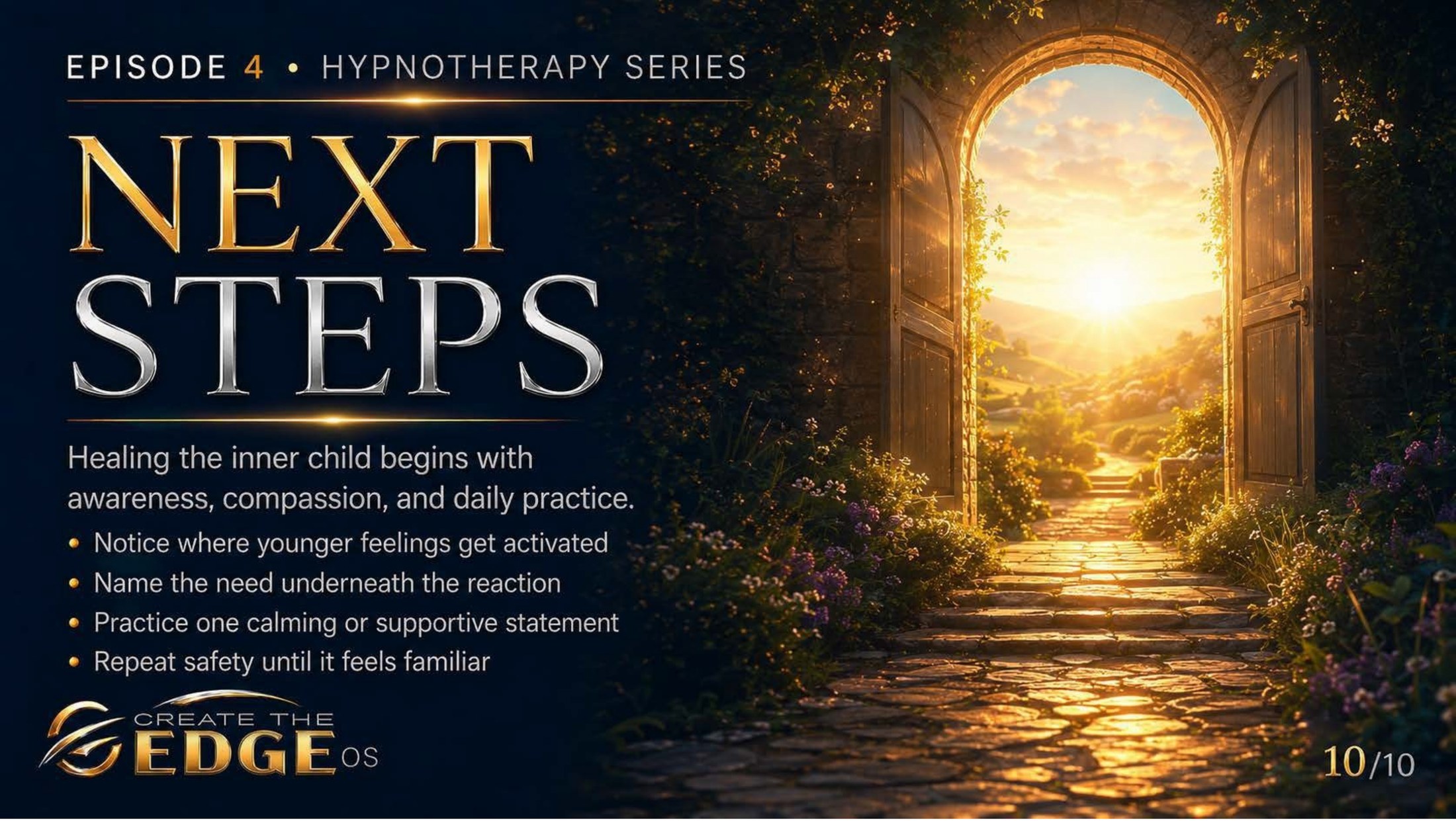
On the slideHealing the inner child begins with awareness, compassion, and daily practice: notice where younger feelings get activated · name the need underneath the reaction · practice one calming or supportive statement · repeat safety until it feels familiar.
Episode 4 · Slide 10
Next Steps
Episode 4 · Slide 10
Look at the doorway in this image — not a stone arch into wilderness this time, but an open garden gate, sunlight pouring over a path that winds into green, gentle hills. That’s where this work leads: somewhere safe, somewhere alive, somewhere a child could finally play. The four steps through that gate are waiting in the workbook below, and the word at the center of the slide is the one to carry with you: compassion. Let’s walk them.
One: Notice where younger feelings get activated. Through your day, start catching the moments you suddenly feel small — the flush of not-enoughness, the sting of feeling left out, the urge to please or hide or prove. In that moment, ask softly: “how old do I feel right now?” When the honest answer is “about seven,” you’ve found your inner child reaching up. That noticing is the whole beginning.
Two: Name the need underneath the reaction. Then look beneath the reaction for the need. People-pleasing — the need to feel accepted. Anger — the need to feel safe or respected. Withdrawal — the need for things to stop being so overwhelming. Naming the need with tenderness, rather than judging the behavior with harshness, is how you start parenting the child instead of scolding them.
Three: Practice one calming or supportive statement. Now, speak to the child. Pick one of those four declarations — “I am safe now,” “my needs matter,” “I am worthy of love” — or your own gentle words. Say it inwardly, hand on your heart if it helps, the way you’d reassure a real frightened child. One sentence. Said with care.
Four: Repeat safety until it feels familiar. And then — the faithful work of repetition. You do this again and again, not waiting for a crisis but in the small ordinary moments, until the child within you slowly comes to trust that you’ll show up. Until “I’m safe now” stops feeling like a stretch and starts feeling like the truth. Until you have become, for that little one, the steady loving presence they always deserved.
Notice. Name. Soothe. Repeat — all of it wrapped in compassion, all of it built one gentle day at a time. This isn’t a single dramatic reunion. It’s the slow, beautiful work of becoming someone your inner child can count on.
The garden gate is open and the light is soft and warm. Somewhere in there, a younger you is waiting to see if you’ll really come this time. So let’s take the first step right now, in your own handwriting, in the workbook below — not someday, but today.
Go on. She’s been waiting so long. Reach out your hand. I’m right here beside you both.