
On the slideRestaurants, celebrations, and group dinners can make it harder to stay connected to your intentions. How social pressure influences choices — and how hypnotherapy helps you respond with calm confidence: social settings can wake up old patterns · you can pause before you say yes · confidence makes better choices easier · hypnotherapy helps you stay grounded.
Episode 15 · Slide 1
Eating Out Without Losing Your Power
Look at her at that table. Not isolated, not rigid, not performing some version of herself for the waiter’s approval. Just — present. Engaged with the people around her, reading the menu with genuine curiosity, occupying her own seat with a kind of settled ease. That’s not the suppressed, white-knuckled ease of someone fighting themselves all evening. That’s the real thing: a woman who has done enough inner work that she can be fully in a social setting and still know where she stands.
Eating out is one of the most emotionally complex situations in our relationship with food, and it’s almost never talked about honestly. We talk about what to order and what to avoid, but we rarely talk about what actually happens when you walk into a restaurant with other people. The social dynamics. The group energy. The way belonging can feel threatened when you make a different choice. The fear of seeming difficult. The old conditioning that says the way to be loved at a table is to eat the way the table eats.
And then there’s the environment itself — dim lighting, ambient music, the festive energy of a celebration, the smell of food you didn’t plan for, the way alcohol loosens the edges of intention. Restaurants are expertly designed to maximize pleasure and minimize restraint, and they do it beautifully. This chapter isn’t about resisting that. It’s about walking into it with enough self-knowledge that you can enjoy all of it on your own terms.
The four threads running through this chapter are honest and practical: social settings can activate old patterns around food, belonging, and approval. You can learn to pause before you automatically say yes to anything — the second helping, the dessert you don’t really want, the drink that will make the rest of the evening harder. Confidence in who you are and what you actually want makes navigating these moments easier. And hypnotherapy reaches the subconscious patterns underneath the social reactivity — not just giving you coping strategies but changing the underlying responses.
I want to name something important before we go further. This chapter is not about eating less or making “better” choices by someone else’s standards. It’s about your choices. Made by you. From a place of genuine self-knowledge rather than social pressure or old conditioning. Whatever you choose to eat at any table, if you’re choosing it consciously and freely — that’s the goal. All of it.
Take my hand. We’re going to every dinner table you’ve ever felt uncomfortable at and we’re going to learn something together. Not how to eat differently. How to show up as yourself — fully, warmly, with enough self-trust that you never have to choose between belonging and integrity. Let’s begin.

On the slideIt is easy to confuse belonging with following the crowd. Group energy can nudge us toward choices we would not make alone — especially when food is tied to fun, comfort, or approval: belonging can trigger over-ordering · group energy can override intention · awareness breaks the autopilot loop · your goals still matter at the table.
Episode 15 · Slide 2
When Everyone Else Orders Indulgence
Look at this table — pure celebration energy, everyone laughing and ordering and saying yes to everything, the whole scene vibrating with the particular joy of people who have decided that tonight is a night for pleasure. And here’s the real, honest question: have you ever sat at a table like this and ordered something you didn’t actually want because the energy of the group was so strong that saying something different felt like puncturing a balloon?
Of course you have. Almost everyone has. Because belonging is one of the most powerful forces in human experience, and we learned from an early age that choosing differently from the group can feel like choosing against it. The social brain is wired to track belonging carefully, and it raises an alarm when our choices create separation. Ordering a salad when everyone is ordering pasta can feel, in the heat of that moment, like a small social threat. And our nervous systems take threats seriously.
This isn’t weakness. This is the brilliant, frustrating, deeply human way that social belonging and personal intention can come into conflict — and food, which is so tied to celebration and comfort and communal pleasure, is exactly where that conflict most often shows up. The table is a social organism, and the social organism has its own momentum. Understanding that momentum is the first step to navigating it.
The slide’s final point — your goals still matter at the table — is so simple and so easy to forget in the heat of the moment. Your goals, your values, your relationship with your own body and wellbeing — they don’t take a night off just because the table is festive. They’re still yours. They still matter. And holding onto them isn’t anti-social. It’s self-respect. The two things can coexist at the same table.
Here’s what I’ve found: real belonging doesn’t require you to make identical choices to everyone else. Real belonging is the kind where you can order what actually calls to you and the table is fine, because the connection isn’t actually about the food — it’s about the people. The tables where you have to match everyone else to belong are the ones that were never really offering you belonging to begin with. Just compliance.
Take my hand. We’re learning to be fully present at the celebration and fully present to ourselves at the same time. That’s the skill. And it’s learnable.
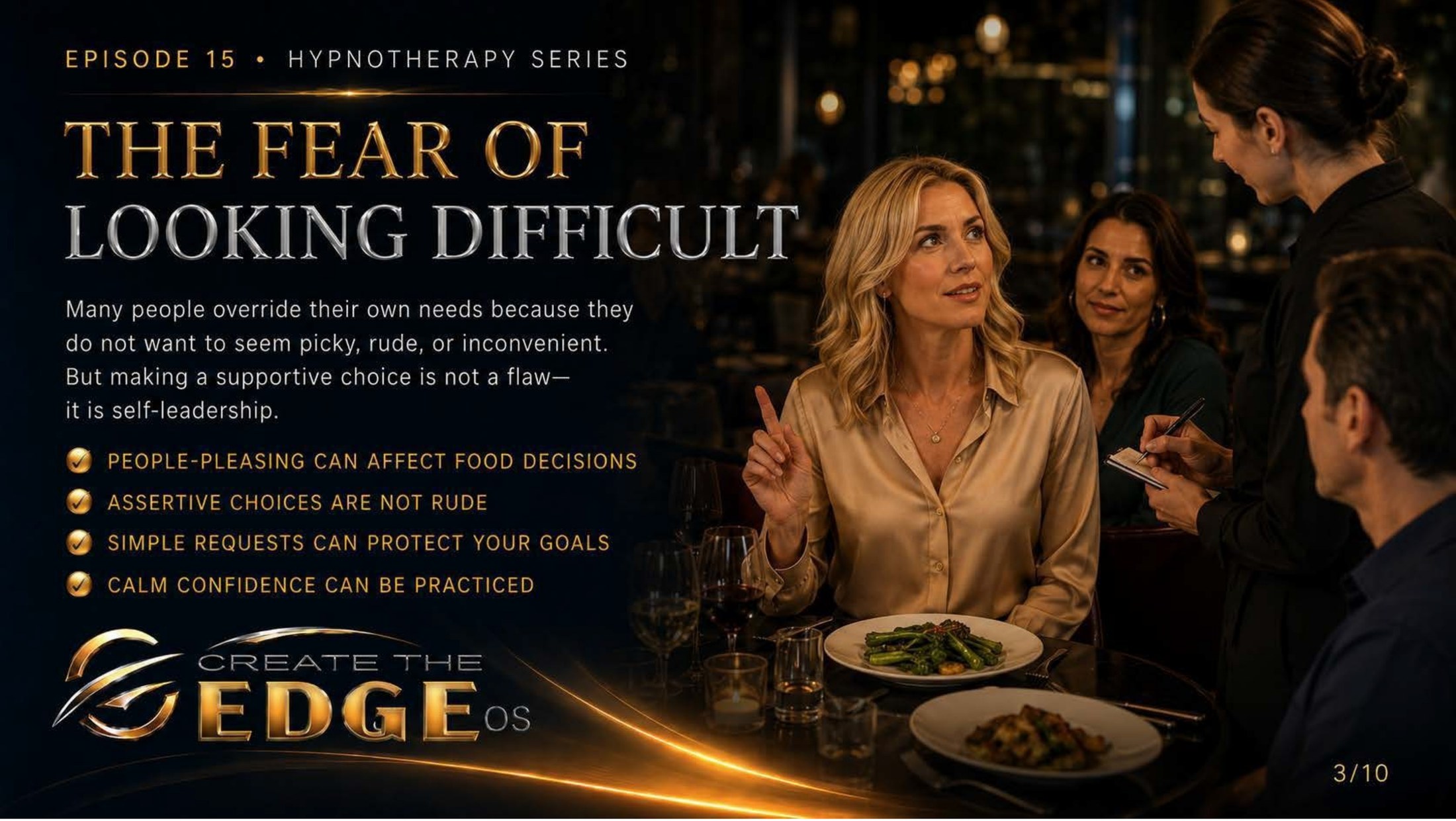
On the slideMany people override their own needs because they do not want to seem picky, rude, or inconvenient. But making a supportive choice is not a flaw — it is self-leadership: people-pleasing can affect decisions · assertive choices are not rude · simple requests can protect your intentions · calm confidence can be practiced.
Episode 15 · Slide 3
The Fear of Looking Difficult
Here she is at the restaurant table, quietly, calmly, without drama, speaking to the server while the people around her carry on their conversation. She isn’t apologizing. She isn’t over-explaining. She’s just making a simple, clear request and then returning to the warmth of the evening. It looks easy. It is, once you understand something that most of us were never taught: asking for what you need at a restaurant is not rude. It’s just asking.
The fear of looking difficult is enormous, and it runs deep. Many of us learned, particularly as women and particularly around food, that having needs was an imposition. That modifying your order was high-maintenance. That asking for something special was a burden on the people around you and the staff serving you. That the polite thing — the good thing, the selfless thing — was to just eat what was put in front of you without complaint.
And that conditioning sends a powerful message about whose needs matter. When you consistently override your own needs to avoid inconveniencing others, you are practicing, at the level of the body, a belief that your needs are less important than other people’s comfort. That’s worth naming clearly, because it’s a belief that shows up in much bigger places than restaurant orders.
The slide says it directly: assertive choices are not rude. A simple, clear, kind request to a server is part of that server’s job. They have answered thousands of modification requests and will answer thousands more. You are not an unusual burden. You are a customer communicating your needs with courtesy. That’s the whole thing. And doing it without apology, without over-explanation, without the anxious disclaimers that say I’m so sorry to be difficult — that is what the slide means by calm confidence.
Calm confidence is a practice. It doesn’t come from nowhere; it comes from repeatedly choosing it — from making the small, quiet assertion that your needs are worth stating, and noticing that the world doesn’t collapse when you do. Each time you make a simple request without the apology spiral, you’re building a new neural groove: I can ask for what I need. It’s fine. The table keeps going.
Take my hand. You are not difficult. You are someone who knows what they need. Those are completely different things, and it’s time you started treating them that way.
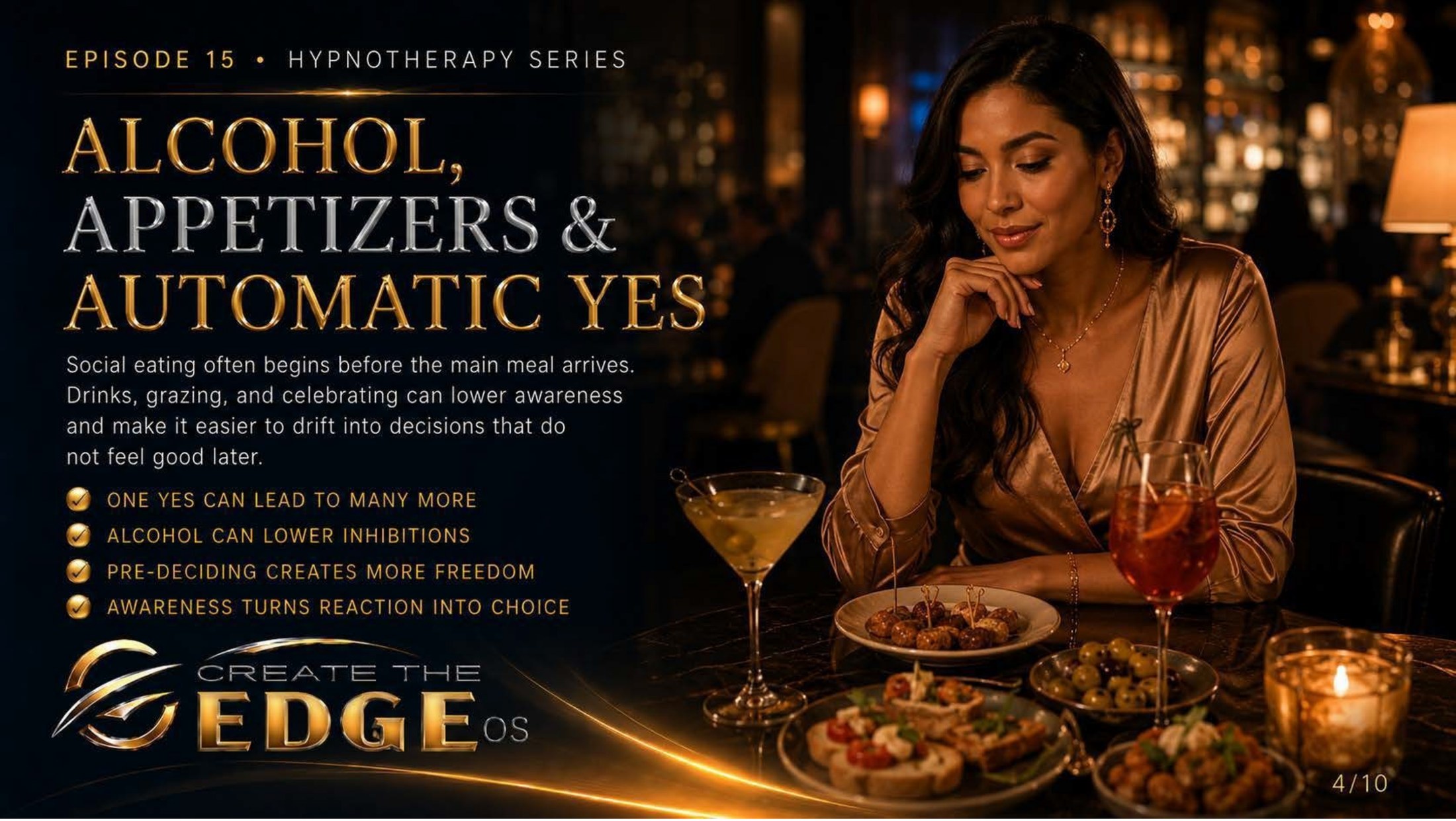
On the slideSocial eating often begins before the main meal arrives. Drinks, grazing, and the celebratory energy can lower awareness and make it easier to drift into choices that do not feel good later: one yes can lead to many more · alcohol can lower inhibitions · pre-deciding creates more freedom · awareness turns reaction into choice.
Episode 15 · Slide 4
Alcohol, Appetizers & the Automatic Yes
Here she is, the warm candlelight of a bar setting behind her, a cocktail in hand, the whole early-evening energy of a social occasion carrying its particular looseness and pleasure. And I want to talk honestly about this moment — not to make it threatening, but because it’s real and almost nobody discusses it: the beginning of a social dining experience is often where intention is most quietly lost.
Not because anyone meant to lose it. But because the social eating experience is specifically designed to be pleasurable from the first moment, and pleasure loosens the edges of intention in ways that aren’t inherently bad. A drink at the bar. An appetizer passed around the table. The festive energy of a celebration that says tonight is different, tonight is special, tonight the rules are suspended. All of this is beautiful. And all of it can, without awareness, become the beginning of a cascade where one yes makes the next one easier and the next one easier still.
The slide names something worth understanding: pre-deciding creates more freedom. This sounds counterintuitive, but it’s one of the most practically useful things in this chapter. When you decide in advance — before the atmosphere, before the social energy, before the first drink — where you’d like to land by the end of the evening, you’re not restricting yourself. You’re giving yourself a compass to navigate by when the environment is actively trying to redirect you.
Pre-deciding isn’t rigidity. It’s not “I will eat exactly this and drink exactly that.” It’s more like “I want to enjoy tonight and also feel good tomorrow, so I’ll plan to have what genuinely sounds good to me rather than whatever the evening momentum generates.” That intention — loose, kind, your own — is a much more reliable guide through a social eating experience than trying to make each individual decision fresh in an atmosphere designed to maximize enjoyment.
I want to say something about alcohol specifically, because it matters and it’s honest: alcohol is a real factor in social eating choices, not because it makes you weak, but because it genuinely changes how the subconscious weighs immediate pleasure against longer intentions. That’s not a moral judgment. It’s biology. Knowing it in advance is just information you can use to make whatever choices actually serve you.
Take my hand. We’re not building a fortress against pleasure. We’re building a relationship with yourself solid enough that you can fully enjoy an evening out and still come home to yourself at the end of it. That’s the whole goal.

On the slideHypnotherapy helps notice the emotional trigger underneath the social moment. By relaxing the nervous system and rehearsing new responses, it becomes easier to choose from intention instead of pressure: identify the social trigger · calm the stress response · rehearse a new choice in advance · build a stronger inner voice.
Episode 15 · Slide 5
How Hypnotherapy Rewires Social Eating Triggers
Look at this image — a therapist and client in a warm, candlelit session, and floating above them in thought-bubble form: the restaurant table, the celebration energy, the offered dessert. They’re rehearsing. In the safety of the therapeutic space, they’re running through the social scenario — identifying the emotional trigger that fires when the group energy pushes toward a choice the client doesn’t actually want — and practicing a new, calmer response to it before the real moment arrives.
This is one of hypnotherapy’s most powerful applications, and it’s one that purely intellectual strategies can’t replicate. You can know, in your rational mind, that you don’t have to match everyone else’s order. You can have your script prepared and your intention clear. And then you sit down at the actual table, with the actual people, in the actual social energy — and the subconscious activates an older, faster pattern: belong. don’t make trouble. fit in. this is what we do here. The knowing doesn’t always stop the firing.
What hypnotherapy can do is reach that faster layer. In a relaxed, focused state, you can identify the specific social trigger — the moment the group energy activates — and practice a new response at the level where the old pattern lives. Not override it with willpower, but actually replace it with something that feels different in the body: calmer, more grounded, more connected to what you actually want.
The rehearsal piece is something worth dwelling on, because it works in a way that direct instruction simply doesn’t. When you’ve mentally and emotionally rehearsed making a different choice in a social setting — feeling the social pressure, breathing through it, connecting to your own intention, and experiencing the moment of choosing yourself without the world ending — the real moment has a template. Your nervous system has been there before. The unknown has been rehearsed into the familiar, and familiar is calmer.
And the slide ends with something I love: build a stronger inner voice. Not louder, not more aggressive, not better at arguing with the people at your table. Stronger. The kind of inner voice that knows what you want and says so to you, clearly and without drama, even in a noisy restaurant surrounded by people who are choosing something different. That voice — calm, clear, yours — is what hypnotherapy helps you build.
Take my hand. We’re building the inner voice that stays with you at every table, in every setting, in every social moment where the pressure to choose away from yourself has ever made you lose your way. You’re not going back there. Let’s keep going.
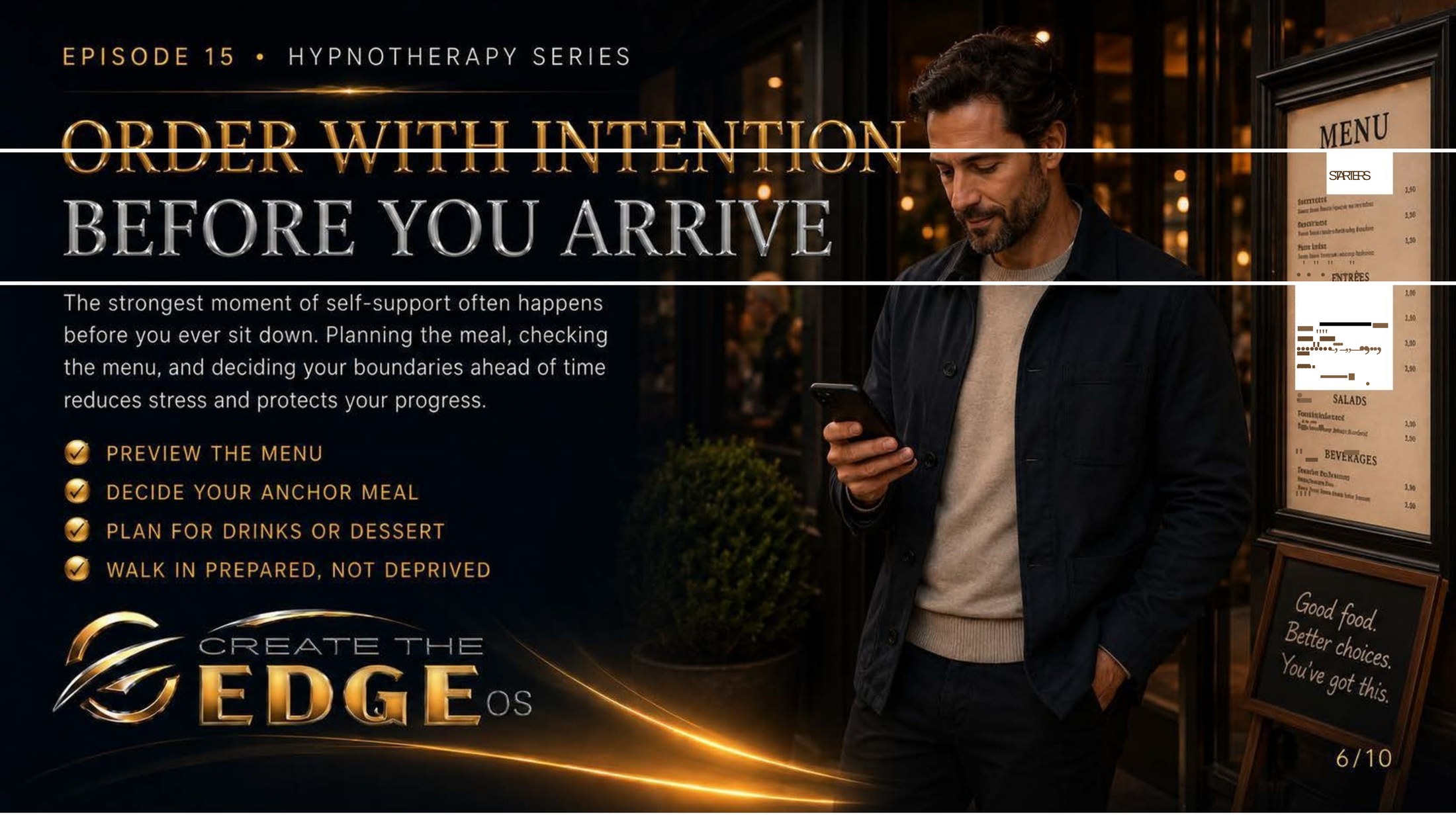
On the slideThe strongest moment of self-support often happens before you ever sit down. Planning the meal, checking the menu, and deciding your boundaries ahead of time reduces stress and protects your progress: preview the menu · decide your anchor meal · plan ahead for drinks or dessert · walk in prepared, not deprived.
Episode 15 · Slide 6
Order With Intention Before You Arrive
Here he is on his phone before the evening begins, checking the menu outside the restaurant, the whole posture of a man who has taken thirty seconds to look at his options before the social energy of the evening takes over. And on the sign behind him: good food. better choices. you’ve got this. That’s it. That’s the whole slide in three short lines. The preparation happened before the pressure could reach him.
Previewing the menu before you arrive is one of those strategies that sounds almost embarrassingly simple and works with a power completely out of proportion to its effort. When you look at the menu in advance — at home, without social pressure, without the smell of the kitchen or the energy of the table — you’re making choices from your most resourced self. The version of you who knows what you actually want. The version of you who isn’t also managing group dynamics and conversation and the waiter appearing at your elbow. That version makes better decisions. Let her decide.
The concept of an anchor meal is worth spending a moment with. An anchor meal is simply the thing you’ve decided in advance sounds genuinely good to you and aligns with how you want to feel. It’s not the most restrictive option on the menu, and it’s not chosen as a punishment. It’s chosen because it actually appeals to you and because having decided in advance means you can arrive at the restaurant as a participant in the evening rather than someone who still has to figure out what they’re doing.
And notice the slide’s framing of this: walk in prepared, not deprived. This is critical. Preparation and deprivation are completely different states, but they can get confused when food decisions feel emotionally loaded. Choosing your anchor meal in advance from a menu full of options you actually find appealing is preparation. Arriving at a restaurant having decided you can only eat the plain salad as a form of pre-emptive punishment is deprivation. One comes from self-care. The other comes from self-punishment. They produce entirely different experiences at the table.
I also want to say something about planning for drinks and dessert, because this isn’t about planning how to avoid them. It’s about deciding — in advance, from your own values and intentions — what role you actually want them to play in the evening. Maybe you genuinely want one good glass of wine and would like to savor it. Maybe the dessert menu has something you’re truly excited about. Deciding in advance means you can have those things with full presence and satisfaction rather than arriving at them through a series of automatic yeses.
Take my hand. The thirty seconds of menu-checking is thirty seconds of self-respect. Let’s get in the habit of giving ourselves that.
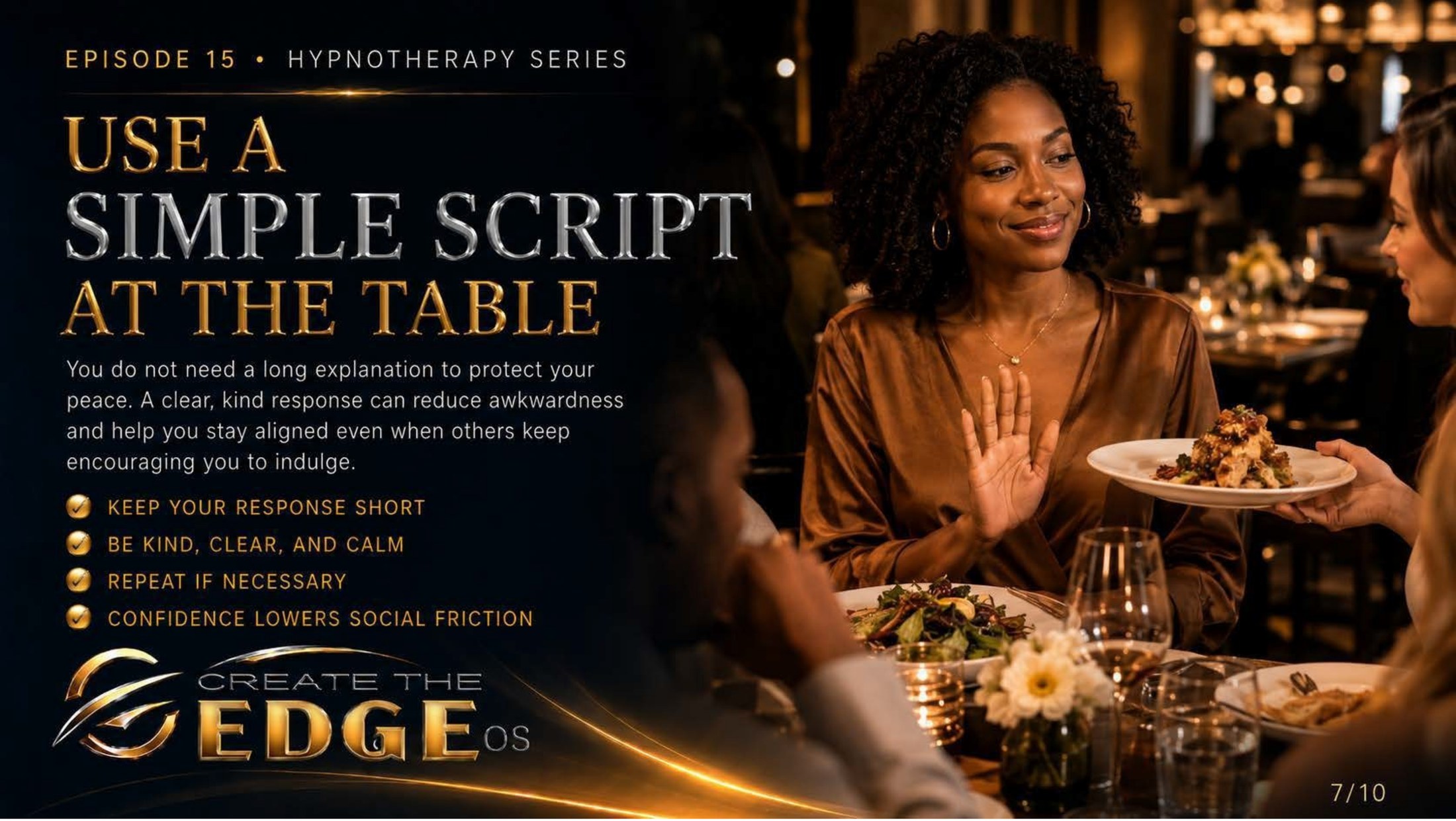
On the slideYou do not need a long explanation to protect your peace. A clear, kind response can reduce awkwardness and help you stay aligned even when others keep encouraging you to indulge: keep your response short · be kind, clear, and calm · repeat if necessary · confidence lowers social friction.
Episode 15 · Slide 7
Use a Simple Script at the Table
Look at her at the table — someone is offering her something she has decided she doesn’t want, and her hand is raised in the gentlest, most natural gesture of “no thank you,” her face warm and present and completely undramatic about the whole thing. The table continues. Nobody is devastated. The evening is entirely fine. This is what the script looks like when it’s working: so smooth that it barely registers as a thing that happened.
Most of us have never been taught a simple, effective response to social food pressure. We’ve been left to improvise in the moment, which means we either over-explain (“I’m trying not to have sugar right now because I’ve been really watching my intake and my doctor said…”) or cave completely to avoid the explanation. Neither works particularly well. The over-explanation invites debate and draws attention. The caving leaves you having made a choice that wasn’t really yours.
The slide offers something better: keep it short. “I’m good, thank you.” “Not for me tonight, thank you.” “That looks amazing — I’m going to pass, but please enjoy.” These phrases share three qualities: they’re kind in tone, clear in content, and completely uninviting of follow-up. They don’t explain or apologize. They’re just a clear, pleasant close to that particular conversation.
And repeat if necessary — because sometimes one clear response doesn’t end it. Some tables have a member who seems personally invested in getting you to indulge. (“Come on, just one.” “You’re being so good — you can have one.”) The same script, repeated with the same warmth and the same firmness: “Really, I’m good, but thank you.” The repetition without escalation is the skill. You don’t have to get more emphatic, more defensive, or more explanatory. You just hold your position with the same calm tone, as many times as needed.
And here’s what the slide names in its final point — confidence lowers social friction. When you make your choice with ease and warmth and zero drama, the table responds to the energy you bring. Apologetic or defensive energy invites pressure. Calm, easy energy signals that there’s nothing to push against. The script works partly because of the words and partly because of the way they’re delivered. Both are learnable.
Take my hand. You’re allowed to say no thank you at a table. Not just allowed — entitled to. Kindly, briefly, and without one more word of explanation.

On the slideThe heart of a meal out is often the people, not the pressure. When we shift our focus back to conversation, presence, and enjoyment, food can return to its proper place instead of becoming the main emotional event: focus on the people, not the pressure · slow down and savor · notice when you feel satisfied · let connection lead the experience.
Episode 15 · Slide 8
Choose Connection, Not Just Consumption
Look at this image — a table of people genuinely engaged with each other, a woman laughing freely, the whole scene radiating the particular warmth of a meal that is actually about connection. The food is there, beautiful and abundant. And it is clearly not the main event. The main event is the people. And something about that image is deeply restoring, because it points to what eating out is supposed to be: not an athletic event of managing food in a social context, but a gathering of human beings who like each other, sharing a meal.
When food becomes the primary emotional focus of a meal out — the thing you’re most managing, most anxious about, most occupied with — you lose something real. The conversation that might have happened. The laughter. The genuine connection. The memory of the evening becomes the food decisions rather than the people around you. And that’s a cost that’s worth naming honestly.
The shift this slide invites is a reorientation: let connection lead the experience. When you arrive at the table genuinely curious about the people there, genuinely interested in the conversation, genuinely present to the warmth of the gathering — food becomes one element of a rich evening rather than the whole show. You eat what genuinely appeals to you, you savor it fully, you notice when you feel satisfied, and then you return your attention to the reason you came: the people.
Slowing down and savoring is worth dwelling on here, because it’s one of those simple things that changes the entire texture of eating out. When you eat slowly and with genuine attention to flavor and pleasure, you receive more satisfaction from what you eat. The food actually registers as enjoyment rather than disappearing in a blur of conversation and social management. And you’re more likely to notice natural satisfaction rather than going past it because you weren’t paying attention.
I want to say something true about this from my own life: some of my most meaningful evenings have been around tables where the food was entirely unremarkable and the connection was extraordinary. And some evenings where the food was exceptional were flattened by an internal anxiety that made it impossible to really taste any of it. Connection is nourishment. Not a substitute for food, but a dimension of nourishment that food alone can never provide.
Take my hand. The next time you walk into a restaurant, walk in as someone who came to see the people. The food is there to support the experience. Let the people lead.
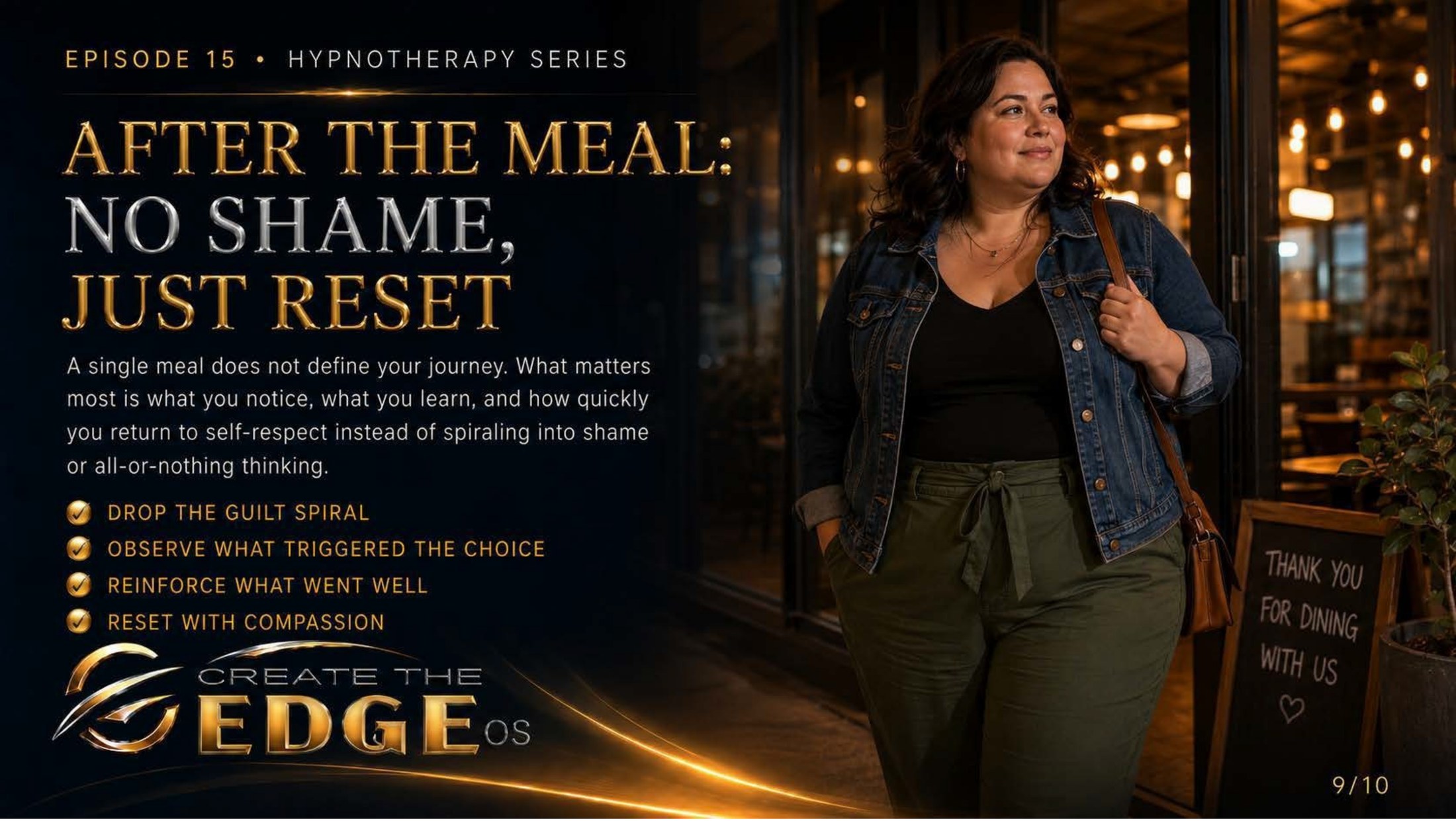
On the slideA single meal does not define your journey. What matters most is what you notice, what you learn, and how quickly you return to self-respect instead of spiraling into shame or all-or-nothing thinking: drop the guilt spiral · observe what triggered the choice · reinforce what went well · reset with compassion.
Episode 15 · Slide 9
After the Meal: No Shame, Just Reset
Here she is, walking out of the restaurant into the evening air, her expression easy and clear, the evening behind her. And the sign in the window: thank you for dining with us. Something about this image is quietly radical: she looks like someone who has had a nice evening and is simply walking home. Not someone cataloguing every choice she made and whether it was good enough. Just a person who went out to dinner and is now going home. That simplicity is the goal.
Because what happens after a meal out is just as important as what happens during it, and it’s where many of us have historically done the most damage to ourselves. The guilt spiral. The all-or-nothing collapse. The decision that because the evening went differently than planned, the whole effort is compromised and you may as well stop trying until Monday. That spiral isn’t a sign that you care about your wellbeing. It’s a sign that you’re using shame as a management tool, and shame, as we’ve said throughout this book, does not produce lasting change. It produces exhaustion.
The slide offers a completely different template for after the meal, and it’s worth reading slowly: drop the guilt spiral. Observe what triggered the choice. Reinforce what went well. Reset with compassion. Notice what that template doesn’t include: self-punishment, harsh review, sweeping declarations about your character. It’s curious. It’s kind. It’s interested in learning rather than condemning.
Observe what triggered the choice is the piece I find most valuable, because it turns what could be a source of shame into a source of useful information. If the evening went differently than you’d intended, what happened? Was it the group energy? The alcohol? Arriving hungry? Someone at the table pushing? The food being unexpectedly wonderful? These aren’t accusations. They’re data. They help you prepare better for the next time.
And reinforce what went well — because something went well. Maybe you previewed the menu. Maybe you used your simple script once. Maybe you chose connection over consumption for the first three courses even if the last two went differently. Maybe you simply walked out without the guilt spiral. That counts. All of it counts. The wins are real even when the evening wasn’t perfect, and naming them is how you build the pattern you actually want.
We don’t fail, we fall forward. Every evening out is information. Every evening out is practice. And the person walking home from dinner who is curious and kind with herself is building something much more lasting than the person who is ruthless and ashamed. Take my hand. Let’s go home easy.
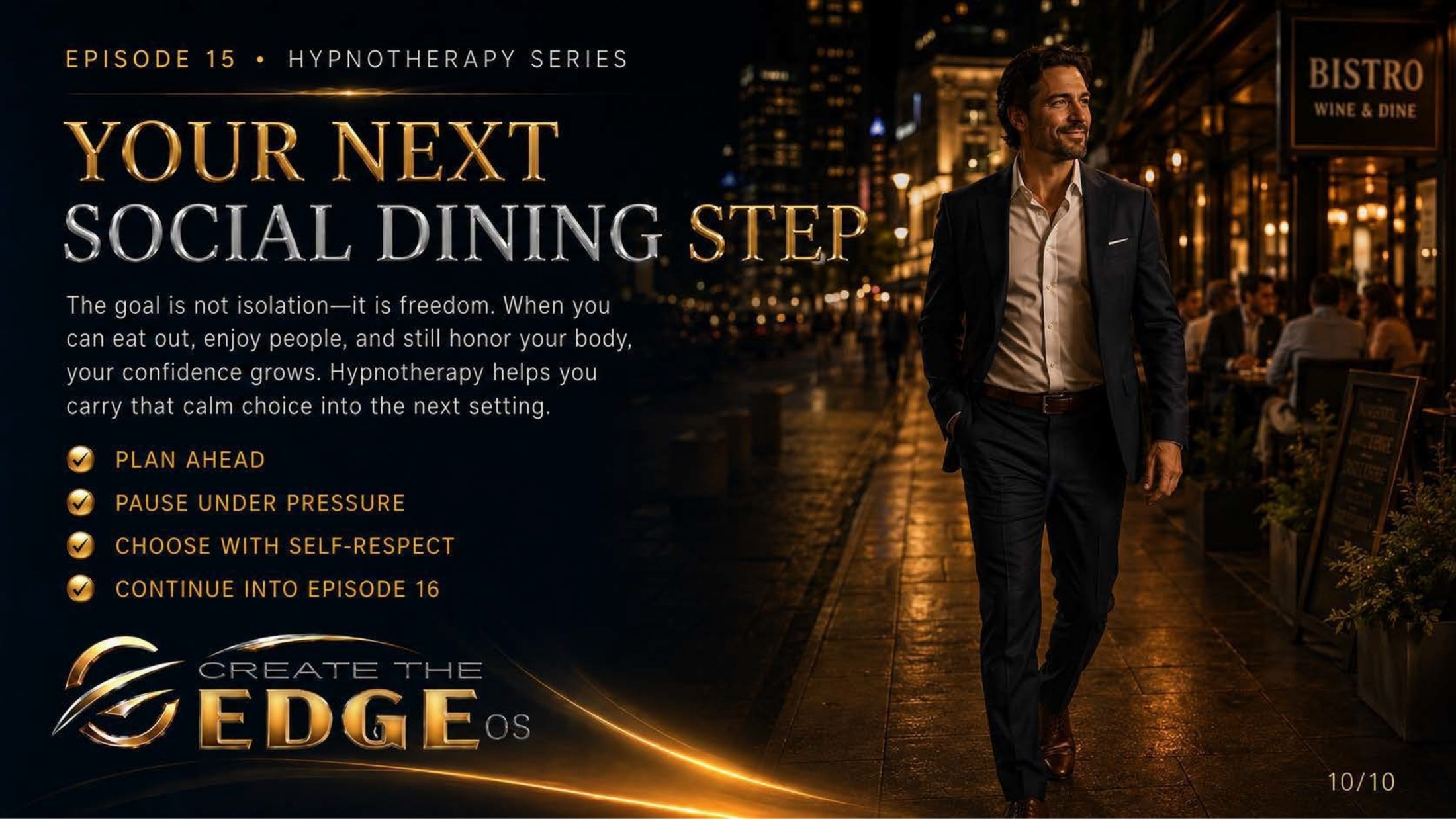
On the slideThe goal is not isolation — it is freedom. When you can eat out, enjoy people, and still honor your body, your confidence grows. Hypnotherapy helps you carry that calm choice into the next setting: plan ahead · pause under pressure · choose with self-respect · continue into Episode 16.
Episode 15 · Slide 10
Your Next Social Dining Step
Look at him walking down that street, the warm lights of the bistro behind him, the whole evening-city energy of someone who has been somewhere good and is now walking forward into what’s next. Not fleeing. Not relieved. Just — moving. That ease of motion is what we’re building: the ability to walk into any social dining situation and walk back out of it still yourself.
The slide makes the point I want to leave this chapter with: the goal is not isolation. I say this because it’s important to name, because sometimes in the work of trying to change our relationship with food, isolation can start to feel like safety. If I don’t go out, I can’t be pressured. If I avoid restaurants, I can’t make choices I’ll regret. If I skip the celebration, I can control what I eat. That logic is understandable and it is also, in the long run, a narrowing of life rather than an expansion of it.
The real goal — the one worth building toward — is the freedom to go everywhere. To sit at any table. To be surrounded by any social energy. To encounter any menu. And to come through all of it still feeling like yourself. That’s not a restriction. That’s the opposite: it’s a fullness of participation in the world that is available to you when you’re not managing every situation as a potential emergency.
The three practices this chapter leaves you with are: plan ahead, because your most resourced self makes better decisions than your pressured, in-the-moment self. Pause under pressure, because the pause is where choice lives, and without it you’re just reacting. Choose with self-respect, because that’s the only kind of choice that actually feels good afterward.
And here’s what I know from working with people on exactly this: as you do this more — as you plan and pause and choose from self-respect, one social evening at a time — it gets easier. Not because the social pressure disappears, but because your nervous system builds a new normal. Going out stops being a high-stakes management exercise and starts being just dinner with people you like. The calm spreads. The confidence becomes reliable. You become someone who can be anywhere and remain herself.
So take my hand, as always, from right here on the road. I still preview menus. I still use my scripts. I still notice when the group energy is pulling me somewhere I don’t actually want to go. And I’ve learned to do all of that so quietly, so naturally, that it no longer takes up very much space at all. That’s where we’re going. We don’t fail, we fall forward, and we go together into Episode 16 and every table that waits beyond it. The path is lit. Let’s keep walking.