
Episode 17 · Slide 1Episode 17 · Slide 1 · the unconscious mind shapes more than you realize
Episode 17 · Slide 1
THE UNCONSCIOUS MIND SHAPES MORE THAN YOU REALIZE
Most of the decisions we make about food, movement, and self-care do not begin in the rational mind. They begin in a quieter, older part of us that learned its lessons long before we had words for what was happening around us.
The unconscious mind is not a mystery to fear. Think of it as a record keeper, holding every message you received about your body, your worth, your capability, and your safety. It learned what to do to help you survive, and it has been running those programs ever since.
When you understand that so much of your behavior is rooted in those early recordings, something important shifts. The struggle is no longer a character flaw. It is a pattern, and patterns can be changed. This episode begins the work of understanding that inner landscape.
Reflect
1. Think about one habit around food or self-care you have tried to change more than once. What has gotten in the way?
2. What messages did you receive growing up about your body, your weight, or your worth?
3. Can you think of a moment when you felt one thing consciously but did something very different? What drove that?
4. What does it feel like to consider that your struggles may not be about willpower at all?
5. What would it mean to you if lasting change turned out to be safer and more possible than you once believed?
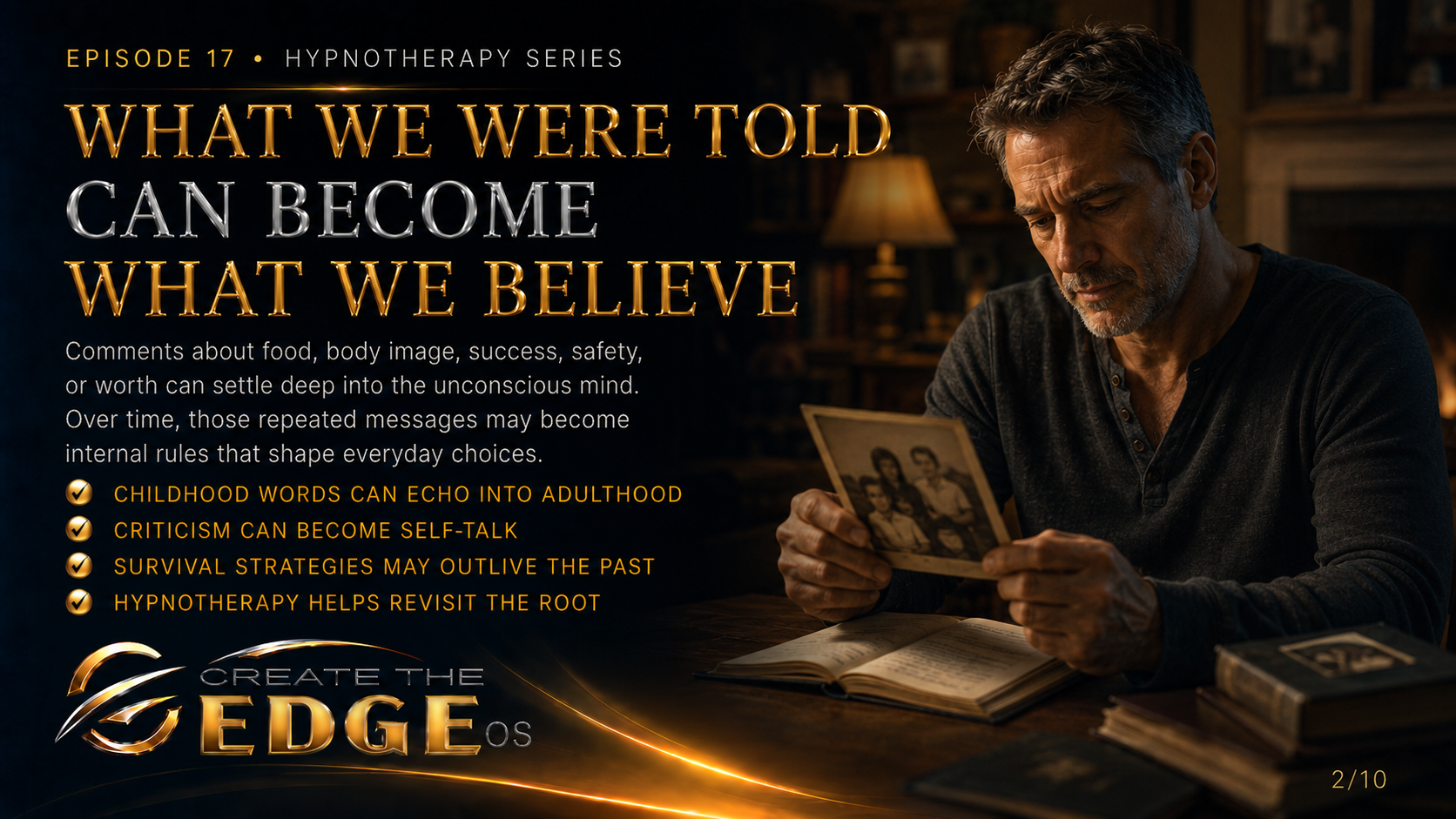
Episode 17 · Slide 2Episode 17 · Slide 2 · what we were told can become what we believe
Episode 17 · Slide 2
WHAT WE WERE TOLD CAN BECOME WHAT WE BELIEVE
Comments about food, body image, success, safety, or worth can settle deep into the unconscious mind when we are young. Over time, those repeated messages may become internal rules that shape everyday choices without our realizing it.
A child who was told they eat too much, that their body is a problem, or that they should be grateful regardless of how they feel may carry those words forward for decades. Not as remembered statements, but as invisible instructions.
Hypnotherapy offers a way to revisit those roots with compassion, to examine what was installed, and to begin choosing what stays and what gets gently released.
Reflect
1. What is one belief about your body or your ability to change that you suspect you absorbed from someone else?
2. Do you remember being told anything about food or weight as a child that still echoes in your daily choices?
3. How does it feel to consider that some of your most deeply held beliefs may be borrowed rather than true?
4. What would you tell a younger version of yourself about their worth, separate from their body?
5. If you could replace one inner rule you did not choose, what would it be and what would you replace it with?

Episode 17 · Slide 3Episode 17 · Slide 3 · trauma can teach the body to stay on guard
Episode 17 · Slide 3
TRAUMA CAN TEACH THE BODY TO STAY ON GUARD
When the nervous system experiences stress or threat repeatedly, it learns to stay alert. It watches for danger even when the original danger is long gone. What looks like avoidance, resistance, or a lack of discipline may actually be an old protective response still doing its job.
Comfort eating, withdrawal, overworking, numbing: these are not signs of weakness. They were once solutions. The unconscious mind found what eased the pain, and it kept reaching for those same things.
Healing begins not with more willpower but with more safety. When the nervous system learns that it no longer needs to protect at that level, new choices become possible.
Reflect
1. Is there a pattern in your life that, when you look at it honestly, might be protecting you from something?
2. What does your body do when you feel stressed or overwhelmed? Where do you feel it first?
3. Have you ever noticed that rest or self-care feels uncomfortable or even unsafe? What do you think that is about?
4. What would it mean to approach your patterns with curiosity rather than judgment?
5. What conditions help you feel safe enough to try something new?
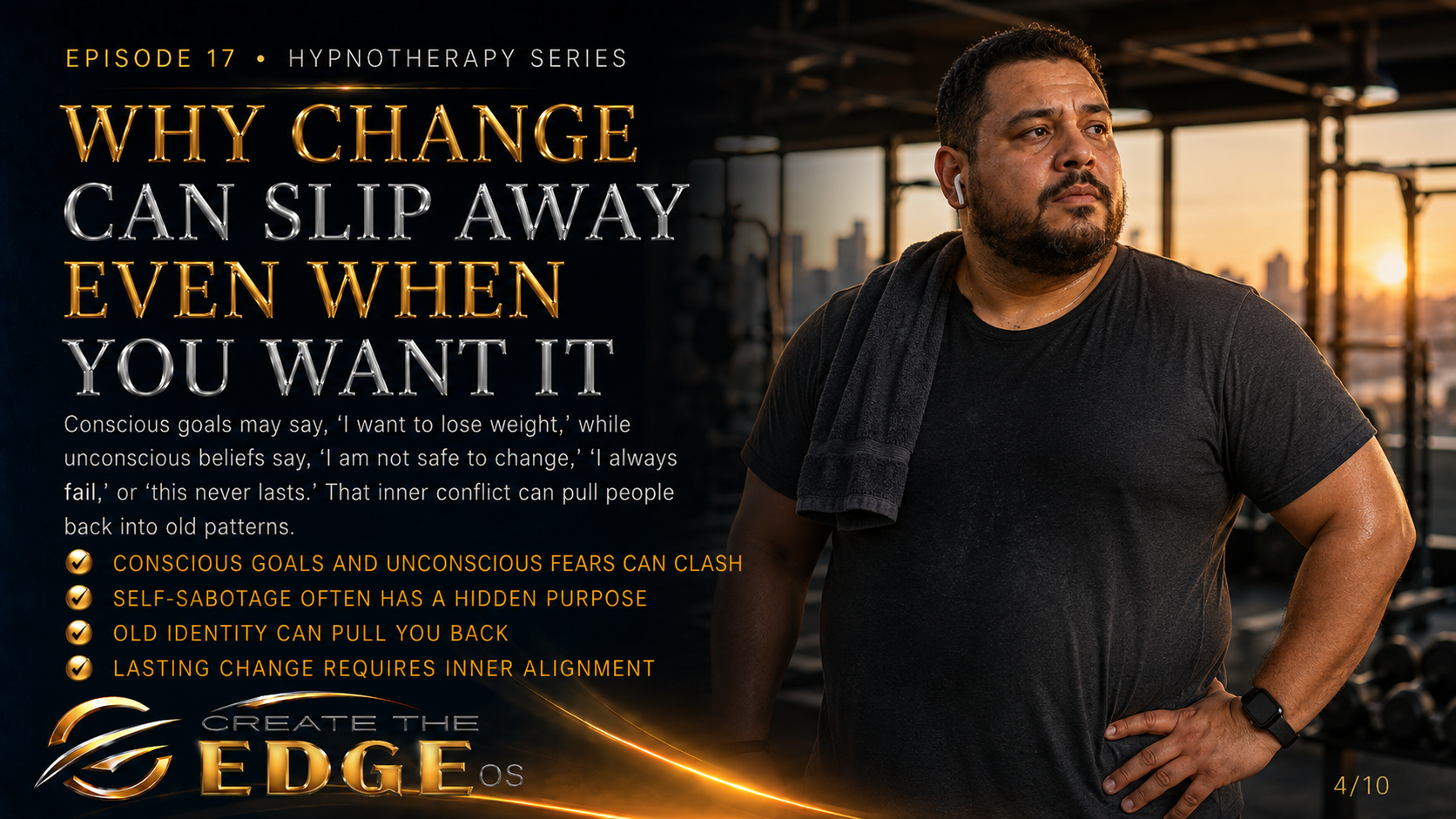
Episode 17 · Slide 4Episode 17 · Slide 4 · why change can slip away even when you want it
Episode 17 · Slide 4
WHY CHANGE CAN SLIP AWAY EVEN WHEN YOU WANT IT
You make a decision. You start strong. Then, somewhere between intention and follow-through, the old pattern resurfaces. It does not mean you do not want change. It may mean a deeper part of you does not yet feel safe with it.
The unconscious mind holds onto what it knows. If change has felt threatening, painful, or dangerous in the past, part of you will resist it now, not out of stubbornness but out of loyalty to an older version of survival.
Lasting change asks us to work with that resistance rather than against it. To say: I see you, I understand why you are here, and I am ready to show you something safer.
Reflect
1. Think of a time you started a health goal with real momentum and then stopped. What was happening in your life or inner world at that moment?
2. What part of you might be afraid of what change would mean or require?
3. If the old pattern had a voice, what would it say it is trying to protect?
4. What would you need to feel or believe in order for change to feel safe rather than frightening?
5. What has staying the same cost you? And what might it cost you to continue?
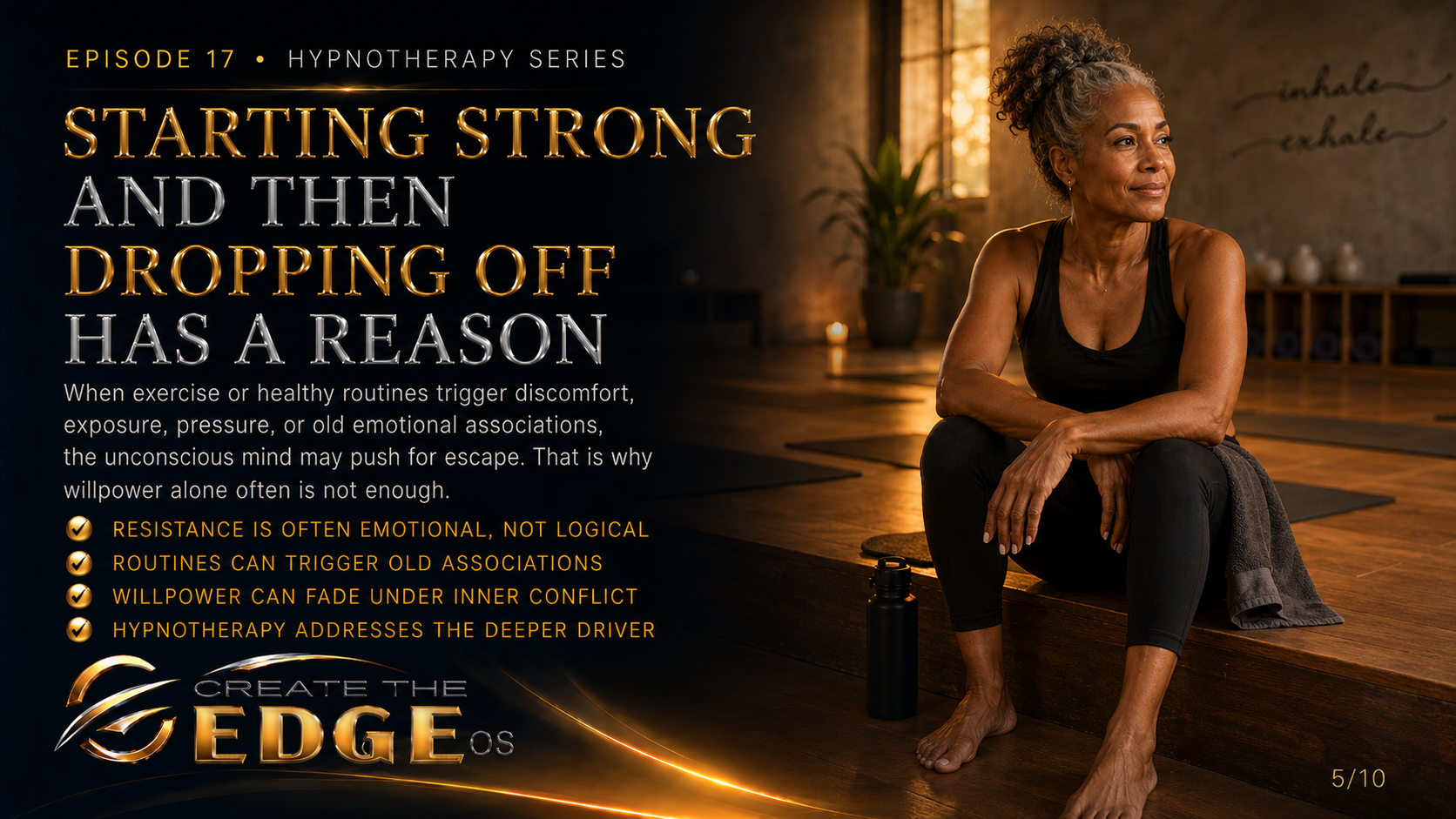
Episode 17 · Slide 5Episode 17 · Slide 5 · starting strong and then dropping off has a reason
Episode 17 · Slide 5
STARTING STRONG AND THEN DROPPING OFF HAS A REASON
When exercise or healthy routines trigger discomfort, exposure, pressure, or old emotional associations, the unconscious mind may push for escape. That is why willpower alone often is not enough to carry a new habit forward.
It is not about lacking discipline. It is about what the activity or change means at a deeper level. For some people, being seen at the gym feels terrifying. For others, cooking for themselves feels pointless. These feelings have history.
Hypnotherapy helps uncover the emotional charge behind the resistance, so that new habits feel less like a battle and more like a natural extension of who you are becoming.
Reflect
1. What health habits have you started and stopped most often? What feelings arise when you think about them?
2. Is there an activity or change that you want to make but feel a strong, unexplained resistance to?
3. What story does your mind tell you when you are about to do something good for yourself and then do not?
4. If you removed the emotional charge from that habit, just made it neutral, would it feel easier?
5. What would it feel like to show up for yourself consistently, not perfectly, but consistently?
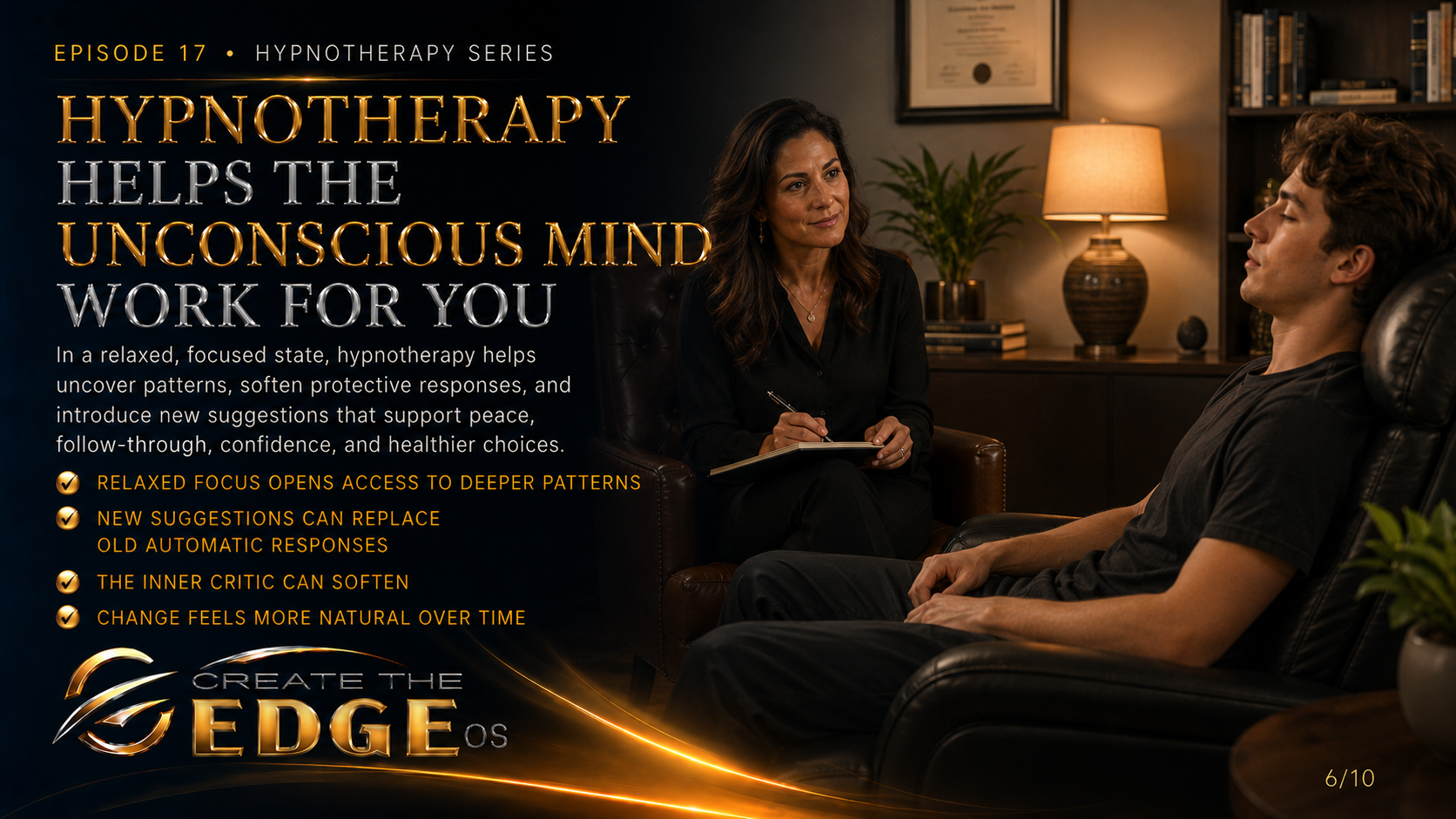
Episode 17 · Slide 6Episode 17 · Slide 6 · hypnotherapy helps the unconscious mind work for you
Episode 17 · Slide 6
HYPNOTHERAPY HELPS THE UNCONSCIOUS MIND WORK FOR YOU
In a relaxed, focused state, the mind becomes more receptive. Old patterns can be gently surfaced and examined. New suggestions can be introduced that feel natural rather than forced.
This is not about controlling your mind. It is about creating a conversation with the part of you that has been running old programs quietly, and inviting it into something better.
Over time, as the unconscious mind takes on new beliefs about safety, worth, and capability, the behaviors that felt like a constant struggle begin to feel more effortless. Change stops feeling like a fight and starts feeling like coming home.
Reflect
1. Have you ever experienced a deep state of relaxation, whether in meditation, nature, or sleep, where an insight arrived on its own?
2. What would it mean to you if your unconscious mind were working with your goals instead of against them?
3. What belief, if your deeper mind truly accepted it, would change the most for you?
4. How open do you feel right now to the idea that change can happen at a level below conscious thought?
5. What would a week feel like if your inner voice were kind, encouraging, and genuinely on your side?
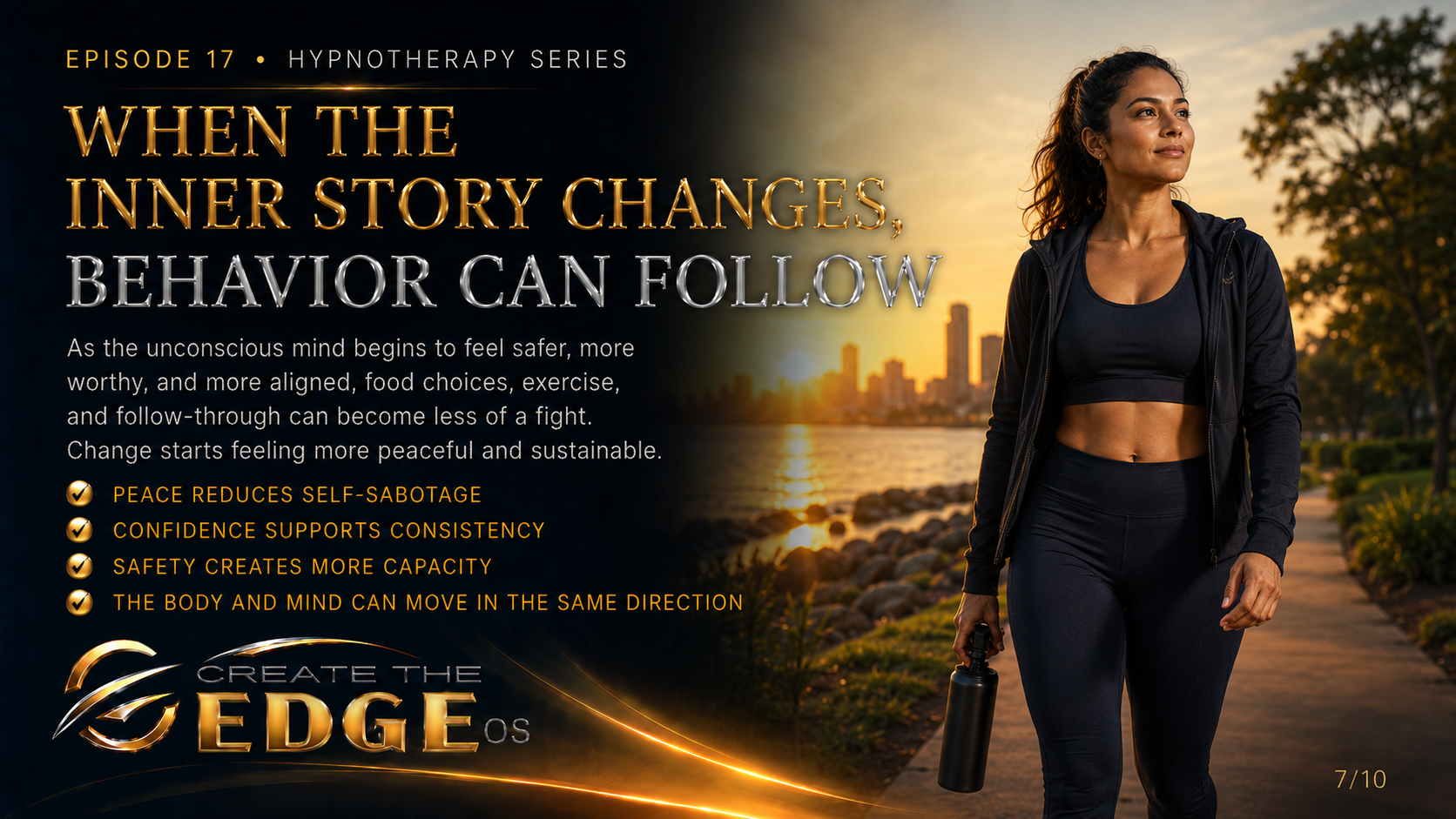
Episode 17 · Slide 7Episode 17 · Slide 7 · when the inner story changes, behavior can follow
Episode 17 · Slide 7
WHEN THE INNER STORY CHANGES, BEHAVIOR CAN FOLLOW
As the unconscious mind begins to feel safer, more worthy, and more aligned, food choices, exercise, and follow-through become less of a fight. The effort does not disappear, but the resistance softens.
Identity is powerful. When we begin to see ourselves differently, as someone who takes care of their body, as someone who follows through, as someone who deserves good things, behavior begins to follow that new self-image.
This is the heart of hypnotherapy's role in transformation: not to will you into change from the outside, but to help the inside shift so that the outside naturally follows.
Reflect
1. How do you currently describe yourself when it comes to health and self-care? What words do you use?
2. What would you call yourself if your inner story had already shifted? Who would that person be?
3. Is there a version of yourself you are quietly afraid you will never become? What would you tell her?
4. What would change first if your relationship with yourself became genuinely kind?
5. What evidence do you already have, even small, that this shift is already beginning?
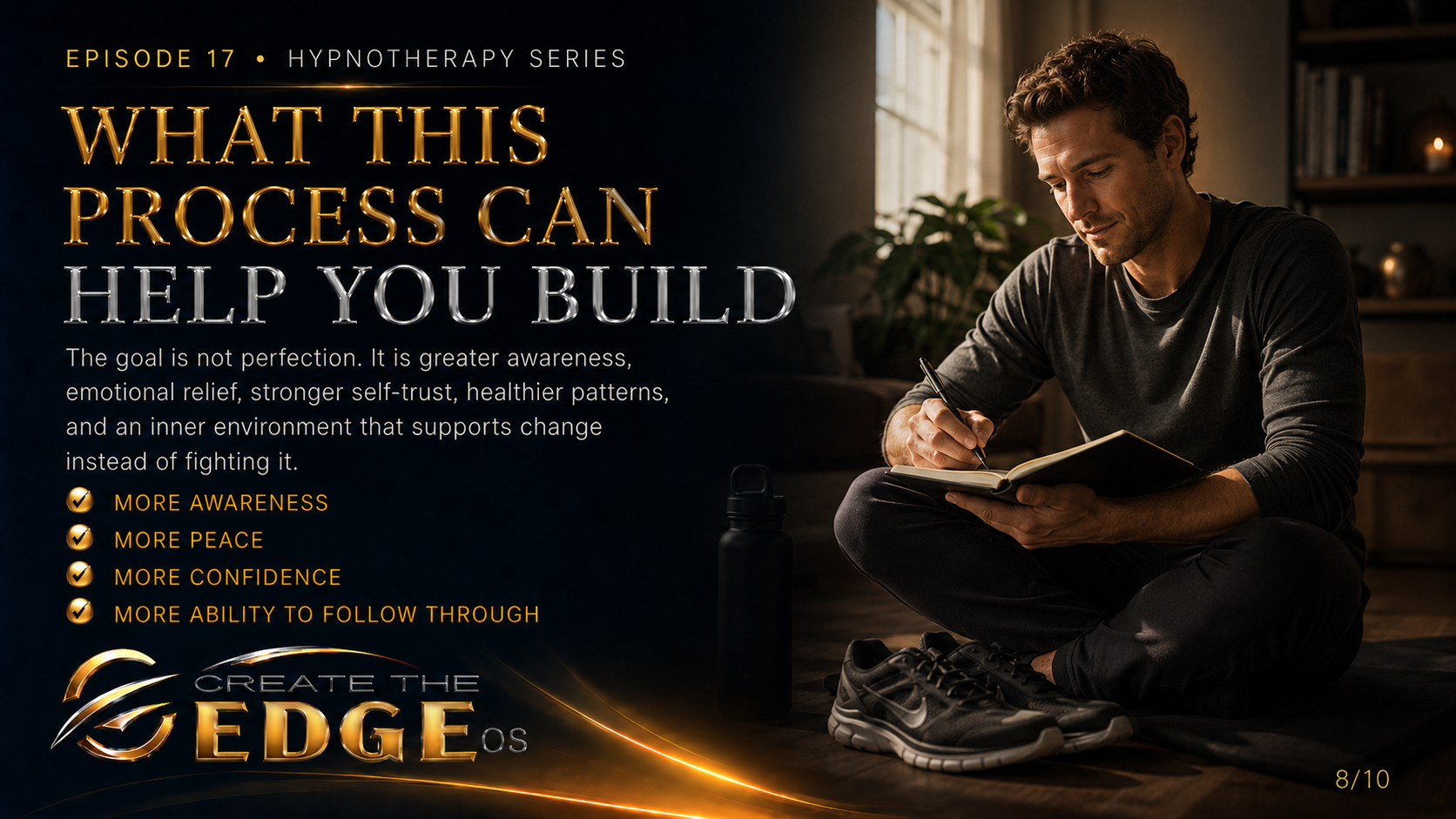
Episode 17 · Slide 8Episode 17 · Slide 8 · what this process can help you build
Episode 17 · Slide 8
WHAT THIS PROCESS CAN HELP YOU BUILD
The goal is not perfection. It is not a flawless body or a spotless record. It is greater awareness, emotional relief, stronger self-trust, and an inner environment that supports change instead of fighting it.
More peace. More confidence. More ability to follow through. These are not rewards saved for later. They are available now, as you do the inner work that makes outer change possible.
Each session, each reflection, each moment of honest self-examination is building something real. A foundation that will hold even when life is hard.
Reflect
1. What does peace feel like in your body? When have you felt it?
2. What does confidence look like for you, specifically, in your daily choices?
3. What is one area where you are already stronger than you were a year ago?
4. What would following through, even imperfectly, look like for you in the next seven days?
5. What are you building through this work that is bigger than any single habit or goal?
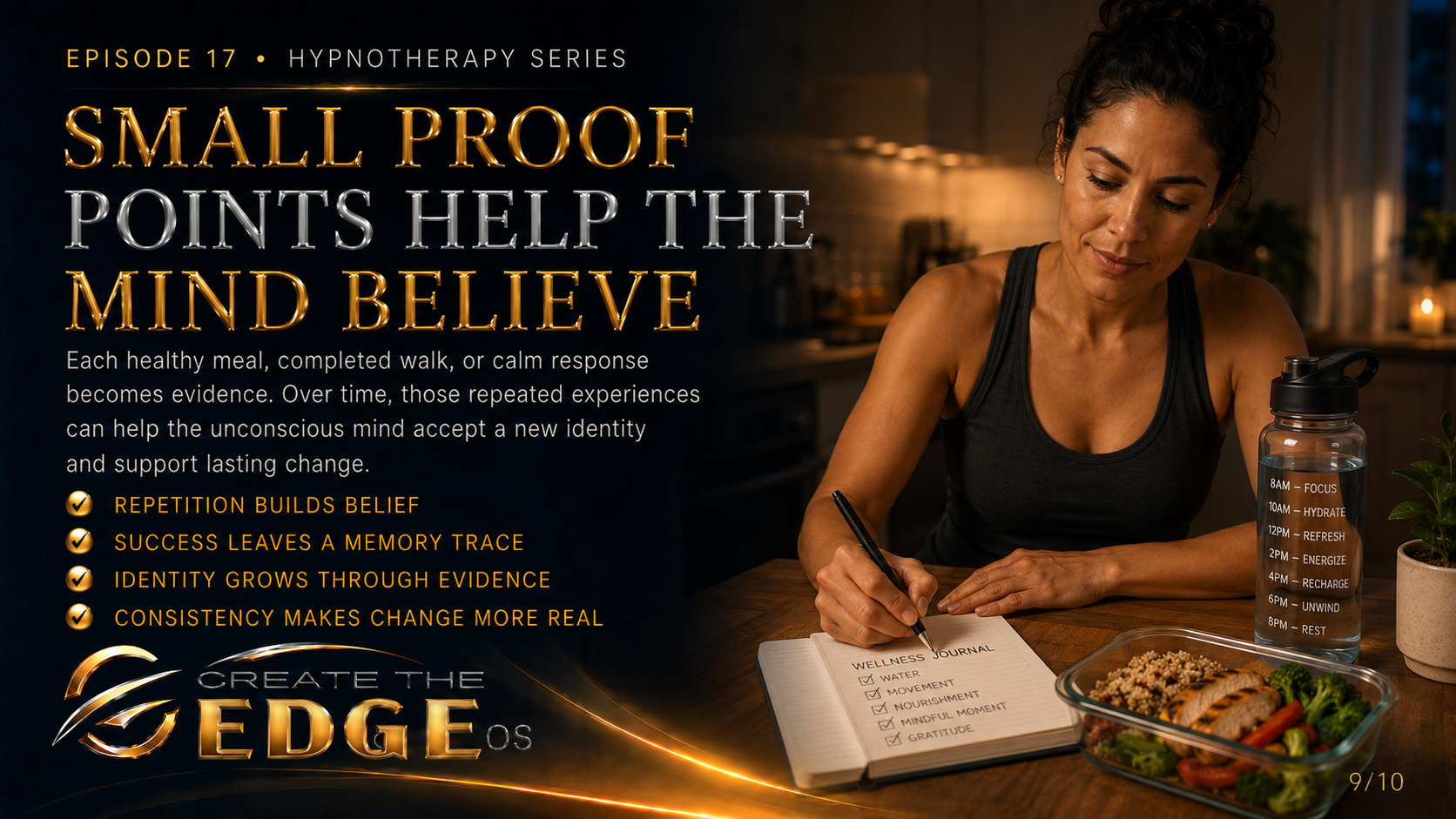
Episode 17 · Slide 9Episode 17 · Slide 9 · small proof points help the mind believe
Episode 17 · Slide 9
SMALL PROOF POINTS HELP THE MIND BELIEVE
Each healthy meal, completed walk, or calm response becomes evidence. Not just of discipline, but of identity. Over time, those accumulated experiences help the unconscious mind accept a new story about who you are.
The mind believes what it sees repeated. When you act in alignment with the person you are becoming, even once, even briefly, you are writing new code. You are showing your deeper self that the new direction is real.
This is why small steps matter so much. Not because big leaps are wrong, but because consistent small ones are what eventually make the unconscious shift durable.
Reflect
1. What is one small action you took this week that reflects the person you want to become?
2. How do you usually talk to yourself after a good choice? Does your inner voice acknowledge it?
3. What would it look like to celebrate small wins in a way that actually lands for you?
4. What evidence can you point to right now that change is already happening inside you?
5. How would it feel to trust the process, to believe that small, repeated actions are genuinely enough?
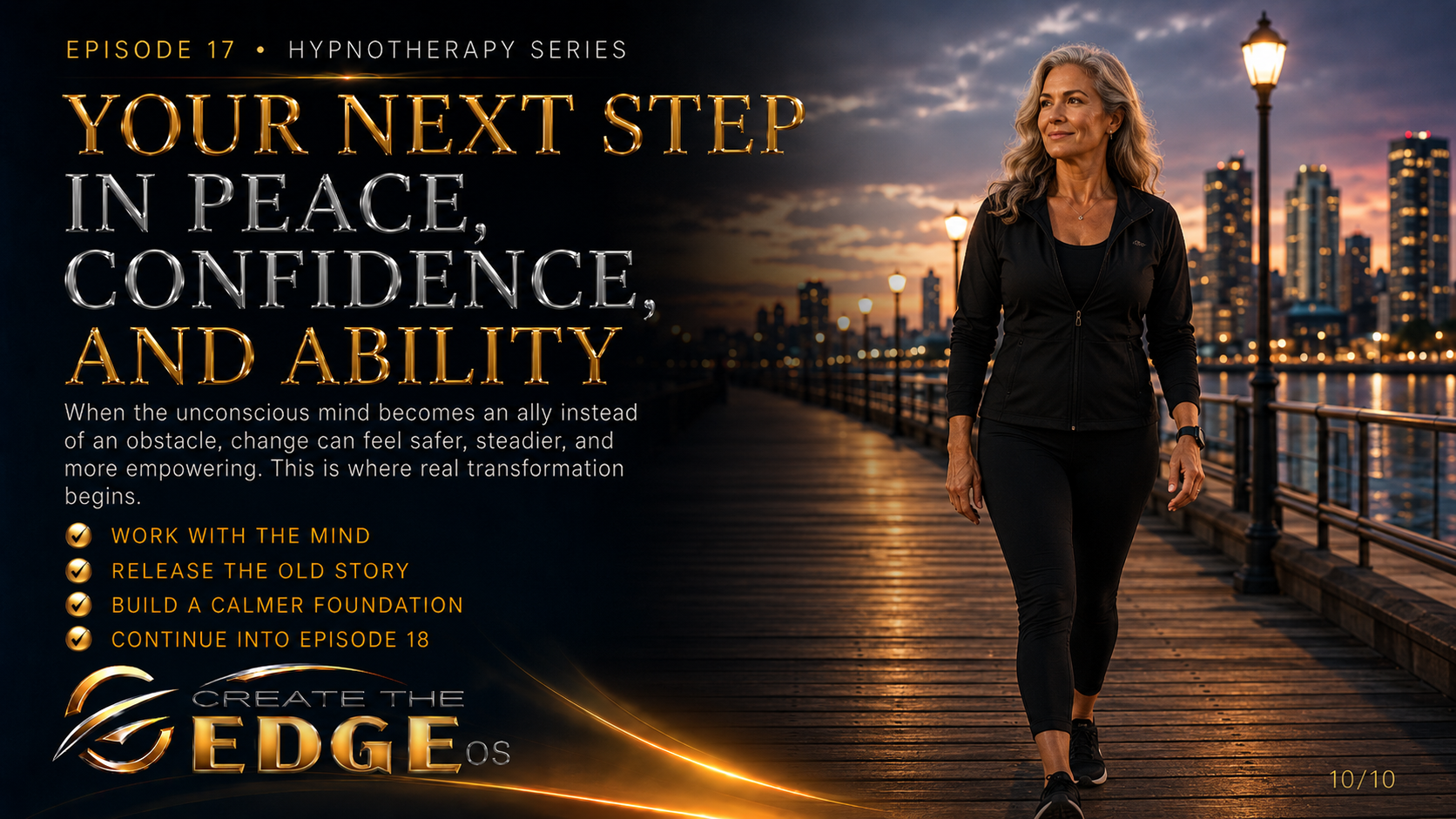
Episode 17 · Slide 10Episode 17 · Slide 10 · your next step in peace, confidence, and ability
Episode 17 · Slide 10
YOUR NEXT STEP IN PEACE, CONFIDENCE, AND ABILITY
When the unconscious mind becomes an ally instead of an obstacle, change can feel safer, steadier, and more empowering. The work you have begun here does not end when this episode does.
Peace is not a destination. Confidence is not a reward. Ability is not a gift given to certain people and withheld from others. They are built, slowly, through the kind of honest inner work you have been doing right now.
Episode 18 continues this journey, exploring how the unconscious mind can be actively retrained and what that process looks and feels like as it unfolds.
Reflect
1. What has shifted in you, even slightly, from the beginning of this episode to now?
2. What is the one insight from this episode you most want to carry forward?
3. What would you commit to practicing or exploring before you begin Episode 18?
4. Who in your life, if anyone, would benefit from knowing what you have learned here?
5. What does your next step look like? Not the whole journey, just the very next step.