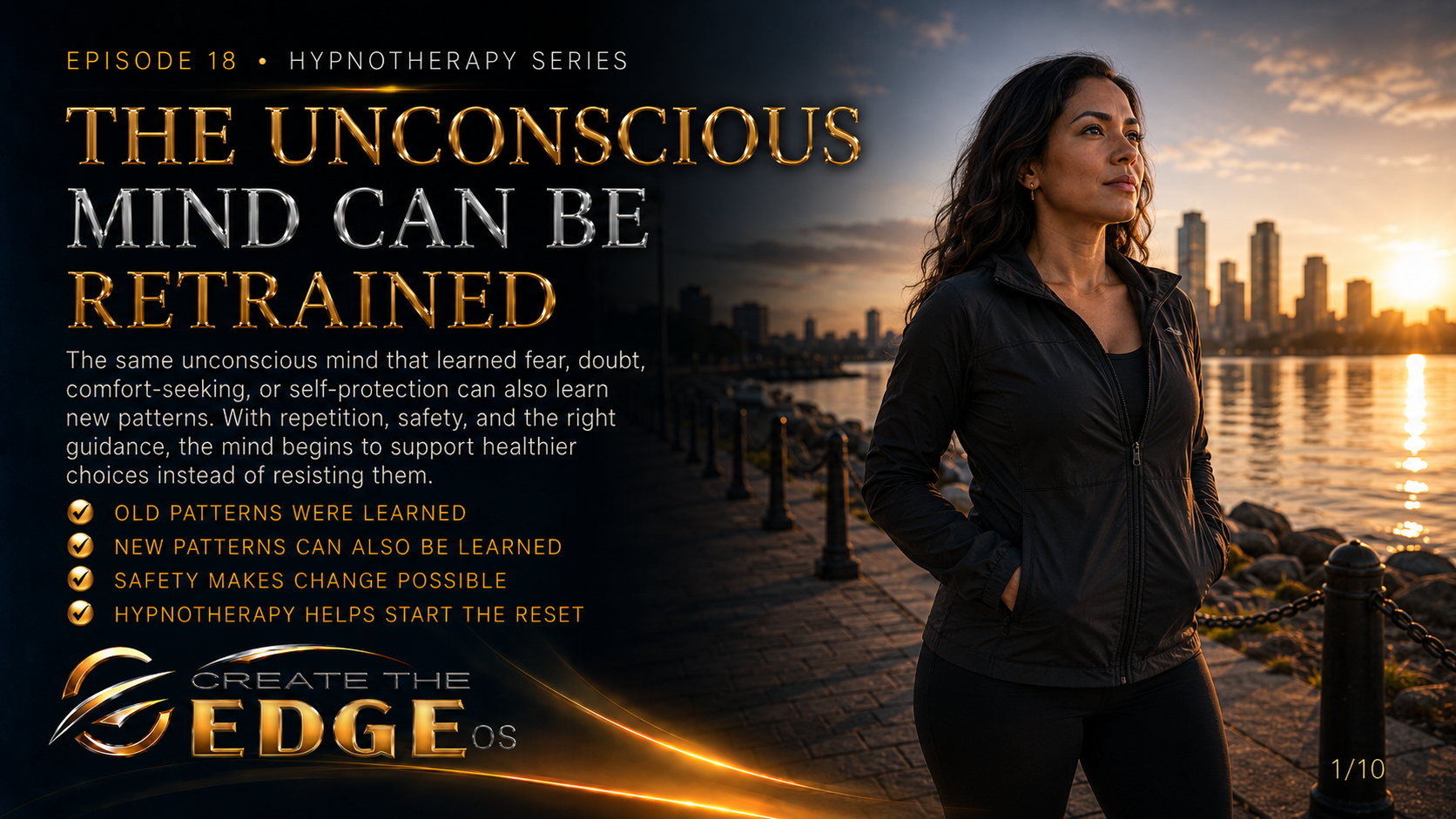
Episode 18 · Slide 1Episode 18 · Slide 1 · the unconscious mind can be retrained
Episode 18 · Slide 1
THE UNCONSCIOUS MIND CAN BE RETRAINED
The patterns you carry were not born with you. They were learned. And because they were learned, they can be unlearned. The unconscious mind is far more flexible than most of us were ever taught.
This is not wishful thinking. Neuroscience supports what hypnotherapy practitioners have long observed: the brain retains plasticity throughout life. New pathways can form. Old ones can weaken when they are no longer reinforced.
With repetition, safety, and the right guidance, the mind begins to support healthier choices instead of resisting them. That shift is what this episode is about.
Reflect
1. What old pattern would you most like to see retrained in your life?
2. Do you believe your mind is capable of genuine change? What makes you say yes or gives you pause?
3. Think of something you changed once that you did not think you could. How did that happen?
4. What would it feel like to approach this work with curiosity rather than pressure?
5. If retraining were truly possible for you, what would be the first thing you would change?
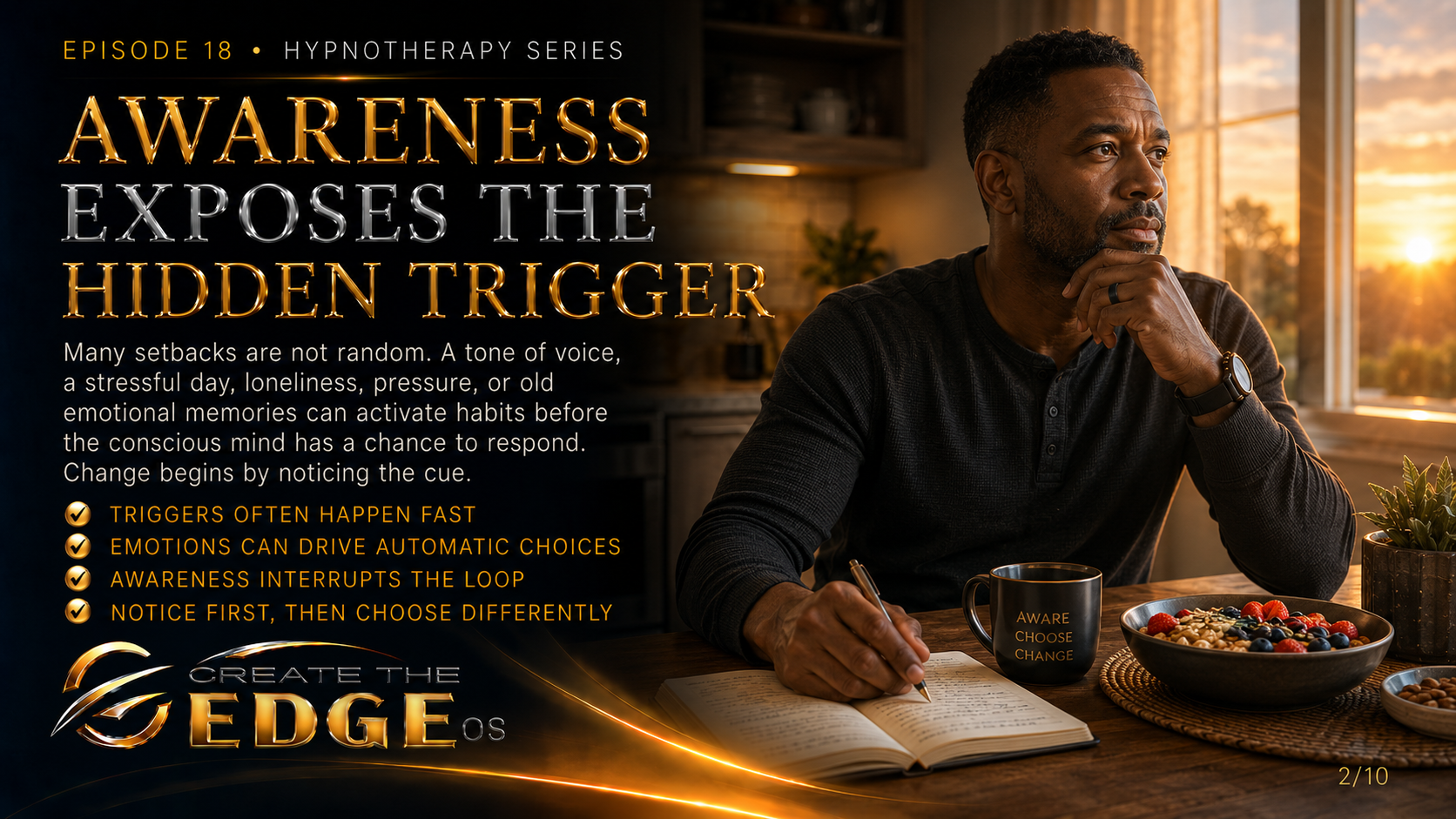
Episode 18 · Slide 2Episode 18 · Slide 2 · awareness exposes the hidden trigger
Episode 18 · Slide 2
AWARENESS EXPOSES THE HIDDEN TRIGGER
Many setbacks are not random. A tone of voice, a stressful day, loneliness, pressure, or an old emotional memory can activate a habit before the conscious mind has a chance to intervene. The unconscious responds faster than thought.
The first step in changing any pattern is noticing it. Not judging it, not immediately trying to stop it, but simply seeing it clearly. What triggered this? What did I feel just before I reached for this habit?
That moment of noticing, even a half-second pause between trigger and response, is where everything begins. You cannot change what you cannot see.
Reflect
1. What tends to trigger your most challenging habits? Is it stress, boredom, loneliness, conflict?
2. Is there a specific time of day when your old patterns feel most powerful? What is usually happening then?
3. What does it feel like in your body just before you make a choice you later regret?
4. Have you ever caught yourself mid-pattern and paused? What happened in that moment?
5. What would you need to notice differently to start changing your most automatic responses?
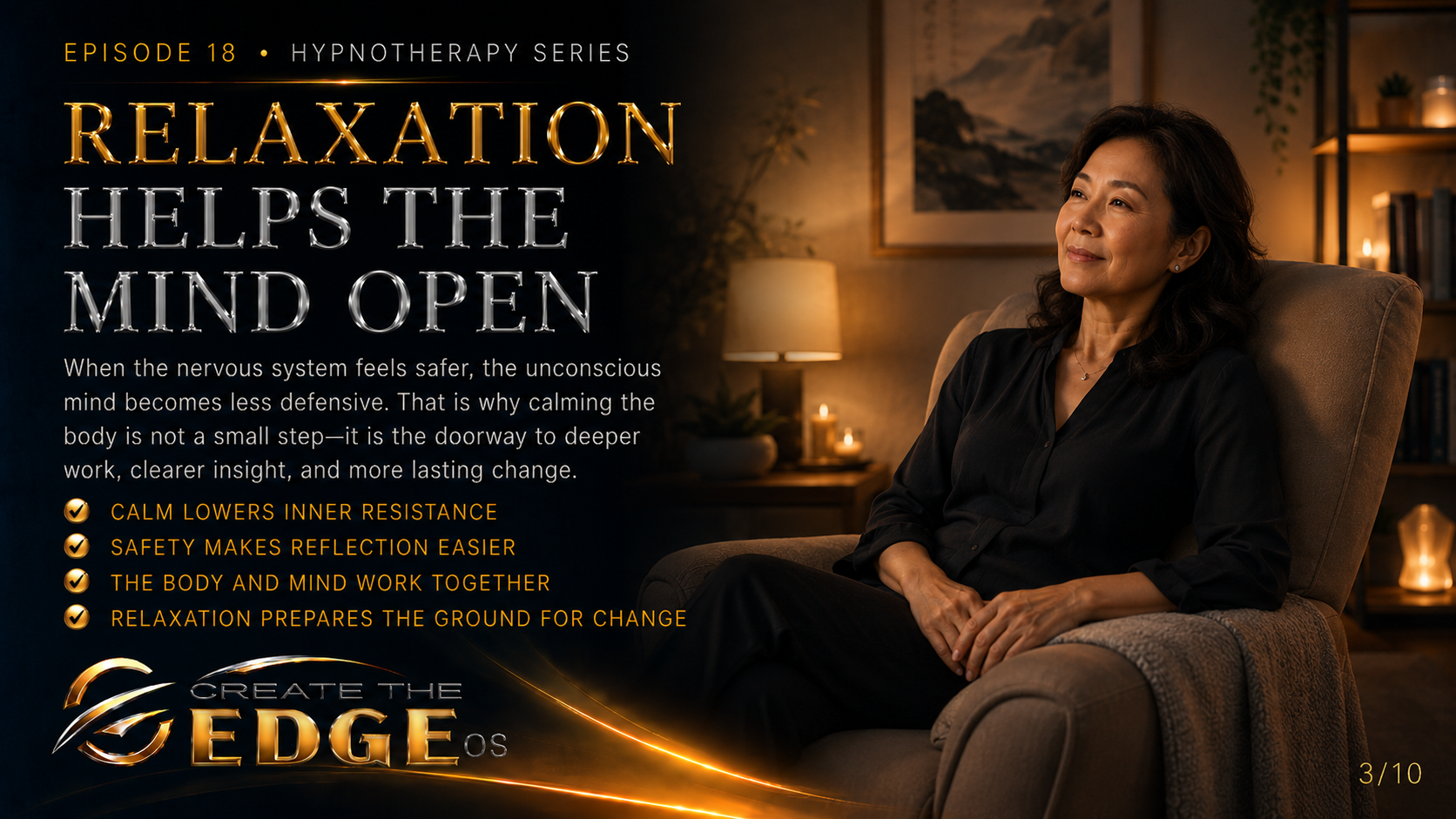
Episode 18 · Slide 3Episode 18 · Slide 3 · relaxation helps the mind open
Episode 18 · Slide 3
RELAXATION HELPS THE MIND OPEN
When the nervous system feels safer, the unconscious mind becomes less defensive. In a relaxed state, we are more open to insight, to new possibility, and to the kind of deep inner work that actually produces lasting change.
This is why calming the body is not optional in this process. It is the doorway. Breathwork, guided relaxation, meditation, and hypnotherapy all work, in part, because they bring the nervous system out of protection mode.
When you are relaxed, you can see yourself more clearly. Old patterns become less threatening to examine. And new directions become genuinely imaginable.
Reflect
1. What brings your nervous system into a relaxed state most reliably? What works for you?
2. Is there a part of this inner work that feels activating or uncomfortable? Where does that show up in your body?
3. How do you feel right now, in this moment, compared to when you began this episode?
4. What would a daily five-minute relaxation practice change for you over the course of a month?
5. How might making relaxation a priority, rather than a reward, change your relationship to change?
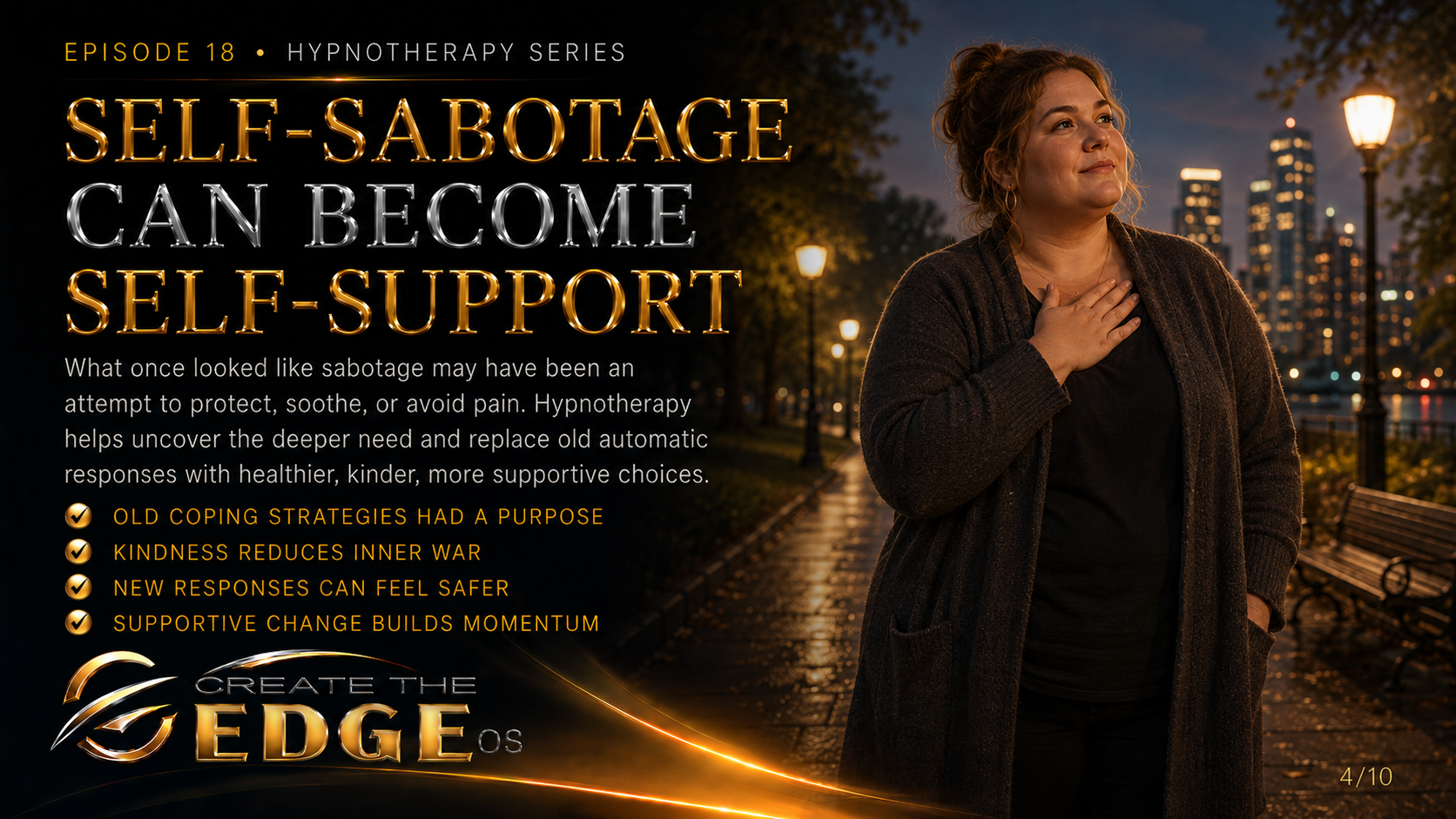
Episode 18 · Slide 4Episode 18 · Slide 4 · self-sabotage can become self-support
Episode 18 · Slide 4
SELF-SABOTAGE CAN BECOME SELF-SUPPORT
What we call self-sabotage almost always had a purpose. It was once a solution. The eating that soothed anxiety. The withdrawal that protected from rejection. The giving up that prevented the pain of failing again.
Hypnotherapy helps uncover the deeper need behind the pattern and ask: what is this really serving? And once that is visible, we can find a healthier way to meet that same need.
Kindness is the key. Not the kind of softness that accepts mediocrity, but the kind that refuses to keep punishing yourself for what was once a survival strategy. From there, self-support can begin to replace self-destruction.
Reflect
1. Is there a pattern in your life that, when you trace it back, was once protecting you from something painful?
2. What need might your most challenging habit be trying to meet? Safety, comfort, control, connection?
3. How do you typically respond to yourself when you fall back into an old pattern? What does that inner voice say?
4. What would it feel like to thank an old coping strategy for its service and then gently release it?
5. What healthier way might you begin to meet the need that the old pattern was serving?
Episode 18 · Slide 5Episode 18 · Slide 5 · new suggestions help build new beliefs
Episode 18 · Slide 5
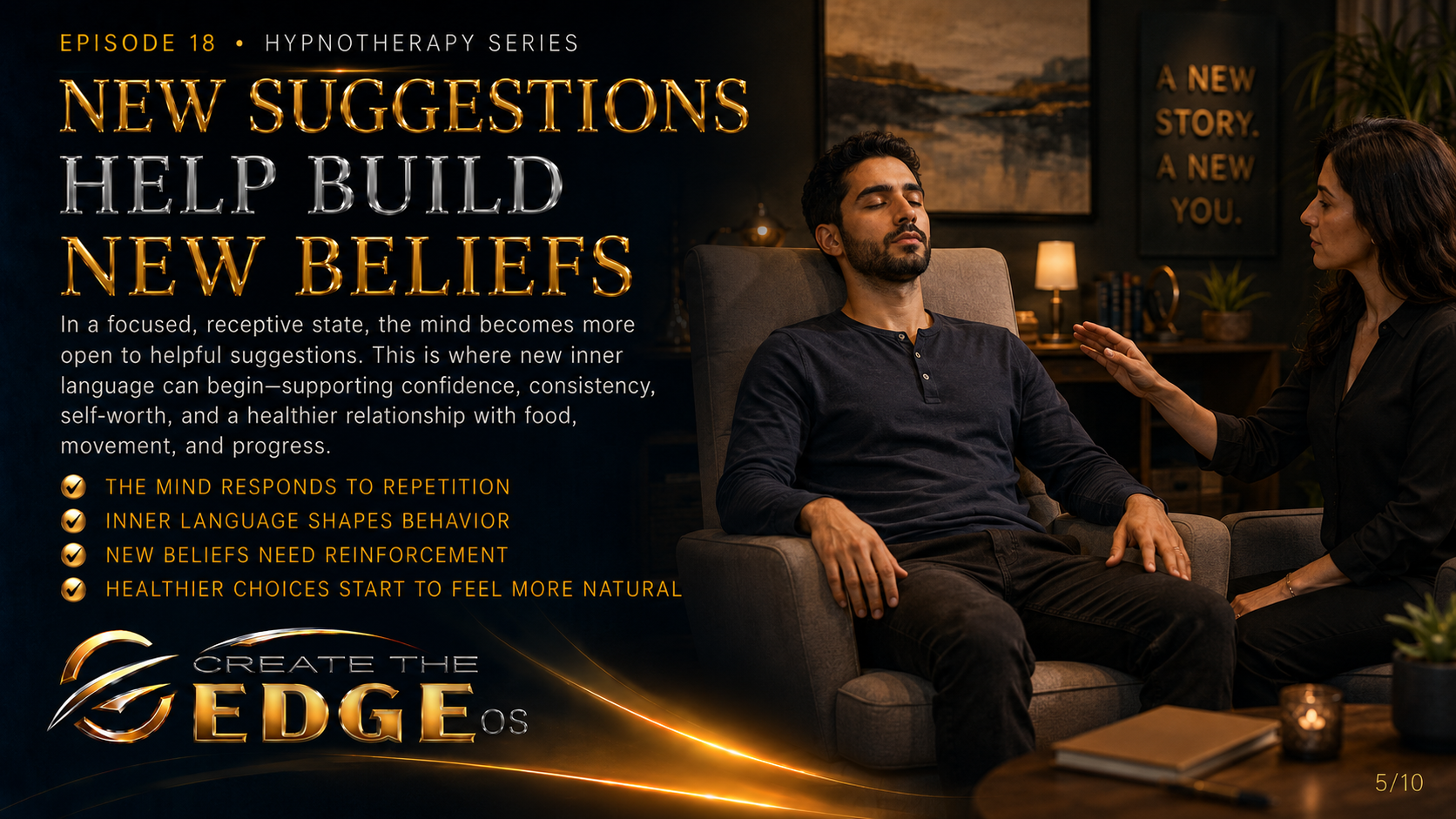
NEW SUGGESTIONS HELP BUILD NEW BELIEFS
In a focused, receptive state, the mind becomes more open to helpful suggestions. This is the moment when new inner language can take root: I am someone who takes care of myself. I deserve to feel well. I can follow through.
These are not affirmations to chant at the mirror. They are beliefs being introduced at a deeper level, where the old contradictory messages were stored. Over time, with repetition, they begin to feel true rather than aspirational.
The goal is not to override reality with positivity. It is to replace a distorted inner narrative with one that is more accurate, more compassionate, and more aligned with who you are choosing to become.
Reflect
1. What is one belief about yourself that, if you truly held it at the unconscious level, would change everything?
2. What inner voice do you most want to quiet? And what would you replace it with?
3. Do you find it easier to believe negative things about yourself than positive ones? Why do you think that is?
4. What would it mean to let a genuinely supportive inner voice become the loudest one?
5. What new belief, if truly installed in your deeper mind, would most change your daily choices?
Episode 18 · Slide 6Episode 18 · Slide 6 · change grows between sessions too
Episode 18 · Slide 6
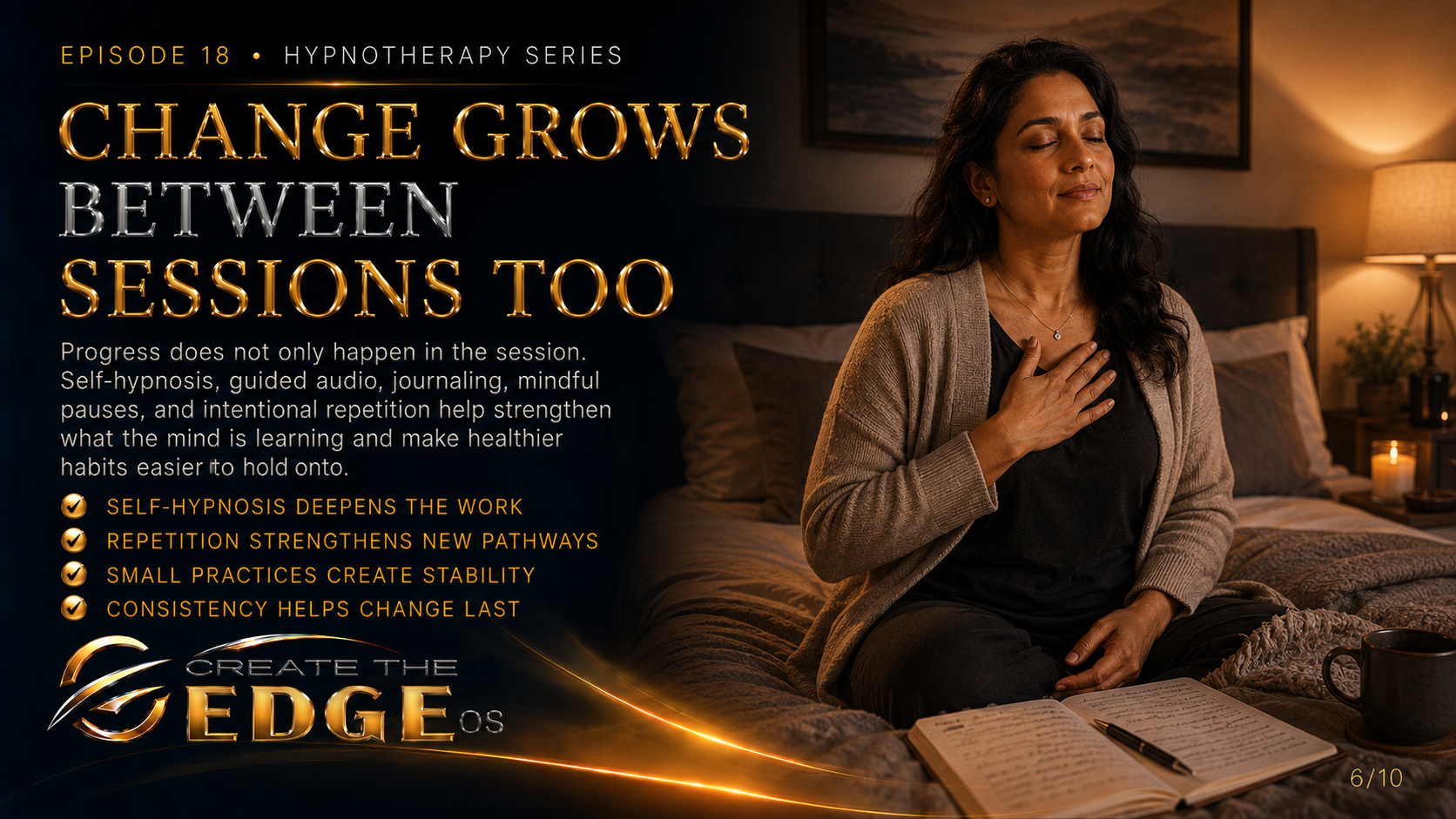
CHANGE GROWS BETWEEN SESSIONS TOO
The work does not only happen in a session. It happens in the quiet moment before you reach for something you do not want. In the breath you take before you respond. In the choice to keep a commitment you made to yourself.
Self-hypnosis, guided audio, journaling, and intentional repetition all help strengthen what the mind is learning. Each practice between sessions reinforces the new pathway and makes it more automatic over time.
Consistency, not intensity, is what builds lasting change. Small, steady practice repeated over time creates something no single breakthrough session can: a new normal.
Reflect
1. What daily practice feels most natural and sustainable for you right now?
2. How do you currently care for your inner world between formal sessions or episodes?
3. Is there a time of day when you feel most open and reflective? How might you use that time?
4. What one practice could you commit to every day this week, even for just five minutes?
5. How does it feel to consider that small, daily effort is actually more powerful than occasional large efforts?

Episode 18 · Slide 7Episode 18 · Slide 7 · the mind begins to accept a new identity
Episode 18 · Slide 7
THE MIND BEGINS TO ACCEPT A NEW IDENTITY
When change is repeated often enough, the unconscious mind begins to accept a new story about who you are. Not I am trying to be someone who exercises, but I am someone who moves my body. Not I am hoping to eat better, but this is simply how I eat now.
Identity is one of the most powerful forces in human behavior. We act in ways that are consistent with who we believe we are. When the identity shifts, the behavior follows with far less effort.
This is the deepest work of retraining: not just changing what you do, but changing who you understand yourself to be.
Reflect
1. How do you currently identify yourself when it comes to health and self-care?
2. What new identity would you most like your unconscious mind to accept as true?
3. What small, repeated action this week could serve as evidence of that new identity?
4. Think of someone you admire. What identity do they seem to hold about themselves that allows them to live that way?
5. If your body already reflected your new identity, what would be different about how you moved through the world?
Episode 18 · Slide 8Episode 18 · Slide 8 · small proof helps the mind trust change
Episode 18 · Slide 8
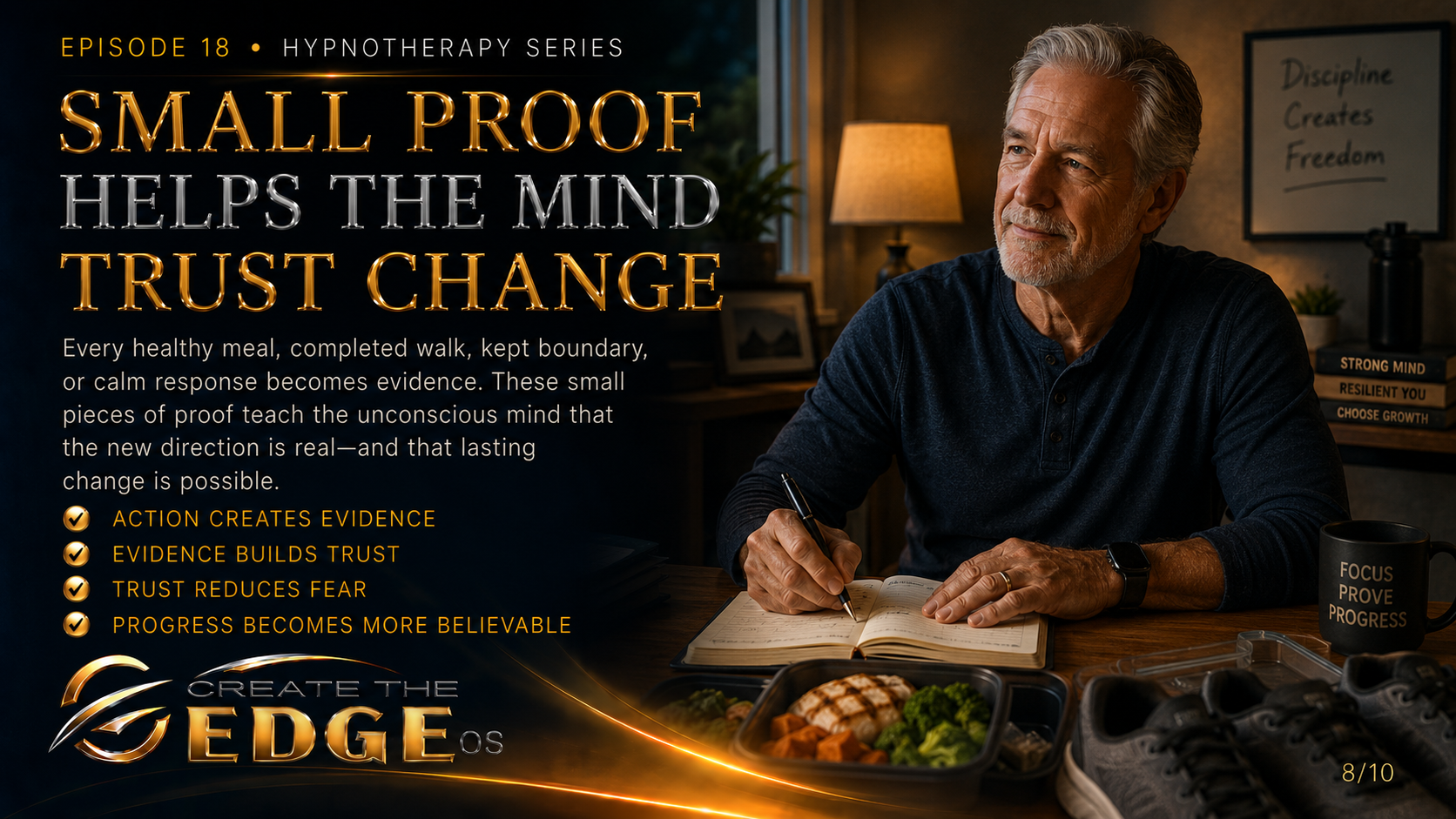
SMALL PROOF HELPS THE MIND TRUST CHANGE
Every healthy meal, completed walk, kept commitment, or calm response is evidence. It teaches the unconscious mind that the new direction is real, that it is possible, and that you are capable of sustaining it.
The mind is watching. Every time you follow through, even imperfectly, you are writing new data. Every time you meet a setback with compassion rather than collapse, you are demonstrating resilience to the part of you that was not sure you had it.
Trust is built through evidence. And you are building it right now, with every honest step.
Reflect
1. What is the smallest proof point you have from your own life that you are capable of change?
2. How do you typically handle a setback? Do you collapse into it or come back?
3. What does showing up for yourself look like on a hard day, when everything in you wants to give up?
4. What would it mean to count your comeback, not just your consistency, as success?
5. What evidence would you need to accumulate before you fully trusted that you could do this?
Episode 18 · Slide 9Episode 18 · Slide 9 · when the mind works with you, change feels lighter
Episode 18 · Slide 9
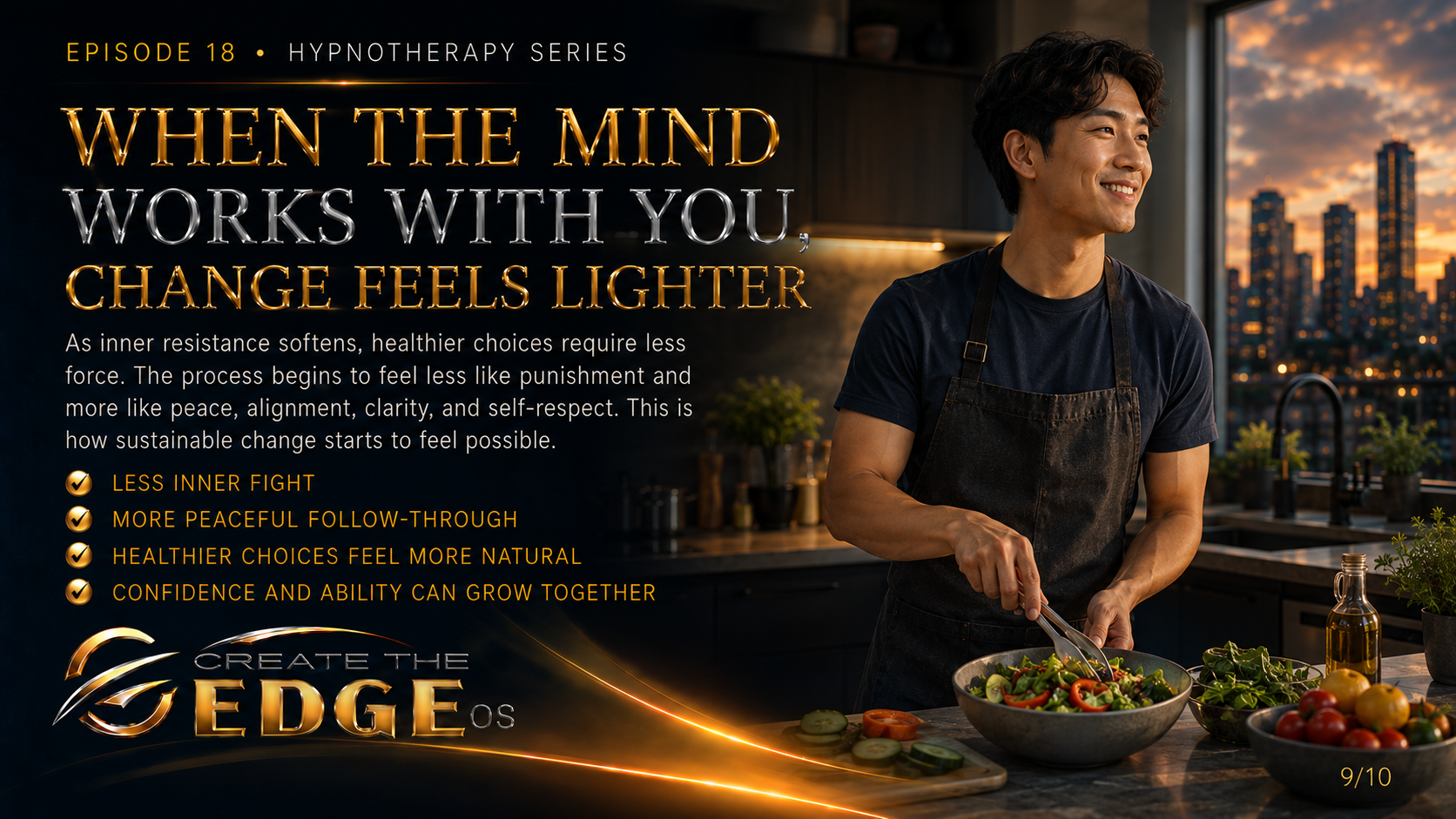
WHEN THE MIND WORKS WITH YOU, CHANGE FEELS LIGHTER
As inner resistance softens, healthier choices require less force. The process begins to feel less like punishment and more like peace. Like alignment. Like respect for yourself that does not need to be earned.
This is what sustainable change actually feels like. Not a grinding battle won through sheer will. A gradual settling into a way of living that feels truer, easier, and more natural than the old patterns ever did.
You do not have to white-knuckle your way to health. You can ease your way into it, one small honest choice at a time.
Reflect
1. Think of an area in your life where healthy choices already feel natural. What made them that way?
2. What would it feel like to have your health choices feel natural rather than forced?
3. Where in your body do you feel the difference between straining toward change and moving with it?
4. What does ease feel like in your daily choices? When have you experienced it?
5. What would you need to let go of, an old belief, an impossible standard, a punishing voice, for change to feel lighter?
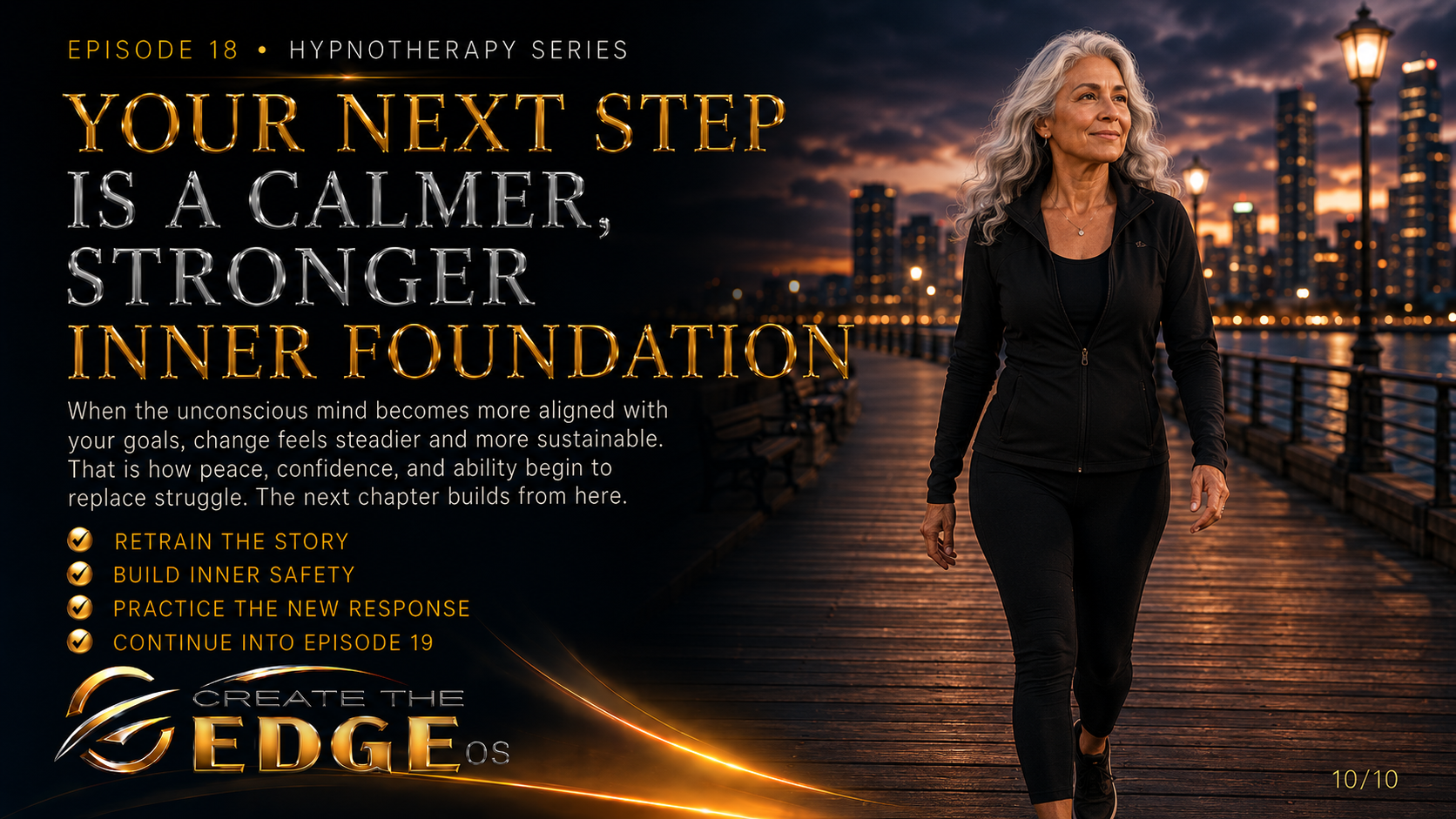
Episode 18 · Slide 10Episode 18 · Slide 10 · your next step is a calmer, stronger inner foundation
Episode 18 · Slide 10
YOUR NEXT STEP IS A CALMER, STRONGER INNER FOUNDATION
When the unconscious mind becomes more aligned with your goals, change feels steadier and more sustainable. The episodes ahead will continue building on what you have started here.
A calmer foundation. A stronger inner voice. A clearer sense of who you are and what you are building. These are not the byproducts of transformation. They are the very things that make it possible.
Episode 19 continues the journey, turning toward the outer world, exploring how the way we dress and present ourselves can either support or undermine everything we are building inside.
Reflect
1. What is the most important shift in your thinking that this episode has offered you?
2. What do you feel in your body right now that you did not feel when you began?
3. What would you commit to practicing before you move on to the next episode?
4. Who in your life might benefit from understanding the ideas in this episode?
5. What does your calmer, stronger inner foundation feel like, even in its early form, right now?