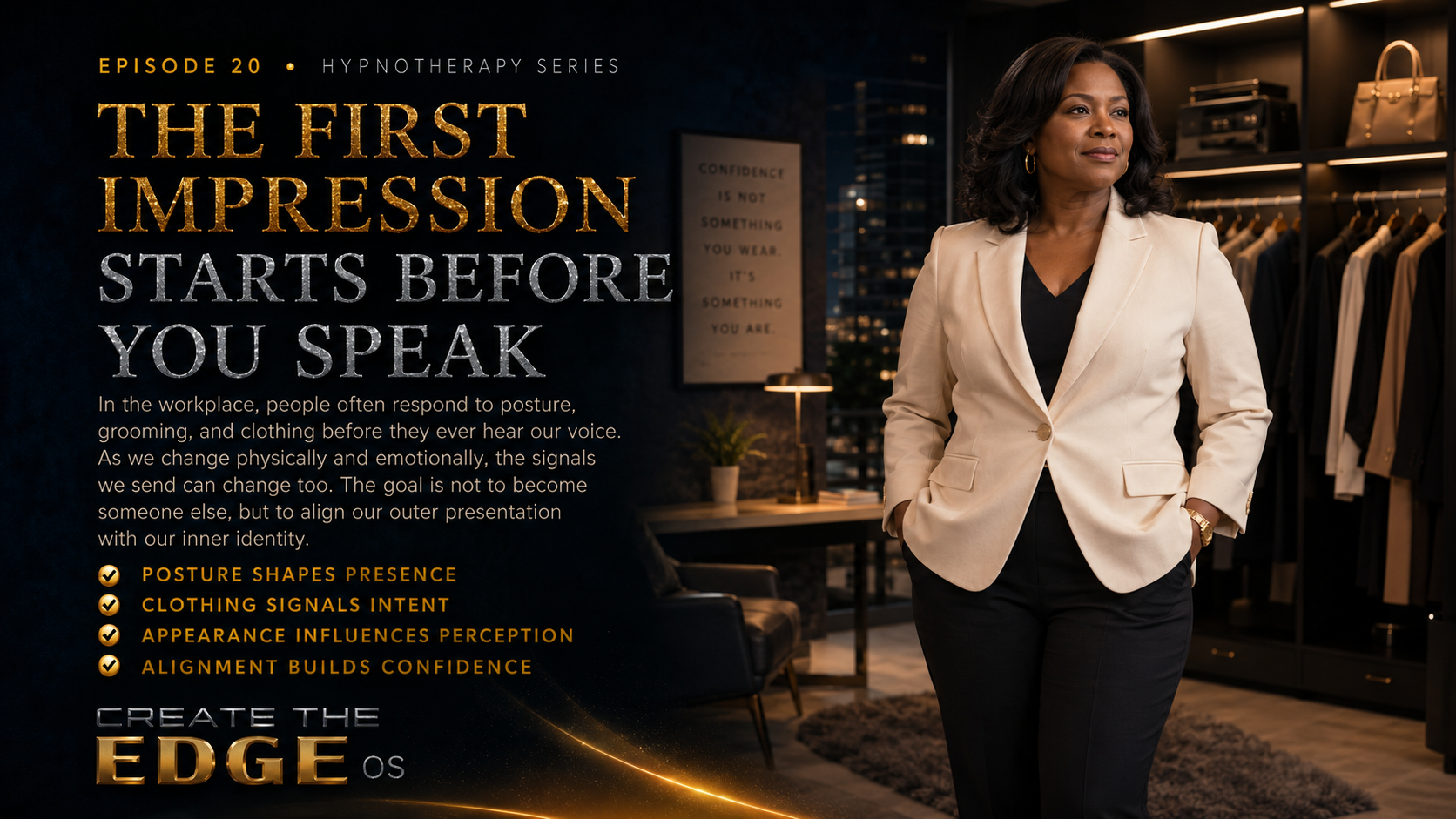
Episode 20 · Slide 1Episode 20 · Slide 1 · the first impression starts before you speak
Episode 20 · Slide 1
THE FIRST IMPRESSION STARTS BEFORE YOU SPEAK
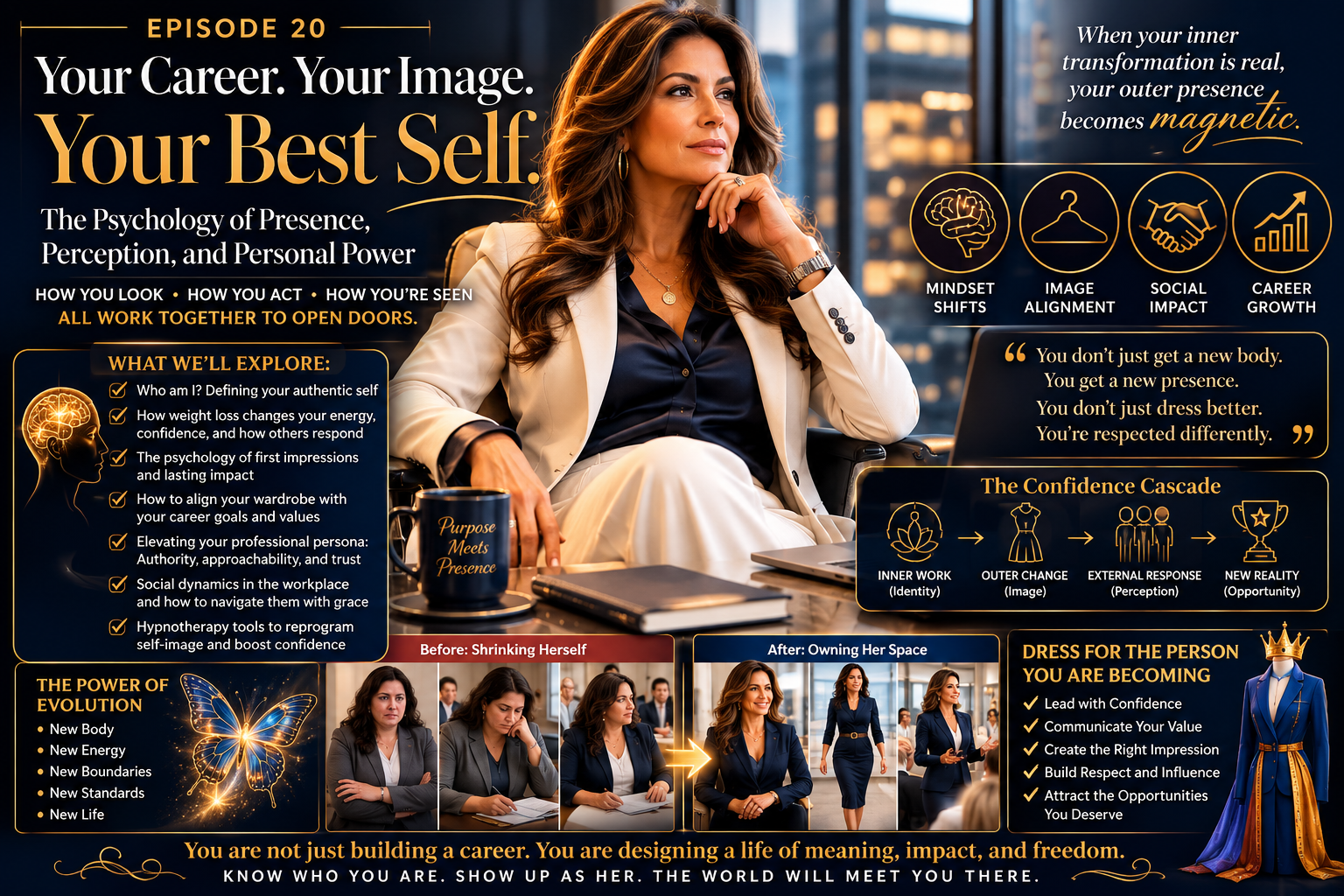
In professional settings, people respond to posture, grooming, and clothing before a single word is exchanged. As we change physically and emotionally, the signals we send into a room change too.
The goal is not to become someone else. It is to align your outer presentation with the inner identity you are building. When those two things match, there is a quality of ease that people around you can sense even if they cannot name it.
This episode explores that alignment, and what becomes possible when you choose to show up, consciously and fully, as the professional you are becoming.
Reflect
1. What impression do you believe you currently make in professional settings? What would you most like to change?
2. Think of a time when your outer appearance felt out of sync with how capable you actually are. What did that cost you?
3. What is one professional setting where you would like to show up differently?
4. What does confidence look and feel like in your body when you are at your best?
5. What would it mean to treat your professional image as a deliberate choice rather than an afterthought?
Episode 20 · Slide 2Episode 20 · Slide 2 · who are you teaching the room to see?
Episode 20 · Slide 2
WHO ARE YOU TEACHING THE ROOM TO SEE?
The way we dress, move, and carry ourselves becomes part of our nonverbal story. Before we have said anything substantive, we have already communicated something about authority, warmth, creativity, or uncertainty.
Understanding the persona you project is not about performance. It is about intentionality. When you know what you want to communicate, you can make choices that support that communication rather than contradict it.
Style shapes expectation. Consistency builds trust. And when your identity is clear to you, it becomes more legible to everyone around you.
Reflect
1. What three words do you hope people use to describe you professionally? Do your current choices support that?
2. Is there a gap between how you see yourself professionally and how you fear others see you?
3. What would it feel like to walk into your next meeting knowing exactly the impression you intend to make?
4. How might more intentional professional dressing change how you show up internally, before anyone else even notices?
5. What persona do you most want to project, and what would you need to change to align with it?
Episode 20 · Slide 3Episode 20 · Slide 3 · when your body changes, social responses change too
Episode 20 · Slide 3
WHEN YOUR BODY CHANGES, SOCIAL RESPONSES CHANGE TOO
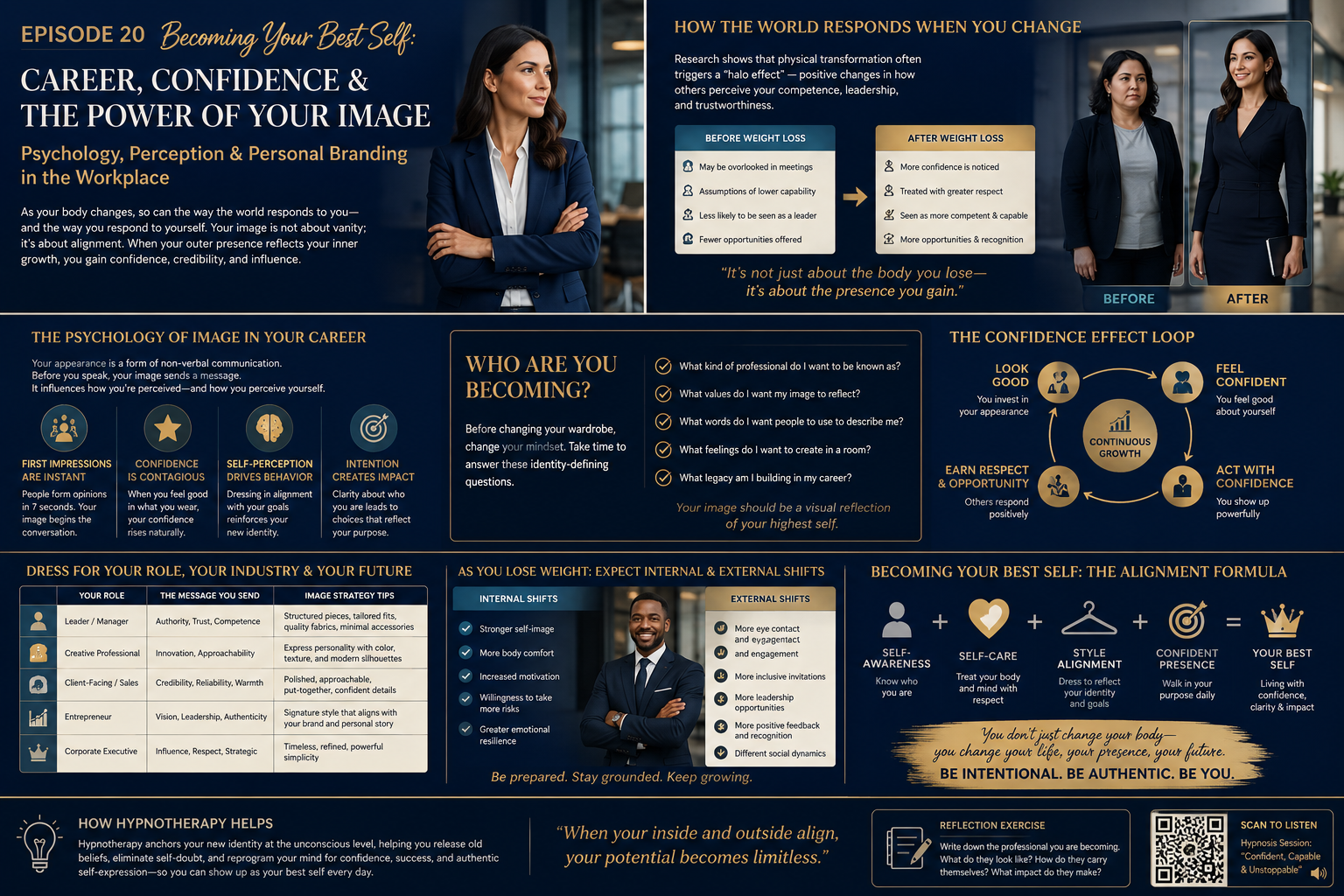
Physical transformation often changes the way others respond. People may offer more attention, more inclusion, or different assumptions. This can feel validating but also confusing, even unsettling.
When the world starts treating you differently because of how you look, it can be disorienting, particularly if you have not changed how you feel inside. Old insecurities can surface. Old questions about worth and belonging can re-emerge.
Hypnotherapy helps you stay grounded in your own sense of self through these external shifts, so that your confidence comes from inside rather than depending on the responses you receive from others.
Reflect
1. Have you experienced a time when your appearance changed and others treated you differently? How did that feel?
2. What might change in your professional relationships if your confidence and presence increased?
3. What insecurities do you carry into professional spaces that you would most like to release?
4. How do you currently protect your sense of worth from being too dependent on others' approval?
5. What does it mean to you to be seen accurately, for who you actually are, rather than for how you look?

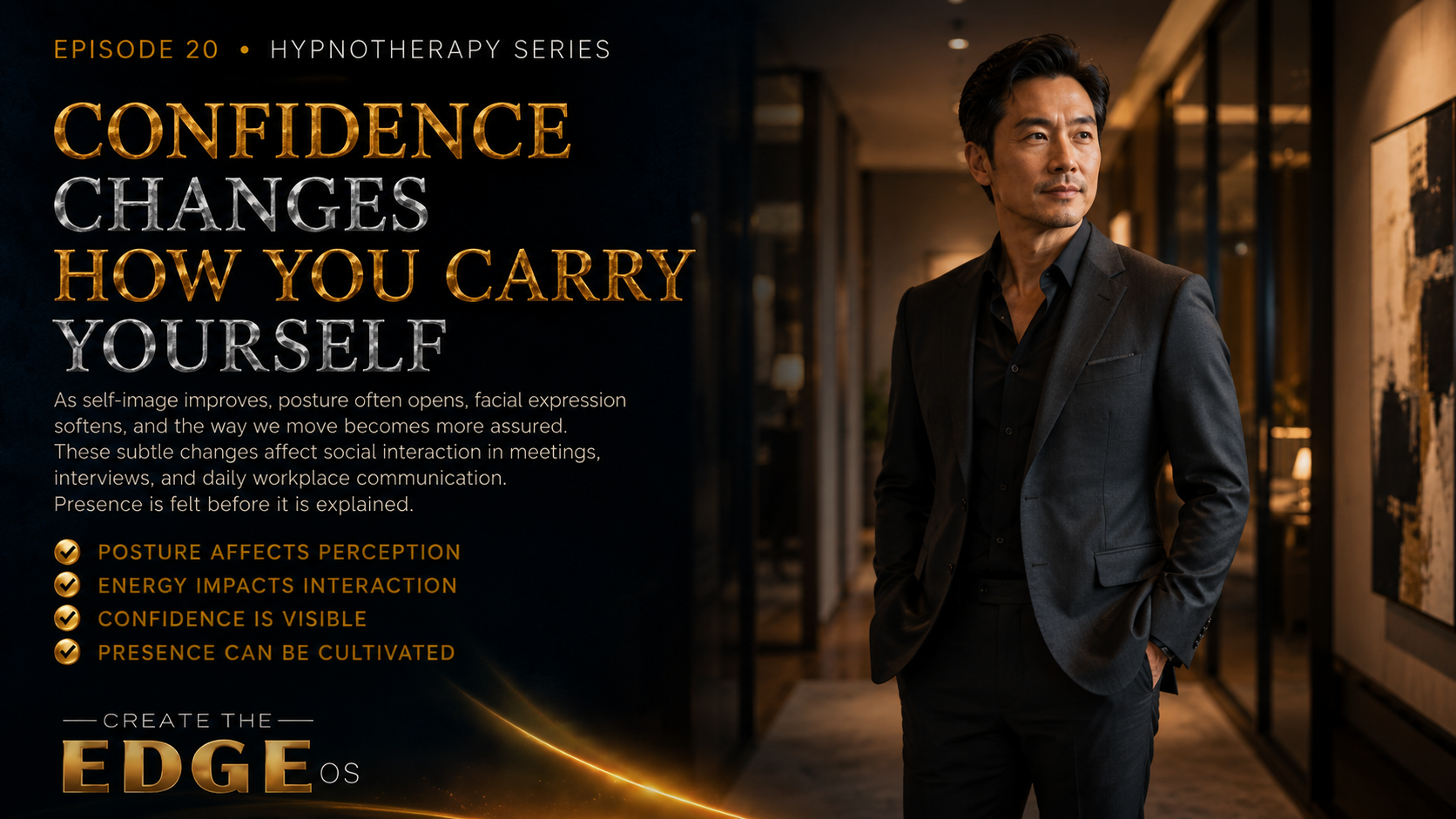
Episode 20 · Slide 4Episode 20 · Slide 4 · confidence changes how you carry yourself
Episode 20 · Slide 4
CONFIDENCE CHANGES HOW YOU CARRY YOURSELF
As self-image improves, posture often opens. Facial expression softens. The way we move becomes more assured. These changes affect social interaction in meetings, interviews, and daily workplace communication in ways that are subtle but cumulative.
Presence is felt before it is explained. When you carry yourself with genuine confidence, the room responds. Not because of how you look but because of the energy you bring: settled, clear, and unhurried.
This is the confidence that hypnotherapy supports: not the performance of confidence, but the real thing, rooted in a stable inner sense of worth that does not require external validation to stand.
Reflect
1. How does your body posture change when you feel confident versus when you feel insecure?
2. What professional situation would you handle very differently if you felt completely grounded?
3. What does genuine, unperformative confidence feel like in your body when you have it?
4. Who in your professional life models the kind of presence you aspire to? What do you notice about them?
5. What would change in your career if you consistently showed up with that kind of grounded presence?

Episode 20 · Slide 5Episode 20 · Slide 5 · your wardrobe can support your identity
Episode 20 · Slide 5
YOUR WARDROBE CAN SUPPORT YOUR IDENTITY
Clothing is not just decoration. It can reinforce self-respect, emotional readiness, and role clarity. Dressing with intention creates congruence between who you are becoming and how you show up at work.
When the outer presentation matches the inner identity, there is far less cognitive and emotional energy spent on second-guessing, adjusting, or compensating. You can simply be present for the work.
Outer order often supports inner order. A wardrobe that reflects your values, your ambition, and your professionalism quietly reinforces your commitment to showing up as the person you intend to be.
Reflect
1. Does your current work wardrobe reflect the professional you want to be seen as? What is missing?
2. What would it feel like to open your closet every morning and feel genuinely ready for the day?
3. How much mental and emotional energy do you currently spend on how you look at work?
4. What would a deliberate investment in your professional wardrobe communicate to yourself, not just to others?
5. What one change to your professional presentation would have the greatest immediate impact?
Episode 20 · Slide 6Episode 20 · Slide 6 · workplace psychology is deeply visual
Episode 20 · Slide 6
WORKPLACE PSYCHOLOGY IS DEEPLY VISUAL
People form rapid judgments about competence, status, confidence, and approachability. These judgments are not always fair, but they are real and they influence outcomes: who gets invited into conversations, who gets offered opportunities, who gets taken seriously.
Understanding visual psychology does not mean playing a game. It means being informed. When you know how these judgments work, you can make conscious decisions about how you present yourself rather than leaving it to chance.
Awareness reduces reactivity. When you understand the environment you are operating in, you can navigate it more skillfully, more calmly, and with a much stronger sense of agency.
Reflect
1. Have you ever been judged quickly in a professional setting based on your appearance? What was the impact?
2. What assumptions do you make about others based on visual cues? How accurate do you think those judgments are?
3. What aspect of professional visual psychology do you find most challenging to navigate?
4. How might understanding visual perception make you a more effective professional?
5. What would it mean to be fully intentional about the first impression you make, every single time?

Episode 20 · Slide 7Episode 20 · Slide 7 · becoming your best self requires self-study
Episode 20 · Slide 7
BECOMING YOUR BEST SELF REQUIRES SELF-STUDY
Before changing the outside, we must understand the inside. What values matter to you? What energy do you want to bring into every room? What kind of professional presence reflects the real you, not the worried you, not the apologetic you, but your actual self at your best?
Real transformation begins with honest personal analysis. Not comparison to others, not adherence to trends, but a genuine reckoning with who you are and who you are choosing to become.
When you know yourself clearly, your choices, in dress, in communication, in how you invest your time, become far more aligned with that truth.
Reflect
1. What are your three most important professional values? Do your daily choices reflect them?
2. Who is your best professional self? What does that person believe about themselves?
3. What stops you from being that person more consistently?
4. What would deeper self-knowledge change about how you navigate your professional life?
5. What is one honest truth about yourself as a professional that you are ready to stop avoiding?

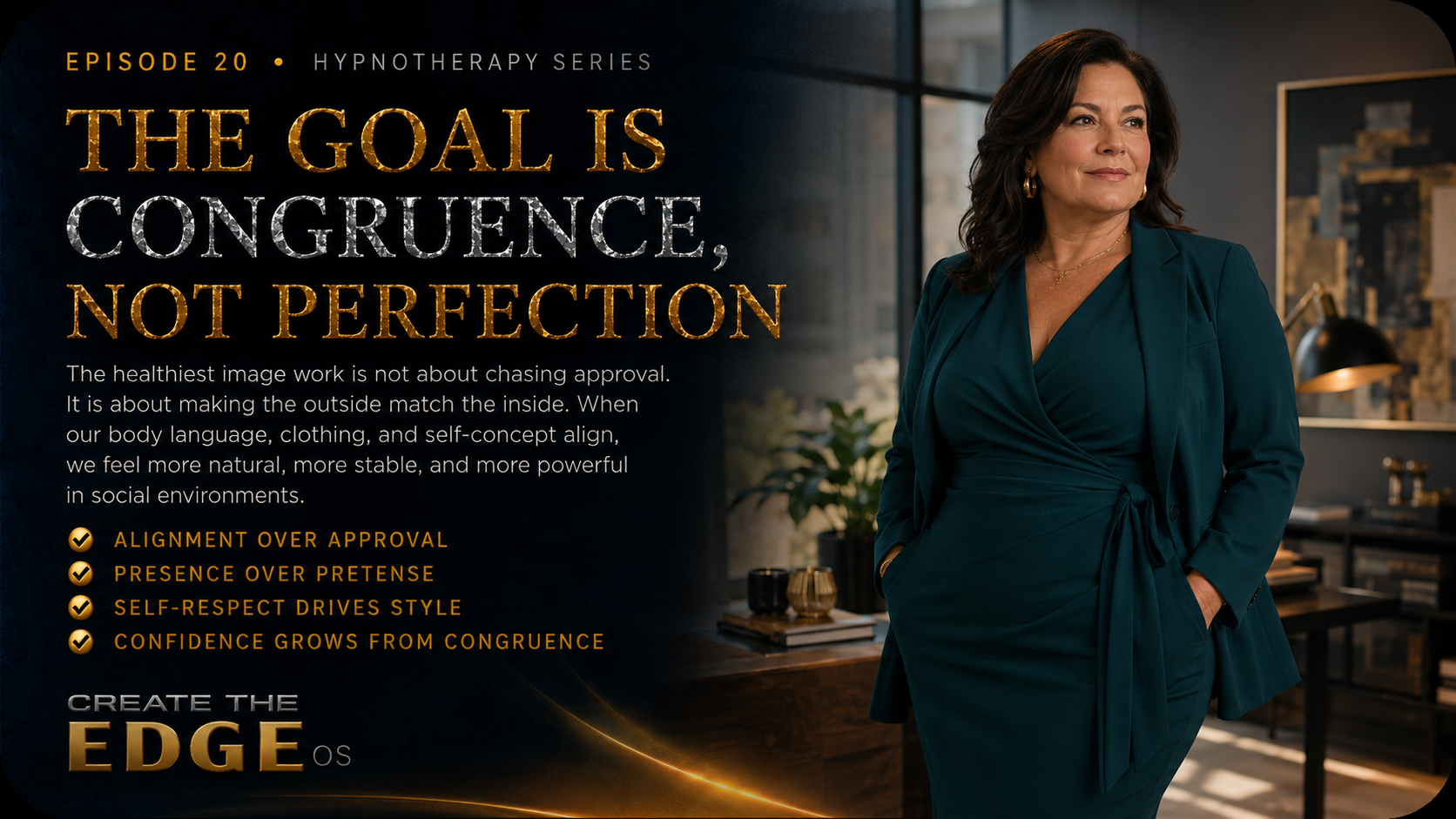
Episode 20 · Slide 8Episode 20 · Slide 8 · the goal is congruence, not perfection
Episode 20 · Slide 8
THE GOAL IS CONGRUENCE, NOT PERFECTION
The healthiest image work is not about chasing approval. It is about making the outside match the inside. When body language, clothing, and self-concept align, we feel more natural, more stable, and more powerful in social and professional environments.
Congruence does not require perfection. It requires honesty. When the way you present yourself genuinely reflects who you are, others can feel that authenticity. And it is far more compelling than any performance of an ideal.
Alignment over approval. Presence over pretense. Self-respect as the foundation from which everything else grows.
Reflect
1. Where do you feel the greatest gap between who you are inside and how you show up professionally?
2. What does alignment feel like for you, that sense that the inside and outside match?
3. What is one area where you are currently performing rather than being? What would it take to close that gap?
4. How might releasing the need for others' approval change how you show up in your career?
5. What would your work feel like if self-respect, rather than fear of judgment, were driving your choices?

Episode 20 · Slide 9Episode 20 · Slide 9 · how others treat us can trigger old beliefs
Episode 20 · Slide 9
HOW OTHERS TREAT US CAN TRIGGER OLD BELIEFS
When attention or approval changes, old insecurities can resurface. We may feel pressure to maintain a look, fear being found out as not enough, or doubt whether the new version of ourselves is real or sustainable.
These moments are not signs that you are failing. They are opportunities. Old beliefs surfacing can be examined, questioned, and released when you have the tools and support to do so.
Hypnotherapy helps uncover and reframe the hidden beliefs that get activated when the world responds to you differently, so that your confidence has a stable internal root rather than depending on an ever-shifting external environment.
Reflect
1. What old insecurity tends to resurface when you receive more attention or recognition than usual?
2. Do you sometimes feel that you are performing a version of yourself that you fear you cannot sustain?
3. What would it mean to trust that the transformation you are experiencing is real and lasting?
4. What inner story would you most like to release about whether you are enough?
5. How might stronger inner confidence change your relationship to both praise and criticism?
Episode 20 · Slide 10Episode 20 · Slide 10 · analyze who you are, then dress from that truth
Episode 20 · Slide 10
ANALYZE WHO YOU ARE, THEN DRESS FROM THAT TRUTH
Personal image becomes most powerful when it grows from identity, values, and purpose. When you understand who you are, you can choose clothing, body language, and professional habits that reflect your best self not just at work but in every area of your life.
This is not about looking the part. It is about being the part, so completely that the look is simply a natural expression of what is already true inside.
You are building something real here: a professional identity that is authentic, sustainable, and genuinely your own. Episode 21 continues this exploration, turning toward the personal style that best expresses who you truly are.
Reflect
1. What is the most honest, complete description you can write of who you are as a professional?
2. What does your best professional self believe, value, and prioritize?
3. How does that person dress? How do they carry themselves? How do they communicate?
4. What is one commitment you will make to your professional presence before the next episode?
5. What would your career look like in one year if you showed up every day as the professional you have just described?