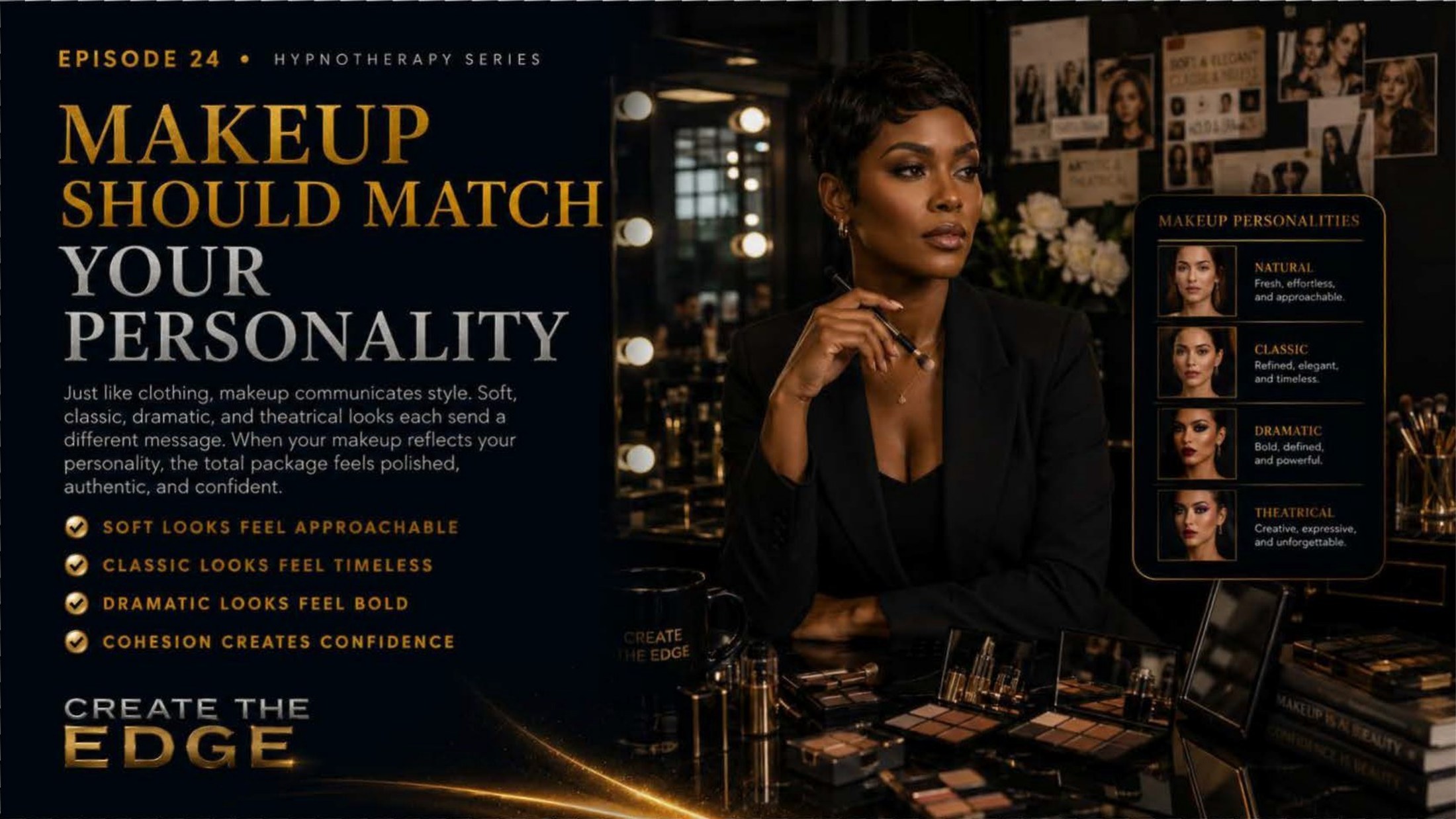
On the slideSoft looks feel approachable · Classic looks feel timeless · Dramatic looks feel bold · Cohesion creates confidence
Episode 24 · Slide 1
Makeup Should Match Your Personality
Look at her — short cropped hair, polished skin, brushes arranged with the precision of someone who has mastered her craft. To the right: four makeup personalities displayed like a menu of possibilities — Natural: fresh, effortless, approachable. Classic: refined, elegant, timeless. Dramatic: bold, defined, powerful. Theatrical: creative, expressive, unforgettable. Same face. Four completely different stories.
Just like clothing, makeup communicates style. Before you open your mouth, before you extend your hand, the makeup you are wearing has already told the room something about who you are. It has signaled your energy, your intention, your level of formality, your relationship with yourself. And when that signal is aligned with your true personality — when the outside is confirming rather than contradicting the inside — the result is unmistakable: a person who looks completely, effortlessly like themselves.
I have spent thirty years behind the chair and behind the counter, and in all of that time one truth has remained constant: the most beautiful face in the room is rarely the one with the most makeup. It is the one where the makeup, the hair, the clothing, and the person's actual energy are all speaking the same language. That coherence is what we register as beauty. That is what makes a face stay with us.
When your makeup reflects your personality, the total package feels polished, authentic, and confident — not because you have achieved some external standard, but because you have stopped working against yourself. The energy that would have been spent managing the gap between who you are and what you look like is freed up. And that freed energy shows up in the room before you say a word.
In this episode we are going to explore four makeup personalities, how to read the technique differences between them, how to build cohesion between your makeup and your wardrobe, and how the inner work of hypnotherapy connects to all of it. Because finding your signature makeup style is not a cosmetic exercise. It is part of becoming who you are choosing to be.
Let us begin with the most important question: which personality lights something up when you look at it?
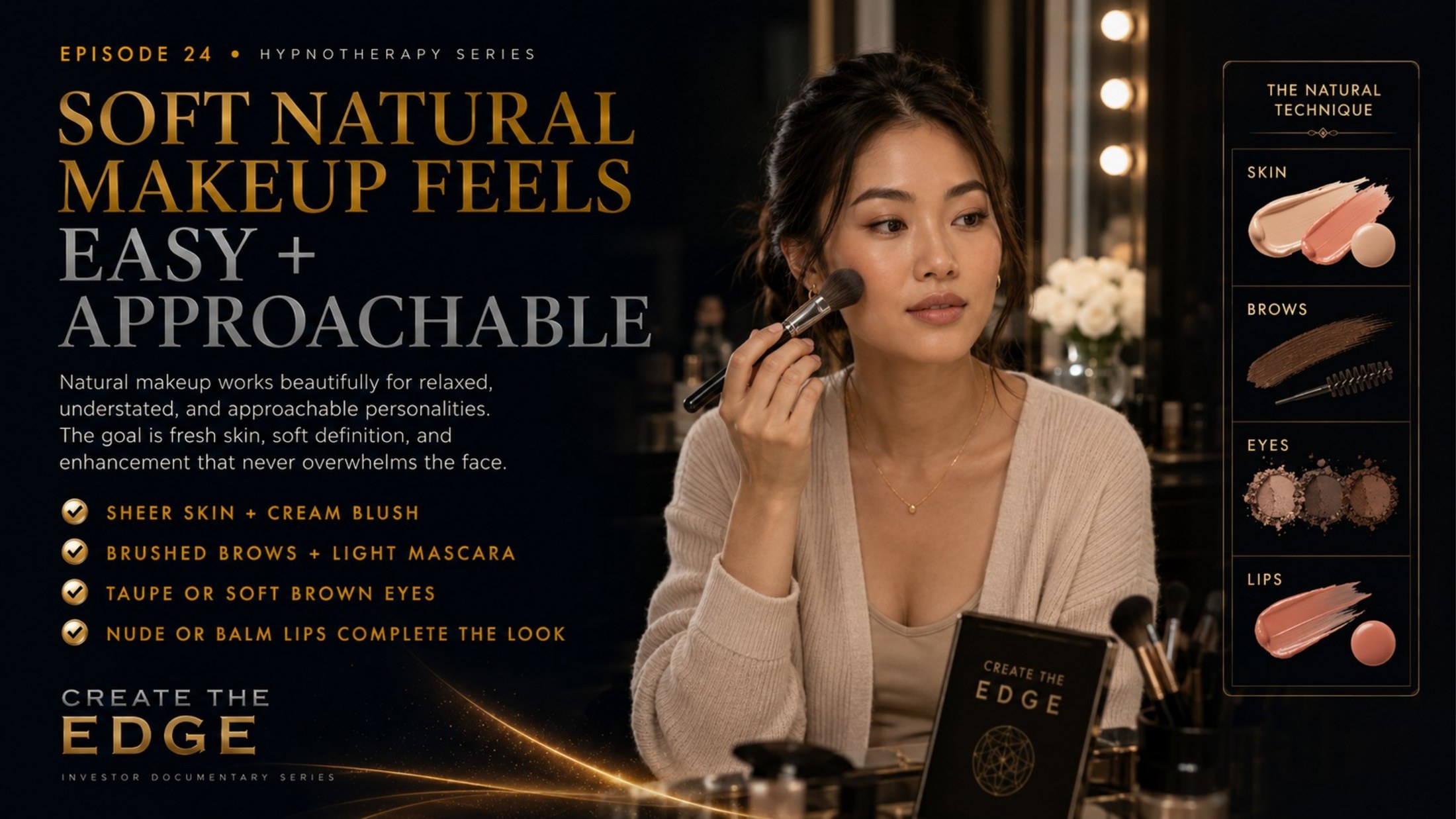
On the slideSheer skin and cream blush · Brushed brows and light mascara · Taupe or soft brown eyes · Nude or balm lips complete the look
Episode 24 · Slide 2
Soft Natural Makeup Feels Easy and Approachable
Look at her — barely-there skin with a flush of warmth at the cheeks, soft lashes, brows brushed and natural, lips just touched with color. To the right: the Natural technique laid out in swatches — sheer skin tint, soft brow product, neutral shadow, blush-toned lip. The message is ease. The message is approachability. The message is *I am not trying to be anything other than what I am.*
Natural makeup works beautifully for relaxed, understated, and approachable personalities. If this is your direction, you already know it — because heavy foundation feels like a mask, bold eye looks feel like a costume, and the mornings when you leave the house with barely anything on feel like the mornings you look most like yourself. You are drawn to skin that looks like skin, color that looks like health rather than application.
The goal of natural makeup is fresh skin, soft definition, and enhancement that never overwhelms the face. The technique centers on sheer coverage that evens the complexion without obscuring it — a tinted moisturizer, a serum foundation, a light cushion — with cream blush applied with fingers or a soft brush so it blends into the skin rather than sitting on top of it. Brows brushed and filled lightly where they need it. Mascara on the top lashes, maybe not even the bottom. A taupe or soft brown on the lid — neutral enough to disappear, present enough to define. And for the lips, a nude or a balm that enhances the natural lip color without replacing it.
What makes natural makeup work is restraint applied with intention. It is not the absence of skill. It requires real technique to make skin look this healthy, this lit-from-within, this present without being decorated. The professional secret is in the skin prep: hydrated, primed skin catches light differently than dry or congested skin, and that difference is the foundation everything else is built on.
Sheer skin. Cream blush. Soft eyes. Balm lips. Four decisions that say, together: *I am comfortable here. I belong here. I do not need to perform for this room.* That quiet confidence is exactly what natural makeup carries into the world.
For anyone who has spent years hiding behind heavy makeup — using products as armor rather than expression — the natural direction can feel vulnerable at first. Stay with it. The face you reveal under careful minimal application is the face people will remember.
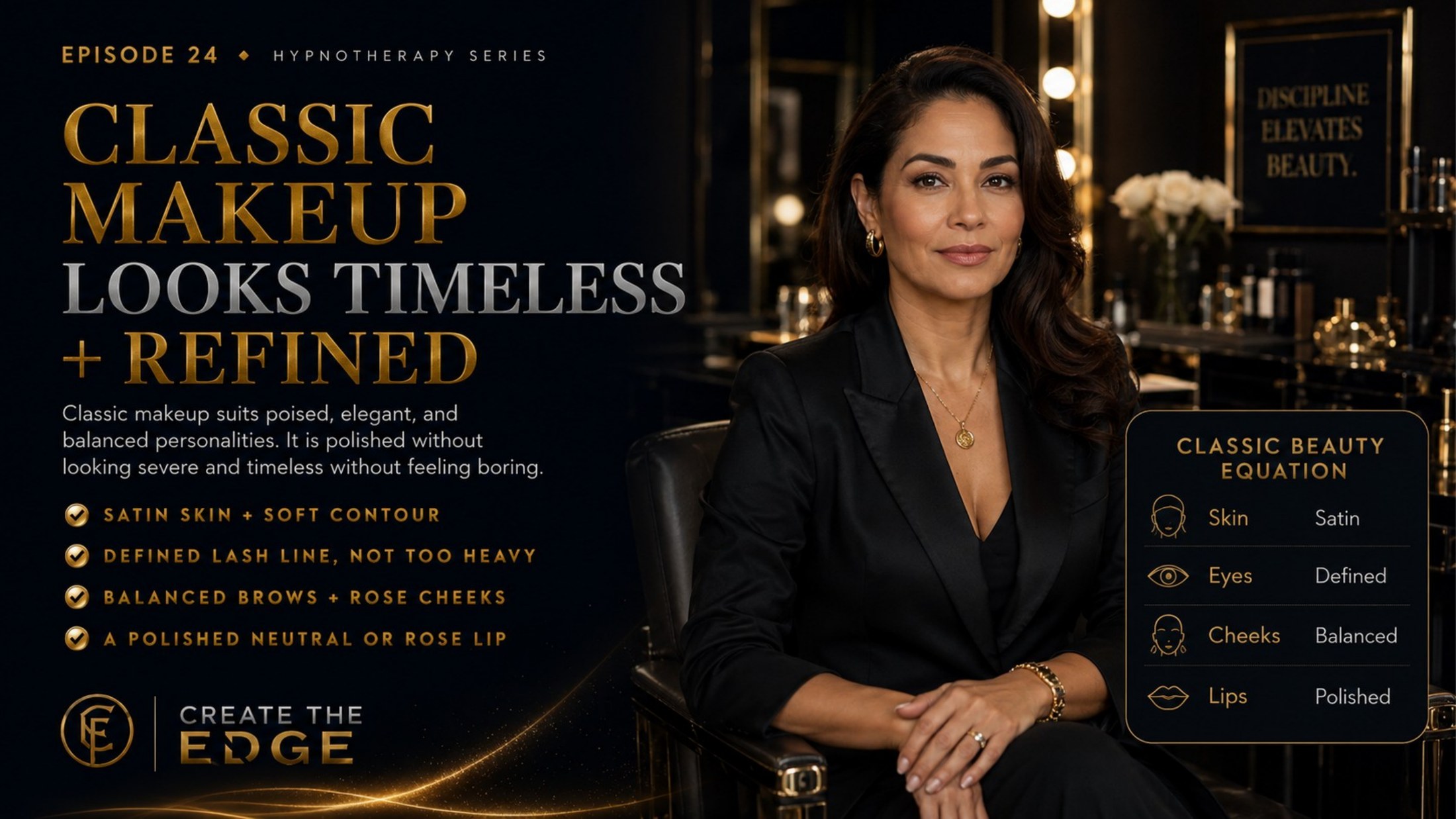
On the slideSatin skin and soft contour · Defined lash line, not too heavy · Balanced brows and rose cheeks · A polished neutral or rose lip
Episode 24 · Slide 3
Classic Makeup Looks Timeless and Refined
Look at her — seated with the ease of someone who has made a thousand decisions and trusted every one of them. On the wall: *Discipline Elevates Beauty.* Her Classic Beauty Equation spelled out beside her: Skin — Satin. Eyes — Defined. Cheeks — Balanced. Lips — Polished. Everything in agreement. Everything deliberate.
Classic makeup suits poised, elegant, and balanced personalities. It is polished without looking severe, and timeless without feeling boring. If this is your direction, you understand intuitively that makeup should *elevate* the face, not decorate it. You are drawn to looks that will photograph as beautifully in ten years as they do today. You reach for quality over novelty and consistency over experimentation.
The classic technique centers on satin skin — a medium-coverage foundation or skin tint finished with a satin rather than matte or dewy finish, giving the complexion a refined, smooth quality. Soft contour applied with a light hand to add dimension without drama. A defined lash line — liner drawn with precision along the upper lash line, close to the lashes rather than lifted away from them, present enough to frame the eye without dominating it. Brows that are groomed and balanced, filled to their natural shape rather than overdrawn.
Rose cheeks — blush in a soft rose or mauve that adds warmth without looking flushed — are the hallmark of the classic face. The color is natural enough to be believed and present enough to be noticed. And the lip: a polished neutral or a soft rose that completes the face without making itself the subject of the look. The classic lip is never an afterthought, but it is never a statement either. It is the final piece of a balanced composition.
What classic makeup communicates, ultimately, is *I have thought about this.* Not in a self-conscious way — in the way that a well-tailored jacket communicates that its wearer understands the difference between dressed and dressed well. Classic makeup signals refinement, reliability, and a certain confidence that does not need to announce itself.
Polished without being severe. Timeless without being boring. That is the classic promise — and for those who live up to it, it never goes out of style.
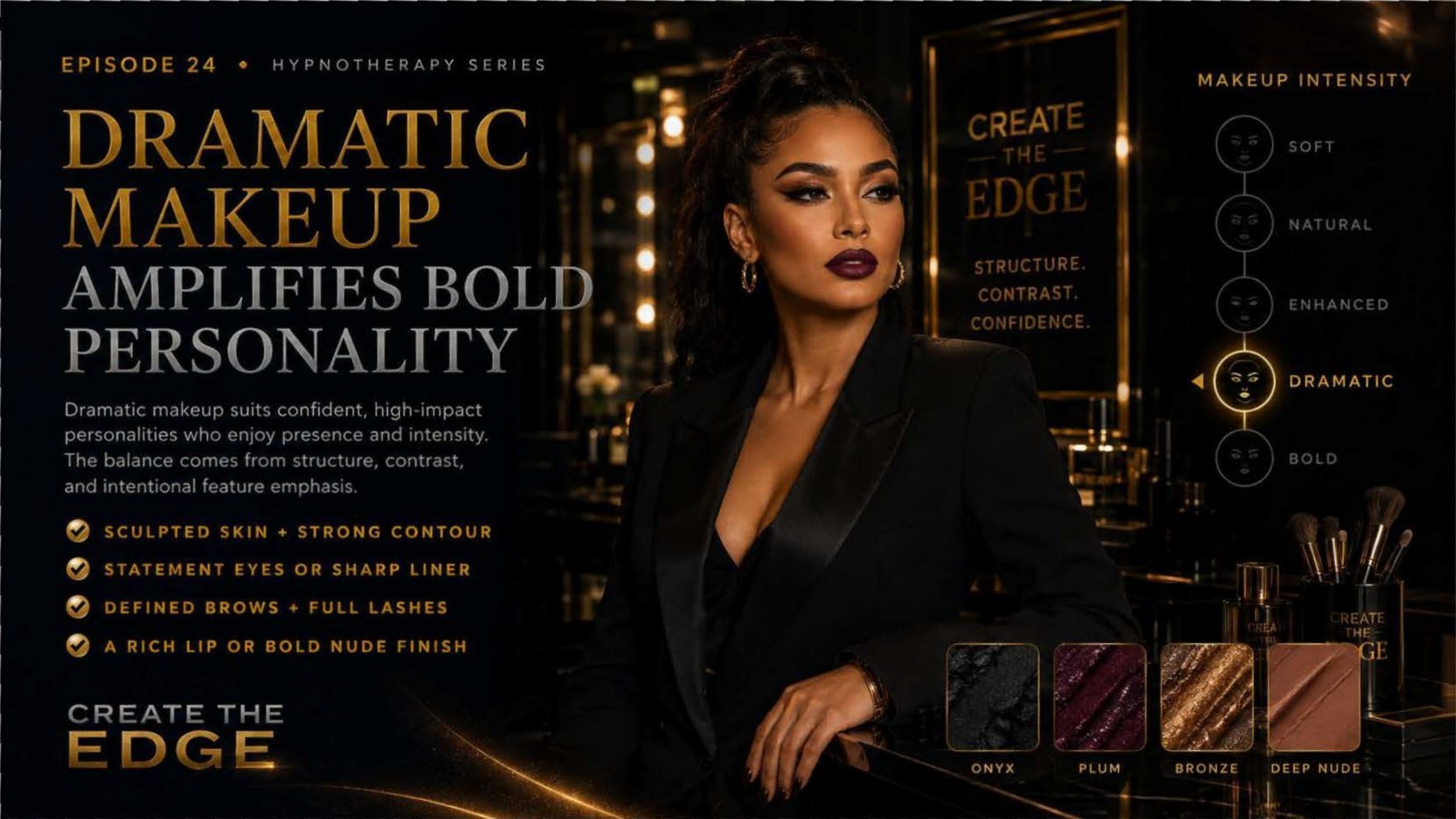
On the slideSculpted skin and strong contour · Statement eyes or sharp liner · Defined brows and full lashes · A rich lip or bold nude finish
Episode 24 · Slide 4
Dramatic Makeup Amplifies Bold Personality
Look at her — plum lip, sculpted cheekbones, full lashes, intensity at every feature. Behind her on the wall: *Structure. Contrast. Confidence.* To the right: the makeup intensity scale, with Dramatic highlighted — the penultimate level before Bold. Below: the color palette for this look — onyx, plum, bronze, deep nude. Every choice deliberate. Every choice high-impact.
Dramatic makeup suits confident, high-impact personalities who enjoy presence and intensity. If this is your direction, you know it — because the soft look feels like playing it safe, the classic look feels too understated, and the days when you walk out wearing something that commands attention are the days you feel most like yourself. You are drawn to contrast, definition, and the sense that every feature has been considered.
The dramatic technique centers on sculpted skin — full-coverage foundation or serum foundation finished for a sculpted, luminous effect, with contour applied with intention to define the cheekbones, slim the nose if desired, and create clear light-and-shadow architecture on the face. Statement eyes: a smoky eye, a cut crease, a dramatic winged liner — whichever speaks to your personality, applied with precision so the intensity reads as deliberate rather than heavy. Defined brows that are strong and groomed, establishing the frame through which the dramatic eye is read. Full lashes — strip, individual, or built with several coats of mascara.
The lip in dramatic makeup is either a statement or a strategic recede. A rich, saturated lip — deep red, plum, berry, brick — makes the face a composition of two focal points: the eye and the lip, playing off each other. A bold nude — a lip that is matte and precisely defined but neutral in color — lets the eye carry everything. Both approaches work; the choice depends on which statement the personality wants to make that day.
What the dramatic personality is really doing with their makeup is this: choosing to show up fully. Not apologetically. Not hedging. Choosing to be seen — completely, on purpose, in the full knowledge that some people will find it too much and not caring. That decision, made every morning, is its own form of confidence.
Structure. Contrast. Confidence. The dramatic face does not walk into a room. It arrives.
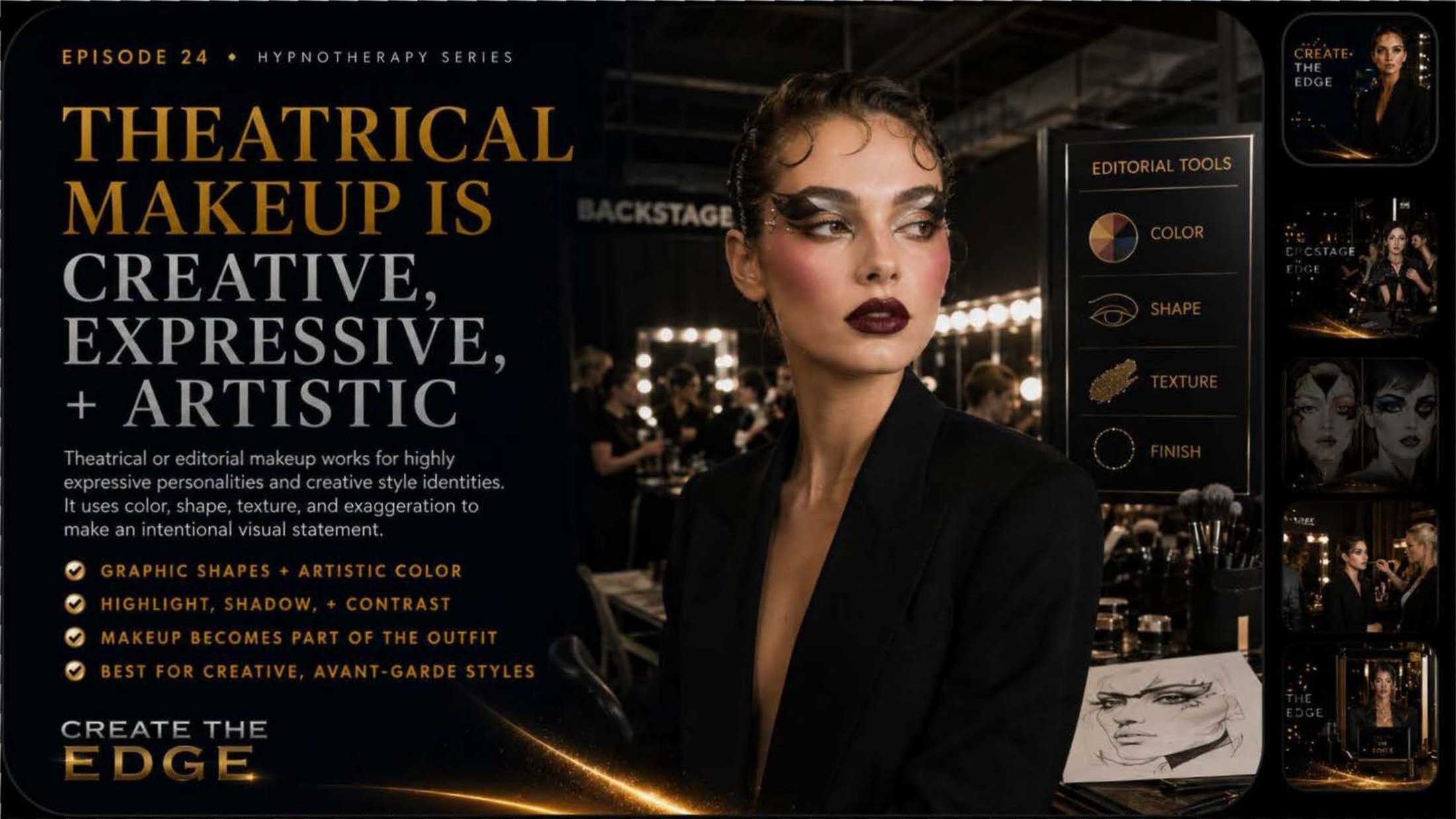
On the slideGraphic shapes and artistic color · Highlight, shadow, and contrast · Makeup becomes part of the outfit · Best for creative, avant-garde styles
Episode 24 · Slide 5
Theatrical Makeup Is Creative, Expressive, and Artistic
Look at her — backstage energy, graphic metallic eye shapes extending past the orbital bone, blush that is almost sculptural, a statement lip, hair slicked back to let the face be the full canvas. To the right: the editorial tools — Color, Shape, Texture, Finish. Above: a mood board of experimental looks. This is not makeup application. This is face art.
Theatrical or editorial makeup works for highly expressive personalities and creative style identities. If this is your direction, you probably have strong feelings about color, you see the face as a canvas that most people are using too conservatively, and you experience conventional makeup looks as limitations rather than guidelines. You are drawn to the experimental, the unexpected, the look that creates a reaction.
Theatrical makeup uses color, shape, texture, and exaggeration to make an intentional visual statement. Graphic shapes — liner that extends into geometric forms, shadow that travels past the conventional eye area, brow shapes that are sculptural rather than natural. Artistic color — eye shadow in jewel tones, unexpected metallics, pops of color on the lower lash line or inner corner that reframe the entire face. Highlight, shadow, and contrast used for drama rather than merely definition.
In theatrical makeup, the face and the outfit are part of the same composition. The makeup does not merely complement the clothing — it extends it, echoes it, argues with it productively. A deep graphic eye in the same tone as a jacket. A sculptural cheek that echoes the architecture of an earring. Makeup that becomes part of the outfit rather than an accessory to it.
This direction is not for everyone — and that is exactly as it should be. The theatrical personality does not want to look like everyone. They want to look like themselves taken to their most expressive, most considered, most fully realized extreme. That is a valid and beautiful goal. The technical skill required is considerable, but the intention behind it is simply this: to make the outside match the full, unedited truth of what is happening inside.
Creative. Expressive. Artistic. When theatrical makeup is done with skill and intention, it is not costume. It is the truest self, made visible in its most vivid form.
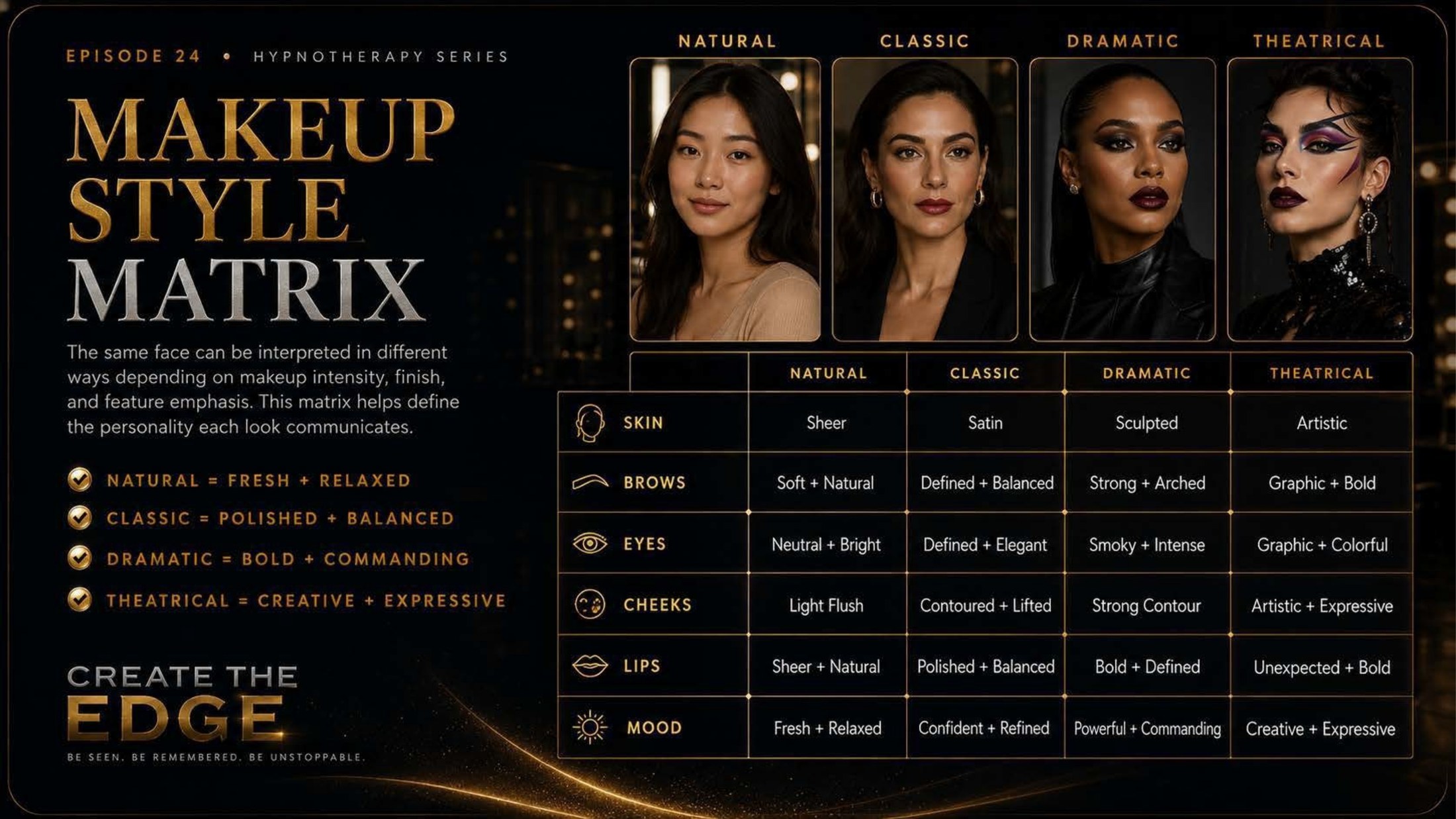
On the slideNatural equals fresh and relaxed · Classic equals polished and balanced · Dramatic equals bold and commanding · Theatrical equals creative and expressive
Episode 24 · Slide 6
The Makeup Style Matrix
Look at this — four faces, side by side, the same lighting, the same neutral expression, four completely different presences. Natural: clean, open, approachable. Classic: refined, balanced, poised. Dramatic: commanding, sculpted, powerful. Theatrical: expressive, artistic, unforgettable. Then below them: a full matrix mapping each personality across skin, brows, eyes, cheeks, lips, and overall mood.
The same face can be interpreted in entirely different ways depending on makeup intensity, finish, and feature emphasis. This is one of the most remarkable things about the craft: the bone structure does not change, the proportions do not change, and yet the presence changes completely. What changes it is not the amount of product but the *intention behind the placement* — and understanding that shifts everything about how you approach your mirror.
Natural skin is sheer and undetectable. Classic skin is satin and refined. Dramatic skin is sculpted and architectural. Theatrical skin is artistic and experimental. Natural brows are soft and barely filled. Classic brows are defined and balanced. Dramatic brows are strong and arched. Theatrical brows are graphic and bold. And through the eyes, the cheeks, and the lips, the same progression continues — from minimal presence to maximal expression, with every gradation along the way deliberately serving the personality it is meant to reflect.
The mood column is perhaps the most revealing: Natural reads as Fresh and Relaxed — the person who has nothing to prove. Classic reads as Confident and Refined — the person who has done this before and knows it. Dramatic reads as Powerful and Commanding — the person who intends to be remembered. Theatrical reads as Creative and Expressive — the person who has decided that the full range of what they are is worth showing.
None of these is better than the others. All of them are complete. The matrix is not a ranking — it is a map. And the most important thing a map can do is show you where you already are, so you can choose where you want to go.
Which column, when you read it, feels like coming home?
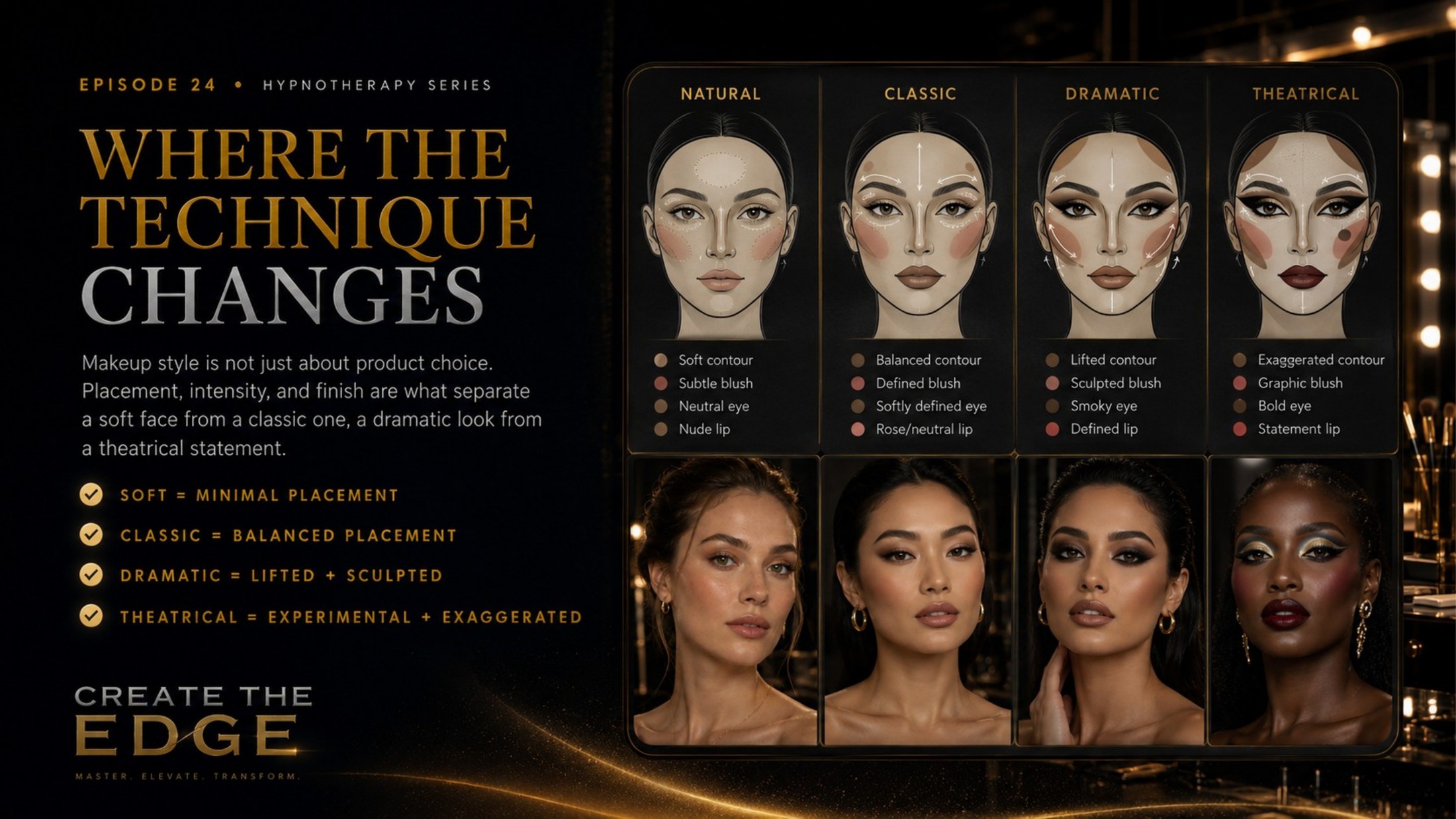
On the slideSoft equals minimal placement · Classic equals balanced placement · Dramatic equals lifted and sculpted · Theatrical equals experimental and exaggerated
Episode 24 · Slide 7
Where the Technique Changes
Look at this slide — four face diagrams mapped with contour, blush, and eye placement for each makeup personality, paired with four real-face photographs showing the results. Natural: subtle, barely-there blush, neutral lids, nude lip. Classic: balanced contour, softly defined eye, rose lip. Dramatic: lifted contour with strong blush, smoky intensity at the eyes, defined lip. Theatrical: exaggerated contour, graphic eye, statement lip. Same face structure. Completely different architectural stories.
Makeup style is not just about product choice. Placement, intensity, and finish are what separate a soft face from a classic one, a dramatic look from a theatrical statement. And this is the most technical piece of this episode — because once you understand that the *where* matters as much as the *what*, you can begin to build any look you want with complete intentionality.
Natural placement is minimal: blush applied softly to the apples of the cheeks, fading outward. Contour barely suggested rather than clearly drawn. Eye shadow blended so softly it disappears into the skin. The goal is skin that looks healthy and rested, features that look naturally present, nothing that draws the eye to the makeup itself. The product should be invisible. Only the effect should show.
Classic placement is balanced: contour structured but not dramatic, blush placed at the cheekbones rather than the apples, eye shadow blended in a defined but not heavy shape, liner drawn with precision rather than drama. Everything in proportion. Everything earning its place through balance rather than intensity.
Dramatic placement is lifted and sculpted: contour drawn to visually lift and define the cheekbones, blush placed high and blended upward rather than outward, eye shadow extended to elongate and intensify, liner creating lift at the outer corners. The face reads as having more dimension, more definition, more architectural clarity than it has without the makeup.
Theatrical placement is experimental: contour that may be used for artistic effect rather than conventional structure, blush that may be graphic rather than blended, eye shapes that extend beyond the conventional orbital space, lip shapes that may be overdrawn or under-drawn for artistic effect. The technique is in service of vision rather than convention.
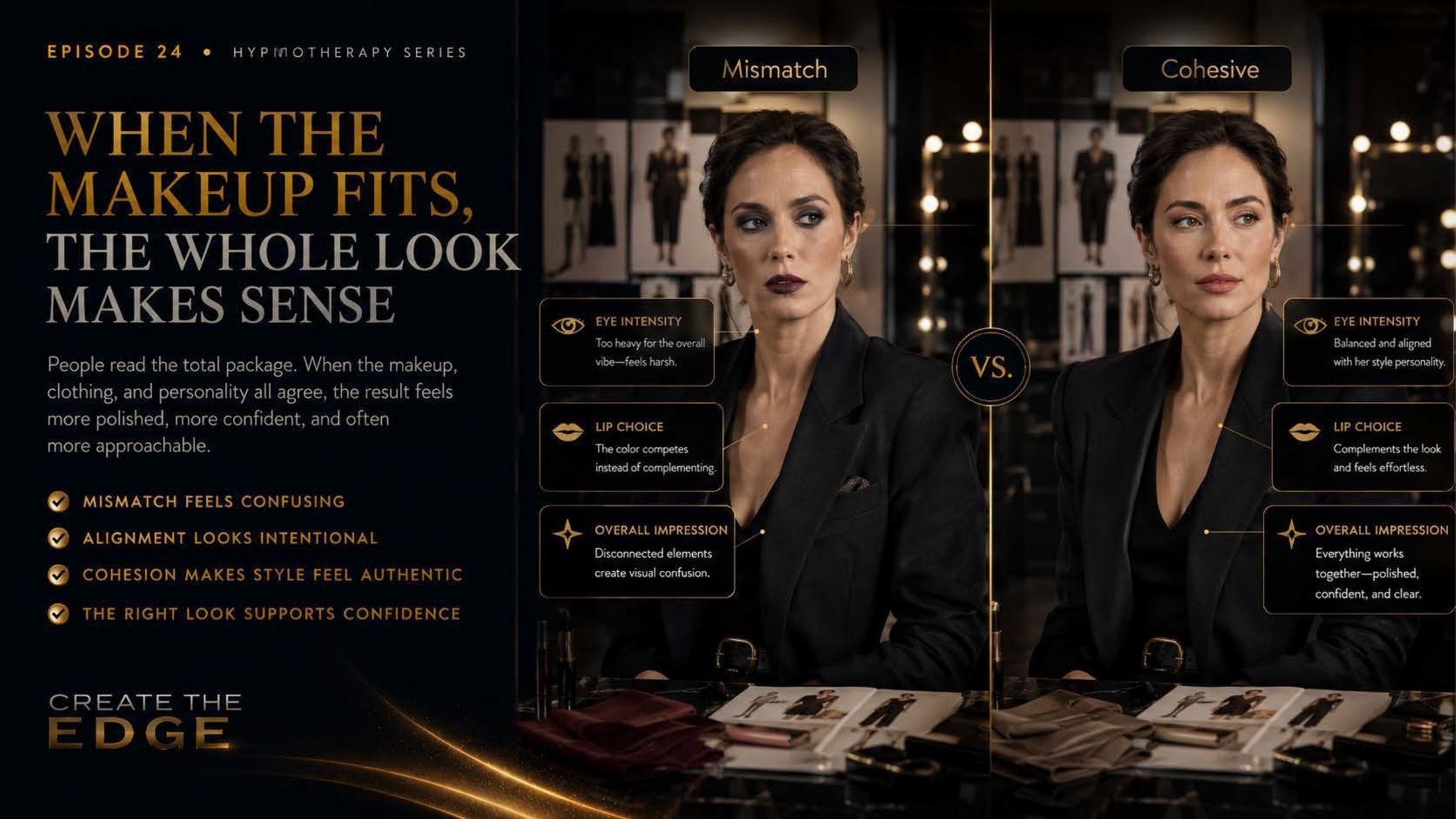
On the slideMismatch feels confusing · Alignment looks intentional · Cohesion makes style feel authentic · The right look supports confidence
Episode 24 · Slide 8
When the Makeup Fits, the Whole Look Makes Sense
Look at this split image — on the left, mismatch: eye intensity too heavy for the overall vibe, lip color competing instead of complementing, disconnected elements creating visual confusion. On the right, the same person with cohesion: eye intensity balanced with her style personality, lip choice complementing the look, everything working together to produce a result that reads as polished, confident, and clear. Same face. Same features. One looks like she is wearing her makeup. The other looks like she is wearing herself.
People read the total package. This is not something we consciously choose to do — the brain assembles all the visual information at once and delivers an impression in milliseconds. When the makeup, clothing, and personality all agree, that impression is immediate and clear: *this person knows who they are.* When they disagree, the impression is equally immediate: *something is off.* The viewer may not be able to name what, but they feel it.
Mismatch feels confusing. A heavy smoky eye on someone who is otherwise dressed in soft, easy, approachable clothes sends two messages at once that do not add up. A perfectly natural face on someone wearing a dramatic, architectural look leaves something missing. The individual elements might each be beautiful in isolation — but when they are not in conversation with each other, the total reads as unresolved.
Alignment looks intentional. When a soft, natural face accompanies relaxed, easy clothing, the impression is complete. When a classic face accompanies tailored clothing, the polish deepens. When a dramatic face accompanies a statement look, the impact multiplies. Each element amplifies the others because they are all pulling in the same direction — toward the same personality, the same energy, the same presence.
Cohesion makes style feel authentic. And authenticity — the sense that what you are seeing on the outside is an honest expression of what exists on the inside — is ultimately what people find most compelling about another person. The right look supports confidence not because it is the most beautiful thing you can do to your face, but because it is the most *true* thing.
When your makeup fits, you stop performing. You start inhabiting. And the difference in the room is everything.

On the slidePersonality guides the intensity · Clothing lines influence makeup · Grooming counts for everyone · The total package feels powerful
Episode 24 · Slide 9
Head-to-Toe Alignment Builds Polish and Confidence
Look at these three — a Soft-Natural woman in cream and camel, effortless and warm; a Classic-Polished man in a navy suit, clean and trustworthy; a Dramatic-Bold woman in structured black, commanding and memorable. Each one is completely coherent from head to toe. The clothing, the makeup or grooming, the posture, the energy — all of it speaking the same language. Each is unmistakably a complete person.
When personality, clothing lines, grooming, and makeup all speak the same language, the result feels clear and complete. And that clarity — that sense of a person who has made deliberate, aligned choices about how they show up — is what produces the experience of confidence that other people register from across the room.
Personality guides the intensity. Start there. Not with trends, not with what your makeup-wearing friends do, not with what a tutorial told you was correct. Start with who you are and what energy you want to bring. If your personality is warm and approachable, your makeup intensity and clothing energy should reflect that. If your personality is commanding and high-impact, the same. The mistake is choosing a makeup intensity that belongs to a different personality than the one you are actually living.
Clothing lines influence makeup. Structured, tailored clothing often benefits from makeup with more definition — because the precision of the clothing sets an expectation of intention that extends to the face. Soft, easy clothing often benefits from softer makeup — because the effortlessness of the clothing is echoed in a face that looks equally unconstructed. When these two are aligned, the overall impression is seamless.
Grooming counts for everyone. For men, this means that skin care, brow maintenance, facial hair intention, and hair grooming are the equivalent of makeup for the total package. A man who has tended to these elements reads as someone who has thought about his presentation. And that intention communicates reliability, self-respect, and competence in exactly the same way that makeup does for women.
The total package feels powerful. Not intimidating — powerful in the original sense: capable, aligned, fully present. That is what head-to-toe cohesion produces. And it is available to anyone willing to do the work of self-knowledge that makes it possible.
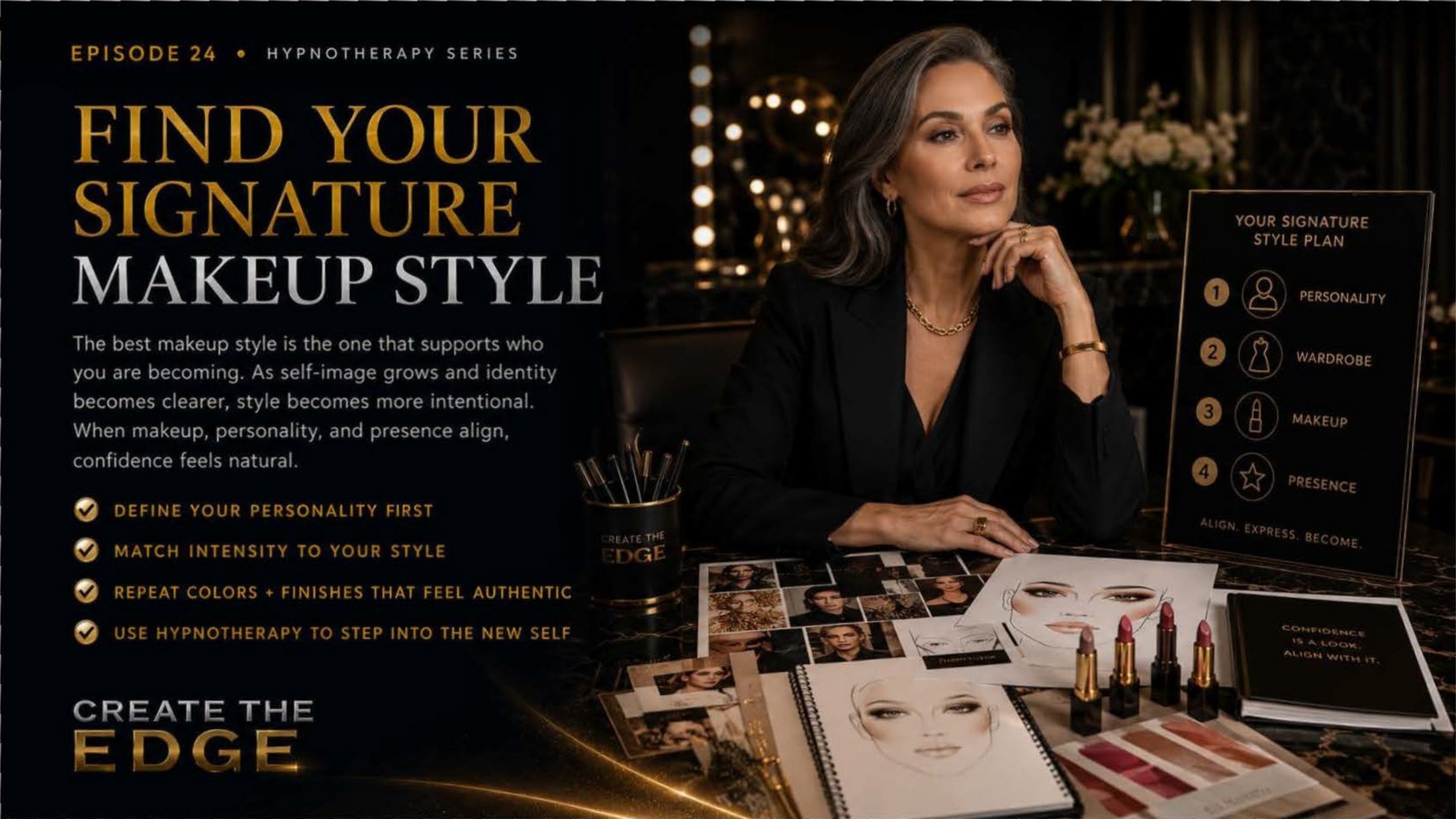
On the slideDefine your personality first · Match intensity to your style · Repeat colors and finishes that feel authentic · Use hypnotherapy to step into the new self
Episode 24 · Slide 10
Find Your Signature Makeup Style
Look at her — silver-haired, seated at a desk covered with face charts, lipstick swatches, polaroids of styled looks. On the card beside her: *Confidence is a look. Align with it.* On the panel: Your Signature Style Plan — four steps: Personality, Wardrobe, Makeup, Presence. Three words at the bottom: *Align. Express. Become.* She is not finished becoming. None of us is. But she is doing the work.
The best makeup style is the one that supports who you are becoming. Not who you were five years ago. Not who someone else told you to be. Who you are actively, deliberately, in the midst of choosing to be — right now, in this chapter of the journey.
Define your personality first. Before you open a palette or choose a foundation, spend a moment with the question: what energy do I want to inhabit today? What story do I want my face to tell? The answer to that question is the foundation of everything that follows — and it changes as you change, which is why the signature style is not something you find once and carry forever. It is something you refine continuously, in alignment with who you are growing into.
Match intensity to your style. The four personalities — Natural, Classic, Dramatic, Theatrical — are not fixed categories but points on a spectrum. You may find yourself drawn to Classic most days and Dramatic for evenings. You may live in Natural but reach for Theatrical on weekends. What matters is not consistency for its own sake, but conscious alignment: choosing the intensity that matches the version of yourself you are inhabiting in a given context.
Use hypnotherapy to step into the new self. This is the piece that ties everything together — because the signature makeup style is not just a cosmetic choice. It is an act of identity. Every morning when you choose your makeup with intention, you are practicing being the person you are becoming. Hypnotherapy deepens that practice by making the future self more accessible: by rehearsing, in the subconscious, the version of you who wears this look with ease, with ownership, with the settled confidence of someone who has arrived.
Align. Express. Become. Those three words are the whole map. You have always been the territory. — Misty