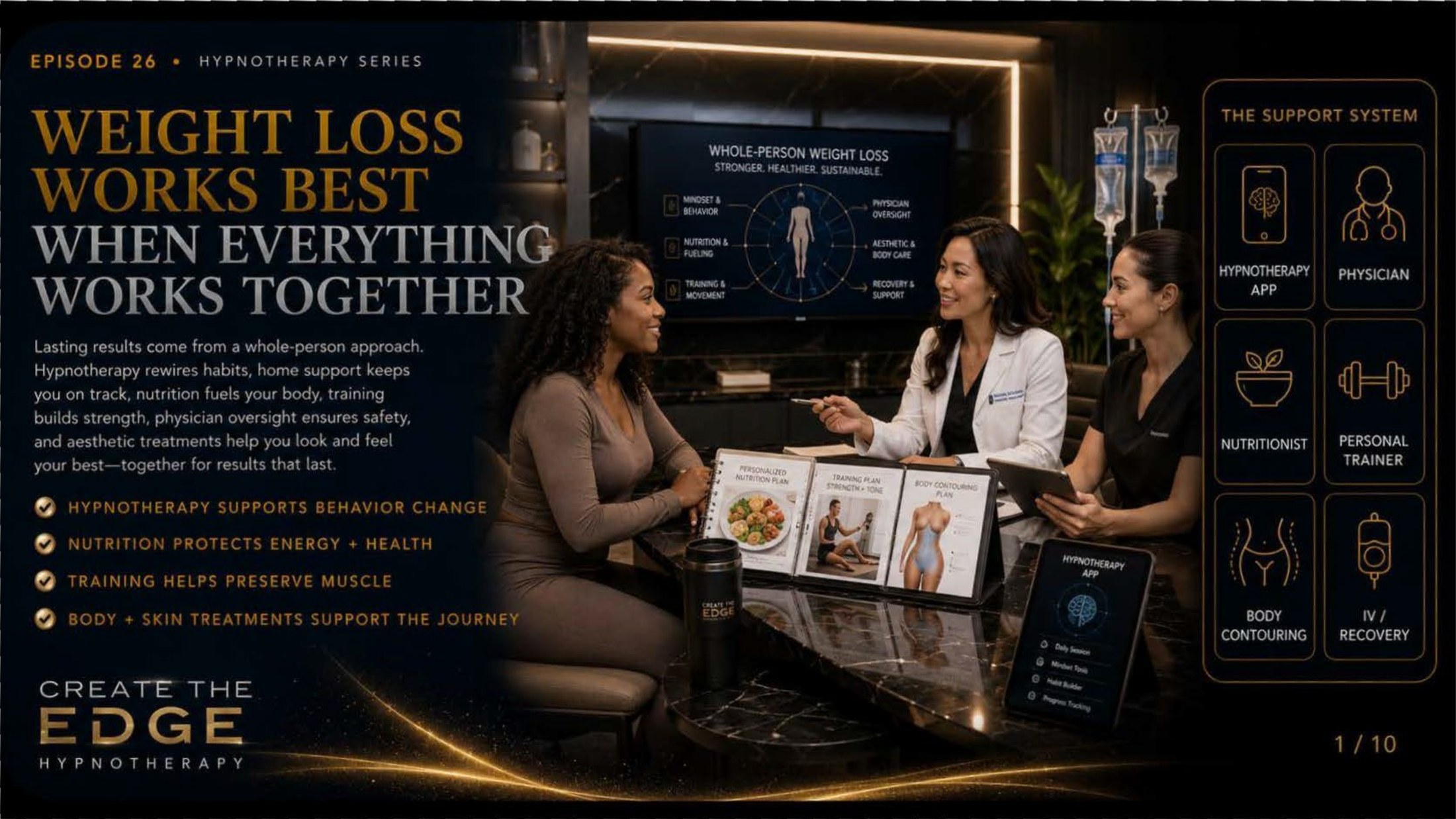
On the slideHypnotherapy supports behavior change · Nutrition protects energy and health · Training helps preserve muscle · Body and skin treatments support the journey
Episode 26 · Slide 1
Weight Loss Works Best When Everything Works Together
Look at this — a client sitting with a physician and an aesthetician, three personalized plans open on the table: Nutrition Plan, Training Plan with Strength and Tone, Body Contouring Plan. On the screen behind them: Whole-Person Weight Loss — Stronger, Healthier, Sustainable. Around it: Mindset and Behavior, Nutrition and Fueling, Training and Movement, Recovery and Support, Aesthetic and Body Care, Physician Oversight. Every element connected. Every element required.
I want to talk to you about something that the weight-loss industry has been getting wrong for decades: the idea that transformation is a single-variable problem. That if you just eat less, or move more, or take the right supplement, or find the right willpower — that is all it takes. The evidence does not support that. And the people I have worked with for thirty years do not support it either.
Lasting results come from a whole-person approach. Not because any individual component is insufficient — each one is meaningful — but because they amplify each other in ways that none of them can produce alone. Hypnotherapy rewires the habits, the self-talk, and the subconscious beliefs that drive behavior. Nutrition fuels the body with what it actually needs to function well and change safely. Training builds and protects the muscle that keeps metabolism strong and the body feeling capable. Physician oversight ensures safety and catches the physiological factors — hormonal, metabolic, medical — that no amount of willpower can override.
And aesthetic and body care — skin treatments, body contouring, the professional support that addresses how the body looks and feels as it changes — plays a role that most people underestimate. When you feel good in the body you are in right now, you are more likely to keep going. When the outside begins to reflect the inside's progress, motivation deepens.
This is not a shortcut. This is not a quick fix. This is what actually works — a comprehensive, personalized system that takes care of the whole person and produces results that hold.
You are not a single variable. You deserve a plan built for all of you.

On the slideReinforces new habits · Helps reduce self-sabotage · Supports daily consistency · The app keeps you connected between visits
Episode 26 · Slide 2
Hypnotherapy Helps the Plan Stick Every Day
Look at her — settled on the couch in the evening, her tablet showing a hypnotherapy session, the daily support loop mapped to the right: Listen, Visualize, Track, Repeat. And on the app itself: Daily Session, Craving Reset, Mindset Tools, Progress Check. This is not a once-a-week treatment. This is a daily practice.
The most common reason that wellness plans fail is not lack of knowledge. Most people who have tried to change their relationship with their body and their health know what to do. They know that vegetables are better than chips, that sleep matters, that movement helps. The gap is not information — it is consistency. And the gap in consistency is almost always rooted in subconscious patterns that knowledge alone cannot shift.
This is where hypnotherapy is irreplaceable. Hypnotherapy reinforces the habits that create real change by accessing the subconscious directly — the part of the mind that runs the automatic programs, makes the 11pm decisions, generates the self-sabotaging thoughts right when progress is happening. It builds new neural pathways around food, movement, and self-care — not through willpower, but through repetition at the level where behavior actually originates.
Between formal sessions, the support continues. The daily practice — whether through a guided audio session, a brief visualization, a mindset check-in — maintains the neurological work that the formal session initiates. The brain responds to repetition. Every day that the new pattern is reinforced is a day the old pattern loses some of its grip. Over weeks and months, the change stops feeling like effort and begins to feel like identity.
Helps reduce self-sabotage. This phrase deserves to be said slowly. Self-sabotage is not weakness. It is a subconscious protective mechanism — a pattern that was originally designed to keep you safe, or comfortable, or in the familiar. Hypnotherapy is one of the most effective tools available for understanding what that pattern was protecting against and building something healthier to replace it.
The plan stays the plan because the person doing it stays connected. That is what the daily practice is for.

On the slideSmart fueling helps prevent energy crashes · Protein and fiber support satiety · Balanced meals help stabilize blood sugar · A nutritionist tailors the plan to you
Episode 26 · Slide 3
Nutrition Protects Your Energy, Health, and Results
Look at this — a registered dietitian nutritionist working with a client, a diagram of a balanced meal open on the counter, a blood sugar stability chart on the tablet. The sustainable progress markers above: Steady Energy, Strong Health, Balanced Blood Sugar, Sustainable Fat Loss. To the right: a comparison graph — the red jagged line of crash dieting energy versus the steady green line of a balanced plan.
Proper nutrition is the foundation of lasting change. Not restriction — foundation. This is an important distinction that the diet industry has spent decades obscuring. When I say nutrition is the foundation, I do not mean eating as little as possible and hoping your body cooperates. I mean nourishing the body with what it actually needs to function, change, and feel well — consistently, sustainably, over time.
A nutritionist helps build meals and habits that support steady energy, healthy body composition change, muscle preservation, and balanced blood sugar — so you feel your best and make progress that lasts. Protein at each meal supports the muscle that training is building and the satiety that makes it possible to stop eating when satisfied rather than when stuffed. Fiber supports the digestive system, slows glucose absorption, and creates the kind of fullness that holds.
Blood sugar stability is one of the most underappreciated factors in both weight management and psychological wellbeing. When blood sugar swings dramatically — the spike and crash cycle that processed foods and skipped meals create — the body generates stress hormones in response, cravings increase, mood drops, and the willpower that was doing its best to hold the plan together runs out. Stable blood sugar means stable energy, stable mood, and dramatically reduced cravings. It is physiological support for the psychological work.
And crash dieting — extreme restriction, dramatic cuts, the no-carbs-no-sugar-no-fun approach that promises quick results and delivers short-term numbers followed by rebound, fatigue, and often a worse relationship with food than before — may lead to short-term results, but it often leaves you depleted and out of balance. The body is smarter than the plan. When it perceives starvation, it protects itself. That protection works against every goal the restriction was designed to achieve.
A nutritionist tailors the plan to you. Your preferences, your medical history, your schedule, your relationship with food. That personalization is not a luxury. It is what makes the plan a plan you can actually live.
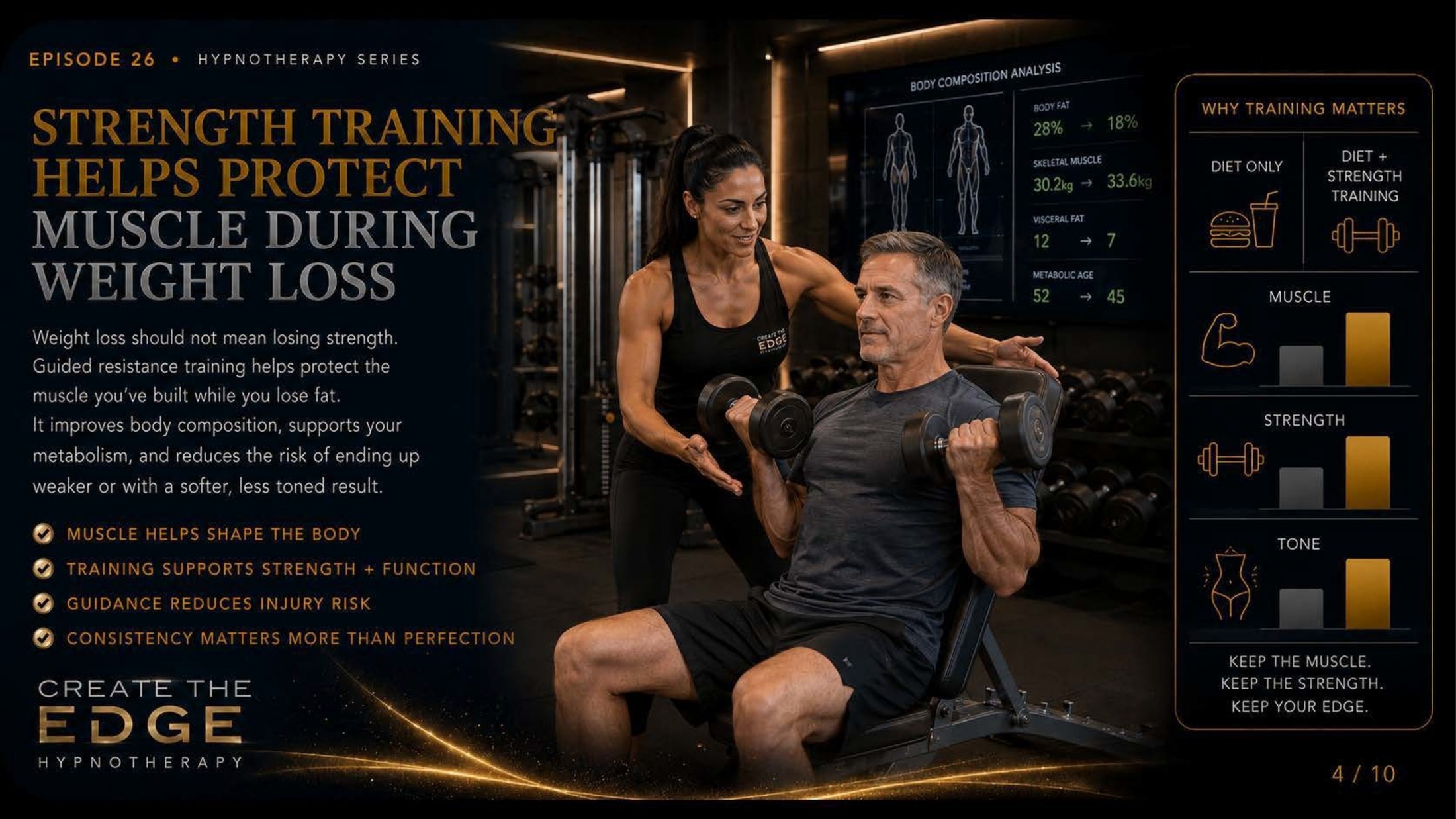
On the slideMuscle helps shape the body · Training supports strength and function · Guidance reduces injury risk · Consistency matters more than perfection
Episode 26 · Slide 4
Strength Training Helps Protect Muscle During Weight Loss
Look at this — a trainer guiding a client through a dumbbell exercise, a body composition analysis on the screen showing changes in body fat, skeletal muscle, visceral fat, and metabolic age. To the right: the comparison of diet only versus diet plus strength training across three outcomes — Muscle, Strength, and Tone. Diet only: flat bars. Diet plus strength training: dramatically higher results in all three.
Weight loss should not mean losing strength. This is one of the most important things I want you to hear in this episode — because the cultural image of what losing weight looks like often includes becoming thinner without much consideration for what that thinning is actually made of. Muscle tissue is metabolically active, structurally supportive, and responsible for the kind of physical capability that determines how the body feels to live in. Losing it while losing fat produces a result that looks smaller but often feels weaker, softer, and less energetic than before.
Guided resistance training helps protect the muscle you have built while losing fat. More than that — it can build additional muscle, which improves body composition, supports your metabolism, and changes the shape of the body in ways that fat loss alone cannot produce. The person who loses body fat while maintaining or building muscle looks and feels different from the person who achieves the same scale result through restriction alone. The physiology is different. The energy is different. The long-term outcome is different.
Training supports strength and function. This means carrying groceries more easily, climbing stairs without losing breath, recovering from physical challenges more quickly, maintaining the physical capability that makes daily life feel good rather than effortful. These are not vanity outcomes — they are quality-of-life outcomes that compound over years.
Guidance reduces injury risk. Working with a qualified trainer ensures that the movements that build and protect muscle are performed with the technique that keeps the joints and connective tissue safe. An injury that takes someone out of their routine for weeks or months can be far more costly to long-term progress than any single workout is beneficial.
Consistency matters more than perfection. Three sessions a week, done regularly, with appropriate progression over time — this is the formula. The perfect program that goes undone is worth nothing. The good-enough program that happens consistently is worth everything.

On the slideSupports appearance goals · May help with small stubborn areas · Works best after real lifestyle progress · Does not replace healthy wellness habits
Episode 26 · Slide 5
Body Contouring Can Support Shape — But It Is Not Weight Loss
Look at her — receiving a non-surgical body contouring treatment, the sign behind her: *You're Building More Than a Number.* To the right: What It Does / What It Doesn't. Does: Refines Shape, Supports Confidence, Complements the Journey. Doesn't: Treat Obesity, Replace Nutrition, Replace Exercise.
I want to be completely clear with you about what body contouring is and what it is not — because the marketing around these treatments is often vague in ways that lead to disappointment. Non-surgical body contouring can help reduce the look of small bulges or improve the appearance of areas that have been resistant to change through lifestyle alone. It can support confidence by addressing specific spots that training and nutrition are not reaching. It is a real and valuable tool.
What it is not: a substitute for the work. Body contouring does not produce significant weight change. It does not replace the metabolic benefits of nutrition and training. It does not address the internal factors — insulin sensitivity, hormonal balance, cardiovascular health — that make the wellness journey meaningful beyond appearance. A person who uses body contouring as their primary weight-loss strategy will be disappointed. A person who uses it as a complementary tool after making genuine lifestyle progress will find that it adds a satisfying and motivating layer to results they have earned.
Works best after real lifestyle progress. This is the timing principle that professionals consistently emphasize. When the body is at or near a stable, healthy state — when nutrition and training are already in place — contouring treatments can refine and enhance what has already been built. When used prematurely, before the lifestyle foundation is established, the results are less pronounced and less stable.
It does not replace healthy wellness habits. I will say that again because it matters: body contouring is a tool to complement the journey, not to shortcut it. The person who has done the inner work, built the habits, fueled the body, trained consistently, and supported their progress through hypnotherapy — that person will get the most from what body contouring can offer.
Refine. Support. Empower. In that order.
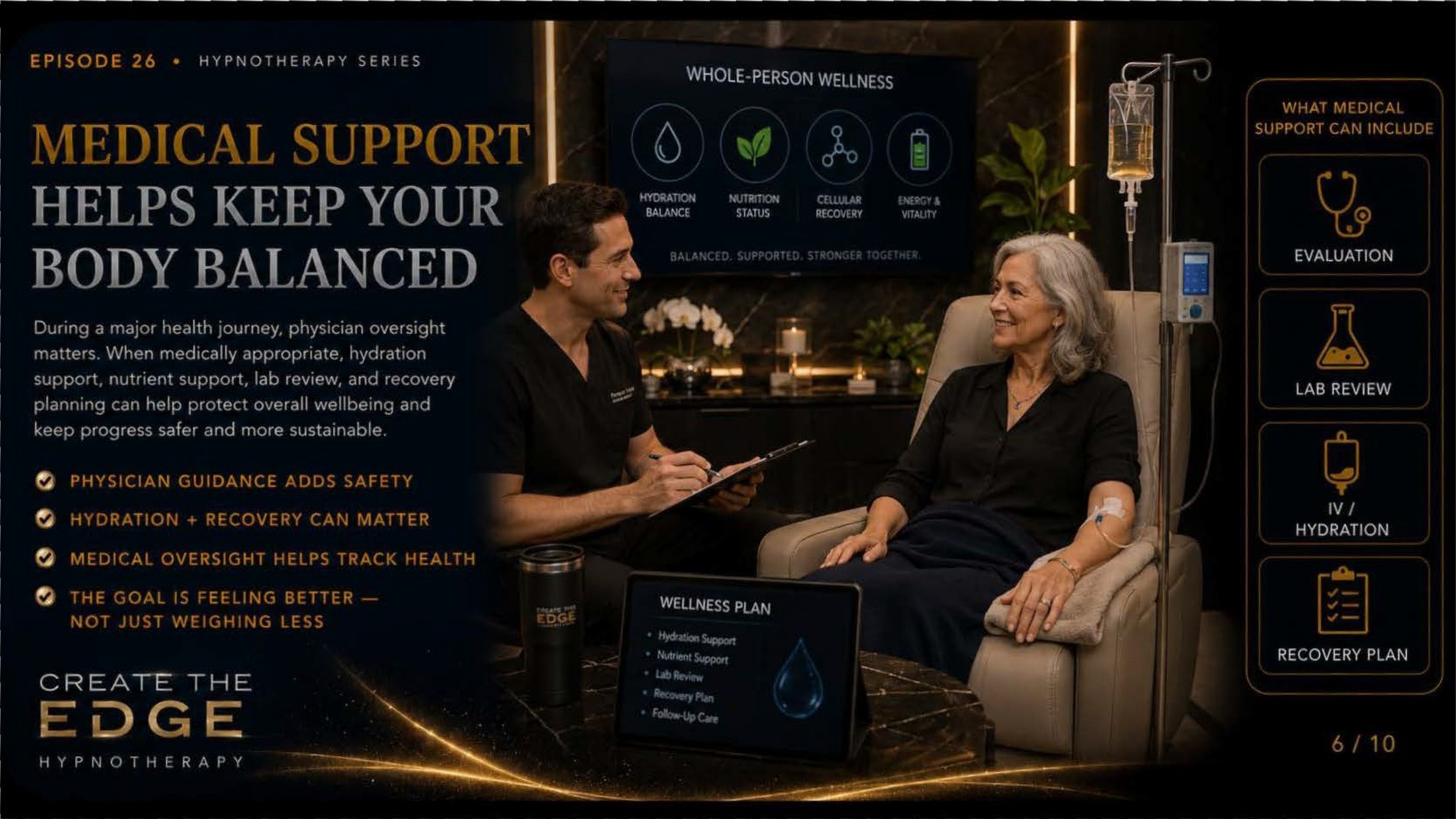
On the slidePhysician guidance adds safety · Hydration and recovery can matter · Medical oversight helps track health · The goal is feeling better, not just weighing less
Episode 26 · Slide 6
Medical Support Helps Keep Your Body Balanced
Look at this — a physician in consultation with a mature female client, an IV hydration setup nearby, the Wellness Plan on the tablet: Hydration Support, Nutrient Support, Lab Review, Recovery Plan, Follow-Up Care. On the screen: Whole-Person Wellness — Hydration Balance, Nutrition Status, Cellular Recovery, Energy and Vitality. Balanced. Supported. Stronger Together.
During a major health journey, physician oversight matters. This is not a statement about the danger of making positive lifestyle changes — those changes are almost always beneficial. It is a statement about the physiological complexity of the human body and the value of having a trained professional monitoring what is happening beneath the surface as you make significant changes.
Thyroid function, adrenal health, hormonal balance, metabolic markers, nutrient status — these are factors that profoundly affect how the body responds to changes in nutrition and exercise, and they are factors that no amount of willpower or nutritional knowledge can assess from the outside. A lab review at the start of a wellness journey establishes a baseline. Follow-up reviews track how the body is responding. When something is off — when the expected results are not appearing, or when new symptoms arise — medical oversight is what catches it early.
When medically appropriate, hydration support, nutrient support, and recovery planning can help protect overall wellbeing and keep progress safer and more sustainable. IV hydration and nutrient replenishment, administered under physician guidance, can support the body's cellular function, energy production, and recovery capacity during periods of significant change.
The goal is feeling better — not just weighing less. This distinction is foundational to the whole-person approach. A number on a scale that comes at the cost of energy, muscle, hormonal balance, or psychological wellbeing is not success. Success is a body that functions better, feels better, and has more capacity for the life you want to live. Medical support helps ensure that the changes you are making are producing that kind of success rather than trading one problem for another.
Physician guidance adds safety. Let the science and the care work together.

On the slideSkin quality affects the final look · Professional care can support tone · Body treatments complement training and nutrition · Confidence grows when the whole body is supported
Episode 26 · Slide 7
As Your Body Changes, Your Skin Needs Support Too
Look at him — receiving a professional body treatment, the Skin Support Benefits diagram on the screen: Improve Firmness, Boost Hydration, Enhance Texture, Support Recovery. To the right: four skin support goals — Firmness, Texture, Hydration, Recovery. The message is complete care for the whole body, not just the face.
When you lose weight — when the body changes significantly through the combination of nutrition, training, and the other elements of a whole-person plan — the skin is part of that change. And the skin may need extra support to keep up with the body's progress.
Skin is the largest organ in the body, and it is both resilient and responsive to significant change. When body composition shifts — when fat beneath the skin diminishes and the underlying structure changes — the skin's elasticity, hydration, and tone are all affected. For some people, the skin adapts readily. For others, particularly when change happens rapidly or when significant change has occurred, the skin may benefit from professional support to maintain the quality and tone that makes the result feel as good as it looks.
Professional skin and body treatments — radiofrequency for firmness, hydration treatments for moisture restoration, microneedling for skin quality and collagen support — can complement the journey by supporting the skin's structure as the body underneath it changes. This is not about achieving a particular appearance standard. It is about the relationship between how the body looks and how the person inhabiting it feels.
Confidence grows when the whole body is supported. When the skin feels firm and comfortable, when texture feels smooth, when the body's surface reflects the care that is being given to its interior — the overall experience of being in the body improves. And that improved experience feeds the behaviors that created it: the consistency, the investment in care, the belief that this progress is worth protecting.
Body treatments complement training and nutrition. They are not a shortcut to either — they are the support layer that helps the whole system work better.
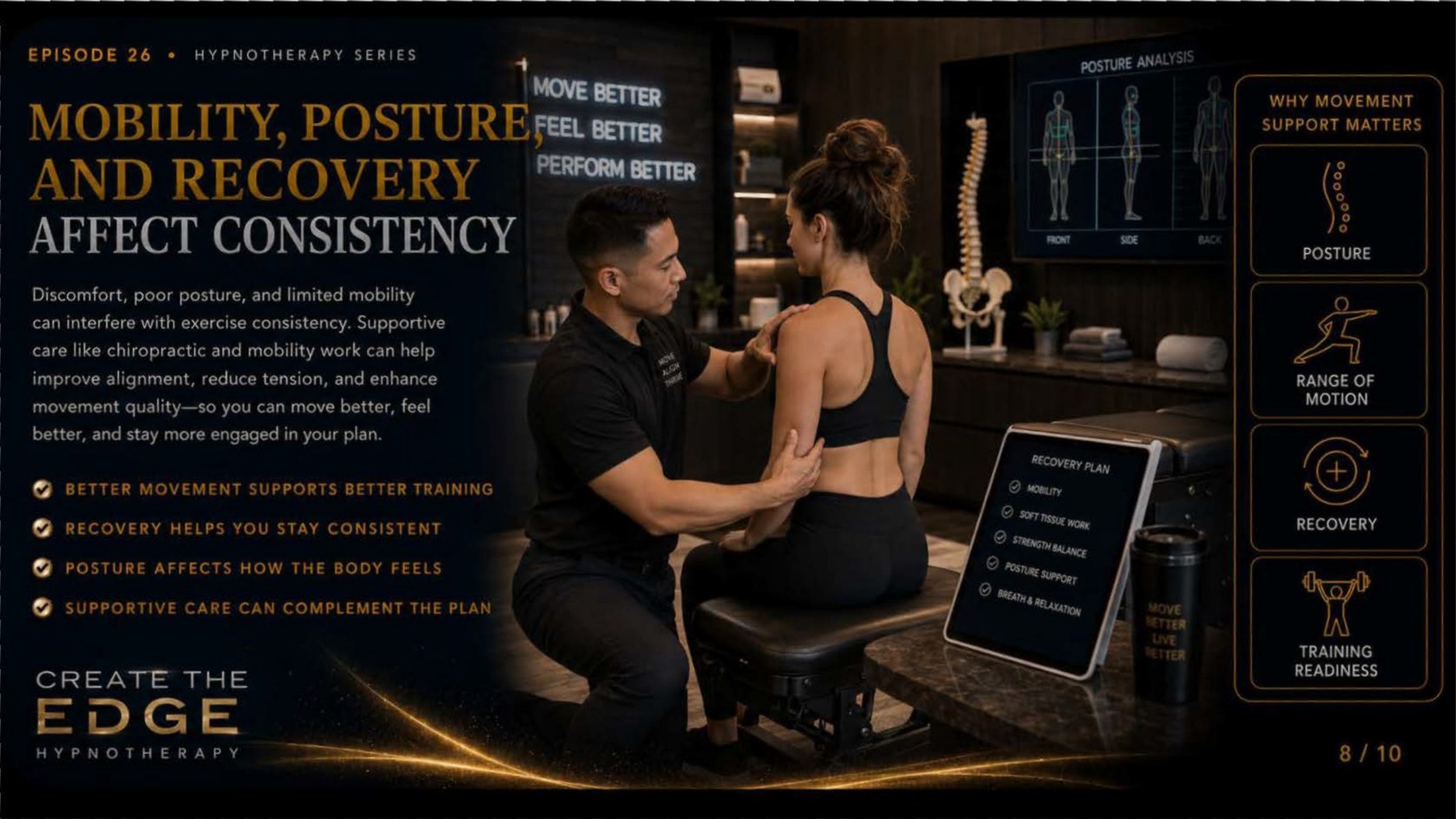
On the slideBetter movement supports better training · Recovery helps you stay consistent · Posture affects how the body feels · Supportive care can complement the plan
Episode 26 · Slide 8
Mobility, Posture, and Recovery Affect Consistency
Look at this — a chiropractor and movement specialist working with a client, a posture analysis on the screen showing front, side, and back alignment. On the tablet: Recovery Plan — Mobility, Soft Tissue Work, Strength Balance, Posture Support, Breath and Relaxation. On the wall: *Move Better. Feel Better. Perform Better.*
One of the most underappreciated barriers to exercise consistency is physical discomfort. Not the productive discomfort of a good training session — the unproductive discomfort of a body that is tight, misaligned, or in low-grade chronic pain that makes showing up to workouts feel like a fight rather than a choice. Over time, that fight becomes one that most people lose — not because of lack of commitment, but because the body is signaling that something needs attention.
Discomfort, poor posture, and limited mobility can interfere with exercise consistency in ways that no amount of motivational content can fully override. When it hurts to do the movement, people avoid the movement. When the form is compromised by tightness or imbalance, the risk of injury increases. When the body feels stiff and limited, the identity of someone who moves freely and trains regularly becomes harder to inhabit.
Supportive care — chiropractic care, mobility work, soft tissue treatment — can help improve alignment, reduce tension, and enhance movement quality so that the training component of the plan becomes more accessible and more effective. These are not luxury additions. For many people, they are what makes the difference between a plan that holds and one that stalls.
Recovery helps you stay consistent. This is the principle. The person who never takes a recovery day and trains through injury is not more committed than the person who takes two days to allow the body to repair — they are usually less consistent over time because they end up forced into longer breaks by the accumulated damage. Recovery planning is part of the plan, not a deviation from it.
Move better. Feel better. Perform better. These three things compound. And the body that moves well, recovers well, and feels comfortable in its own architecture shows up for the work again and again.
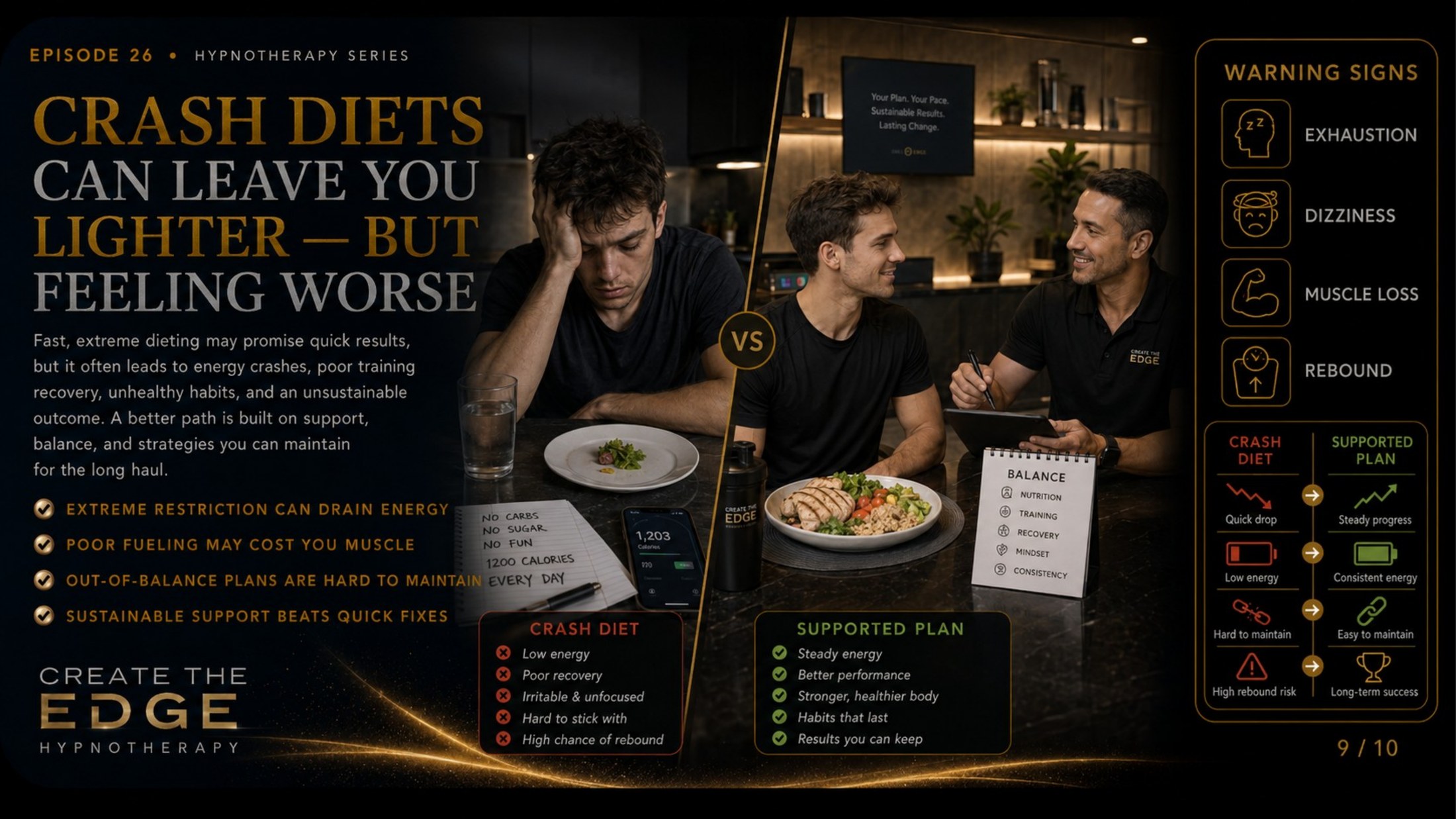
On the slideExtreme restriction can drain energy · Poor fueling may cost you muscle · Out-of-balance plans are hard to maintain · Sustainable support beats quick fixes
Episode 26 · Slide 9
Crash Diets Can Leave You Lighter — But Feeling Worse
Look at this split image — on the left, the crash diet: a man slumped forward in exhaustion, a near-empty plate, a notebook that reads *No Carbs. No Sugar. No Fun.* The outcomes listed: Low energy. Poor recovery. Irritable and unfocused. Hard to stick with. High chance of rebound. On the right, the supported plan: the same man engaged in an animated conversation with a coach, a full, balanced plate in front of him. Balance: Nutrition, Training, Recovery, Mindset, Consistency. Outcomes: Steady energy, Better performance, Stronger healthier body, Habits that last, Results you can keep.
I want to be honest with you about the path that most people have tried before they find their way to a whole-person approach. The crash diet. The extreme restriction. The weeks of white-knuckling through a plan that was never designed to be lived in — only survived.
Fast, extreme dieting may promise quick results. And often it delivers them, briefly — a rapid early drop that the scale reflects and the person feels briefly excited by. But what the scale is not measuring during that initial drop is what is being lost alongside fat: muscle, hydration, nutrient stores, and the hormonal balance that makes sustainable change possible. The body, perceiving an emergency, responds with measures designed to preserve itself. Metabolism adapts. Hunger hormones amplify. The energy available for movement and clear thinking diminishes.
Extreme restriction drains energy. Poor fueling costs muscle — the muscle that shapes the body, supports metabolism, and makes training worthwhile. Out-of-balance plans are hard to maintain not because of weakness, but because they are physiologically unsustainable. The rebound is not a character flaw. It is the body doing exactly what it was designed to do: returning to equilibrium after a period of threat.
Sustainable support beats quick fixes. Not eventually, not in theory — in practice, in the real lives of real people who have tried both. The person who loses more slowly while preserving muscle, maintaining energy, and building habits that hold reaches a better outcome than the person who loses quickly and then regains, usually more than was lost, in the months that follow.
The better path is built on support, balance, and strategies you can maintain. That path is less dramatic. It is less photogenic. And it is infinitely more powerful.
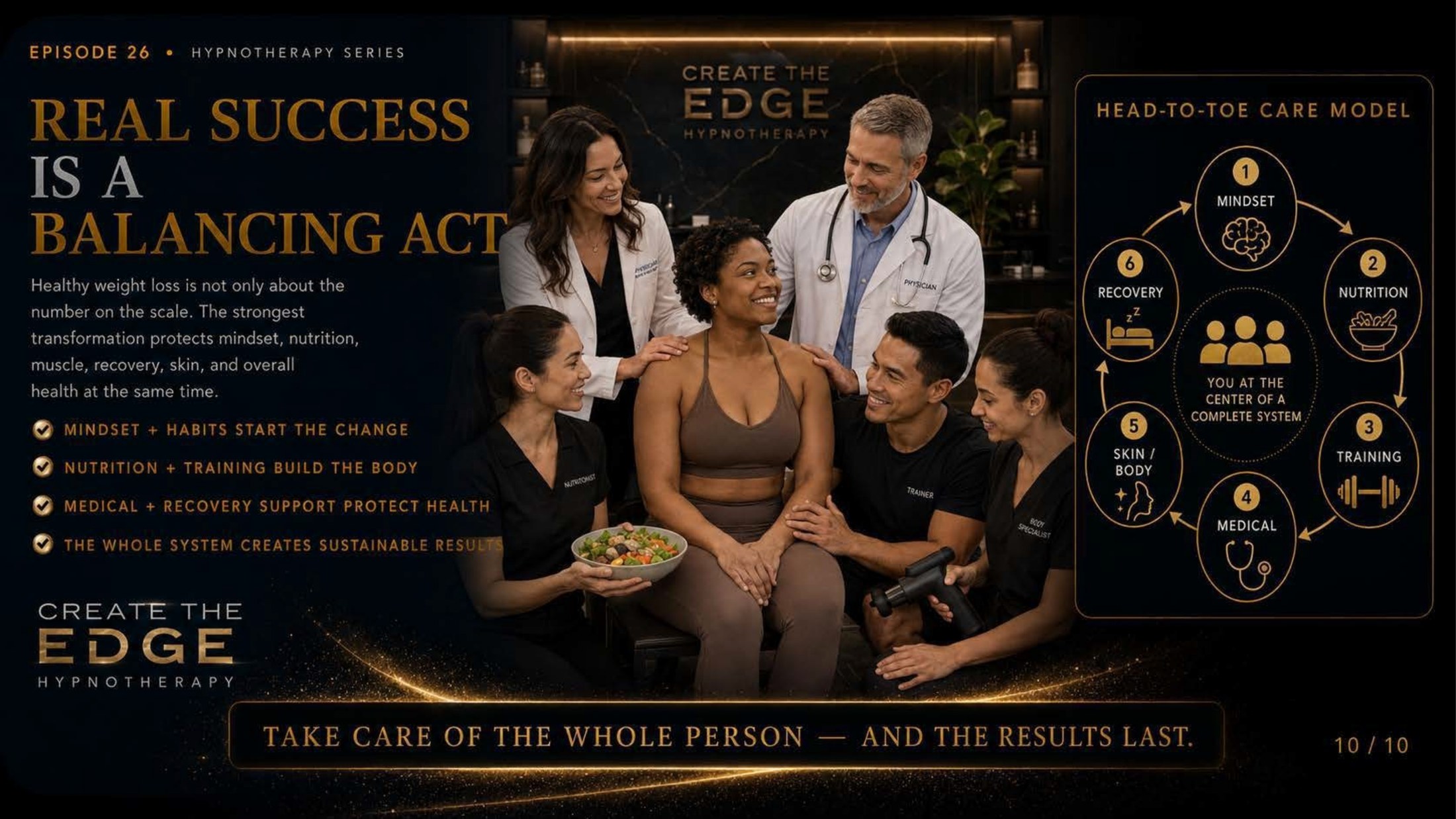
On the slideMindset and habits start the change · Nutrition and training build the body · Medical and recovery support protect health · The whole system creates sustainable results
Episode 26 · Slide 10
Real Success Is a Balancing Act
Look at this — a whole care team surrounding a client: the hypnotherapist, the physician, the nutritionist, the trainer, the body specialist. All of them present. All of them part of the system. The Head-to-Toe Care Model behind them: Mindset → Nutrition → Training → Medical → Skin and Body → Recovery → You at the center. At the bottom: *Take care of the whole person — and the results last.*
Healthy transformation is not only about the number on the scale. This is the sentence I want to close this episode with — because I have spent thirty years watching people achieve a number and still feel like they missed the point. The strongest transformation protects mindset, nutrition, muscle, recovery, skin, and overall health at the same time. It produces a person who is not just lighter but better: more capable, more energetic, more at home in their body, more clear about who they are.
Mindset and habits start the change. Not the meal plan — the belief that change is possible and the decision to pursue it. Hypnotherapy is where that foundation is built: in the subconscious, where behavior actually originates, where the old stories that have been running the show begin to be replaced by new ones. Nutrition and training build the body: giving it the fuel it needs to function and the resistance it needs to grow stronger. Medical and recovery support protect health: ensuring that the changes happening are sustainable, safe, and supported by the body's physiology rather than working against it.
And skin and body care — the professional treatments, the daily practices, the attention to the body's surface as well as its interior — complete the picture. Because the person who feels good in their skin, who carries their body with ease and care, who sees the evidence of their transformation reflected in the mirror — that person is more likely to keep going. Evidence of change fuels more change.
The whole system creates sustainable results. Not any single element of it, however powerful — but all of them working together, each amplifying the others, each contributing the piece that the others cannot provide alone.
Take care of the whole person. That has always been the answer. And it always will be. — Misty