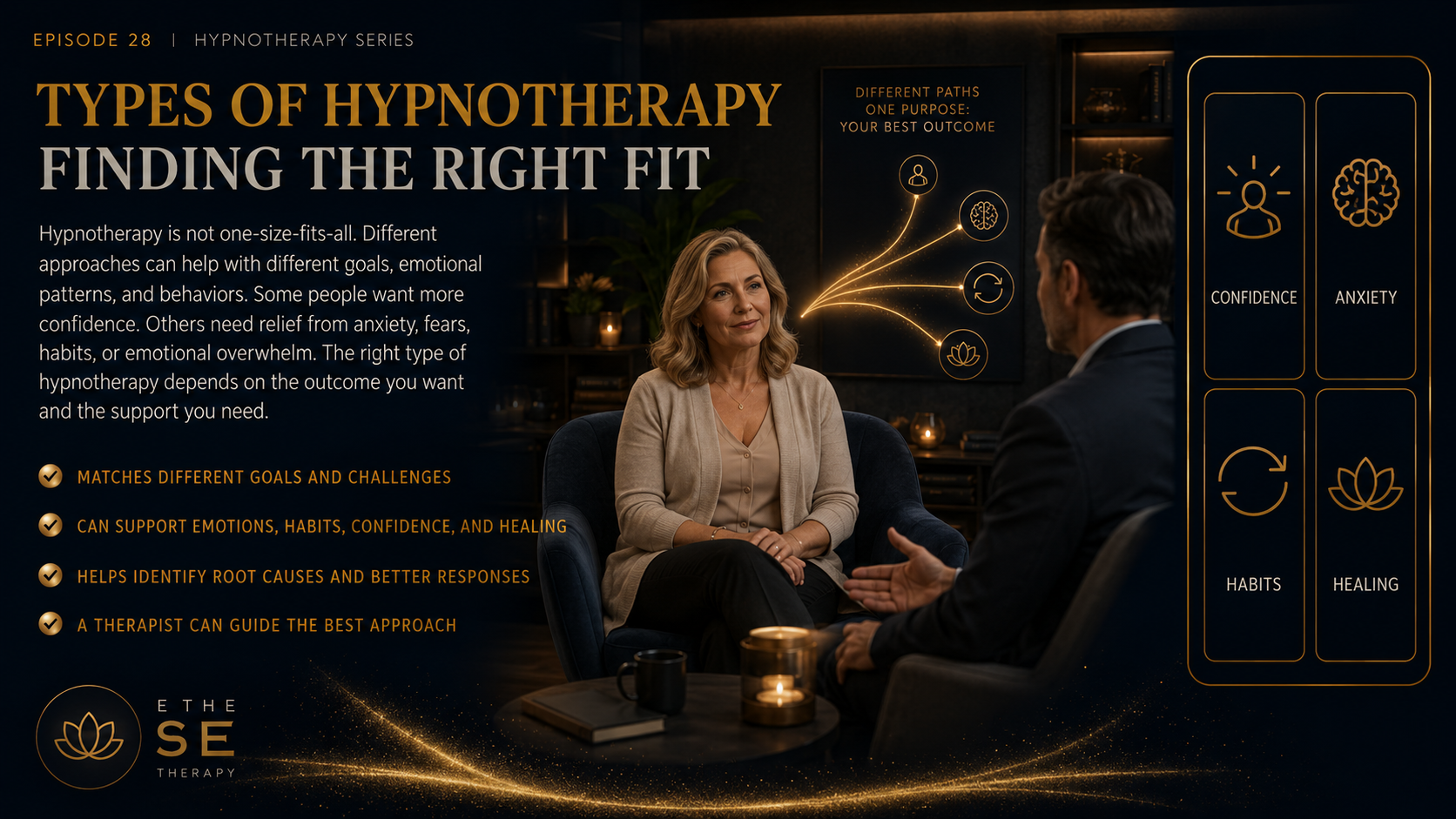
Episode 28 · Slide 1Episode 28 · Slide 1 · types of hypnotherapy: finding the right fit
Episode 28 · Slide 1
TYPES OF HYPNOTHERAPY: FINDING THE RIGHT FIT
Hypnotherapy is not one-size-fits-all. Different approaches are designed for different goals, emotional patterns, and behaviors. Some people come seeking more confidence. Others need relief from anxiety, habit patterns, fears, or emotional overwhelm.
Understanding the range of what hypnotherapy can address helps you approach the process with more clarity and more realistic expectations. The right type depends on the outcome you want and the level of support you need.
A skilled therapist can help identify which approach, or combination of approaches, best fits your situation. This episode introduces the landscape so you can arrive at that conversation better prepared.
Reflect
1. What is the primary goal or challenge that brings you to hypnotherapy right now?
2. What do you most hope hypnotherapy will help you with?
3. What has prevented you from seeking support for this area in the past?
4. What would success look like to you, in concrete, daily terms, if hypnotherapy worked exactly as you hoped?
5. What questions do you most want answered before you begin or continue working with a hypnotherapist?
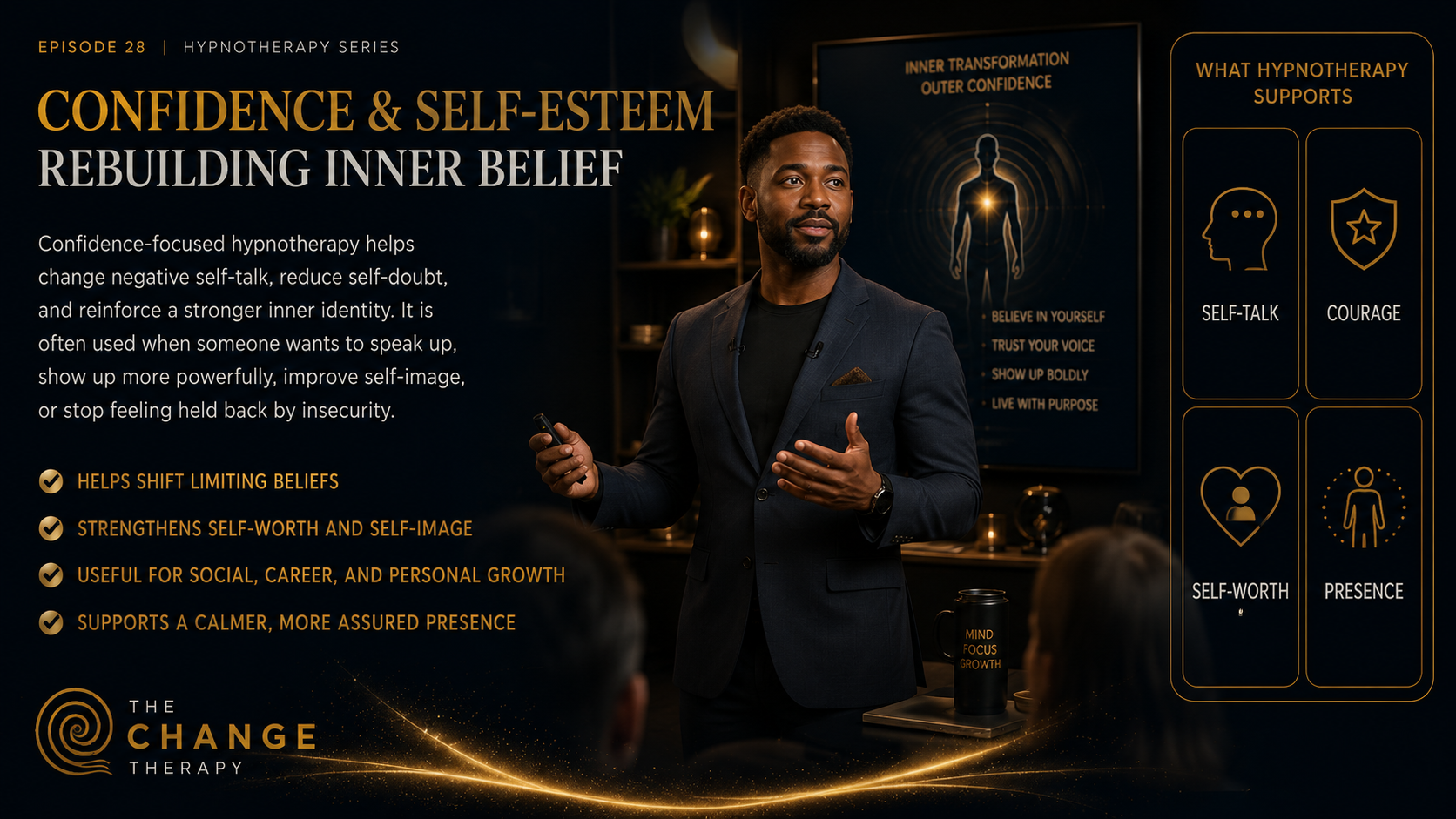
Episode 28 · Slide 2Episode 28 · Slide 2 · confidence and self-esteem: rebuilding inner belief
Episode 28 · Slide 2
CONFIDENCE AND SELF-ESTEEM: REBUILDING INNER BELIEF
Confidence-focused hypnotherapy helps change the negative self-talk, reduce self-doubt, and reinforce a stronger inner identity. It is particularly useful when someone wants to speak up more effectively, show up more powerfully, or stop feeling held back by insecurity.
This approach works at the level where limiting beliefs were originally formed, often in childhood or adolescence, and introduces new, more accurate and supportive perspectives in their place.
For many people, this type of hypnotherapy produces a shift that feels almost physical: a lightening, a settling, a sense of being more grounded in their own value without needing to perform or prove it.
Reflect
1. What limiting belief about yourself has most held you back in your life so far?
2. Where does your inner critic speak loudest? In social situations, professional settings, relationships?
3. What would a genuinely confident version of yourself believe about their own worth?
4. Have you ever had a glimpse of what it feels like to be fully yourself without self-doubt? What was happening?
5. What would change in your life if self-doubt were significantly reduced or absent?
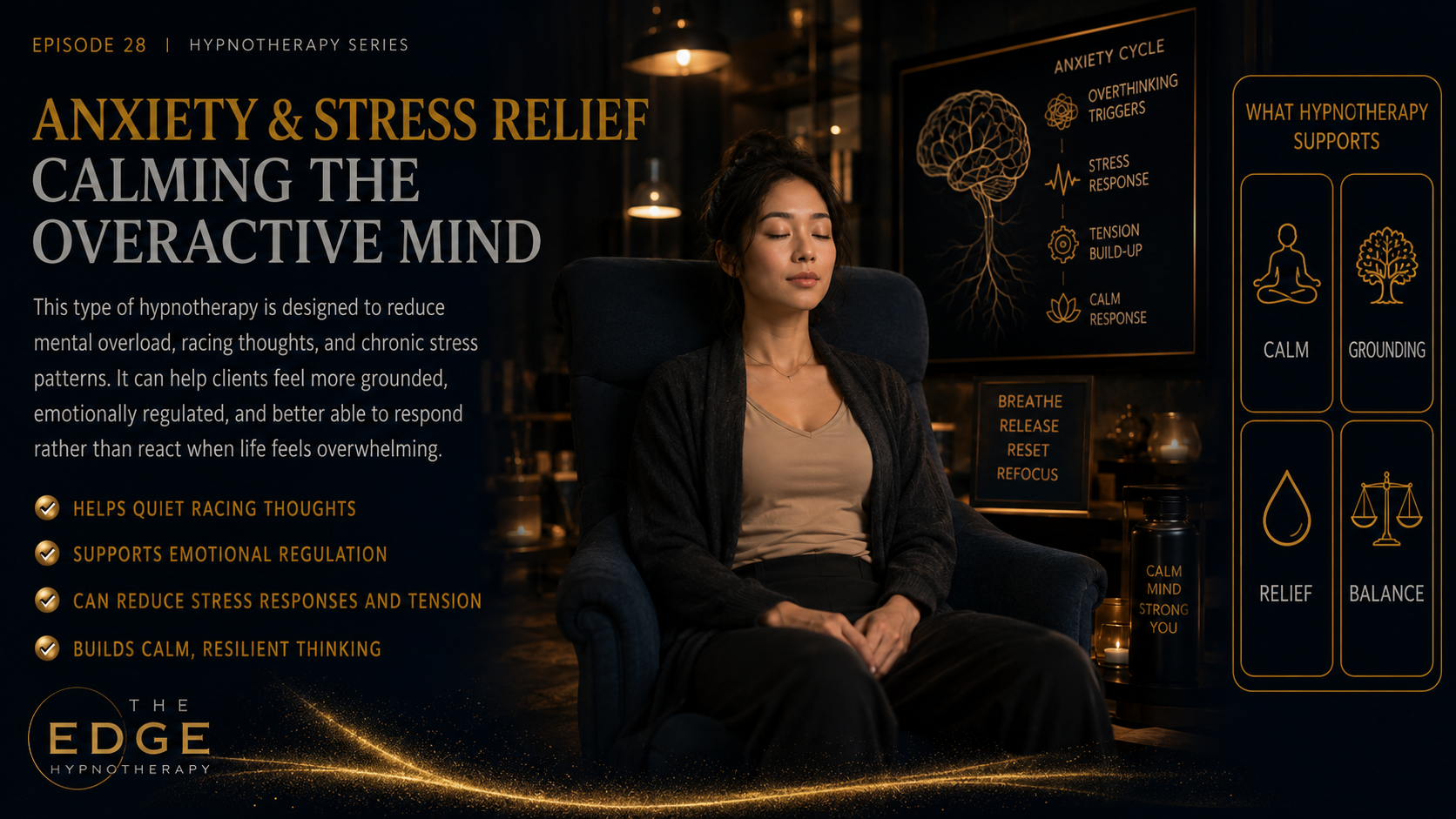
Episode 28 · Slide 3Episode 28 · Slide 3 · anxiety and stress relief: calming the overactive mind
Episode 28 · Slide 3
ANXIETY AND STRESS RELIEF: CALMING THE OVERACTIVE MIND
Anxiety-focused hypnotherapy is designed to reduce mental overload, racing thoughts, and the chronic stress patterns that keep the nervous system in a state of elevated arousal. It helps clients feel more grounded, more emotionally regulated, and better able to respond rather than react.
This approach does not try to eliminate all anxiety, which is a normal and sometimes useful response. It works to reduce the chronic, disproportionate version: the worry that wakes you at 3 a.m. over things that cannot be solved at 3 a.m.
Over time, clients often describe developing a new relationship with anxious thoughts: seeing them more clearly, taking them less seriously, and returning to calm more easily and reliably.
Reflect
1. How much of your daily mental energy goes to worry or anxious thinking?
2. What topics or situations trigger your anxiety most reliably?
3. What does anxiety feel like in your body? Where do you first feel it?
4. Have you ever found a technique or practice that reliably calmed your anxiety? What was it?
5. What would your life feel like if anxious thoughts had significantly less power over your daily experience?
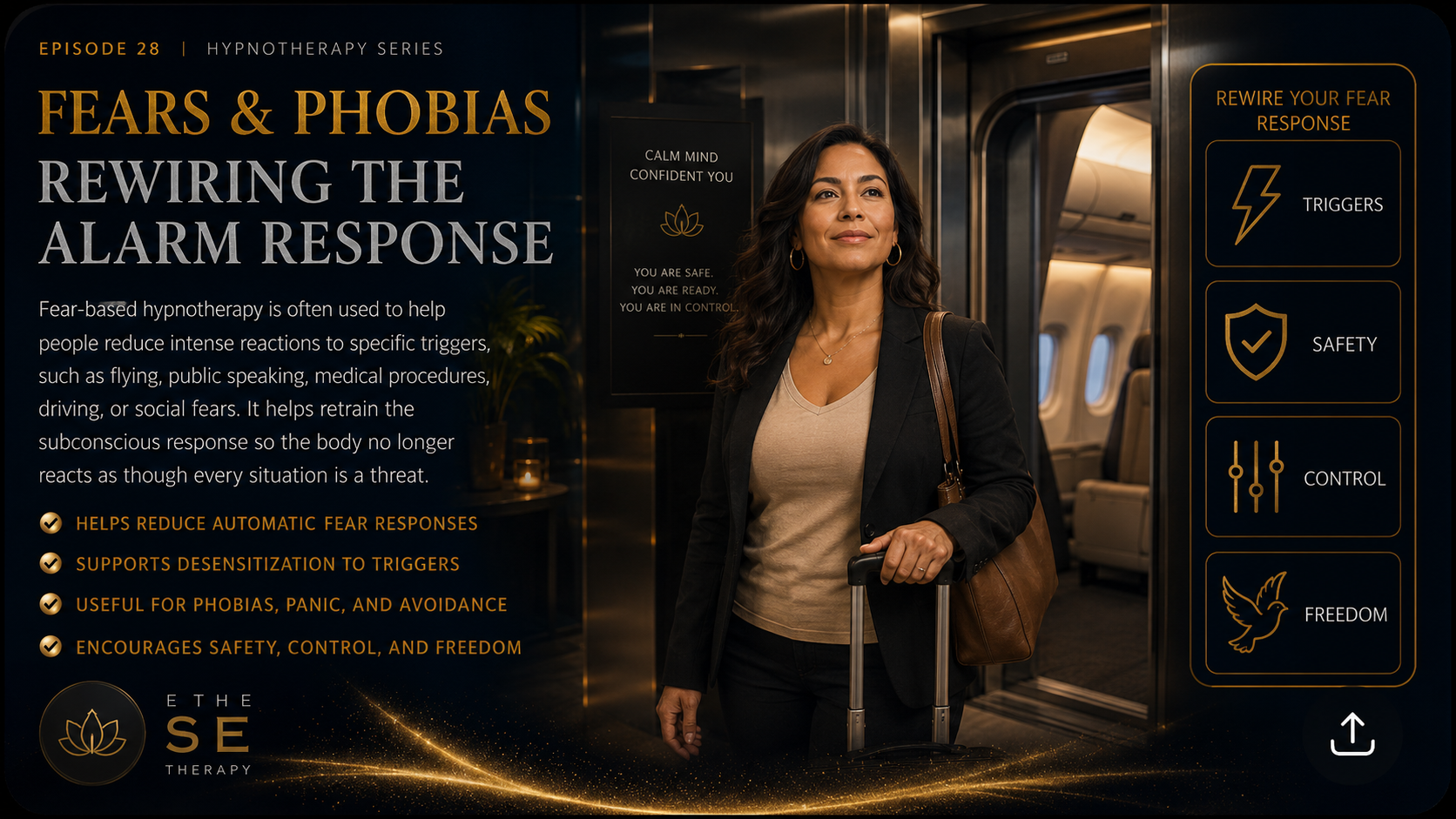
Episode 28 · Slide 4Episode 28 · Slide 4 · fears and phobias: rewiring the alarm response
Episode 28 · Slide 4
FEARS AND PHOBIAS: REWIRING THE ALARM RESPONSE
Fear-based hypnotherapy helps reduce intense automatic reactions to specific triggers, from flying and public speaking to medical procedures and social situations. The goal is to retrain the subconscious response so the body no longer treats every exposure as a genuine threat.
This works through a gradual process of desensitization, often combined with relaxation and positive suggestion, that allows the nervous system to encounter the feared object or situation with progressively less alarm.
Many people are surprised by how much their quality of life expands when a long-held phobia or fear response is reduced. Opportunities that were once simply unavailable begin to open.
Reflect
1. Is there a specific fear or phobia that has limited your choices or quality of life?
2. How long have you carried that fear? Can you trace where it originated?
3. What would you do differently if that fear were significantly reduced?
4. What would it feel like to face a previously feared situation with calm rather than alarm?
5. What has the cost of this fear been, in terms of opportunities avoided or experiences missed?
Episode 28 · Slide 5Episode 28 · Slide 5 · habits and addiction support: interrupting the cycle
Episode 28 · Slide 5
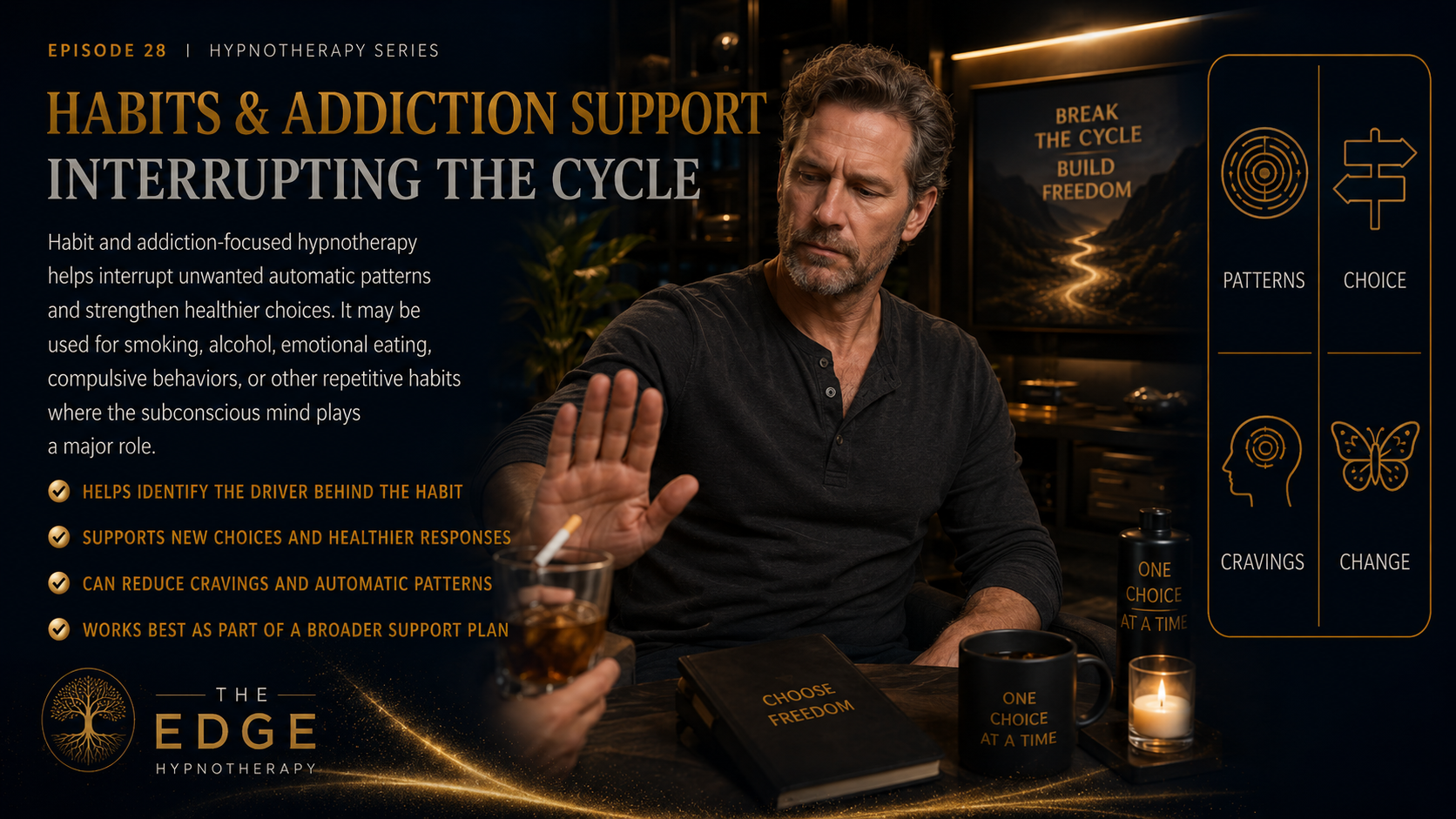
HABITS AND ADDICTION SUPPORT: INTERRUPTING THE CYCLE
Habit and addiction-focused hypnotherapy helps interrupt the automatic patterns that keep people reaching for the same response again and again, whether that is a food, a substance, a behavior, or a compulsive thought pattern.
This approach works best when it is part of a broader support plan, not a standalone solution, but as one component of a comprehensive strategy it can be genuinely powerful. It helps identify the emotional driver behind the habit and introduces healthier, more satisfying ways to meet that underlying need.
Understanding the driver is often the key. When you know what the habit is actually serving, you can begin to meet that need more directly and less destructively.
Reflect
1. What habit or pattern do you most want to interrupt? How long have you been trying?
2. What do you think the habit is actually serving, emotionally? What need is it meeting?
3. What healthier alternative might meet that same underlying need?
4. What is the earliest moment in the habit cycle where you have some capacity to make a different choice?
5. What would your life look and feel like if this pattern were genuinely resolved?

Episode 28 · Slide 6Episode 28 · Slide 6 · trauma-informed hypnotherapy: creating safety and regulation
Episode 28 · Slide 6
TRAUMA-INFORMED HYPNOTHERAPY: CREATING SAFETY AND REGULATION
Trauma-informed hypnotherapy prioritizes safety, pace, and choice above all else. It is designed to help clients feel more grounded, to gently regulate distress, and to build trust with their own inner experience without forcing anything too quickly or too deeply.
This approach recognizes that the nervous system that has been through significant stress needs to be met with great care, with absolute respect for its boundaries and its pace. The therapist's role is not to push through defenses but to create the conditions in which healing can occur naturally.
This type of work is best done with a therapist who has specific training in trauma-informed approaches and who understands the profound difference between moving through something and being pushed into it.
Reflect
1. Have you experienced significant stress, loss, or trauma that you believe is still affecting your daily life?
2. How does that past experience show up in your present, in your body, your choices, or your relationships?
3. What does feeling genuinely safe feel like for you? When and where do you most experience it?
4. What would it mean to find a therapeutic approach that meets you where you are, without pressure or rush?
5. What would healing, even partial healing, make possible in your life that does not feel possible right now?
Episode 28 · Slide 7Episode 28 · Slide 7 · sleep and relaxation: resetting rest and recovery
Episode 28 · Slide 7
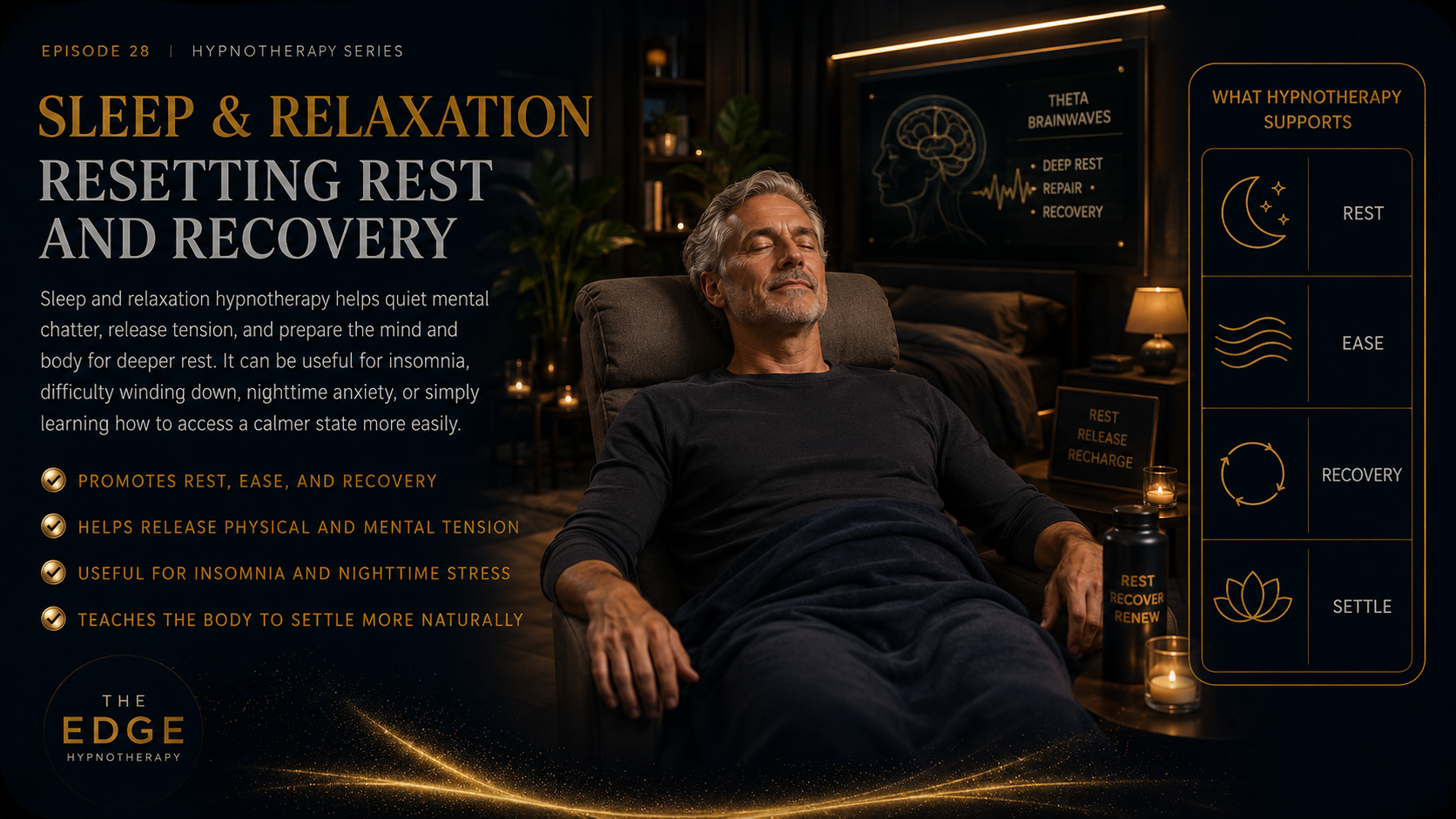
SLEEP AND RELAXATION: RESETTING REST AND RECOVERY
Sleep-focused hypnotherapy helps quiet the mental chatter, release physical tension, and prepare the mind and body for genuine rest. It is particularly useful for people who cannot seem to switch off at the end of the day, whose minds race with thoughts and worries the moment they lie down.
The approach often includes suggestions for relaxation, guided imagery for peaceful settling, and direct work with the beliefs and habits that interfere with sleep. Over time, the body begins to associate the bed with ease rather than effort.
Improved sleep changes everything downstream: mood, decision-making, food choices, exercise motivation, emotional resilience, and creative capacity. It is one of the highest-leverage changes a person can make.
Reflect
1. Describe your typical experience of falling asleep. Is it easy, difficult, or inconsistent?
2. What thoughts or feelings most often interfere with your ability to rest?
3. What is the impact of poor sleep on your daily functioning, mood, and choices?
4. What is one thing you could change about your pre-sleep environment or routine that might support better rest?
5. What would consistently excellent sleep make possible for you?
Episode 28 · Slide 8Episode 28 · Slide 8 · pain management: mind-body support for comfort
Episode 28 · Slide 8
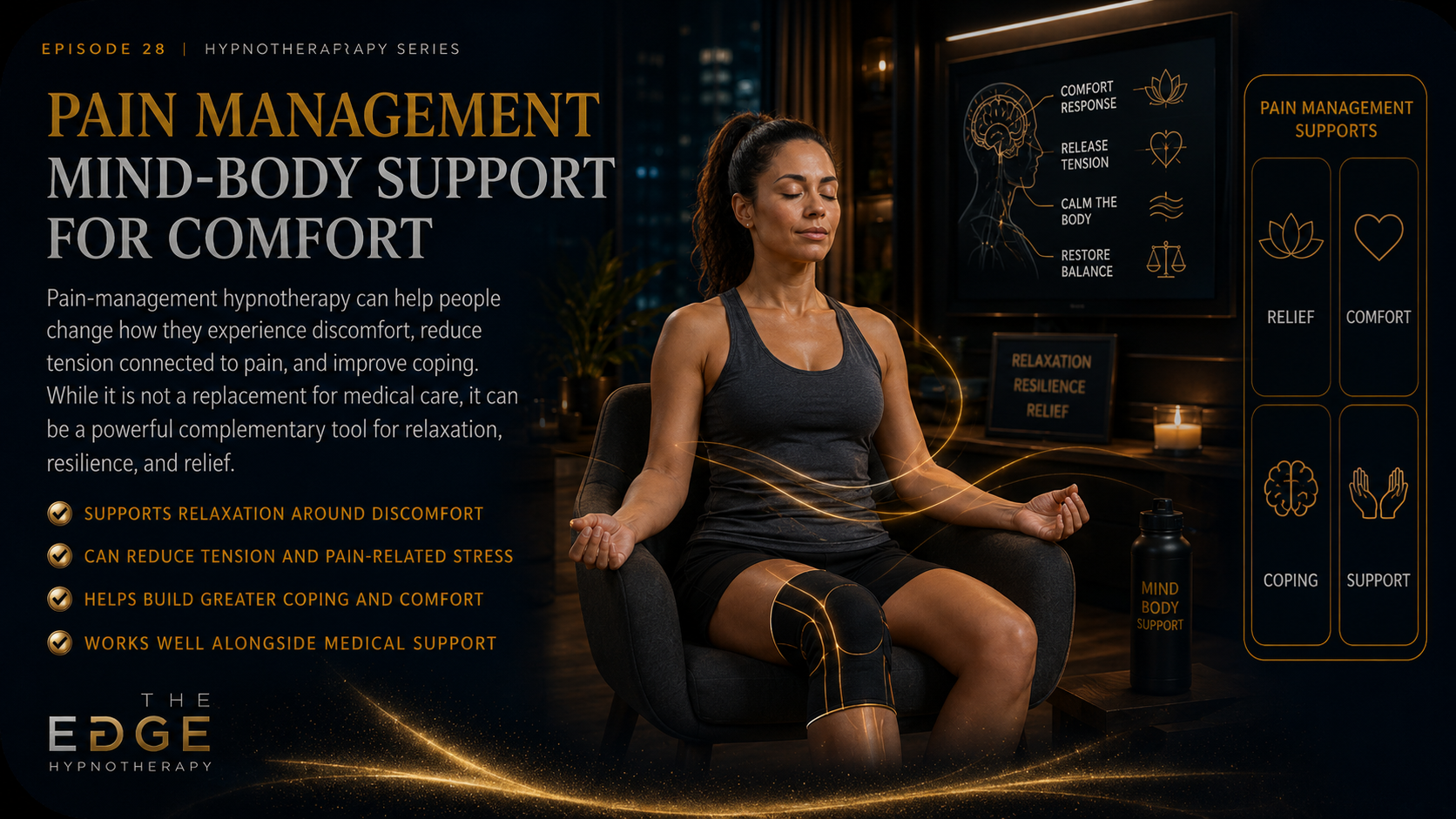
PAIN MANAGEMENT: MIND-BODY SUPPORT FOR COMFORT
Pain management hypnotherapy does not replace medical care. It works alongside it, offering a way to change how discomfort is experienced, reduce the tension and anxiety that often amplify pain, and improve coping and daily functioning.
The mind and body are not separate systems. Pain has a significant psychological component, and the perception of pain can be meaningfully influenced by mental state. When the nervous system is relaxed and the mind is not catastrophizing, pain signals are often experienced with less intensity.
For people managing chronic pain or recovering from injury or surgery, hypnotherapy can offer a genuine and evidence-supported addition to their broader care plan.
Reflect
1. Are you currently managing any chronic pain or physical discomfort? How does it affect your daily life?
2. How does your mental state affect your experience of physical discomfort?
3. Have you ever noticed pain feeling worse when you were stressed and better when you were relaxed?
4. What would meaningful pain reduction, even partial, make possible in your life?
5. How might adding a mind-body component to your pain management approach change your experience?

Episode 28 · Slide 9Episode 28 · Slide 9 · performance and goal achievement: sharpening focus and motiv
Episode 28 · Slide 9
PERFORMANCE AND GOAL ACHIEVEMENT: SHARPENING FOCUS AND MOTIVATION
Performance hypnotherapy helps strengthen concentration, motivation, consistency, and the kind of mental rehearsal that athletes, performers, and high achievers have used for decades. When the mind can clearly picture and emotionally feel a desired outcome, the path toward that outcome often becomes clearer.
This approach is effective for career goals, creative work, study performance, sports, and any domain where unconscious habits, mental blocks, or inconsistency have been limiting results.
The tools are straightforward: focused attention, positive suggestion, mental rehearsal, and the installation of new identity-level beliefs about capability and follow-through. They are simple in principle and remarkably powerful in practice.
Reflect
1. What performance goal is most important to you right now?
2. What mental or emotional pattern most interferes with your ability to perform at your best?
3. Have you ever used mental rehearsal or visualization? What was your experience?
4. What would your best performance, your actual ceiling, look and feel like in concrete terms?
5. What belief about yourself, if truly shifted, would most unlock your potential?

Episode 28 · Slide 10Episode 28 · Slide 10 · which type is right for you? choosing with a therapist
Episode 28 · Slide 10
WHICH TYPE IS RIGHT FOR YOU? CHOOSING WITH A THERAPIST
The best type of hypnotherapy depends on your goals, your history, your symptoms, and your readiness for change. A trained therapist can help you think through these factors and identify the approach or combination of approaches that most closely matches your situation.
This is not a decision you need to make alone or get perfectly right from the start. The therapeutic relationship itself is a significant part of what makes this work effective. Starting is more important than starting perfectly.
Wherever you are in your journey, there is an approach designed to meet you there. The next step is simply deciding to begin.
Reflect
1. Based on everything you have explored in this episode, which type of hypnotherapy feels most relevant to where you are?
2. What would you most want a potential hypnotherapist to know about you before your first session?
3. What concerns or hesitations do you carry about beginning this kind of work?
4. What would make you feel most safe and supported in a therapeutic relationship?
5. What is your next concrete step toward seeking or deepening hypnotherapy support?