The Model's Compass
Navigating style, business, and career resilience. A nineteen-module course for women ready to understand exactly what they bring into a room, and to present it with intention.
This is not a modeling course. It is a mirror.
Every principle in this program, from posture and color to negotiation and resilience, was built to shape a career in front of a camera. Here, the same principles are used to help a woman understand her own architecture: her coloring, her proportions, her face, her presence, and the way she wants to be experienced.
The curriculum moves through four parts. Each module teaches with real research, gives you a practical laboratory to complete, and ends with a five-question Knowledge Check and a set of flashcards so that progress can be measured, not guessed.
Learn
Each module opens with what you will be able to do, then teaches the why behind every technique, with the research named so you can trust it.
Practice
Laboratories, protocols, and final assignments turn reading into skill: a Brand Fit Fingerprint, a Color Passport, a Hair Passport, a Style Compass, a readiness-tested model bag.
Measure
Five multiple-choice questions close every module. When you are enrolled, your answers are recorded in your student dashboard so you and Misty can see exactly where you stand.
Misty L. Klein
Creator of The Model's Compass

Beauty Is More Than What You See in the Mirror
For nearly four decades, Misty Klein has worked in the beauty and aesthetics industry helping women understand, enhance, and reconnect with the person they see in the mirror. Her experience began with the fundamentals: hair, color, shape, proportion, skin, makeup, and personal presentation. Over the years that work expanded into something much deeper.
Misty became fascinated not only by what makes someone look beautiful, but by why certain colors illuminate one person and overwhelm another, why the right hairstyle can completely change facial balance, why clothing proportions alter the appearance of the body, why skin health affects how makeup performs, and why a woman can look beautiful to everyone around her and still struggle to see it herself. That curiosity became a lifelong study of beauty from both the outside and the inside.
Nearly Forty Years of Beauty Experience
Misty is a Master Cosmetologist with approximately forty years of experience in the beauty industry and a Medical Aesthetician with more than twenty-five years of experience in advanced skin and aesthetic care. Throughout her career she has worked with every element that shapes a woman's appearance and personal image: hair design and facial balance, dimensional hair color, skin health, makeup selection and application, facial proportion, personal color analysis, wardrobe coordination, body shape and visual proportion, garment silhouette and fit, personal style development, age-appropriate beauty evolution, and the confidence and self-perception that sit underneath all of it.
Rather than treating these as separate subjects, Misty sees them as parts of one interconnected system. Hair affects the perception of the face. Color affects the perception of the skin. Clothing affects the perception of proportion. Makeup affects visual balance and emphasis. Environment and habit influence behavior. And the way a woman perceives herself influences nearly every decision she makes about all of them. That systems-based understanding is the foundation of The Model's Compass.
From Beauty Professional to Transformation Designer
After decades of working closely with women, Misty recognized a recurring pattern. Women often knew what they did not like about themselves, but they did not necessarily understand what actually worked for them. They bought colors because they were fashionable, chose hairstyles from photographs of other women, purchased makeup without understanding undertone, filled closets with clothing that did not complement their proportions, and followed trends never designed for their features. Sometimes they tried to change their bodies when the real problem was that no one had ever taught them how to dress, style, and present the body they already had.
So Misty began asking a different question. Not "What is wrong with this woman?" but "What information does this woman need to understand herself better?" That distinction became one of the central ideas behind The Model's Compass.
Where Beauty Meets Psychology
Misty is also a Certified Hypnotherapist, which gives her work a dimension that is unusual in the traditional beauty industry. After years of hearing how women speak about their bodies, faces, age, weight, and worth, she became increasingly interested in the psychology of self-image, because changing someone's appearance does not automatically change the way she sees herself. A woman can receive a beautiful haircut and still criticize her face. She can own an extraordinary wardrobe and still feel uncomfortable walking into a room. She can receive compliments and immediately dismiss them. Meaningful transformation, in Misty's view, requires attention to both external presentation and internal perception. The Model's Compass was designed around both.
The Creation of The Model's Compass
The Model's Compass is the convergence of Misty's professional worlds: beauty, aesthetics, color science, hair, skin, makeup, style, body proportion, personal image, psychology, behavior, education, and now interactive technology. Her goal was never another beauty quiz. She wanted a system that could help a woman progressively understand herself: which colors truly complement her, which hair colors work with her complexion, which hairstyles balance her face, which makeup shades belong on her skin, which silhouettes work with her proportions, which pieces she should actually buy, how her beauty routine should change as she changes, and, most importantly, how to stop trying to become somebody else and learn to work with who she already is.
Misty's Philosophy
Misty does not believe beauty has an expiration date. She does not believe every woman should look the same, and she does not believe confidence should require perfection. She believes women deserve to understand themselves: to know why something works instead of simply being told that it does. Once a woman understands her colors, her proportions, her features, and her options, something changes. She stops guessing. She stops buying blindly. She stops comparing quite so much. And she begins making choices intentionally.
Etiquette and Poise

- Explain what the research on posture does and does not show, and use it without overclaiming.
- Align your body in two planes and hold that alignment while moving, sitting, and waiting.
- Deliver a handshake, an introduction, and a period of eye contact that read as warm and capable.
- Describe how first impressions form and why the first seconds of a casting matter.
- Apply industry etiquette for arrivals, agencies, castings, and digital communication.
- Recover your poise under pressure using a repeatable reset.
What Presence Actually Is
Presence is not a personality trait, and it is not something a woman either has or lacks. It is a set of measurable signals that other people read before you say a word: how you carry your spine, where your eyes rest, how you enter a room, how long you hold a hand, and how quickly your face settles after a surprise. Because these signals are physical and observable, they can be studied, practiced, and refined at any age.
This matters for you in particular. Many women who begin modeling at 35, 50, or 65 arrive with a lifetime of habits built for other rooms: the boardroom, the classroom, the kitchen table. Those habits are not wrong. They are simply tuned for a different audience. This module retunes them for casting directors, photographers, agents, and clients, while keeping the warmth and judgment you have already earned.
The Research Behind the Posture
Two lines of research shaped how the modeling and business worlds talk about posture, and it is worth knowing both, including where the science has been corrected. In 2011, Li Huang and Adam Galinsky, with colleagues at Northwestern's Kellogg School and Stanford, published a series of experiments comparing an expansive, open posture against a formal high-power role (for example, being assigned the manager rather than the subordinate). Posture, not role, was what activated a felt sense of power, prompted people to take action, and encouraged more abstract thinking. Role changed what people reported about themselves, but posture changed what they did.
A second study, by Dana Carney, Amy Cuddy, and Andy Yap in 2010, reported that two minutes in an expansive pose raised testosterone, lowered cortisol, and increased risk tolerance. That paper became famous. It was also not replicated. A larger 2015 study led by Eva Ranehill, with 200 participants, found no effect on hormones or risk-taking, and in 2016 Carney herself stated publicly that she no longer believed the hormonal effects were real. What survived is narrower and more useful: across many studies, people who hold an open posture tend to report feeling more confident. A later analysis by Cuddy, Schultz, and Fosse in 2018 found the evidence for that subjective feeling of power to be strong, even as the hormone claims fell away.
The most practical finding came in 2020, when Emma Elkjær and colleagues at Aarhus University reviewed 73 studies on expansive and contractive postures. Their conclusion was a correction to the whole conversation: the measurable benefits come mostly from avoiding a collapsed, contracted posture rather than from striking a dramatic open one. Compared with a neutral stance, contraction had a moderate negative effect on mood and behavior, while expansion added almost nothing. In plain terms, you do not need to pose like a superhero in the bathroom before a casting. You need to stop folding inward.
Teach yourself the accurate version. Open, aligned posture reliably changes how you feel and how others read you. It does not change your hormones in two minutes. The goal is a neutral, lifted, uncollapsed body that becomes your default, not a performance you switch on.
Alignment in Two Planes
Professional posture is checked from two directions, and both must agree. From the side, you are looking for a stack: each major joint balanced over the one beneath it so that muscles are not working to hold you up. From the front, you are looking for symmetry and level.
Side Alignment
Ears over shoulders, shoulders over hips, hips over knees, knees over ankles. If a plumb line dropped from your ear would land in front of your ankle bone, your head is leading and your upper back is rounding.
Front Alignment
Eyes level, chin parallel to the floor, shoulders level and drawn gently back and down, weight distributed evenly through both feet. The center of the chest faces the person you are speaking with.
Notice the phrase "back and down" for the shoulders. Many women lift their shoulders toward their ears when they try to stand tall, which shortens the neck and reads as tension. The lift you want comes from the crown of the head and the length of the spine, not from the shoulders. The chest opens because the upper back lengthens, not because the ribs are pushed forward.
Imagine a fine string attached to the crown of your head, pulling gently upward. Let the spine lengthen along it. As the string lifts, allow the shoulders to release downward and the chin to level. Hold for three breaths, then walk five steps without losing the string. Repeat this every time you stand up from a chair for one week; the goal is for the lift to become your resting state.
The First Impression Is Faster Than You Think
You may have heard that people form an impression in the first seven seconds. The research suggests the process starts far sooner. In 2006, Janine Willis and Alexander Todorov at Princeton showed participants unfamiliar faces for one tenth of a second and asked them to judge attractiveness, likeability, trustworthiness, competence, and aggressiveness. Those snap judgments matched the judgments people made with unlimited viewing time. Longer exposure, at half a second and one full second, mostly increased how confident people felt about an impression they had already formed.
Trustworthiness was the trait people judged most quickly and most consistently. For a model, this has a specific meaning. The moment you walk through a casting door, before the walk, before the card, the person behind the table has already registered whether you look open or guarded. You cannot control their snap judgment entirely, but you can control the two things that feed it: an uncollapsed body and a face that has softened rather than braced.
This is why the first section of this module was posture and not conversation. The impression is largely formed before the conversation begins. Your job in the first second is to look like someone it would be easy to work with. Everything that follows either confirms or contradicts that first read.
The Handshake
A handshake is one of the few moments in professional life when a stranger is permitted to touch you, and people read a great deal into it. In 2000, William Chaplin and colleagues at the University of Alabama had trained raters shake hands with 112 participants and score each handshake for firmness, grip, duration, eye contact, and vigor. Firmer, more complete handshakes were associated with participants who described themselves as more extraverted and open to experience, and those participants also received more favorable first impressions from the raters.
A 2011 study by Frank Bernieri and Kristen Petty added a useful caveat. Handshakes improved the accuracy of first impressions mainly in pairs where handshaking was a well-practiced, culturally expected behavior, which at the time was more true for men than for women. The lesson is not that women's handshakes matter less. It is that a handshake communicates clearly only when it is practiced and habitual. If yours is tentative because you rarely do it, practice it until it is automatic.
Two industry notes. First, read the room: on a busy casting day the director may not offer a hand at all, and reaching across a table to insist on one is a mistake. Offer when a hand is offered, or when you are formally introduced. Second, if your hands run cold or damp under nerves, keep a small handkerchief in your pocket and press your palm against it before you enter. It is a small thing that removes a distraction.
Eye Contact and the Comfortable Gaze
Older etiquette guides give percentages for eye contact, and you may have seen numbers like "hold eye contact 70 percent of the time." Those figures are folklore rather than findings. What the research does show is that people have a clear sense of how long a single stretch of mutual gaze should last. In 2016, Nicola Binetti and colleagues at University College London tested almost 500 visitors to the Science Museum from 56 countries. On average, people were most comfortable with gaze lasting just over three seconds, and most preferred somewhere between two and five seconds. Personality made surprisingly little difference. Almost no one wanted eye contact that lasted more than nine seconds.
For you, this translates into a rhythm rather than a rule. Meet the eyes, hold for a natural phrase or a breath, look away briefly to think or to gesture, and return. When you are listening, you can hold a little longer than when you are speaking, because listening gaze reads as attention while speaking gaze can read as pressure. What you want to avoid is the two extremes: the darting glance that never lands, and the fixed stare that feels like a test.
Practice with someone you trust. Ask them to tell you a two-minute story while you listen, and have them note when your gaze feels warm and when it feels either absent or intense. Most women find they drift into looking away too much, especially when they feel evaluated. Bring the gaze back to the bridge of the nose, which reads as eye contact from across a table and is easier to sustain.
Rapport Is Built in the Body
There is a reason some conversations feel easy and others feel like an interview under lights. In 1999, Tanya Chartrand and John Bargh at New York University documented what they called the chameleon effect. In their first experiment, people spontaneously copied a partner who rubbed her face or shook her foot, without noticing they were doing it. In the second experiment, a partner who subtly mirrored a participant's posture and gestures was liked more, and the interaction was rated as smoother, than when the partner stayed neutral. In the third, people who habitually take another person's perspective mirrored more.
You do not need to imitate anyone. Deliberate copying looks like a trick and reads as one. What you can do is stop fighting the natural pull. When a casting director leans in, allow yourself to lean in. When a photographer speaks slowly, slow your own pace. When a stylist laughs, let your face answer. This is not manipulation; it is the physical form of paying attention, and it is why the perspective-takers in Chartrand and Bargh's third study mirrored more than anyone else. Attention creates rapport, and rapport is what makes a person want to book you again.
Industry Etiquette: Arrivals, Agencies, and Digital Manners
Etiquette in modeling is less about which fork to use and more about respecting other people's time, space, and work. The people who hire and rehire models talk to each other, and the reputation you build in your first year follows you. The table below sets out the standards that agents, casting directors, and producers describe most often.
| Situation | The Standard | Why It Matters |
|---|---|---|
| Arrival | Arrive ten to fifteen minutes early, prepared, in the requested attire, with hair and face as briefed. | Castings run on a schedule shared by dozens of people; lateness costs everyone and is remembered. |
| Introductions | State your name and agency clearly, hand over your card if asked, and wait for direction. | The panel sees many faces; clarity helps them find you again. |
| Phones | Silent and away from the moment you enter; never photograph a studio, garment, or other model without permission. | Unreleased collections and private spaces are confidential; a leaked photo ends careers. |
| Agency communication | Reply to your booker the same day; confirm every job in writing; never negotiate directly with a client behind your agency. | Your agent's ability to place you depends on trust and on knowing where you are. |
| On set | Greet the crew, learn names, ask before touching equipment or wardrobe, and thank people on the way out. | Photographers, stylists, and assistants recommend models they enjoyed working with. |
| Social media | Post only what the client has released; tag the team correctly; keep private conflicts off public platforms. | Clients now check feeds before booking; discretion reads as professionalism. |
Notice that every row comes back to the same principle: the industry is a small, interconnected community of people doing difficult work under time pressure. Etiquette is how you show that you understand this. The model who is easy to schedule, easy to direct, and easy to have in the room becomes the model who is booked when the choice is close.
Etiquette in Practice: The Tea Room Series
Six views of a formal tea: the tables, the pour, the presentation, the greeting, the group. Notice the distances, the posture in the chairs, and the eye lines. Every rule in this module is visible somewhere in these frames.
Poise Under Pressure
Etiquette is what you do when everything goes to plan. Poise is what you do when it does not: the shoe that breaks, the panel that barely looks up, the comment about your age that lands sideways. Poise is not the absence of feeling. It is the ability to keep your alignment, your breath, and your manners while you feel it.
The physical reset is simple and can be done in a doorway. Find the invisible string. Exhale slowly through the nose for longer than you inhaled; a longer exhale is one of the most reliable ways to settle your own nervous system. Let the shoulders drop. Soften the jaw and the space between the eyebrows. Then choose one specific thing to do next, such as "walk to the mark" or "say thank you and gather my bag." Poise lives in the next concrete action, not in the story about what just happened.
When the difficulty comes from another person, the poised response is the brief one. A short, level "Thank you, I appreciate your time" ends an unpleasant exchange without giving it more of your energy. You do not owe a room your composure as a performance, but you do owe yourself the exit that you will be glad of tomorrow. Module 18 returns to rejection and comparison in depth; for now, practice the reset until it is faster than the reaction.
Practice and Final Assignment
Presence is built through repetition in ordinary rooms, long before it is needed in a casting. Work through the following exercises over two weeks, and keep brief notes on what felt unnatural, because the unnatural parts are where the growth is.
- The doorway audit. For seven days, every time you pass through a doorway, check side alignment and front alignment before you cross the threshold. Aim for the check to take under two seconds by the end of the week.
- The three-second gaze. In three separate conversations, deliberately hold eye contact for one breath at a time, then release and return. Notice where your natural rhythm drifts.
- The practiced hand. Shake hands with five people this week using the four-step protocol. Ask one of them for candid feedback on pressure and duration.
- The mirror walk. Record yourself entering a room, introducing yourself, and sitting down. Watch it once with sound and once without. Note what your body says when the words are removed.
- The reset drill. Practice the exhale, shoulder drop, and "next concrete action" sequence ten times in low-stakes moments so that it is available in high-stakes ones.
Film a mock casting entrance: open a door, walk to a mark, greet an imagined panel by name, offer a handshake to a helper, state your name and agency, and stand in alignment for five seconds. Review it against every section of this module and write a one-page note identifying the two signals that most strengthen your presence and the one habit you will retrain first. Keep this file; you will compare it with your Module 10 runway footage.
Huang, Galinsky, Gruenfeld and Guillory (2011), Psychological Science, on posture versus role; Carney, Cuddy and Yap (2010), Psychological Science, and the Ranehill et al. (2015) replication with Carney's 2016 statement; Cuddy, Schultz and Fosse (2018) p-curve analysis; Elkjær, Mikkelsen, Michalak, Mennin and O'Toole (2020) systematic review and meta-analysis in Perspectives on Psychological Science; Willis and Todorov (2006), Psychological Science, on 100-millisecond first impressions; Chaplin, Phillips, Brown, Clanton and Stein (2000), Journal of Personality and Social Psychology, on handshakes and first impressions; Bernieri and Petty (2011), Social Influence; Binetti, Harrison, Coutrot, Johnston and Mareschal (2016), Royal Society Open Science, on preferred gaze duration; Chartrand and Bargh (1999), Journal of Personality and Social Psychology, on the chameleon effect; British Psychological Society summary of a decade of power-posing research.
Skin and Hair Intelligence

- Identify your skin type and separate it from any skin condition riding alongside it.
- Build a morning and evening routine in the correct order, with evidence-supported ingredients introduced one at a time.
- Decide which skin treatments belong at home, which belong with a professional, and which belong nowhere near your face.
- Assess your hair's diameter, density, pattern, porosity, elasticity, and chemical history before choosing any product or service.
- Explain what conditioners, oils, proteins, and silicones actually do to a hair fiber, and why hair cannot repair itself.
- Evaluate a salon service, a smoothing treatment, and a stylist using the Compass safety and scorecard standards.
Half One: Your Skin as Canvas
Great skin is not about perfection. It is about health, preparation, and consistency. A model can own a sixty-dollar foundation and still photograph poorly if the barrier beneath it is irritated, flaky, dehydrated, or inflamed, because every product applied afterward performs worse on a compromised surface. The first half of this module teaches you to read your own skin the way a makeup artist reads it in the chair: type first, condition second, routine third, and only then the question of what to put on top.
The American Academy of Dermatology has been consistent for years on one point: the routine that works is gentle cleansing, moisturizer, and sun protection, not a twelve-step ritual. A simple routine you repeat every day, including the night after a long shoot, outperforms an elaborate one you abandon by Thursday.
Understanding the Skin Barrier
The outermost layer of your skin, the stratum corneum, is a thin wall of flattened cells held together by lipids, including ceramides, cholesterol, and fatty acids. Its job is to lock moisture in and keep irritants out. When that wall is intact, skin looks smooth, even, and quietly luminous under studio light. When it is compromised, by over-cleansing, harsh exfoliation, too many actives, or cold weather, water escapes, irritants enter, and the surface turns reactive and rough. Foundation then sits on top of texture instead of blending into skin.
This is why dermatologists talk so much about barrier support. A 2021 qualitative review in the Journal of Dermatology found that ceramide-containing moisturizers improve water retention and barrier function, especially in dry and barrier-impaired skin. The AAD adds two practical notes for dry skin: creams and ointments deliver more moisture than thin lotions, and moisturizer works best applied while the skin is still slightly damp.
Normal and Combination
Balanced, or balanced in some zones and oily in others. Lightweight, targeted care; do not treat every zone identically.
Dry and Oily
Dry skin needs richer layers and damp-skin application. Oily skin still needs a barrier-safe, noncomedogenic moisturizer; stripping it backfires.
Cleanse gently, pat dry, apply nothing, and wait 30 minutes. Examine your face in natural daylight near a window. Tightness or flaking across the whole face suggests dry skin. Shine across the whole face suggests oily skin. Shine through the forehead, nose, and chin with comfortable cheeks suggests combination skin. Comfortable everywhere suggests normal skin. Stinging, flushing, or itching during the wait suggests sensitivity, which can accompany any of the four. Repeat the test at the change of each season; your answer is allowed to change.
Skin Type, Skin Condition, and Skin Color Are Three Different Things
The common classifications are normal, dry, oily, combination, and sensitive. The nuance most beauty content misses is that sensitivity is not about oil production at all. The Cleveland Clinic states it plainly: you can have sensitive skin that is also dry, oily, or combination. Skin type also shifts with age, hormones, climate, stress, and medication, so a woman of 55 who "has always had oily skin" may now be dealing with dehydration and a thinner barrier.
A second separation matters just as much. Skin type describes how your skin behaves. Skin condition describes what is happening on it right now: acne, rosacea, melasma, eczema, post-inflammatory dark marks. Skin color tells a makeup artist what color family to reach for. Tone chooses the shade; condition chooses the formula and the technique.
Three conditions deserve their own notes. For rosacea-prone skin, the AAD recommends gentle cleansing with fingertips, daily moisturizer, year-round SPF 30, and avoiding alcohol, fragrance, glycolic acid, and menthol; a green-tinted concealer can camouflage redness, but the skin must tolerate whatever formula carries it. For acne-prone skin, the AAD is clear that makeup is permitted if it is labeled oil-free or noncomedogenic, removed before bed, and applied with brushes that are cleaned weekly and never shared. Acne does not require heavier and heavier coverage; it requires intelligent preparation and patience. For skin prone to hyperpigmentation, often medium to deep skin tones, irritation itself can create new dark marks, so gentleness is not optional, and the AAD specifically recommends tinted sunscreen containing iron oxides because visible light, not only ultraviolet light, contributes to dark spots.
The Order That Actually Works
The sequence below is the universal framework for healthy skin, morning and night. Products are layered from thinnest to richest, and the sunscreen always goes last in the morning because it must sit on top to do its work.
The evening routine removes the sunscreen step and adds a non-negotiable one: makeup comes off completely, including eye makeup, before you cleanse. The AAD advises removing makeup before bed every night. For a working model this is a professional discipline, not a beauty tip.
Note the phrase "if appropriate" under Treat. Many students returning to skincare after years of doing very little add a retinoid, a vitamin C serum, an acid, and a brightener in the same week. The rule in this course is absolute: introduce one active ingredient at a time, give it six to eight weeks, and only then judge it. If you add five things at once and your skin flares, you will never know which one did it.
The Ingredient Guide
You do not need to become a cosmetic chemist, but you do need to recognize the handful of ingredients with real evidence behind them, so that a label makes sense and a salesperson cannot sell you a shelf of promises.
| Ingredient | What the evidence supports | How to use it well |
|---|---|---|
| Ceramides | Skin barrier lipids; ceramide moisturizers improve hydration and barrier function, especially in dry or impaired skin (Journal of Dermatology review, 2021). | In your daily moisturizer, morning and night. Safe for every skin type. |
| Glycerin and hyaluronic acid | Humectants that draw water into the upper skin and temporarily plump its appearance. | In serums or moisturizers, applied to damp skin and sealed with a cream. |
| Niacinamide | Evidence for barrier support, pigmentation control, and some signs of skin aging (Antioxidants review, 2021). | Morning or evening; generally well tolerated and pairs with most routines. |
| Vitamin C | A meta-analysis of 31 controlled studies found topical vitamin C reduced UV-induced pigmentation (JCAD, 2019). Stability and formulation matter considerably. | Morning, under sunscreen. Buy small, keep it sealed, discard when it darkens. |
| Retinoids | Among the best supported topical ingredients for acne, pigmentation, texture, and fine lines. | Night only. Start with the gentlest strength every other night; irritation is common. Not during pregnancy. Sunscreen every morning. |
| Salicylic acid | Supported in AAD acne guidance for clogged pores and breakouts. | A cleanser or spot treatment; do not combine with a scrub. |
| Azelaic acid | Useful for acne and post-inflammatory discoloration; valuable when dark marks are the main concern. | Evening or morning; often tolerated by sensitive and rosacea-prone skin. |
| Iron oxides (in tinted SPF) | Protect against visible light, a contributor to dark spots (AAD). | Choose a tinted broad-spectrum SPF 30 or higher if you are prone to hyperpigmentation. |
A word on retinoids, since this is where students over 40 ask the most questions. The AAD's guidance is to start with the least potent formulation every other night, moisturize alongside it, and add strength only after the skin adapts. Irritation on deeper skin tones can itself trigger hyperpigmentation, so slow is not timid. Slow is correct.
Routines by Skin Profile
The framework is universal; the products inside it are not. Use the table below as your starting template, then adjust after the Bare-Face Test. Every row still follows cleanse, treat, moisturize, protect.
| Profile | Morning | Evening | Watch for |
|---|---|---|---|
| Dry | Gentle rinse or cream cleanser, hydrating serum if desired, cream moisturizer on damp skin, SPF 30 or higher. | Remove makeup, gentle cleanser, barrier-focused cream. Introduce actives slowly. | Powder emphasizes flakes; hydrate first, powder sparingly. |
| Oily | Gentle cleanser, lightweight noncomedogenic moisturizer, noncomedogenic SPF. | Remove makeup, cleanse, acne active if required, lightweight moisturizer. | Over-drying triggers more oil (AAD). Never skip the moisturizer. |
| Combination | Cleanse, hydrate the cheeks, lighter moisturizer through the center, SPF everywhere. | Remove makeup, cleanse, treat zones independently, moisturize by zone. | One face, two strategies. Powder the T-zone only. |
| Sensitive | Fragrance-free cleanser or water rinse, fragrance-free moisturizer, mineral SPF. | Remove makeup gently, fragrance-free cleanser, moisturize. | Patch test everything. Skip unnecessary acids and scrubs. Persistent burning is not "working." |
| Acne-prone | Gentle cleanser, treatment where prescribed, noncomedogenic moisturizer and SPF. | Remove makeup, cleanse, evidence-based acne active, moisturizer. | No scrubbing, no picking. Give one product six to eight weeks before judging it. |
| Mature | Gentle cleanser, vitamin C or niacinamide, cream moisturizer, SPF 30 or higher. | Remove makeup, cleanse, retinoid on adapted skin, barrier cream. | Heavy powder settles into fine lines and raises visual contrast; use it only where shine appears. |
The mature-skin row is not a different philosophy. It is the same four steps with hydration weighted more heavily and the actives chosen with care. Age changes priorities; it does not change the system.
Professional Treatments, Kitchen Comfort, and the Banned Wall
Professional treatments should solve a specific problem you have identified, not a problem social media told you every model has. Dermatologists use controlled chemical peels for uneven pigmentation, some acne, rough texture, and sun damage; the AAD warns that some peels sold for home use are causing serious injuries and that peels should be done only under supervision. Professional microneedling can help acne scars and texture, but the AAD cautions that home devices can pierce the skin, spread warts and herpes across the face, and cause scarring or color change. Microdermabrasion gently exfoliates the surface for temporary smoothness and brightness and is not the same as medical resurfacing. Laser and light procedures address specific pigment, vascular, scar, and texture concerns, and the person operating the device must have real experience with your skin tone.
Kitchen skincare has a place, and that place is comfort. A colloidal oatmeal paste (one tablespoon of commercially prepared colloidal oatmeal with cool water, ten minutes, rinse, moisturize) or a cool oatmeal compress soothes dry, irritated skin; the AAD recommends colloidal oatmeal baths for exactly this purpose. A fully cooled plain green tea compress is cooling and pleasant. Plain petrolatum on clean, slightly damp lips at bedtime treats dry lips without any scrub. None is a cure, a detox, or a substitute for formulated skincare.
Toothpaste on a pimple: the AAD says absolutely not; it is abrasive and irritating. Lemon juice on the face. Baking soda masks. Undiluted essential oils. Sugar or salt facial scrubs. Any home microneedling device that penetrates the skin. Any unsupervised strong chemical peel. Any experimental mask the night before a shoot. When acne is the problem, the evidence-based answers are adapalene, benzoyl peroxide, salicylic acid, and azelaic acid, one at a time, for six to eight weeks.
One boundary closes the skin half of this module. Persistent redness, painful cysts, rashes, spreading dark patches, a mole that changes, or any concern that does not respond to a gentle routine within two months is a reason to see a board-certified dermatologist, not a reason to buy another product.
Half Two: Hair as Professional Equipment
Models spend enormous energy on their bodies, skin, posing, and portfolios, then treat hair as an afterthought for whoever is on set. The camera does not agree. Hair condition changes the perceived quality of an entire image, in agency thumbnails, casting photographs, comp cards, and e-commerce crops, not only in beauty close-ups.
The evidence here is recent and specific. A 2025 study in the International Journal of Cosmetic Science (Will, Fink and colleagues) photographed natural hair wigs prepared for high or low shine and for orderly or disordered fiber alignment, then asked 1,500 women in the United States, Germany, and Spain, and a further 2,000 women in the United States, to judge youthfulness, health, and attractiveness. Shiny hair was chosen as healthier for every one of the ten hair types tested, and aligned fibers were consistently read as younger and healthier regardless of hair color or viewing angle. The best-rated combination was high alignment, high shine, and modest volume. The condition of the fiber is doing much of the work people credit to the cut.
Module Six covers face architecture and hairstyle geometry. This half covers what comes first: the fiber itself, how it is damaged, how it is maintained, and how to choose the professionals who touch it.
Hair Science: Why Hair Cannot Heal Itself
A hair fiber has an outer cuticle of overlapping scales and an inner cortex that holds most of the keratin and all of the pigment. The cortex is held together by three kinds of chemical bonds. Hydrogen bonds break with water and reform as hair dries, which is why a blow-dry can reshape hair until the next wash. Ionic bonds are sensitive to pH. Disulfide bonds are the strong permanent ones, and they are the bonds that relaxing, permanent waving, and bleaching deliberately break or oxidize. A 2024 review in the International Journal of Cosmetic Science (Breakspear and colleagues) describes how these bond systems together govern hair's strength, elasticity, and shape, and how chemical and thermal processes alter them.
Bleaching deserves particular respect. Peroxide does not simply lift pigment. A 2013 proteomic study in the same journal showed that bleaching oxidizes hair proteins, degrades the cuticle, damages the cortex, and increases protein loss as the treatment becomes more severe. The lesson is not "never lighten your hair." It is that you cannot repeatedly transform hair chemically without paying a structural price, and that price should be planned for, not discovered.
Now the correction that protects you from a great deal of marketing. The visible hair shaft is not living tissue; it has no blood supply and no cells capable of repairing it. Conditioners, proteins, silicones, and oils can reduce friction, flatten cuticle scales, increase shine, reduce static, improve combability, and temporarily reinforce damaged areas. A 2015 review in the Indian Journal of Dermatology (D'Souza and Rathi) lays out exactly these mechanisms. All of these effects are cosmetic and protective, and all of them wash away or wear away. So retire the sentence "this repaired my hair" and replace it with the accurate one: "this improved the condition and mechanical behavior of my hair fiber." The distinction tells you that every treatment must be repeated, and that the only permanent fix for damaged hair is time and scissors.
The Hair Condition Assessment and the Home Routine
Before you buy a product or book a service, assess the fiber. Work through the table on clean, dry hair in good light, and write your answers into the Hair Passport at the end of this module.
| Characteristic | Ask yourself | Why it matters |
|---|---|---|
| Diameter | Fine, medium, or coarse? Roll one strand between your fingers; if you can barely feel it, it is fine. | Fine hair is overwhelmed by heavy oils and creams; coarse hair drinks them. |
| Density | How many fibers occupy the scalp? Is the scalp visible at the part or hidden? | Governs volume, cut choice, and how much product the hair can carry. |
| Pattern | Straight, wavy, curly, coily, or mixed across the head? | Pattern determines washing frequency, styling, and vulnerability to tangling. |
| Porosity | Does the hair absorb water quickly and lose it quickly, or resist wetting? | High porosity usually signals cuticle damage and needs more sealing. |
| Elasticity | Does a wet strand stretch and return, or snap? | Snapping suggests protein or bond damage; over-stretching suggests too little structure. |
| Surface | Smooth, rough, frizzy, coated, or brittle to the touch? | Roughness is a lifted cuticle; a coated feel is product buildup. |
| Chemical history | Virgin, colored, bleached, relaxed, permed, or repeatedly processed? | Every service sits on top of the last; a stylist cannot plan without this. |
| Heat exposure | How often do hot tools touch this hair, and at what setting? | Heat is cumulative; the AAD advises low or medium settings with a protectant. |
| Mechanical exposure | Extensions, tight ponytails, wigs, aggressive brushing, friction? | Tension and friction damage both fiber and follicle. |
| Scalp condition | Comfortable, oily, dry, itchy, scaling, tender, or inflamed? | Hair grows from the scalp; a troubled scalp is a dermatologist's territory. |
The home routine revolves around four objectives: clean scalp, conditioned fiber, controlled mechanical stress, controlled heat. There is no universal shampoo schedule. The AAD advises washing according to how quickly the scalp becomes oily: straight, oily hair may be shampooed daily, while dry, thick, curly, or textured hair may need washing only when needed, sometimes only once a week or every two weeks. Shampoo belongs on the scalp, not scrubbed down the lengths. Conditioner follows every wash: ends only for fine or straight hair, root to tip for dry or curly hair. Press hair dry rather than rubbing, detangle from the ends upward, and when you use heat, use the lowest setting that works, with a protectant first.
Hair by Face Shape: Before and After
The same woman with a less successful cut and a more successful one, for each of the six face shapes. What changes is where the volume, length, and line sit relative to the face. Module 6 teaches how to identify your face shape; this series shows what the hair decision looks like once you know it.
Evidence Versus Folklore: Oils, Masks, Deep Conditioning, and Silicones
Coconut oil has one of the strongest evidence bases of any household hair oil. A 2003 comparison in the Journal of Cosmetic Science (Rele and Mohile) tested coconut, sunflower, and mineral oil and found that only coconut oil reduced protein loss in both damaged and undamaged hair, an effect the authors attributed to its lauric acid structure and its ability to penetrate the fiber. It is therefore a reasonable pre-wash treatment on the mid-lengths and ends of medium to coarse hair. More is not better: fine hair goes limp under it, and the scalp does not need to be saturated. The wider lesson is that "natural oil" is not one thing; molecular size and structure decide whether an oil penetrates the shaft or merely coats it, and different hair responds differently.
Egg, mayonnaise, aloe, rice water, and flaxseed masks are everywhere online. The evidence for them is thin. A 2026 narrative review in the International Journal of Women's Dermatology (Humphrey and colleagues) notes that evidence for the efficacy of many community-favored products and traditional preparations remains limited and should be recommended cautiously. In this course the standard is: natural does not automatically mean proven, safer, or more effective. Enjoy a pleasant kitchen mask if it does no harm; do not expect it to replace a conditioner with a known mechanism.
Deep conditioners earn their place for dry, chemically processed, weathered, or mechanically stressed hair. They carry more concentrated conditioning agents, sometimes with silicones, oils, and hydrolyzed proteins. Protein treatments can temporarily deposit into or penetrate damaged regions and improve mechanical behavior, but the benefit is not permanent and needs maintenance; too much protein leaves some hair feeling rigid and brittle, which is the signal to pull back and prioritize moisture.
Silicones are the most misunderstood ingredient in the category. A 2025 review in Skin Appendage Disorders concludes that silicones form a protective film that reduces friction, limits moisture loss, enhances shine, smooths the cuticle, and offers some protection against heat and chemical damage. The legitimate caveat is that water-insoluble silicones such as dimethicone can accumulate, and removing that buildup requires stronger cleansers that can dry delicate hair. Water-soluble and volatile silicones rinse away cleanly. The professional approach is formulation literacy rather than ingredient fear: match the silicone to the hair and alternate with a silicone-free or clarifying wash.
Textured Hair, Protective Styles, and Night Care
Curly and highly textured hair is a fiber characteristic, not an ethnicity, and this course teaches it that way. The 2026 review cited above urges dermatologists to describe hair by its structure (elliptical shaft, retro-curved follicle, coily or kinky pattern) rather than by race, because curl architecture exists across populations. Structurally, tightly curled fibers have more points where the cuticle is stressed, sebum travels down the shaft less evenly, and strands are more prone to tangling, knotting, and breakage. Textured hair therefore usually wants less frequent cleansing, conditioning through the full length, detangling only when wet and coated with conditioner, and minimal heat.
Braids, twists, extensions, wigs, and sew-ins can reduce daily manipulation, which is the sense in which they are called protective. They are not automatically protective. Excessive tension damages follicles and contributes to traction alopecia, and a 2016 review in the Journal of the American Academy of Dermatology (Haskin and Aguh) found that risk rises with tight styling, particularly on chemically weakened hair, and that advanced traction alopecia can become scarring and permanent. The Compass rule is short: a hairstyle that hurts is communicating something. Pain, persistent tightness, bumps along the hairline, scalp tenderness, or breakage at the edges are not the price of beauty; they are the early warning that the style is too tight or has stayed in too long.
Night care is friction control. The same review recommends satin or silk bonnets or pillowcases to reduce friction and moisture loss during sleep, and the principle applies to anyone with fragile, colored, or fine hair. A loose braid or soft scrunchie, never a tight elastic, finishes the job.
Salon Treatments and Chemical Safety
Before you agree to any service, know what it is physically doing to the fiber. Permanent coloring, perming, bleaching, and straightening all alter hair chemically; a 2023 review in Frontiers in Medicine describes how repeated or poorly controlled dyeing and perming impairs both shaft and scalp.
| Salon service | What it does | Major consideration |
|---|---|---|
| Precision haircut | Alters visual architecture around the face. | Must account for face, texture, density, your styling ability, and your modeling requirements. |
| Demi or deposit-only color | Adjusts tone and depth with less structural change than lightening. | Still requires allergy precautions. |
| Permanent color | Alters natural pigment and deposits new color. | Repeated oxidative processing weakens the fiber. |
| Bleaching | Removes melanin to reach lighter levels. | Significant, cumulative structural stress. |
| Gloss | Enhances tone and shine. | Results depend on formula and existing condition. |
| Deep conditioning | Improves lubrication and manageability. | Temporary; must be repeated. |
| Protein treatment | Temporarily reinforces damaged fibers. | Overuse leaves hair rigid. |
| Chemical relaxing | Permanently alters bonds to straighten. | Damage and breakage risk; never combine with fresh bleach. |
| Permanent waving | Chemically alters bond structure to add curl. | Requires careful processing and condition assessment. |
| Smoothing treatment | Reduces curl or frizz for weeks or months. | Ingredient safety is critical; see below. |
| Clarifying treatment | Removes selected buildup. | Excessive use increases dryness. |
Smoothing safety. The U.S. Food and Drug Administration warns that many hair smoothing and straightening products release formaldehyde gas when heated, even when the label lists formalin or methylene glycol instead of the word formaldehyde. Exposure irritates the eyes, nose, lungs, and skin and is linked to more serious long-term harm. The FDA advises never applying these products at home and asking the salon direct questions: does the product contain formaldehyde or a related ingredient, is the ingredient list and Safety Data Sheet available, has the stylist completed the manufacturer's training, is the room ventilated. A newer concern applies to some products marketed as formaldehyde-free: a 2024 correspondence in the New England Journal of Medicine reported acute kidney injury after use of a straightening product containing glyoxylic acid, with evidence of calcium oxalate crystal formation. Formaldehyde-free does not mean risk-free.
Color safety. The FDA states that hair dye can cause allergic reactions and sensitization even in someone who has colored her hair for years without a problem, because formulas change and sensitivity develops with repeated exposure. Its guidance is to perform the instructed skin allergy test every time before using a dye, to wear gloves, and to keep dye away from the eyes and never on lashes or brows. A negative test does not rule out a reaction, and a colorist who waves the test away is telling you something about her standards.
Choosing Your Stylist and Keeping Your Hair Passport
Do not search for the best stylist in town. Search for the best stylist for your hair, your career, and your objectives. Use the scorecard below at your first consultation, before any chemical service.
| Category | What you evaluate |
|---|---|
| Licensing | Is the required professional license current and displayed? |
| Specialization | Does this stylist regularly work with your texture and density? |
| Face analysis | Can she explain how the proposed shape relates to your features? |
| Color competence | Can she discuss undertone, depth, contrast, and maintenance? |
| Portfolio and similar clients | Does her actual work show the result you want, on hair like yours? |
| Consultation quality | Does she ask questions before recommending? |
| Chemical history | Does she ask what has been done to your hair before? |
| Safety | Does she patch test, strand test, and discuss product ingredients? |
| Damage strategy | Can she explain what your hair can realistically tolerate? |
| Maintenance | Can you reproduce the look at home between appointments? |
| Modeling awareness | Does she understand continuity, castings, digitals, and portfolio needs? |
| Honesty and communication | Will she refuse a service that would seriously damage your hair, and can you each explain decisions clearly? |
The consultation test. Arrive with current photographs from the front, sides, and back; reference images of what you want and what you do not want; your complete chemical history; your current product routine; any agency restrictions; and an honest statement of the time and budget you can give to maintenance. A good consultation ends with the stylist able to tell you what she recommends, why, what it will cost, what maintenance it requires, what the risks are, and what it will look like as it grows out. If she cannot, you have learned something valuable for free.
- Red flag: promises dramatic lightening today without discussing your hair's condition.
- Red flag: cannot name the chemical product being used, or dismisses scalp burning.
- Red flag: says patch or strand testing is unnecessary when it is recommended, or never asks about previous processing.
- Red flag: pulls tightly enough to cause lasting pain, cannot show work on similar hair, or gives every client the same cut.
- Red flag: insults your natural features in order to sell a service. The right stylist collaborates with your architecture; the wrong one imposes a favorite technique on everyone.
Continuity. If you were booked because your portfolio shows shoulder-length brunette hair and you arrive platinum with a pixie, you have delivered a different product than the one the client bought. Hair is part of what is being booked. A represented model should speak with her agency before any major cut or dramatic color change.
The dermatologist boundary. Stylists manage the appearance of hair. Dermatologists diagnose disease of the hair and scalp. Persistent shedding, bald patches, scalp pain, sores, inflammation, unexplained breakage, or suspected scarring should not be covered with extensions or another cosmetic treatment. The AAD recommends partnering with a board-certified dermatologist when the scalp or hair needs diagnosis, and this course agrees without exception.
Create the first two pages of your permanent Compass profile. Skin page: skin type from the Bare-Face Test, any conditions, known sensitivities and allergies, your current morning and evening routine written in the four-step order, the one active you are introducing now and the date you started it, your sunscreen, products that have irritated you, and a bare-face photograph in window light. Hair page: natural color and current formula, diameter, density, pattern, porosity, elasticity, complete chemical history with dates, allergy history, heat habits, extension history, night-care practice, products in use, your stylist's contact, date of your last chemical service, your best photographic styles, an emergency styling alternative, and photographs from the front, profile, and back. Then list every service you will do at home, every service you will book professionally, and any service your hair should not receive right now. Update both pages every season.
American Academy of Dermatology public guidance on dry skin, acne and makeup, moisturizer for acne, adult acne treatment, rosacea skin care, retinoids, sunscreen application, sun protection for darker skin tones, chemical peels, microneedling, colloidal oatmeal, and healthy hair; Cleveland Clinic, Understanding Skin Types; Journal of Dermatology (2021), ceramide-containing formulations review; Boo, Antioxidants (2021), niacinamide; De Dormael and colleagues, Journal of Clinical and Aesthetic Dermatology (2019), vitamin C meta-analysis; Will, Fink and colleagues, International Journal of Cosmetic Science (2025), hair shine and alignment; Breakspear and colleagues, International Journal of Cosmetic Science (2024), chemical bonds and hair behaviour; International Journal of Cosmetic Science (2013), redox proteomic evaluation of bleaching damage; D'Souza and Rathi, Indian Journal of Dermatology (2015), shampoos and conditioners; Rele and Mohile, Journal of Cosmetic Science (2003), coconut oil and hair protein loss; Skin Appendage Disorders (2025), silicones in hair care; Humphrey and colleagues, International Journal of Women's Dermatology (2026), Afro-textured hair care; Haskin and Aguh, Journal of the American Academy of Dermatology (2016), hairstyling and traction alopecia; Frontiers in Medicine (2023), hair dyeing and perming impairment; U.S. Food and Drug Administration, formaldehyde in hair smoothing products and hair dye safety; New England Journal of Medicine (2024), kidney injury and glyoxylic acid straightening products.
Garment Intelligence
- Explain the difference between size fit and style fit, and between functional ease and design ease.
- Diagnose a garment using the five professional elements of fit: ease, balance, set, grain, and line.
- Record your own body as geometry, including the waist-to-hip difference and vertical proportions that decide how a pattern block sits on you.
- Compare brand fit blocks intelligently instead of trusting a size number.
- Predict how fabric weight, stiffness, stretch, and drape will change a garment's behavior, and adjust your posing to suit it.
- Describe a fit problem to a designer, fit technician, or stylist in precise professional language.
The Central Distinction
A model should not think, "I am a size 6," or even "I am an hourglass." She should understand how her specific three-dimensional body interacts with a brand's pattern block, garment ease, rise, torso length, shoulder construction, fabric behavior, print, and intended silhouette. Apparel research is clear that size fit and style fit are not the same thing. A garment can be technically the correct size and still be visually wrong for a person's proportions, or fail to express the designer's intended silhouette entirely.
This module treats clothing as an engineered system. Once you see a garment that way, a fitting stops being a verdict on your body and becomes a conversation between two pieces of architecture: yours and the garment's. That shift is the foundation of everything that follows, and it is why this module sits in Part One rather than later in the course.
Why Professional Models Need This
A 2024 study in the journal Fashion and Textiles followed professional fit models through live fitting sessions and interviewed them about their work. The researchers found that the job goes far beyond standing still while pins go in. Fit models evaluate comfort, tactile sensation, fabric behavior, movement, and placement while raising their arms, sitting, squatting, and lunging, and they report problems a designer cannot see from the outside. Full-time fit models in the study were working with roughly 25 brands at a time, and the most experienced had built what the researchers describe as a personal database of how garments behave on their own body across seasons and fabrics.
A beginning model thinks: "These pants feel tight." A trained model thinks: "The waist circumference is adequate, but the low hip ease is insufficient, the back rise is pulling, the side seam is migrating toward the back, and this rigid denim has almost no recovery." That difference in language is the professional advantage this module builds. It makes you more useful in the room, and it protects you from the quiet damage of believing that a garment's failure is your failure.
The Five Elements of Fit
Fit technicians evaluate every garment through five elements. Learn them as a checklist you run silently in every fitting, in this order, before you say a word.
| Element | What It Means |
|---|---|
| Ease | The space between body measurement and garment measurement. It creates room for movement and also helps create the intended silhouette. |
| Balance | Whether a garment hangs correctly around the body, rather than pulling forward, backward, or sideways. |
| Set | How smoothly a garment sits. Unwanted wrinkles, drag lines, puckering, or tension signal a fit problem. |
| Grain | Whether the fabric grain sits where the patternmaker intended. Twisting side seams and rotating trouser legs reveal grain issues. |
| Line | Whether seams, waistlines, bust lines, shoulder seams, hems, and design lines align correctly with the body and the design. |
Functional ease lets the body move. Design ease creates the silhouette. A fitted sheath and an oversized coat can both be correctly fitted despite dramatically different amounts of ease. "Loose" is not automatically "too big," and "close" is not automatically "too small." When you evaluate a garment, ask first what silhouette the designer intended, and only then whether the ease serves it.
The Body as Geometry
Beyond the five familiar shape categories (Apple, Pear, Rectangle, Hourglass, Inverted Triangle), a professional specification record tracks measurements most students never think about. Research on body-optimized pattern systems considers proportion, circumference differences, and posture, because two people with identical circumferences can still require different pattern adjustments. Shape labels are a useful starting vocabulary, but they are not a measurement.
| Measurement | Why It Matters to Clothing |
|---|---|
| Full bust and under bust | Bodice volume, button tension, darts, princess seams, jacket closure, lingerie, and formalwear. |
| Natural waist and high hip | Primary reference for dresses, trousers, skirts, and belts; high hip shapes fitted skirts and pants. |
| Full hip and full seat | Trousers, denim, skirts, dresses, and coats; the seat matters when the buttocks project beyond the widest side hip. |
| Shoulder width and slope | Jackets, tailoring, coats, and structured dresses; slope decides whether seams sit cleanly or throw diagonal wrinkles. |
| Front and back torso length | Bust placement, waist position, back waist placement, and jacket balance. |
| Front and back rise | Critical for pants and denim; back rise is especially important for a prominent or flatter seat. |
| Inseam, outseam, thigh, calf | Trouser length, leg proportion, waist placement, and fit through skinny trousers, boots, and leggings. |
| Total height and torso-to-leg ratio | Sample and runway reference; explains why identical garments look different on two models of the same height. |
One number matters more than most: waist-to-hip difference. A woman with a 28-inch waist and a 38-inch hip (a 10-inch difference) and a woman with a 27-inch waist and a 42-inch hip (a 15-inch difference) can both wear a nominal size 6. They should not automatically be expected to fit the same pants pattern, and neither of them is "wrong." They are simply different geometry, and different geometry calls for a different block.
Measurement and Body Shape Guides
The three reference charts that open the body-architecture work: how to take the professional measurements, the six body-shape lineup, and the same six shapes on slim frames. Read them together, because shape is a matter of proportion, not size.
Brands Are Built Around Different Bodies
A size number is not universal. A brand develops garments from its own fit block and target customer, and even within one company, different collections carry different proportions. Zara states openly that sizing can vary with the style, cut, and fabric of each garment, and Reformation notes that its silhouettes range from slim to oversized and recommends checking bust, waist, high hip, and low hip against each piece. The rule this module teaches: never learn a brand only by size. Learn its block, proportions, fabric habits, and individual garment categories.
Abercrombie: Curve Love
Adds roughly 2 additional inches through hip and thigh versus the regular fit in the same waist size, while keeping a proportional waist to reduce gapping. A logical starting point for a pronounced waist-to-hip difference, though it does not mean every hourglass body will fit the line. It means the block is engineered around a different waist-to-hip relationship.
Madewell: Curvy
Built for curvier figures with a contoured waistband that prevents gapping, extra room at hip and thigh, and a longer rise. A reminder that a prominent seat often needs more back rise, not just more hip circumference.
Aritzia: Original vs. Curve Fit
Separate fit blocks plus short, regular, and tall proportions. Proof that width is only one dimension; height, rise, and torso length matter just as much. Classify yourself vertically as well as horizontally.
Everlane: Original Cheeky vs. Cheeky Hourglass
Same size 28, two different bodies. Everlane's chart lists the Original at a 29-inch waist and 39-inch hip, and the Hourglass at a 27-inch waist and 42-inch hip. One label, two completely different architectures. This is the cleanest classroom example in the industry.
Good American
Contour seaming, gap-resistant waistbands, and power-stretch or super-stretch denim across several lines. Proof that fabric mechanics can radically alter fit independent of the pattern. The pattern is only half of the garment.
Universal Standard
Sizes 00 to 40, fit-tested across the full range rather than one pattern mathematically enlarged. Bodies do not scale like a photograph: shoulders, bust projection, rise, arm circumference, and torso length change at different rates.
Gucci and Luxury Sizing
A luxury house builds its size chart on its own sample block, and the steps between adjacent sizes are small. A model may fit the waist specification of a sample while needing more room through the hip. In that situation the garment is not proof that the body is wrong. It means the garment block and the body architecture do not match perfectly.
Build Your Brand Fit Fingerprint
Instead of "I wear Gucci size 4," a trained model records something closer to a diagnostic report. Built consistently, this becomes a personal database, exactly what the fit models in the 2024 study developed naturally over years of work. Yours can begin this week.
| Field | What to Record |
|---|---|
| Brand and category | Fashion house, and whether the piece is a tailored trouser, denim, dress, jacket, coat, or knit. |
| Size | Tagged size and region (US, EU, UK, IT) where relevant. |
| Waist, hip, rise, thigh | Correct, loose, tight, tension, excess, too short, too long, or alteration needed. |
| Fabric and stretch | Fiber and construction; stretch none, low, moderate, or high. |
| Waist gap and seat drag lines | None, mild, or severe. |
| Hem position | Correct, or adjustment needed. |
| Movement test | Sit, squat, lunge, walk, and arm reach as appropriate. Does a deep squat restrict? |
| Alteration | The specific tailoring recommendation that would fix it. |
Fabric Changes Everything
Garment appearance is shaped by bending stiffness, shear stiffness, weight, thickness, construction, yarn properties, and finishing, not by weight alone. Drape describes how a material hangs under its own weight: a rigid fabric maintains structure, while a softer fabric falls into deeper folds. A relatively heavy knit can drape beautifully, and a lighter fabric can remain very stiff. When you learn to predict fabric behavior before a garment is on your body, you can predict how it will photograph and how you will need to move in it.
| Fabric Family | Examples | Visual Effect |
|---|---|---|
| Very fluid | Charmeuse, soft satin, viscose, selected crepes | Follows gravity and body curves; creates movement |
| Soft knit | Jersey, modal knit, fine rib | Conforms closely to the body |
| Stable knit | Ponte, double knit | Follows the body with greater structure |
| Crisp woven | Poplin, organza, crisp cotton | Holds away from the body, creates shape |
| Structured woven | Tailoring wool, gabardine, heavy twill | Creates architectural lines |
| Rigid denim | Mostly cotton denim with little stretch | Holds shape, demands accurate pattern fit |
| Stretch denim | Denim with elastane | Adapts more readily to body variation |
| Heavy coating | Wool coating, dense melton | Adds substantial structural volume |
| Sheer lightweight | Chiffon, organza, voile | Visual layering without heavy physical volume |
| Bias-cut | Satin, silk, crepe on the diagonal | Contours the body using diagonal grain |
Fabric weight is usually expressed in grams per square meter. As working teaching ranges (not universal textile standards), extremely light fabrics sit around 50 to 100, light around 100 to 170, medium around 170 to 280, heavy around 280 to 450, and very heavy above 450. Use these numbers as a first orientation only. Two fabrics of identical weight can behave completely differently depending on fiber and construction.
Matching Fabric to Body Architecture
| Body Architecture | Useful Fabric Behavior When Seeking Balance |
|---|---|
| Rectangle | Structured fabric adds dimensional shape; draped fabric with waist manipulation creates curvature |
| Hourglass | Moderate drape follows the waist naturally; extreme stiffness bridges over it, and very limp fabric may cling more than desired |
| Triangle / Pear | Softer fabric skims the lower body; more structure or detail above creates presence |
| Inverted Triangle | Softer fabric at the shoulders; more structure or volume below creates balance |
| Oval / Round | Medium-weight fabric with clean vertical fall creates continuity; very thin jersey reveals every contour and very rigid fabric builds a box |
These are styling strategies toward a desired visual result. They are not rules declaring that any body should hide or change itself.
Body Shape Series: Fuller Frames, Before and After
Six shapes, each shown twice on the same woman: a less successful look and a more successful one. Read them as strategies toward a visual result, never as rules about what a body should hide.
Posing Changes With the Fabric
A model who understands fabric before she steps in front of the camera can present a garment the way its designer imagined it. Each family asks for a different body.
- Fluid silk or satin. Use extended lines and give the material time to fall. Slow turns create secondary motion; a slight twist activates reflected light across satin. Hands should not crush the fabric.
- Structured tailoring. Posture is everything. The jacket shoulder line must stay visible, and excessive arm crossing can destroy the silhouette the designer built.
- Pleated fabric. Movement activates the design. A slight turn may reveal more than a static frontal pose.
- Jersey. Because it conforms closely, posture, pelvic position, shoulder placement, and abdominal tension all become visible.
- Denim. Know the intended rise, seat fit, leg shape, and hem break before you stand or move, and whether the denim is rigid or stretch.
Pattern Is More Complicated Than "Stripes Slim, Stripes Widen"
The conventional rule that horizontal stripes always widen and vertical stripes always slim is too simple. A 2026 study in the journal i-Perception surveyed 214 respondents viewing a model in dresses with five stripe configurations. Narrow horizontal pencil stripes with a 2-centimeter gap were judged the most slimming from the front, wider horizontal spacing lost the effect, and vertical stripe results were inconsistent and changed with the viewing angle. The researchers concluded that direction, stripe type, and spacing all shape the effect together. The real lesson: pattern direction never acts alone. Scale, spacing, silhouette, contrast, body geometry, and viewing conditions work together.
Plaid
An excellent fit diagnostic. When lines that should travel horizontally rise sharply over the seat or bust, everyone can see what the fabric is doing in three dimensions.
Large Prints
Large motifs create focal points. Placement on the bust, hip, abdomen, or shoulder directs attention there.
Small Prints and Borders
Fine repeats read as texture from a distance. A border print creates a strong visual termination that can divide the leg, torso, hip, or hem.
Diagonals and Color Blocking
Diagonal movement creates energy and redirects the eye. Blocks of contrasting color create boundaries; know exactly where those boundaries fall on your body.
The Most Important Correction to Body Shape Education
Do not learn "Pear bodies should wear this." Learn the interaction between body architecture and garment architecture. That is more sophisticated, more accurate, and more respectful. Think of the final visual result as a sum: body geometry plus brand block plus garment ease plus fabric mechanics plus silhouette plus pattern plus color plus length plus styling plus movement. Change any term and the result changes. This is also why Module 4, Color Intelligence, eventually merges with this one in practice.
The Professional Vocabulary
This vocabulary is what lets a model communicate professionally with designers, fit technicians, stylists, photographers, and wardrobe departments. Instead of "it feels weird," she can say exactly what is happening and why. In a fitting, describe what you observe and what you feel, in that order, and let the technician decide the fix. "The back rise is pulling when I sit, and there is a drag line from the seat toward the side seam" is a gift to the person holding the pins.
Put on the trousers you wear most. Sit, squat, and walk. Then write three sentences: one on ease (where is there too much or too little?), one on balance and set (which direction do drag lines travel?), and one alteration you would request. Do this for five garments and you have the first page of your Brand Fit Fingerprint.
Body Shape Series: Slim Frames, Before and After
The same six shapes on slim frames, to make the point that body architecture is about proportion at every size.
The Ten-Lesson Sequence
Five garments, no guidance. Identify each garment's probable fabric behavior and intended ease, the measurements that matter most, which of your own proportions will affect the fit, what movement will test it truthfully, whether tension lines mean insufficient ease or poor balance, how to pose to present it, what size you would try first, whether a standard or curvy block is likely to suit, and how you would communicate all of it to a designer.
Yang and Baytar (2024), "Fit models' roles in identifying fit issues in the apparel product development process," Fashion and Textiles; Chen and Peng (2026), striped clothing and visual body perception, i-Perception; Everlane size charts for the Original Cheeky and Cheeky Hourglass jeans; Abercrombie Curve Love fit description; Madewell Curvy fit description; Aritzia, Good American, Universal Standard, Zara, and Reformation fit guidance; ScienceDirect Topics overviews of fabric drape and garment design.
Color Intelligence

- Describe any color in the four professional dimensions: hue, value, chroma, and contrast.
- Explain the perceptual science behind why surrounding color changes how a face is read, without overstating it.
- Conduct a controlled draping comparison and read the signal rather than the preference.
- Place yourself on temperature, value, chroma, and contrast coordinates, using seasonal names only as shorthand.
- Build three working palettes (near-face, wardrobe foundation, impact) and choose neutrals that are right for you.
- Compensate intelligently when an assignment puts you in a difficult color, and choose casting colors that keep you the dominant visual information.
Beyond "Which Season Am I"
A professional model does not just know she likes a green. She can say: this is a moderately muted, medium-value, slightly warm green; it harmonizes with my skin; it gives enough contrast to define my features without overwhelming them; and it should photograph well under this lighting. That is Color Intelligence: understanding what color is doing, not memorizing which bucket you belong to.
Personal color analysis, properly understood, is a structured method for finding which colors create the most visually harmonious relationship between a person and the colors around her, especially the colors close to her face. Traditional systems evaluate some combination of skin, eyes, hair, depth, warmth, coolness, clarity, softness, and overall contrast. This module keeps what is useful in those systems and replaces the folklore with what can actually be observed and measured.
Four Real Dimensions, Not One Label
Color science describes color through three core attributes, formalized in the Munsell system that remains a reference standard: hue (the color family, such as red, yellow, green, blue, or the transitions between them), value (how light or dark a color is, on a scale running from black to white), and chroma (how intense or muted it is, measured as distance from neutral gray). For a model, a fourth matters just as much: contrast, the degree of difference between skin and clothing, hair and skin, eyes and skin, facial features and skin, and the colors within an outfit. These four dimensions are more professionally useful than any seasonal name.
| Dimension | Professional Meaning |
|---|---|
| Hue | The basic color family and the transitions among families. |
| Value | How light or dark the color is. |
| Chroma | How intense, pure, vivid, muted, gray, or soft the color appears. |
| Contrast | The degree of difference between colors: skin and garment, hair and skin, features and skin, colors within an outfit. |
The Real Science Behind Why This Works
The CIE, the international body that defines color science vocabulary, describes chromatic induction as the change in visual response that occurs when two color stimuli are viewed side by side, each altering the appearance of the other. Simultaneous contrast is its everyday form. The shirt does not physically alter your skin; it alters the visual context your face is read against. A 2025 apparel study in Coloration Technology tested 22 plain sweatshirts across a range of hues, saturations, and lightness levels and found measurable relationships between garment color and how observers perceived the wearer's complexion, with darker garments tending to make skin read as fairer. Earlier controlled studies have likewise found systematic differences in which clothing colors observers judged suitable for faces with different skin coloring. The basic premise of color analysis has real empirical support.
There is also real research behind "wrong colors make you look tired." Facial contrast, the luminance and color difference between the eyes, brows, and lips and the surrounding skin, reliably decreases with age. A 2017 study in Frontiers in Psychology measured 763 women aged 20 to 80 across four populations on three continents and found the same pattern in each; when researchers digitally increased that contrast, observers from two different cultures judged the faces as younger in roughly four out of five trials. The honest version of the styling claim is not "the wrong blouse makes you unhealthy." It is that some surrounding colors reduce the visual clarity of your natural contrast, emphasize redness, shadow, or sallowness, or compete with your coloring, and harmonious ones let your features read as clearer and more defined. Appearance, not physiology.
Skin itself is optically complex. Melanin, hemoglobin, carotene, blood flow, and skin thickness all contribute to what we perceive as skin color, and instruments such as colorimeters measure it in the CIELAB system as lightness (L*), a red-to-green axis (a*), and a yellow-to-blue axis (b*). Two women of similar visible depth can differ in redness, yellowness, chroma, and facial contrast. That is why an identical garment interacts differently with two faces, and why skin tone (how light or deep) and undertone (a styling description of whether warmer or cooler colors harmonize) are not the same thing. Yellow-toned skin does not automatically mean warm. Undertone is determined by comparison, never by assumption.
Seasons are a framework, not biology. Traditional stylist categories are not standardized scientific measurements, and different systems can produce different recommendations. Treat "Spring" or "Winter" as useful shorthand for where you sit on the four real dimensions, not a diagnosis. Never use race or skin depth to assign a season. Deep skin is not automatically Autumn or Winter; light skin is not automatically Spring or Summer. Pantone's SkinTone Guide, developed by measuring thousands of real skin tones, documents 138 distinct shades, and people with similar pigmentation still differ in hue, chroma, redness, eye color, hair color, and contrast. Every palette in this course should be shown across the full range of skin tones, never implied to belong to one.
Why the Vein Test Is Not Reliable
Correcting common advice: the familiar rule that green veins mean warm undertones and blue veins mean cool undertones is not a professional diagnostic. Optics researchers publishing in Applied Optics showed in 1996 that veins look bluish even though the blood inside them is dark red, because of how skin scatters and absorbs different wavelengths, the depth and diameter of the vessel, and the way the visual system judges the vein against the surrounding skin. In other words, the color you see is a product of contrast and illumination, not a stable read of your coloring. The gold-versus-silver jewelry comparison is a fine observational starting point, but neither test is proof. The only reliable method is controlled, systematic draping: comparing real fabric against your face under neutral light, which is what the rest of this module teaches.
Color Analysis Chart Series
The eight course charts on color: the four seasons, why analysis matters, undertones, the draping steps, the palettes side by side, swatches for shopping, and the emotional power of wearing your colors. The undertone chart shows the popular vein and jewelry shortcuts; treat them as a starting observation only, because the draping protocol in this module is the method that decides.
Think in Coordinates, Not Categories
Instead of forcing yourself into one of four boxes, place yourself along four spectrums: Temperature (warmer to cooler), Value (lighter to deeper), Chroma (softer to brighter), and Contrast (lower to higher). "Neutral-leaning-warm, medium value, high chroma, medium-to-high contrast" tells a stylist far more than "Spring." The twelve-season system (Light, Warm, and Bright Spring; Light, Cool, and Soft Summer; Soft, Warm, and Deep Autumn; Deep, Cool, and Bright Winter) exists precisely to capture these neighboring combinations.
Seen this way, the neighbors make sense. Bright Spring and Bright Winter both tolerate high chroma; temperature separates them. Soft Summer and Soft Autumn both suit muted color; again temperature decides. Deep Autumn and Deep Winter both carry depth; temperature and chroma distinguish them. Once you understand these relationships, seasonal analysis stops being mysterious. It becomes a system of coordinates.
The Draping Laboratory
Professional color analysis holds real fabric against a clean, makeup-free face in neutral daylight and watches what happens in real time. Human color appearance changes with illumination and adaptation, so the conditions matter as much as the drapes. It is a five-step comparison, narrowing the field at each stage:
What are you looking for at each step? Complexion uniformity. Unwanted redness. A yellow or gray cast. Shadow visibility under the eyes and jaw. Eye definition, lip definition, jaw definition. Overall facial contrast. And finally, whether the fabric has become visually dominant over the face. Write your observations down in that language. "Prettier" is not an observation.
The Four Seasons: Broad Territories
Use these as shorthand starting points, not fixed categories. Refine within your temperature, value, chroma, and contrast coordinates once you have drape-tested.
Spring
Summer
Autumn
Winter
Natural vs. Current Presentation Color
Models need two separate profiles. Natural Color Architecture evaluates skin and native facial characteristics as objectively as possible. Current Presentation Color covers current hair, brows, makeup, and tan, because a model can go brunette to platinum without changing her skin biology at all, yet dramatically change the visible contrast frame around her face. Platinum can raise or lower contrast depending on the skin beneath it; jet black sharply increases hair-to-skin contrast; copper introduces warmth; ash introduces softness; fashion colors introduce deliberate artificial contrast. Keep both profiles current, and update the second one every time your hair changes.
Three Practical Palettes
| Palette | Use |
|---|---|
| Near-Face | Tops, dresses, scarves, collars, jackets, beauty work: anything directly framing the face |
| Wardrobe Foundation | Neutrals and versatile supporting colors: trousers, skirts, coats, denim, shoes, bags, repeated pieces |
| Impact | Stronger colors for runway presence, castings, editorial, event dressing, statement accessories, and photographic impact |
A warm cream and an optical white can behave completely differently against the same face. The same is true of charcoal versus blue-gray, camel versus mushroom taupe, chocolate versus black-brown. Because neutrals dominate a professional wardrobe, identifying your correct neutrals is almost as important as identifying your statement colors. White deserves its own study: optical white, soft white, ivory, cream, oyster, and winter white each photograph differently, and a satin ivory will not behave like a matte ivory. Black shifts just as much across velvet, washed denim, blue-black wool, matte jersey, glossy satin, sheer chiffon, and patent leather.
Draping Comparison Series
Six women, six seasonal families, each shown in a less flattering color and a best color. Look at the face, not the fabric: skin evenness, eye clarity, and jaw definition are what change.
Color Harmony: Beyond "Match Everything"
Once you know your palette, the goal is not to wear one seasonal palette head to toe. You need to understand color relationships. A 2014 study in PLOS ONE on outfit coordination found that outfits were judged most fashionable when their colors were moderately coordinated, neither perfectly matched nor clashing. Modern preferences also do not always follow the classical harmony rules. Harmony does not mean sameness.
Color Directs the Eye: Ties to Garment Intelligence
Color is part of garment architecture, not separate from it. A bright shoulder pulls the eye up; a bright hip pulls it down; a contrasting belt makes the waist a focal point; a light jacket over a deep monochromatic column makes the outer silhouette more visible. Eye-tracking research has found that garment color can shift where viewers look and how they judge body size, while other studies have failed to find any simple universal effect of black, white, or bright clothing. That contradiction is the teaching point: this course does not teach that black makes everyone look thinner. Color, placement, silhouette, contrast, skin relationship, and construction work together, which is exactly why Color Intelligence and Garment Intelligence (Module 3) merge in practice.
Fabric Changes Color
A swatch is not enough. Matte fabric scatters light differently from satin; velvet absorbs and redirects it; metallics create specular reflections; sheers mix visually with whatever lies beneath; pleats alternate highlight and shadow; sequins shift their apparent color as you move. Research on color appearance treats gloss, haze, and reflectance as part of how color is perceived, not as separate from it. The model must understand the color plus the material plus the light.
Color on Camera: The Color Truth Protocol
The color you see in a dressing room is not guaranteed to be the color a camera records. Human vision adapts to lighting; a camera uses sensor characteristics, white balance, color transforms, and processing instead. Daylight, tungsten, LED, and colored stage lighting all shift fabric and complexion, and postproduction and display calibration shift them again. This is why professional color analysis should never be based casually on a selfie. For any reference photo meant to represent true color: use controlled neutral light, consistent exposure, a neutral gray reference (and a color target when accuracy matters), and avoid strong colored walls, reflected clothing, or automatic beauty filters contaminating the read. Poor color input produces poor color classification, for a stylist and for any digital system.
Makeup, Hair, and Metals Are Part of Your Color Architecture
Foundation controls uniformity, blush affects visible redness, bronzer shifts perceived warmth, brows and liner alter contrast around the eyes, and lip color changes contrast around the mouth. Research on cosmetics and facial contrast has shown that makeup increases contrast between features and skin, and that this contrast influences how femininity, attractiveness, and age are perceived. Makeup should support your color architecture and the specific assignment, not just follow a generic seasonal chart. Think of metals as color too, not a gold-or-silver rule: yellow gold carries warmth, rose gold a reddish warmth, white gold and silver a cooler neutrality, antique gold softness and depth, and a high polish creates more contrast than a brushed finish. A model may look excellent in both gold and silver but need different brightness levels of each.
Adaptation Intelligence, Not Restriction
A styling client can simply avoid colors that do not flatter her. A professional model cannot. If the brief calls for chartreuse, she wears chartreuse. So the real purpose of this module is not restriction; it is knowing what compensates when the garment color is difficult: makeup, hair styling, jewelry, lighting, background, exposure, contrast, pose, expression, layering, neckline, and how close the color sits to the face. Castings are the one place a model does control color, and the best casting color is rarely the most exciting one. It is the color that keeps her the dominant visual information, not the blouse. A casting director should see your eyes, your bone structure, your skin, and your presence.
| Category | Color Strategy |
|---|---|
| Commercial | Approachable, natural colors that read clearly on camera |
| Beauty | Deep understanding of facial contrast, makeup, lighting, and skin appearance |
| Runway | How saturated, reflective, sheer, metallic, or fluorescent fabric behaves under show lighting |
| Editorial | Deliberate color tension is sometimes the creative goal, not harmony |
| E-commerce | Consistency and accurate garment color reproduction above all |
A word on color and mood. Research suggests clothing color can influence how a wearer feels and carries herself, and people often report feeling better in colors they believe suit them. The wider field of enclothed cognition is meaningful but not uniform, and some famous findings have not replicated. So use careful language: color can support identity, expression, and confidence. It is not a guaranteed intervention for anything.
Find one warm white (ivory or cream) and one cool white (optical or soft white), in the same fabric weight if possible. Drape each in daylight, bare-faced, and photograph both with the same exposure and a gray card in frame. Note, in observation language, which one clarifies your eyes and jaw and which one shows shadow or redness. Repeat with a warm black (chocolate or brown-black) and a cool black (blue-black). You now know your two most-used neutrals better than most stylists will.
The Twelve-Lesson Sequence
A calibrated reference photo, natural skin and current hair reference, value, chroma, temperature, and contrast profile, seasonal family if useful, near-face and neutral palettes, statement and difficult colors, metals, makeup notes, casting colors, photographic test colors, and before-and-after draping documentation. It becomes a permanent part of your professional profile, built to sit alongside your Brand Fit Fingerprint from Module 3.
Munsell Color, hue, value, and chroma definitions; CIE International Lighting Vocabulary, chromatic induction; Zhang, Chen, Tian, Guan and Liu (2025), clothing colour and skin tone perception, Coloration Technology; Porcheron and colleagues (2017), facial contrast and age across four populations, Frontiers in Psychology; Porcheron, Mauger and Russell (2013), facial contrast and age perception, PLOS ONE; Kienle and colleagues (1996), why veins appear blue, Applied Optics; Pantone SkinTone Guide, 138 shades; Gray, Schmitt, Strohminger and Kassam (2014), colors should match only moderately, PLOS ONE; Jones, Russell and Ward (2015), cosmetics and facial contrast, Evolutionary Psychology.
Runway Modeling Basics
- Trace the runway from the couture salon to the modern fashion week and explain what each era asked of the model.
- Set the foundation stance and hold it under lights without visible tension.
- Walk a single line with the hip movement arising from footwork rather than forced sway.
- Execute the half turn, the full turn, and the pivot cleanly and on the music.
- Explain what heels do to stride and balance and adjust your technique accordingly.
- Build a home practice routine and record your progress for review.
A Short History of the Walk
The runway did not begin as a spectacle. It began as a sales method. In 1858, the English-born couturier Charles Frederick Worth opened his Paris house and, instead of making whatever a client ordered, presented original seasonal collections for clients to view and choose from. Living women wore the clothes so that clients could see fabric move. Those women, called mannequins, were the first professional models, and their job was to walk slowly through a salon so that a seated customer could study a garment from every side.
In the early twentieth century, the London designer Lucile (Lady Duff-Gordon) staged invitation-only mannequin parades in her salon, with music, staging, and named gowns, while Paul Poiret in Paris showed his designs at elaborate private parties. In 1943, with Paris cut off by the war, the American publicist Eleanor Lambert organized New York's first Press Week at the Pierre and Plaza hotels so that American designers could show their collections to journalists in one coordinated event. The 1973 "Battle of Versailles" between American and French designers helped establish an official Paris fashion week, and in 1984 London became the first city to brand its event a "Fashion Week," a name the other capitals soon adopted.
Why does this matter to you as you learn to walk? Because the purpose of the walk has never changed. Whether the room is a salon in 1890 or a converted warehouse this season, the model exists to let a garment be seen in motion. Every technique in this module serves that one purpose. A walk that draws attention away from the clothes is a walk that has failed, however impressive it looks.
The Foundation Stance
Everything begins standing still. Before the first step, at the top of the runway, you will be seen for a second or two by the entire room, and that stance sets the tone for the walk that follows. It also matters because the stance is what you return to at the end of the runway and at the finale.
Feet and Body
Feet roughly hip-width apart or with one foot slightly forward, weight even through both feet, knees soft, pelvis neutral, spine lengthened, core engaged as if fastening a firm belt one notch.
Arms and Gaze
Arms hanging naturally at the sides with a little air under the armpits, fingers relaxed and softly curled, chin level, eyes fixed on a point at the far end of the runway or just above the audience, never down.
The alignment principles from Module 1 apply here without change: ears over shoulders, shoulders over hips, and a lift from the crown of the head. The one addition is the core. On the runway you are moving in a straight line under strong lights, sometimes on a raised platform, and the engaged core is what keeps the torso quiet while the legs do the work. Engaged does not mean sucked in or held rigid; think of the belt notch, not a corset.
The Mechanics of the Walk
The runway walk differs from an ordinary walk in one main way: each foot lands almost directly in front of the other, along a single imaginary line drawn down the center of the runway. In everyday walking your feet travel on two parallel tracks. On the runway the tracks converge. Because of that convergence, the pelvis rotates slightly with each step, and the movement people call "the hip sway" appears on its own as a mechanical consequence of the footwork. You do not push the hips out. If you do, the walk looks exaggerated and the torso begins to rock, which is exactly what the clothes do not need.
Lead each step from the hip and land through the ball of the foot, allowing the heel to touch down a fraction later. The leg extends fully as it swings through, which is what produces the long, unhurried stride that reads as confidence from the back row. Keep the knees tracking forward, not inward. The torso travels smoothly at a constant height; if your head bobs, your stride is too bouncy and you are pushing off the toes rather than driving from the hip.
A note for those of us walking with adult bodies rather than eighteen-year-old ones. Physiotherapists sometimes describe the exaggerated model walk, when adopted as an everyday gait, as a form of bilateral limp: the hip drops and swings sideways off the bony support of the pelvis, and the muscles that stabilize the hips do more work than they should. The clinical concern is with people who walk this way all day. For you, the guidance is simple. Keep the runway walk for the runway and for practice, keep the hip movement modest and mechanical, and strengthen the muscles at the sides of the hips so that the pelvis is supported rather than dragged. Stronger hips make a cleaner walk and a happier lower back.
Arms, Hands, Head, and Eyes
The arms swing naturally in opposition to the legs, right arm with left leg, and the swing comes from the shoulder rather than from a bent elbow. The range should be smaller than an everyday stride: enough that the arms are clearly relaxed, not so much that they draw the eye. Hands stay soft. Clenched fists, splayed fingers, and hands clamped to the thighs are the three most common tells of a nervous walker, and all three disappear the moment you consciously let the fingers curl.
The head stays level and still, carried on the lengthened neck. The eyes fix on a point straight ahead, at eye level, and stay there. Naomi Campbell has said that when she walks she does not see the audience at all; she hears the music. That is a useful image. Looking at the front row, glancing at the photographers' pit, or checking the floor all break the line of the neck and pull the whole body off its axis. Trust the runway to be where it was in rehearsal.
Your expression should be decided before you step out and then left alone. Some shows ask for neutral, some for a soft closed-mouth smile, some for something colder or more theatrical. Whatever the brief, choose it at the top of the runway, set it, and give your attention to the walk. A face that is being managed step by step always looks managed.
The Three Essential Turns
The turn at the end of the runway is where the garment is shown from behind and where the audience sees you settle. It is also where most beginners lose their balance, because they slow down, look down, or try to turn from the shoulders. Every turn is driven by the feet and the core, with the head arriving last and the eyes returning to a fixed point as quickly as possible.
Practice each turn at walking pace before you practice it in heels, and in heels before you practice it in a long skirt. Add one difficulty at a time. When you can perform all three turns on a taped line in your kitchen, on the beat of a metronome, with your eyes on a mark on the wall, you have the foundation the rest of the course builds on.
What Heels Do to the Body
Most runway work is done in heels you did not choose, and the science of heeled gait is worth understanding so that you can work with it rather than against it. A 2025 study by Tanigawa and colleagues, published in PLOS One, fitted seventeen healthy adult women with in-shoe motion sensors and compared six minutes of walking in high heels with the same walk in sneakers. In heels, stride length and walking speed fell significantly, the ankle moved through a smaller range, the foot cleared the ground by less, and the feet turned out slightly more, which the authors interpreted as a strategy for stability. The timing of steps did not change, consistent with an earlier review by Neil Cronin, which found that heels alter the shape of a stride but not its rhythm.
Read that finding as a runway teacher would. Heels shorten your natural stride and lower your foot clearance. The long, confident stride that a show asks for is therefore something you must consciously produce in heels, by driving from the hip and extending the leg fully, because the shoe will not give it to you. The reduced clearance is why models catch a toe on a step or a raised edge; lift the knee slightly more than feels necessary. The turned-out foot the study observed is a balance strategy your body adopts on its own, but on the runway you want the feet pointed forward, which means your core and hip stabilizers must supply the balance instead.
| What Heels Change | What You Do About It |
|---|---|
| Shorter stride | Lengthen from the hip; feel the back leg extend fully before it leaves the floor. |
| Lower foot clearance | Lift the knee a little more, especially on stairs, ramps, and runway edges. |
| Reduced ankle push-off | Let the glutes and hamstrings drive the walk; do not try to spring from the toes. |
| Feet turning out for balance | Train balance on a taped line at home so the feet can stay forward on the runway. |
Break in every pair before a show if you are allowed to, walk on the actual runway surface during rehearsal, and check whether the soles need scuffing to reduce slip. If a shoe is causing pain rather than discomfort, tell the dresser or stylist before you walk. A limp on the runway is remembered longer than a request for a cushion insert.
Tempo and Music
Every show has a tempo, and the model who walks on the music looks like she belongs in the show, while the model who walks against it looks like a guest. In rehearsal, listen for the pulse of the soundtrack and match your footfall to the beat or to every second beat, whichever the director indicates. Count in your head if you must. A steady tempo also solves the beginner's tendency to speed up on the way back, which happens because relief has set in. The walk back to the top is judged as closely as the walk out, and the finale is judged most of all.
Practice with a metronome or a playlist of songs at different tempos, from a slow 90 beats per minute to a brisk 120. Walk your line to each, keeping the stride long and the head still regardless of speed. The skill you are building is the ability to hold your technique while someone else sets the pace, which is what a show demands.
Expression and Energy
Confidence on a runway is not a feeling you wait for. It is a decision expressed in the body: the long stride, the level chin, the settled face, the refusal to hurry. Campbell puts it in terms of meaning every step, and the biomechanics agree with her. A stride that is long and unhurried is one the audience reads as assured, and the reading happens whether or not you feel assured inside. Module 1 explained why: the impression forms in the first fraction of a second from what the body shows.
For women who come to the runway later in life, there is a particular gift in this. You are not being asked to impersonate a girl. You are being asked to walk like a woman who knows where she is going, and that is something you have been rehearsing for decades. Let the technique carry the clothes and let your history carry you.
Home Practice Protocol
The runway walk is a motor skill, and motor skills are built by short, frequent, attentive practice rather than by long occasional sessions. Twenty minutes a day for three weeks will change your walk more than one three-hour class. Use the following routine and record yourself at the end of each week from the front and from the side.
- Hip strength. Three times a week, do side-lying leg lifts and standing single-leg balances, twelve repetitions each side. Strong hip stabilizers keep the pelvis level and make the walk cleaner in heels.
- Wall spotting. Place a small mark at eye level on a wall and practice full turns while keeping your eyes on it for as long as possible before snapping the head around.
- Silent review. Watch your weekly recording with the sound off and note three things: head movement, arm range, and whether the hips are moving because of the feet or because you are pushing them.
Film yourself walking a taped line of at least eight meters in heels, on music, with a half turn at the far end and a full turn at the return, ending in the foundation stance. Film from the front and from the side. Write a half-page assessment covering stance, line, stride, arms, head, turns, and tempo, naming the one correction that would most improve the walk. This recording is your Module 5 baseline; you will repeat it in Module 10 in a garment with a train.
Encyclopaedia Britannica, "Fashion week," on Worth, Lucile, Poiret, Eleanor Lambert's 1943 Press Week, the 1973 Battle of Versailles, and London Fashion Week (1984); Tanigawa et al. (2025), PLOS One, on gait parameters in high-heeled shoes versus sneakers in healthy adult women; Cronin (2014), Journal of Electromyography and Kinesiology, review of high-heeled gait; Lilyfield Physiotherapy clinical note on the "model walk" and hip stabilizer strength; MasterClass, Naomi Campbell's runway walk guidance; posture research summarized in Module 1 (Elkjær et al., 2020; Huang et al., 2011).
Face and Makeup Intelligence
- Photograph and measure your own face under controlled conditions and describe its architecture in four dimensions instead of one label.
- Explain how a haircut's vertical, horizontal, diagonal, and curved forces change the way a face reads, and propose a balancing, a commercial, and an editorial style for any face shape.
- Evaluate hair color through depth, temperature, chroma, contrast, and dimension, and use color placement as a deliberate design tool.
- Match foundation by depth, undertone, chroma, dry down, and the face to neck to chest relationship, and separate coverage from finish when choosing a formula.
- Compare luxury, mass market, and professional makeup on performance rather than price, and defend your reasoning with the regulatory facts.
- Build a Makeup Passport and complete the Makeup Laboratory, photographing yourself in five makeup identities and analyzing what changed.
Face Shape Is Geometry, Not a Ranking
Every beauty magazine you have ever read sorted faces into a handful of shapes: oval, round, square, heart, diamond, oblong. Those categories are useful, and this module keeps them. But you need to understand from the first minute what they are. They are visual classification tools, not anatomical species, and none of them is a grade.
Human faces live on a continuum. A woman can be mostly oval with a square jaw. She can carry a heart-shaped upper face over a long lower face. She can look round from one angle and oval from another, which is one reason a casual glance in the mirror is such an unreliable way to classify yourself.
Scientific facial analysis does not guess. It measures. Anthropometric research locates the face with landmarks: the trichion at the center of the hairline, the zygion at the widest point of each cheekbone, the gonion at each angle of the jaw, and the menton or gnathion at the lowest point of the chin. Total facial height, forehead width, maximum cheekbone width, and jaw width are the working measurements. The face shape name is a shortcut. The measurements are the architecture.
The Controlled Face Photograph
Before you analyze anything, you need a clean piece of evidence. A selfie from below, taken in a bathroom with warm side light and a smoothing filter, tells you nothing reliable. The Model's Compass face analysis begins with a controlled photograph, and the conditions matter as much as the camera.
With that photograph in hand, you evaluate four primary dimensions.
| Dimension | What is being assessed |
|---|---|
| Face length | From the hairline through the lowest point of the chin |
| Forehead width | Width across the upper face |
| Cheekbone width | The widest portion across the zygomatic region |
| Jaw width | Width across the mandibular region at the jaw angles |
Anthropometry separates facial height from facial width for a reason. A face that appears long may be a normal length face with reduced width. A face that appears wide may simply be short. Measuring both tells you which is true, and that changes every styling decision that follows.
The Six Model's Compass Face Shapes
Read the language in this table carefully. Nowhere does it say "correct." The right-hand column describes a styling objective when visual balance is the goal, and later in this module you will learn that balance is only one of three legitimate goals a professional model works toward.
| Face shape | Primary visual architecture | Styling objective when balance is the goal |
|---|---|---|
| Oval | Length moderately greater than width, gentle taper toward the chin | Preserve balance |
| Round | Width and length relatively close, softer contours | Introduce vertical movement and gentle angles |
| Square | Stronger jaw, similar widths at forehead and jaw | Soften or celebrate the angular structure |
| Heart | Greater visual width above with a narrower lower face | Balance forehead and lower face |
| Diamond | Cheekbones create the dominant width | Balance cheekbones with forehead and jaw |
| Oblong | Noticeably greater vertical length than width | Introduce lateral width and interrupt verticality |
We do not tell a student she needs to correct her face. We teach her how visual elements change its presentation. That is the difference between a beauty tip and a professional skill.
Face Shape Series
The six face shapes and how to identify your own from proportion, width, jawline, and length.
Hair as Optical Architecture: The Four Forces
Hair is a movable frame around the face, and a cut works on the eye the way a frame works on a painting. It directs where the viewer looks and how far the eye travels. Every hairstyle exerts some combination of four visual forces.
This is why the same haircut can flatter one woman and fight another. Substantial width placed exactly at the cheek of a round face emphasizes its widest dimension; controlled height and vertical movement create a different impression. A strong blunt line beside a square jaw echoes the jaw; soft movement extending past it produces a different effect. These are design principles, not biological laws, and you are allowed to use them in either direction.
Hair Recommendations by Face Shape
Oval
Balanced proportions tolerate variety, so the risk is not proportion but domination: a style so loud it replaces the face. Soft layers, long waves, controlled bobs, sophisticated ponytails, and curtain movement all work. For this student, versatility itself becomes commercial value, and her portfolio should show several hair identities.
Round
When elongation is wanted: vertical movement, moderate crown lift, longer face framing, diagonal parts, and lengths continuing below the jaw. Short hair is not forbidden. The question is where maximum volume sits. A bob that balloons across the cheek reinforces the widest point; a bob built differently can be beautiful.
Square
The jaw is a fashion asset and photographs with authority. When softness is wanted, movement around or below the jaw interrupts hard horizontals: textured layers, waves, asymmetrical parts, softer perimeters. But an editorial photographer may slick the hair back and sharpen the part to emphasize exactly that jaw. Learn both.
Heart
Width lives above, the chin below is narrower. Soft side movement, side swept fringe, layers near the lower face, and controlled volume around the jaw bring balance. Height and width concentrated only at the crown push the upper face further forward.
Diamond
Cheekbones carry the width and give the face strong structure on camera. Hair can add visual mass near the forehead or below the cheekbone: side parts, softness at the temple, movement below the jaw, dimensional waves. A blunt shape ending exactly at the cheekbone intensifies it, which is an advantage or a disadvantage depending on the assignment.
Oblong
Lateral movement shortens the read: fringe, side swept movement, shoulder length cuts, waves, curls, and controlled width. Extreme crown height over long flat lengths maximizes vertical emphasis, undesirable for everyday styling and extremely useful in avant-garde editorial work.
Consumers ask, "What is the perfect hairstyle for my face?" Professionals know there are three questions hiding inside that one. What is the most balancing hairstyle? What is the most commercially versatile hairstyle? What is the most editorially interesting hairstyle? They are frequently not the same cut. A model with a square jaw might find her most balancing style is long and soft, her most commercial style a clean shoulder length cut that serves catalog, wellness, and corporate clients alike, and her most editorial style a severe, slicked, sculptural shape that makes the jaw the whole story. A professional can name all three for her own face and explain why.
Hair Color Has Five Dimensions
Here is a distinction most salons never make. Face shape determines placement and geometry. Color analysis determines color relationship. Hair color should never be chosen from a face shape chart; it is evaluated against skin, eyes, brows, natural contrast, your makeup strategy, and the market you work in. That is Module 4's Color Intelligence applied to the head.
The research supports treating hair and skin as one visual system. Fink and colleagues (2018) found that the relationship between hair lightness and skin lightness altered judgments of a woman's age, health, and attractiveness. Newer work has shown that changing the surrounding hair color shifts how even the skin appears to be. Hair and skin are read together, never separately. A 2025 study by Will and colleagues in the International Journal of Cosmetic Science manipulated shine, alignment, and volume on wigs and found that high alignment and high shine were rated most youthful, healthy, and attractive, with the effect holding even on small mobile screens. Condition, in other words, is part of color.
| Variable | Meaning | The question to ask |
|---|---|---|
| Depth | How light or dark the hair appears | Does this level sit close to my skin or far from it? |
| Temperature | Warm, cool, or neutral tendency | Does the tone agree with my undertone from Module 4? |
| Chroma | How vivid or muted the color appears | Does my coloring want clarity or softness? |
| Contrast | Difference between hair and skin | Do I look more alive at high, medium, or low contrast? |
| Dimension | Variation among highlights, lowlights, roots, mids, and ends | Where do I want the light to land? |
One woman discovers her complexion handles medium contrast far better than extreme contrast. Another becomes striking with dark hair over light skin. A third looks most harmonious when contrast is reduced. There is no universal blonde, brunette, red, or black rule, and any colorist who has one for everybody is selling a technique, not a consultation.
Color placement is where hair color and face shape finally meet. Imagine two identical cuts, one solid dark, the other with lighter face framing sections. The lighter pieces pull the eye toward themselves. So vertical lighter ribbons can move the eye downward on a round face; lateral dimension can add perceived width to an oblong face; dimension through the lower lengths can build lower facial presence on a heart-shaped face; and light placed near the forehead or jaw can distribute attention away from dominant cheekbones on a diamond face. These are visual design strategies, and you use them by choice.
Makeup Placement Maps by Face Shape
Contour, blush, highlight, brow, eye, and lip placement for each shape, on bare skin so the geometry is visible.
Makeup's Four Jobs
Great makeup does not begin with makeup. It begins with understanding the skin, the face, the light, the assignment, and the result you intend. For a professional model, makeup has at least four jobs. It can perfect the appearance of skin. It can manipulate facial contrast. It can change the perceived architecture of the face. And it can communicate an identity, character, mood, brand, era, or story.
The second job is the one the research illuminates best. Jones, Russell, and Ward (2015), publishing in Evolutionary Psychology, measured facial contrast, the luminance and color difference between the eyes, brows, lips, and the surrounding skin. Facial contrast declines with age and shapes how old a face is judged to be. When women applied makeup, they increased contrast at the eyes and mouth and reduced it at the brows, restoring patterns associated with youth. Makeup, in that light, is visual engineering rather than decoration.
More is not automatically better. Killian, Mitra, and Peissig (2018) in Frontiers in Psychology applied equivalent contrast increases to the lips, upper eyes, and lower eyes separately. Upper eye makeup raised attractiveness ratings. Makeup beneath the eyes lowered them. Lip makeup made no meaningful difference. Placement is more important than quantity, and a model who understands where contrast helps is a better collaborator with every artist she meets.
The Foundation Matching Laboratory
Matching foundation involves more than light, medium, or dark. The variables are depth, undertone, visible surface tone, chroma, olive tendency, the face to neck relationship, the face to chest relationship, the lighting you will be seen in, and the product's dry down. Some foundations become visibly darker after application. Research in Skin Research and Technology (2022) on the darkening of liquid foundation found that pigment treatment, volatility, and formulation each play a role, so the phenomenon should not be described as simple oxidation. Whatever the mechanism, it means you must judge a shade after it has settled, not the second it goes on.
Understanding what foundation is made of removes a surprising number of myths. Modern foundations are emulsions and suspensions: oil in water, water in oil, water in silicone, creams, sticks, and powders. Pigments create the shade. Fillers and powders shape texture, opacity, blur, and oil absorption. Emollients give slip; film formers govern longevity and transfer resistance; silicones improve spreadability and wear. Because nearly every product is a complex mixture, the internet rule "water primer with water foundation, silicone with silicone" is unreliable. The professional rule is simpler: test the actual products together. Pilling and patchiness can come from too much product, insufficient drying time between layers, the skin's condition, film forming systems, or technique.
Formats, Coverage, and Finish
A model who can name every format understands what an artist is reaching for and why.
| Format | Character | Typical use |
|---|---|---|
| Skin tint | Very sheer; skin texture remains fully visible | Digitals, lifestyle, minimal makeup assignments |
| Liquid | The most versatile; sheer to full, luminous to matte | Nearly everything |
| Serum | Thinner, skin-like | Natural commercial beauty; mature skin when texture visibility matters |
| Cream | More emollient, often more coverage | Dry skin, controlled studio work, detailed correction |
| Stick | Portable, pigment rich | Foundation, correction, contour, targeted coverage |
| Powder | Fast and convenient | Normal or oily skin; can look heavy over dry texture |
| Cushion | Liquid in a compact | Portable, light layering |
Professional formulations can be extraordinarily concentrated. Kryolan describes its TV Paint Stick as averaging more than 35 percent pigment, built for full coverage and durability, and thinned with a blending medium when less is wanted. That is a different animal from a serum tint, and neither one is "better." They are built for different jobs.
Two decisions that beginners collapse into one must be kept apart. Coverage describes how much of the underlying skin is concealed: sheer, light, medium, or full. Finish describes how the surface reflects light: matte, soft matte, natural, satin, radiant, or dewy. These combine freely. A foundation can be medium coverage and radiant, medium coverage and matte, or full coverage and satin.
Skin type influences finish but does not dictate it. An oily model does not always need a fully matte face; a dry model does not always need gloss. The artist weighs skin condition, lighting, assignment, camera, climate, wear time, wardrobe, and creative direction. Current products show how blurred the old categories have become: Fenty Beauty positions Soft'lit as hydrating, luminous, and medium coverage for balanced to dry skin; Maybelline's Fit Me Matte + Poreless targets normal to oily skin with oil absorbing micro powders; MAC's Studio Fix Fluid offers medium to full buildable coverage in a soft matte finish with oil control and humidity resistance. Different assignments require different behavior from the makeup.
Luxury, Mass Market, and Professional
This is one of the most important myth-busting lessons in the course. Price does not determine quality, safety, compatibility, or photographic performance. In the United States, prestige and mass market cosmetics operate under the same federal framework. The FDA states plainly that cosmetic products and ingredients are not subject to premarket approval, with the exception of color additives, and that the companies marketing cosmetics carry the legal responsibility for their safety. A sixty dollar foundation and an eight dollar foundation were both brought to market under that same rule.
Compare what the brands themselves claim, verified from their product pages at the time of writing.
Dior Forever Skin Glow (about $60)
42 shades across six undertone groups, medium to high buildable coverage, a natural glow finish, heat and humidity resistance, with hyaluronic acid and niacinamide in the formula.
Armani Luminous Silk (about $69)
Lightweight medium buildable coverage with a natural glow finish and an expanded undertone range that now includes olive shades.
MAC Studio Fix Fluid (about $39)
67 shades, medium to full buildable coverage, soft matte finish, sweat and humidity resistance, and oil control.
L'Oreal Paris True Match (about $14)
47 shades in cool, warm, and neutral families, buildable medium coverage with a skin-like finish, hyaluronic acid, and a fragrance free, noncomedogenic formula.
Maybelline Fit Me Matte + Poreless (about $12)
40 shades, formulated for normal to oily skin, oil free with oil absorbing micro powders and a natural matte finish.
e.l.f. Soft Glam Satin Foundation (about $8)
36 shades, medium buildable coverage, a satin finish, and a noncomedogenic formula.
So what does prestige money buy? Sometimes texture engineering, exclusive pigments, proprietary complexes, sensory refinement, and in some cases more extensive testing. It also buys packaging, fragrance, the retail environment, artist consultation, and advertising. Prestige is not universally superior, and mass market is not universally inferior. Evaluate performance rather than price.
Professional makeup is a third category altogether, built for pigment load, durability, mixability, predictable color, and performance under stage lights and cameras. A luxury foundation may be perfect for close beauty photography; a concentrated professional cream may be right for character work, stage, film, body makeup, or tattoo coverage. Luxury makeup is not automatically professional makeup, and professional makeup is not automatically everyday makeup.
Know the full toolkit, because each product changes one of six things: color, texture, shape, contrast, reflection, or durability.
The Face Shape Makeup Chart as an Optical Map
The same four forces you learned for hair apply to makeup, with two extra tools. Light brings an area forward. Shadow recedes it. Blush creates direction. Brows create structure. Eye makeup shifts horizontal or vertical emphasis. Lip shape adds balance at the bottom of the face. The table below describes placement when balance is the goal. Remember that editorial makeup may deliberately exaggerate the natural shape instead, and a professional can do both on request.
| Face shape | Light (bring forward) | Shadow (recede) | Blush direction | Brow and eye emphasis |
|---|---|---|---|---|
| Oval | Center of forehead, under eyes, chin | Minimal; follow natural hollows | Apples, blended toward temples | Follow the natural brow; any eye emphasis |
| Round | Vertical band down the center | Below cheekbones, sides of forehead, under jaw | Diagonal, cheekbone toward temple | Lifted arch; winged or upward eye lines |
| Square | Center forehead, under eyes, center chin | Corners of forehead and jaw angles | Softly rounded on the apples | Gently curved brow; softened eye edges |
| Heart | Center of chin, under eyes | Temples and sides of forehead | Low on the cheek, horizontal sweep | Softer, slightly straighter brow; balanced eye |
| Diamond | Forehead and chin | Directly below the cheekbone point | On the apples, kept inside the cheekbone | Fuller, softer brow; horizontal eye emphasis |
| Oblong | Cheeks, horizontally | Hairline and under the chin | Horizontal across the cheek | Flatter, longer brow; horizontal eye lines |
A strong square jaw can be softened for commercial work and emphasized for a couture editorial in the same afternoon. That distinction is fundamental to professional modeling, and it is why we teach a map instead of a rule.
The Sanitation Protocol
Models work with many artists and many kits, and your eyes and skin are professional equipment. The FDA's eye cosmetic safety guidance is direct: do not share cosmetics, because another person's bacteria can be hazardous to you; manufacturers generally recommend discarding mascara within two to four months; never revive dried mascara with saliva or water; do not apply eye makeup during an eye infection, and discard the products in use when it began; and request single use applicators at store testers. A professional artist will expect you to protect yourself.
- Clean tools. Brushes washed, sponges fresh or disposable, palettes visibly clean.
- Clean hands. Sanitized before touching your face and between clients.
- Disposables. Fresh mascara wands and lip applicators, never double dipped.
- Decanting. Product scraped onto a palette rather than an applicator touched to the container and then to you.
- No breath, no saliva. No blowing on brushes and nothing moistened by mouth.
- Your own mascara. Carry a personal tube if you prefer, and no artist should object.
The Makeup Identities
Here is the part of the module models enjoy most. Makeup is a visual language, and a working model needs to be fluent in its dialects. Each identity below is a distinct vocabulary with its own purpose.
Camera Makeup and the Question of Intensity
A look that is beautiful in a bathroom mirror can behave very differently under direct flash, a beauty dish, a softbox, tungsten, LED, daylight, colored stage light, high resolution beauty photography, or video. Reflective powder, shimmer, dewy foundation, glitter, sunscreen, and highlighter all photograph differently depending on light direction and exposure. We do not teach the blanket rule "never wear SPF for photography," because skin protection matters. We teach the professional version: test the actual formula under the actual lighting.
Intensity also changes how a face is read socially, and not in a single direction. Liang and colleagues (2026), in Frontiers in Psychology, showed faces with no, light, and heavy makeup to perceivers in China and the United Kingdom. Makeup raised ratings of attractiveness and youthfulness in both groups, but British perceivers responded most to heavy makeup while Chinese perceivers favored light makeup, and the effects on competence, dominance, and trustworthiness depended on who was looking and at whom. Makeup is a culturally interpreted signal. That is the final argument for owning several makeup identities: the same makeup is not optimal for every job, every client, or every market.
The Makeup Passport and the Laboratory
Your Makeup Passport is a permanent section of your Compass profile, alongside the Color Passport from Module 4 and the Hair Passport from Module 2. It turns hard-won knowledge into a document you can hand to an artist, an agent, or your future self.
Record: skin type and sensitivities; known allergies; acne or pigmentation concerns; natural skin depth; undertone and color response; verified foundation matches across at least two brands; best foundation finishes; products that cause irritation; sunscreen information; best blush, lip, and eye color families; face shape and its four measurements; contour and highlight placement; brow architecture; your casting, commercial, and beauty makeup formulas; editorial possibilities; and current photographs without makeup and at several intensities. Update it whenever a match, a product, or your coloring changes.
Under identical light, the same camera position, the same neutral top, and the same distance from the lens, photograph yourself in five makeup identities: bare face, casting, commercial, classic polished, and editorial. Then analyze exactly what changed. For each image, write what shifted in facial contrast, in perceived architecture, in the finish of the skin, and in the story the face tells. Note which identity you found easiest and which one you avoided, and ask yourself why. Add the five images and your analysis to your Makeup Passport. This is not a test of prettiness. It is a test of whether you can see your own face the way a client will.
This module should never teach "wear makeup to hide what is wrong with you." It teaches something more useful and far more dignified. Makeup is a visual tool. Learn your skin. Learn your architecture. Learn your colors. Learn your products. Then decide intentionally what you want the viewer to see.
Jones, Russell and Ward (2015), Cosmetics Alter Biologically Based Factors of Beauty: Evidence from Facial Contrast, Evolutionary Psychology; Killian, Mitra and Peissig (2018), The Role of Regional Contrast Changes and Asymmetry in Facial Attractiveness Related to Cosmetic Use, Frontiers in Psychology; Liang and colleagues (2026), Cosmetic Enhancement as Social Signaling, Frontiers in Psychology; Fink and colleagues (2018), Hair Color and Skin Color Together Influence Perceptions of Age, Health, and Attractiveness; Will and colleagues (2025), Perceptions of Female Age, Health and Attractiveness Vary with Systematic Hair Manipulations, International Journal of Cosmetic Science; Research on the Intrinsic Mechanism of the Darkening of Liquid Foundation (2022), Skin Research and Technology; standard facial anthropometric landmark terminology (trichion, zygion, gonion, menton); U.S. Food and Drug Administration, Does FDA Approve Cosmetics Before They Go on the Market, and Eye Cosmetic Safety; product pages for Kryolan TV Paint Stick, Dior Forever Skin Glow, Armani Luminous Silk, MAC Studio Fix Fluid, Fenty Beauty Soft'lit, L'Oreal Paris True Match, Maybelline Fit Me Matte + Poreless, and e.l.f. Soft Glam Satin Foundation, verified September 2026.
Camera Posing
- Explain why your photographs never look like your mirror, and why that is a feature of perception rather than a flaw in your face.
- Describe how camera distance and focal length reshape the face, and position yourself accordingly on a set or a self-tape.
- Build a pose from the four pillars: lines and angles, weight distribution, negative space, and energy direction.
- Control the jaw, the neck, the eyes, and the smile with specific, repeatable techniques used by working portrait photographers.
- Recognize self-objectification when it arrives on set and replace it with a working attention that keeps you present.
- Run the Posing Laboratory and complete a self-directed test shoot with a written analysis.
The Camera Is Not a Mirror
Almost every woman who begins modeling later in life reports the same private shock: the photographs do not look like her. The mirror version is familiar. The camera version looks slightly wrong, and it is tempting to decide the camera has caught a truth the mirror was hiding. The research says something kinder and more precise.
In 1977, Mita, Dermer, and Knight published a study in the Journal of Personality and Social Psychology in which people were shown a true photograph of themselves and a mirror reversed version. Participants preferred their mirror image. Their friends preferred the true image. Each group liked the version they had seen most often. This is the mere exposure effect, and it means the face you consider "right" is simply the face you have spent a lifetime looking at, flipped. A 2016 paper by Oranges and colleagues in Plastic and Reconstructive Surgery Global Open noted that this same mirror effect now drives people toward cosmetic consultations after seeing themselves in unflipped selfies.
Your discomfort with your photographs is a familiarity problem, not an evidence problem. Everyone who has ever met you knows the camera version. It is the face that has been making friends and building a life for decades. This module teaches you to work for that face.
What the Lens Does to a Face
Before you learn a single pose, understand the physics between you and the photographer, because the lens changes your proportions before you have moved a muscle. The critical variable is distance. Whatever is closest to the lens is rendered largest, and the closer the camera, the more exaggerated that effect becomes.
Noyes and Jenkins (2017), in the journal Cognition, measured faces photographed at different distances and found that faces look convex when the camera is close and flatter when it is far. The changes were large enough that unfamiliar viewers matching two photographs of the same person dropped from 97 percent accuracy to 69 percent when the images came from different distances. Ward, Paskhover, and colleagues (2018) put a number on the everyday case in JAMA Facial Plastic Surgery: a selfie taken at about twelve inches makes the base of the nose appear roughly 30 percent wider than a portrait taken at five feet.
Distance also changes how people judge you, not just how you look. Bryan, Perona, and Adolphs (2012) photographed the same faces from 45 centimeters and from 135 centimeters and had strangers rate them. The far photographs were rated more trustworthy, more competent, and more attractive, and most raters had no idea the distance had been manipulated. In other words, a camera inside your personal space produces a face people implicitly trust less.
On a professional set
Portrait photographers typically work with longer lenses precisely so they can stand farther away and keep facial proportions natural. You will rarely need to manage this yourself, but when a photographer steps back and reaches for a longer lens, know that it is a courtesy to your face, not a retreat.
On your own self-tapes and digitals
Never hold the phone at arm's length for a face shot. Put the camera on a stand or ask a friend to shoot, step back at least four to five feet, and use the zoom or the main lens rather than the wide selfie camera. If your digitals must be shot at home, this one change will do more for them than any pose.
The Four Pillars of Posing
Every flattering pose you will ever be asked for is built from the same four materials. Learn to see them and you will never again stand in front of a camera wondering what to do with yourself.
Nearly every flattering pose is built on subtle asymmetry. The body squared to the camera, arms at the sides, feet together, is the widest and flattest version of you. Turn the hips a quarter turn away, bring the shoulders back toward the camera, place the weight on the back foot, and the same body has depth, curve, and a story. This is not about hiding anything. It is about giving a two-dimensional medium the third dimension it cannot see on its own.
Posing Studies: One Model, One Garment
Eleven foundational stances, weight shifts, seated and kneeling positions, and back views, all in a single black one-piece so that the line of the body is the only variable.
The Jaw, the Neck, and the Squinch
Peter Hurley, one of the most widely imitated headshot photographers in the world, built his method around two small adjustments that are worth more than a hundred poses. The first concerns the jaw. Hurley directs his clients to bring the jawline toward the camera, a movement most people experience as pushing the forehead forward and then tilting the chin slightly down. Done correctly it is almost invisible from the front, and yet it lengthens the neck, defines the jaw, and eliminates the soft fold under the chin that appears whenever we pull our heads back in self-consciousness. Practice it in profile in a mirror: forehead out, chin down, until the skin under the jaw is taut and the head still looks natural.
The second adjustment is the one he named the "squinch," a blend of squint and pinch. When a camera points at us, most of us open our eyes too wide, and wide eyes read as startled or anxious. The squinch is a slight lift of the lower eyelids, far short of a squint, that narrows the eye and reads as confidence and engagement. It works because it borrows the eye shape of a person who is thinking and interested. Try it now: soften the upper lid, raise the lower lid a fraction, and feel the expression settle from surprised into assured.
Which Cheek to Turn
Painters knew something about posing centuries before psychologists measured it. McManus and Humphrey (1973) examined 1,474 portraits from the sixteenth to twentieth centuries and found sitters shown more often with the left cheek toward the viewer, a bias stronger for women (68 percent) than for men (56 percent). Nicholls, Clode, Wood, and Wood (1999), publishing in Proceedings of the Royal Society B, asked people to pose for a portrait that would express as much emotion as possible and found they turned the left cheek forward; asked to pose as an unemotional scientist for the Royal Society, they turned the right. Viewers, in turn, rate left cheek portraits as more emotionally expressive.
The likely explanation is that the lower part of the left side of the face is driven by the emotion-dominant right hemisphere of the brain, so emotion shows there more strongly. For you, this is a practical tool rather than a rule. When the brief calls for warmth, tenderness, or openness, offer the left cheek. When it calls for reserve, authority, or cool editorial distance, offer the right. And regardless of the research, learn both sides of your own face by photographing them, because your personal asymmetries matter more than any population average.
The Eyes and the Duchenne Smile
In the nineteenth century, the French neurologist Duchenne de Boulogne observed that a smile of true enjoyment involves two muscles: the zygomatic major, which lifts the corners of the mouth, and the orbicularis oculi, which contracts around the eyes and produces the crinkle we call crow's feet. Paul Ekman later named the combination the Duchenne smile and used his Facial Action Coding System to show that it accompanies positive emotion, while a mouth-only smile does not. In a famous longitudinal study, Harker and Keltner analyzed women's college yearbook photographs and found that those with Duchenne smiles at about age 21 reported greater well-being and marital satisfaction at 52.
For a model, two later findings are the useful ones. Gunnery and Ruben (2016), in a meta-analysis published in Cognition and Emotion, found that Duchenne smiles and the people producing them are consistently rated more authentic, more attractive, and more trustworthy than non-Duchenne smiles. And Gunnery, Hall, and Ruben (2013), in the Journal of Nonverbal Behavior, tested the old belief that the eye muscle cannot be commanded and found that 71 percent of participants could deliberately produce a Duchenne smile when shown one to imitate. The smile that photographs as real is a skill, and most people can learn it.
The way to learn it is not to force the eyes. It is to recall something that produces the feeling and let the eyes follow, then rehearse the physical shape until you can find it on demand. Combine it with the squinch and you have the two expressions that carry most commercial work: the engaged neutral and the smile that reaches the eyes. Between them lies the whole range of "smize" and "soft smile" a photographer will ask for.
- The engaged neutral. Mouth closed and relaxed, jaw forward and down, lower lids lifted a fraction. This is your default on set.
- The closed smile. Corners lifted without showing teeth, eyes still squinched. Reads as private amusement; excellent for beauty and luxury.
- The Duchenne smile. Teeth showing, cheeks lifted, eyes crinkled. Recall a real memory to find it, then memorize the shape.
- The exhale. Lips slightly parted on a soft outward breath. Softens the mouth for editorial and fragrance work.
Hands, Feet, and the Edges of the Frame
Hands are the part of the body that most reliably betrays tension, and they are the part beginners most often forget. A hand seen flat-on and square to the lens looks large and stiff; a hand seen edge-on, fingers relaxed and slightly separated, looks graceful. Give every hand a job: touching a collar, holding a strap, resting on a hip with the thumb behind, or simply hanging with the fingers soft and the wrist slightly bent. Never clench, and never let the fingers press into the body hard enough to dent it.
Feet decide the rest of the body. Place the back foot pointing slightly away from the camera and the front foot pointing toward it, weight on the back heel, and the hips, waist, and shoulders will fall into line with almost no further effort. In full-length work, the front foot can be pointed and extended to lengthen the leg. In seated work, sit on the front edge of the seat, lengthen through the spine, and cross the legs at the ankle rather than at the knee to keep the line long.
Finally, learn where the frame ends. A three-quarter-length image does not want your hands cut off at the wrist; a beauty crop wants the chin and the top of the head safe. Ask what the crop is before the first frame and you will stop making poses that are lovely in the room and useless in the picture.
Two Models: Composition and Contrast
Ten two-model compositions: mirrored stances, leaning, seated on the block, back to back. Study how two lines share a frame without competing.
The Psychology of Being Photographed
Here is what nobody tells you about the discomfort of the camera: it is measurable, it has a name, and it lessens with age. Fredrickson and Roberts (1997) proposed objectification theory, which describes how women learn to adopt an observer's perspective on their own bodies. The habit of watching yourself from the outside is called self-objectification, and it produces appearance anxiety, a divided attention that steals presence, and a flat, guarded quality that the camera catches immediately.
Tiggemann and Lynch (2001) tested this across 322 women aged 20 to 84 for the journal Developmental Psychology. Body dissatisfaction stayed roughly stable across the lifespan, but self-objectification, habitual body monitoring, appearance anxiety, and disordered eating symptoms all declined significantly with age. Read that carefully, because it is the single most encouraging finding in this course for a woman entering modeling at 45 or 60. The mental habit that makes people freeze in front of a camera is, on average, weaker in you than in a woman of 22. You may still dislike a specific photograph. But you are less likely to be lost inside the watching, and that is the quality a photographer can feel through the lens.
On set, self-objectification announces itself as a familiar inner voice: what does my neck look like, is my arm too big, is she noticing. The professional answer is to replace watching with working. Give your attention a task that is outside your body: the direction of the energy, the person you are imagining behind the lens, the story of the garment, the count of the breath. Attention can only be in one place. Put it on the work and the watching goes quiet.
Working With the Photographer
A photographer is not a judge. A photographer is a collaborator who happens to be holding the instrument, and the best sets feel like a conversation. Your part of that conversation begins before the first frame. Ask three things: what is the crop, what is the mood, and who is the image for. A campaign for a wellness brand, a lookbook for a boutique, and a fine art editorial all want different energy from the same body.
During the shoot, move slowly and continuously rather than freezing into a pose and waiting. Shift the weight, turn the chin a few degrees, breathe out, change the hand. Photographers call this "giving them something," and it produces far more usable frames than perfect stillness. When direction comes, mirror it physically: if the photographer says "chin down a touch," move a centimeter, not a mile, and hold the new position for several frames so it can be evaluated. If direction confuses you, ask. "Do you want the weight on this foot or the other one?" is a professional question, not an admission of ignorance.
Bring references: a folder of a dozen images whose posing and mood you admire lets a photographer understand your instincts in thirty seconds. And ask to see the back of the camera at least once. Learning to read a frame on a small screen, spotting the stiff hand or the lost jaw, is how a model becomes her own best director.
Arrive with clean skin, groomed nails, and the undergarments requested. Do not check your phone between frames. Thank the assistant as sincerely as the photographer. Never say "I hate that one" when looking at the back of the camera; say "let me try that with the weight shifted." The people in the room remember how you made them feel more than any single frame.
The Four Stages of Posing Competence
Learning to pose follows the same four stages as learning any physical skill, a model of competence widely used in training and coaching. In the first stage, unconscious incompetence, you do not yet know what you are doing wrong, and every photograph is a surprise. In the second, conscious incompetence, you can now see the flat hand and the tucked chin, and this is the stage most beginners find discouraging, because seeing precedes fixing. In the third, conscious competence, you can produce the jaw, the squinch, the weight shift, and the Duchenne smile, but only by thinking about each one. In the fourth, unconscious competence, the body does it while your attention is on the story. That is the stage where a photographer will say you are "easy to shoot."
Two truths keep you moving. The second stage is progress, not failure, and the only way out of it is repetition with feedback. And mature women often move through the stages faster than they expect, because they arrive with decades of embodied life, a lower tendency to self-monitor, and a clearer sense of what they want to say. The camera rewards a woman who has something to say.
The Posing Laboratory
This laboratory is the practical core of the module. Do it with a phone on a stand or a friend behind the camera, never at arm's length, in soft window light, wearing a plain fitted top and trousers so you can see your lines.
Keep the best frame from each step in a single folder labeled with the date. This folder is your posing baseline. Repeat the laboratory in three months and compare.
Pose Guide Grids
Ten-pose reference grids: two on a fuller frame, two on a mature model, and one editorial look grid. Use them as warm-up sequences before a shoot.
Final Assignment: The Directed Test Shoot
Arrange a test shoot of at least forty-five minutes with a photographer, a photography student, or a capable friend using a real camera or a phone on a stand at a proper distance. Before the shoot, write a one-page brief stating the crop, the mood, and the imagined client for three distinct setups: a clean commercial headshot, a three-quarter-length lifestyle image, and one editorial frame with deliberate asymmetry. Bring a folder of six reference images. During the shoot, apply the jaw, the squinch, weight distribution, negative space, and a chosen cheek for each setup, and request to review the back of the camera once per setup. Afterward, select your strongest frame from each setup and write a 300-word analysis: what worked, what you would change, where self-objectification appeared and what you did with your attention when it did. Add the three frames and the analysis to your Compass profile.
The camera is your collaborator, not your judge. It cannot see your history, your worry, or your mirror. It can only see what you give it: line, weight, space, direction, and the light in the eyes of a woman who has decided to be present. Give it that, and the photographs will begin to look like someone you recognize.
Mita, Dermer and Knight (1977), Reversed Facial Images and the Mere Exposure Hypothesis, Journal of Personality and Social Psychology; Oranges and colleagues (2016), The Mirror Effect on Social Media Self-Perceived Beauty, Plastic and Reconstructive Surgery Global Open; Bryan, Perona and Adolphs (2012), Perspective Distortion from Interpersonal Distance Is an Implicit Visual Cue for Social Judgments of Faces, PLoS ONE; Ward, Paskhover and colleagues (2018), Distortive Effects of Short Distance Photographs on Nasal Appearance, JAMA Facial Plastic Surgery; Noyes and Jenkins (2017), Camera-to-Subject Distance Affects Face Configuration and Perceived Identity, Cognition; Peter Hurley, published headshot technique on the jawline and the squinch; McManus and Humphrey (1973) on the left cheek bias in portraiture; Nicholls, Clode, Wood and Wood (1999), Laterality of Expression in Portraiture, Proceedings of the Royal Society B; Ekman's Facial Action Coding System and the Duchenne smile; Harker and Keltner (2001) yearbook study; Gunnery and Ruben (2016), Perceptions of Duchenne and Non-Duchenne Smiles: A Meta-Analysis, Cognition and Emotion; Gunnery, Hall and Ruben (2013), The Deliberate Duchenne Smile, Journal of Nonverbal Behavior; Fredrickson and Roberts (1997), Objectification Theory; Tiggemann and Lynch (2001), Body Image Across the Life Span in Adult Women, Developmental Psychology.
Fashion Identity and Personal Style

- Distinguish fashion, style, and identity as three separate systems, and explain why a working model needs all three.
- Describe your true, ideal, creative, and professional selves and use them to make wardrobe decisions.
- Identify your primary, secondary, and accent style archetypes and write them as a Style Formula.
- Complete the Style Identity Interview, the Closet Psychology Audit, and the Personal Style Matrix.
- Write a one-sentence Visual Identity Statement and apply the Five Filters before any purchase.
- Translate one identity across castings, work, travel, and formal events without losing it.
- Prepare a graduation show wardrobe and handle borrowed boutique garments to professional standards.
Fashion, Style, and Identity: Three Different Systems
Everything you have studied so far has been about the relationship between you and the things you wear. Body architecture showed you how clothing interacts with your proportions. Color Intelligence showed you how pigment interacts with your complexion and contrast. Face and makeup work taught you how to frame the face. Garment Intelligence taught you how construction, fabric, and brand pattern blocks behave. This module asks the question underneath all of it: who is the person wearing all of this?
To answer that, you need to separate three words that most people use interchangeably. Fashion is external. It changes by season and by decade. It includes designers, runways, cultural movements, materials, silhouettes, fashion houses, street culture, and commerce. You do not own fashion; you observe it and borrow from it.
Style is personal. It is your repeated method of selecting, combining, modifying, and wearing what fashion offers. Two women can buy the identical coat and wear it in ways that say entirely different things. That difference is style.
Identity is deeper still. It is the meaning you attach to who you are, what you value, what you want to communicate, and how you want to move through the world. A fashionable woman follows fashion successfully. A stylish woman makes fashion personally coherent. A fashion-literate model can read a designer's language fluently while keeping a clear sense of her own. That last skill matters professionally because you may spend much of your working life wearing someone else's visual identity. You still need to know your own.
Clothing Speaks Before You Do
Clothing creates social information very quickly, and it does so whether or not you intend it. A study published in Nature Human Behaviour in 2019 found that subtle economic status cues in clothing changed how competent identical faces were judged to be, and the effect persisted even when viewers were told to ignore the clothes and given time to look carefully. The faces did not change. The shirts did.
Read that finding carefully, because it is easy to misuse. It does not mean expensive clothing makes a woman competent, and this course will never tell you to buy your way to credibility. It means clothing changes the context in which other people interpret you. For a model, that principle operates constantly. Casting wardrobe communicates. Hair communicates. Shoes communicate. Posture communicates. A perfectly fitted black trouser with a white tank sends one message; rhinestone boots with an oversized leather coat send another. Neither is superior. They are different sentences.
So the first question of this module is not "what is in fashion?" It is this: what message am I sending before I say anything? Once you can answer that on purpose, clothing stops being something that happens to you.
The Four Selves
Research on personal clothing style and self-concept, published in the journal Fashion, Style and Popular Culture, found that people experience their style as an expression of three dimensions: the true self, the ideal self, and the creative self. The Model's Compass turns those three into a practical framework and adds a fourth that working models need.
The professional self resolves a confusion that stalls many new models. Your personal style does not need to determine every assignment. You might personally be classic and minimalist and still become romantic for one designer, athletic for a sportswear client, edgy for an editorial, and bohemian for a resort campaign. Fashion modeling requires identity flexibility without identity loss. That is a sophisticated psychological skill, and it is far easier when you know exactly which self you are lending to the job and which one you are keeping.
Archetypes Are Tools, Not Diagnoses
Before we name the eight style identities, one rule must be explicit. The archetypes below are teaching categories that organize visual preferences. They are not validated psychological personality types. A woman who dresses dramatically is not automatically extroverted. A woman who dresses minimally is not emotionally reserved. A woman who loves romantic clothing is not necessarily romantic in her relationships. Style communicates something, but it never reveals a whole person.
We use archetypes to sort what you like to look at and wear, not to put you in a box. Held that way, the tool becomes more powerful, because you can borrow from any archetype for the professional self without feeling that you have betrayed your "type."
The Eight Style Archetypes
Dramatic, Classic, Casual, Sporty, Romantic, Edgy, Bohemian, and Minimalist, one full-length portrait each, plus the grid that puts them side by side. They are lined up on purpose: the difference between them is the lesson.
The Eight Style Identities
Each archetype has a visual language, a clothing vocabulary, a hair and makeup register, and a daily question the wearer tends to ask herself. The public figures named are style references only, drawn from published Vogue coverage, and are offered as visual examples rather than personality claims.
Dramatic
Scale, contrast, architecture, and unexpected shape. Couture silhouettes, sharp shoulders, long coats, asymmetry, monumental jewelry, metallics, black, jewel colors. Hair sculptural or severely slicked; makeup graphic, with a strong lip. Her question: what is the statement? She usually builds the outfit around one focal element. References: Zendaya, whose red carpet collaborations with stylist Law Roach have, in Vogue's assessment, reshaped expectations of celebrity style, and Tilda Swinton, whose futuristic and androgynous silhouettes Vogue has covered for years.
Classic
Proportion, tailoring, symmetry, polish, restraint. Perfect trousers, blazers, cashmere, crisp shirting, pumps, loafers, structured coats, fine leather, pearls. Hair controlled: a smooth bob, a polished chignon. Makeup balanced, brows defined, neutral or red lip. Her belief: I do not need novelty to communicate quality. She often builds a reliable personal uniform. Reference: Audrey Hepburn, whose partnership with Givenchy and reliance on deceptively simple pieces remain fashion's clearest example of timeless restraint.
Casual
Ease, softness, approachability, movement. Perfect jeans, beautiful knitwear, white shirts, premium T-shirts, relaxed jackets, flat shoes, excellent denim. Hair loose and touchable; makeup healthy skin, brows, mascara. Casual never means careless. Luxury casual is one of fashion's hardest aesthetics because the clothes must look effortless while fitting beautifully. Her question: can I move through my entire day in this? References: Jane Birkin's jeans, relaxed shirts, and laissez-faire ease, and Jennifer Aniston's decades-long consistency rather than trend chasing.
Sporty
Movement, utility, performance, clean lines, body awareness. Performance fabrics, luxury athleisure, technical jackets, track trousers, sneakers, bodysuits, bombers, sport-influenced tailoring. Hair in ponytails, braids, or slick backs; makeup durable and skin-focused. Her question: can this move with me? References: Princess Diana's gym wardrobe of oversized sweatshirts, bike shorts, and sneakers, which Vogue has described as an enduring athleisure reference, and Naomi Osaka, whose custom looks show sport and high fashion merging.
Romantic
Curves, drape, softness, floral forms, transparency, flow. Chiffon, silk, lace, draped dresses, fluid skirts, defined waists, beautiful sleeves, organic jewelry. Hair in soft waves and loose updos; makeup luminous, blushed, soft-lipped. At its highest level, romantic is sensual movement and emotion, never childish. Her question: how does this make me feel? Reference: Elle Fanning, whose ladylike, whimsical, and fairytale couture Vogue has documented across many awards seasons.
Edgy
Contrast, rebellion, deconstruction, hard surfaces, dark colors, industrial detail. Leather, asymmetrical tailoring, boots, hardware, oversized jackets, sharp suiting, sheer against opaque, vintage mixed with couture. Hair choppy, wet, cropped, or unconventionally colored; makeup graphic, smudged, or metallic. Her question: what happens if I break the rule? Reference: Rihanna, whose fearless and experimental fashion Vogue has chronicled in retrospectives of her boldest looks.
Bohemian
Layering, texture, craft, organic materials, vintage, global influence. Maxi dresses, fluid trousers, embroidery, suede, fringe, loose blouses, print mixing, vintage jewelry. Hair air dried, loosely braided, unstructured; makeup bronzed and soft with earth tones. She builds intuitively rather than by rule. Her question: what feels interesting together? Reference: Sienna Miller, whom Vogue identifies with vintage, ruffles, lace, maxi dresses, denim, boots, and a consistently free-spirited aesthetic.
Minimalist
Reduction, precision, negative space, controlled color, excellent materials. Architectural trousers, perfect coats, simple knits, silk, monochrome, clean footwear, very little jewelry. Hair simple but exact; makeup minimal. Minimalism is not beige. It demands extraordinary attention to proportion and construction because nothing hides poor quality. Her question: what can I remove? Reference: Carolyn Bessette Kennedy, whose wardrobe of exacting tailoring and muted palettes from Prada, Helmut Lang, Jil Sander, and Yohji Yamamoto Vogue has anatomized in detail.
Almost Nobody Is Only One Archetype: Your Style Formula
Eight boxes produce eight kinds of women, and real women are more interesting than that. So you will identify three layers: a primary style identity, a secondary style identity, and an accent identity. Classic plus dramatic. Minimalist plus edgy. Romantic plus bohemian. Sporty plus minimalist. Casual plus classic. Dramatic plus romantic.
Write it as proportions. A woman who is 70 percent classic, 20 percent dramatic, and 10 percent romantic might wear impeccable tailoring every day and choose one extraordinary sculptural gown for evening, with a soft blouse appearing now and then. That sentence is her Style Formula, and it will do more for her wardrobe than any quiz asking whether she prefers pearls or leather jackets.
Style Confidence Is a Learnable Competency
Many women arrive at this module believing that style confidence is a trait: some women have it, others do not. The research says otherwise. Joyner Armstrong and colleagues, writing in the Journal of Consumer Behaviour in 2018, developed and validated a Clothing Style Confidence scale with five dimensions: style longevity, aesthetic perceptual ability, creativity, appearance importance, and authenticity. Women who scored higher on style confidence were more engaged with their wardrobes and kept and cared for their clothing longer. A later study in the Revista Galega de Economía found style confidence among the strongest predictors of how people actually consume clothing.
Each of those five dimensions is a skill, and skills can be built. Aesthetic perception improves when you study proportion and color, which you have already done. Creativity improves with experimentation. Authenticity improves with self-knowledge, which is the purpose of the exercises that follow. So the course can say this without exaggeration: style confidence is not something you possess or lack. It is developed through knowledge, experimentation, and self-understanding.
One caution belongs here, and Module 18 will treat it fully: confidence built on appearance evaluation alone is unstable, because someone will always be taller, younger, or more booked. The confidence this module builds rests on knowing what you bring into the room, not on outranking whoever else is in it.
The Style Identity Interview
Before you touch a single hanger, answer these questions in writing. Take your time; the answers reveal more than any conventional style quiz, and you will use them in every exercise that follows.
- Relaxed self. Who are you when you are completely relaxed? What three words describe you?
- Desired experience. What three words do you want people to experience when they meet you? What are you afraid they might think instead?
- Power and invisibility. What clothing makes you feel powerful? What makes you feel invisible? What makes you feel you are pretending?
- Before the advice. What did you love wearing before other people began telling you what you should wear? What would you wear if nobody could judge you?
- Attraction. Whose style consistently attracts you, and what exactly do you like about it?
- Compliments versus self. Which clothes in your closet receive the most compliments? More importantly, which make you feel most like yourself? Notice if those lists differ.
- Two extremes. What would your wardrobe look like with unlimited money? What would it look like if you were allowed only twenty pieces?
- The message. What do you want your clothes to say before you speak?
The Closet Psychology Audit
Now open the wardrobe. Every item goes into one of five categories. Do it physically, in piles, because the sizes of the piles are part of the information.
The fifth pile deserves the most attention, and the research explains why. Tiggemann and Lacey, studying women shoppers in a 2009 Body Image paper, found that clothing serves several functions, including assurance and fashion, but that body dissatisfaction was specifically associated with using clothing for camouflage and with more negative shopping experiences. In plain language: the more a woman hides in her clothes, the less she enjoys them. This is not a reason to throw out every loose garment; loose can be a deliberate, beautiful choice. It is a reason to ask of each piece, "did I choose this, or did fear choose it for me?"
When you finish, count. If "This Is Me" is the smallest pile, you have found your assignment for the season. If "Someone Else Told Me to Buy This" is the largest, you have learned where your style confidence has been leaking.
The Visual Identity Statement and the Five Filters
With the interview and audit in hand, write one sentence. It should name your Style Formula and what you want your clothing to communicate. For example: "My style is modern classic with dramatic accents. I use clean tailoring as my foundation and introduce one unexpected element that communicates confidence and creativity." Or: "My style is romantic bohemian. I want my clothing to communicate warmth, movement, sensuality, and artistic freedom." Or: "My style is sporty minimalist. I value movement, exceptional fit, and technical fabrics with very little visual clutter."
That sentence is your Visual Identity Statement, and from now on it is a purchasing filter. It works alongside the four compasses you have already built, which together form the Five Filters.
| Filter | Question | Compass |
|---|---|---|
| Body | Does it fit my three-dimensional body and interact well with my architecture? | Body Compass (Module 3) |
| Color | Does the color support my complexion and contrast level, especially near the face? | Color Compass (Module 4) |
| Garment | Does the construction, fabric, and brand block serve me, or fight me? | Garment Compass (Module 3) |
| Style | Does it express my Visual Identity Statement? | Style Compass (this module) |
| Lifestyle | Does it serve the life I actually live, and the work I am actually pursuing? | Lifestyle Compass |
A garment that fails one filter may still earn its place. A garment that fails three probably does not belong in your wardrobe, however beautiful it was on the hanger or on someone else.
Dressing for Different Worlds
Your personality does not need to disappear because the setting changes. The skill is contextual translation: keeping the identity while adjusting the vocabulary. A dramatic woman going to the gym does not need a couture gown; she might choose black technical pieces, architectural sneakers, a strong jacket, and sculptural sunglasses, and she will still read as herself. A romantic woman at a corporate meeting keeps the soft blouse, a defined waistline, fine jewelry, and a controlled pastel palette. A bohemian woman at a formal event reaches for artisan embroidery, fluid silk, and interesting jewelry. A minimalist at a gala wears one extraordinary architectural gown and nothing else that competes with it.
Practice this across the settings a working model actually moves through: casting, agency interview, airport, gym, business meeting, cocktail, black tie, editorial shoot, runway, fashion week, travel, and ordinary Tuesday. For each, name the version of your Style Formula that fits. The casting version deserves special care: agencies and clients want to see you, not your styling, so the casting uniform for most women is the simplest expression of the formula, in fitted, neutral, well-kept pieces that let the professional self do its work.
The Personal Style Matrix
Archetypes describe the flavor of your style. The matrix describes its structure, and it catches patterns the archetypes miss. Take twenty garments you love and score each on the five axes below, using a scale from one to five where one is the left end and five is the right. Then average each axis.
| Axis | One End (1) | Other End (5) |
|---|---|---|
| Structure | Fluid | Architectural |
| Ornament | Minimal | Decorative |
| Contrast | Subtle | Dramatic |
| Formality | Relaxed | Formal |
| Novelty | Timeless | Experimental |
A woman who scores 4.5 on structure, 1.5 on ornament, 4 on contrast, 3 on formality, and 2 on novelty has a clear profile: architectural, spare, high contrast, moderately formal, and enduring. That profile predicts which garments will earn their place long before she tries them on. It is also a gift to the stylists and photographers you will work with, because you can describe yourself in a language they use.
Building the Signature Wardrobe
The final construction step turns identity into a working system. Rather than one enormous closet, you build several small, purposeful wardrobes that share a spine of color, silhouette, and fabric drawn from your matrix and your Color Compass.
- Casting uniform. Two or three complete outfits of fitted, neutral, camera-ready pieces, plus the shoes and undergarments that go with them. Kept clean and ready at all times.
- Professional wardrobe. What you wear to agency meetings, client visits, trade shows, and speaking engagements: the polished expression of your formula.
- Everyday wardrobe. The clothes of your real life, chosen through the Five Filters rather than by accident.
- Statement wardrobe. A small number of pieces where your accent identity is allowed to speak at full volume.
- Travel wardrobe. A capsule that survives a suitcase, works across climates, and still looks like you at the airport and on set.
- Event wardrobe. Cocktail and black tie options that translate your identity to formal settings.
- Essential shoes and accessories. The few pieces that recur across every wardrobe above and quietly hold the whole system together.
Add to this your signature hairstyle from Module 6 and your signature palette from Module 4, and you have a visual identity that stays legible from the gym to the gala. Coherence, not size, is what makes a wardrobe read as style.
Industry Preparation: The Graduation Show and the Boutique Relationship
Personal style becomes professional the first time you wear clothing that belongs to someone else in front of an audience. For most students that moment is the graduation show, and for most graduation shows the clothing comes from a boutique. Understanding the boutique owner's perspective is the beginning of every professional partnership you will have.
A boutique that lends garments for a show is taking a real risk. The pieces are inventory. Anything stained, stretched, snagged, or returned smelling of perfume cannot be sold at full price, and a small business feels that loss directly. The owner is also lending her taste and her name; she is trusting that you will show her clothes the way she would want them shown. When you treat borrowed garments as more precious than your own, you earn the thing every model wants and few new models understand the value of: a boutique that asks for you by name the next time.
Prepare for the graduation show the way you would prepare for a paid booking. Arrive with the casting uniform from this module, clean nude undergarments, a strapless bra, seamless briefs, and the shoes you were told to bring. Know your looks, your order, and your changes. Ask before you touch anything. Thank the owner and the dresser by name before you leave, and follow up afterward with a short note or message. Professionalism at the graduation show is the audition for everything that follows.
Clean hands always: wash before every fitting and never handle garments after applying lotion, makeup, or fragrance. Support weight from the bottom: carry gowns and heavy knits with an arm beneath them, never by the straps or shoulders. Never drag a train: lift it, or ask a dresser to carry it. Step into garments rather than pulling them over a made-up face, and use a scarf over your head if you must. No eating, drinking, or smoking in borrowed clothing. Report any mark or damage immediately and without excuses; a boutique can forgive an accident but not a surprise.
Final Assignment: The Professional Fashion Laboratory
This assignment is the capstone of the module and one of the most revealing exercises in the course. It asks you to inhabit every archetype, then return to your own with new fluency.
Create eight complete looks, one for each style identity, using clothing you own, borrow, or thrift. Photograph each in the same light against the same plain background, full length and three-quarter. Then create three hybrid looks that combine two archetypes each. Finally, create the twelfth look: your authentic Style Formula at full strength. Model all twelve, paying attention to which ones felt like costume and which felt like home. Compile the results with your Four Selves profiles, your Style Formula, Visual Identity Statement, Personal Style Matrix scores, closet audit counts, signature palette, silhouettes, fabrics, accessories, hairstyle, casting uniform list, and an inspiration board. This is your Style Compass Portfolio. On its final page, write: "I do not need to look like another model to belong in the room. My responsibility is to understand what I bring into it."
Once you combine everything built so far, the purpose of The Model's Compass becomes clear. It is not teaching you to chase an ideal image. It is teaching you to understand every element of your visual presentation well enough that you can make deliberate choices instead of being controlled by comparison, trends, insecurity, or somebody else's definition of beauty.
Oh, Shafir and Todorov (2019), Nature Human Behaviour, economic status cues from clothes and perceived competence; Fashion, Style and Popular Culture (Intellect), personal clothing style and self-concept, the true, ideal, and creative self; Joyner Armstrong and colleagues (2018), Journal of Consumer Behaviour, Clothing Style Confidence scale; Revista Galega de Economía, consumer identities and clothing style confidence; Tiggemann and Lacey (2009), Body Image, functions of clothing among female shoppers; Vogue coverage of Zendaya, Tilda Swinton, Audrey Hepburn, Jane Birkin, Jennifer Aniston, Princess Diana, Naomi Osaka, Elle Fanning, Rihanna, Sienna Miller, and Carolyn Bessette Kennedy as style references; Misty L. Klein, Fashion Identity, Personal Style, Confidence, and Presence research document for The Model's Compass.
Model Bag Mastery

- Explain the difference between a casting bag, a runway kit, a shoot kit, and an overnight travel load.
- Select a professional bag using a ten-criterion scorecard for capacity, access, durability, mobility, appearance, hygiene, and travel compliance.
- Build a permanent core inventory that stays packed, and add the correct assignment module without duplicating the whole bag.
- Protect skin, feet, clothing, electronics, documents, and client property.
- Apply current airline security and lithium battery rules to a traveling model bag.
- Audit expiration dates, missing inventory, weight, cleanliness, and readiness, and diagnose the common failures of traditional model bags.
The Bag Is a Readiness System
A model bag is not a large purse filled with random useful things. It is a portable readiness system. Its purpose is to preserve your ability to present, perform, repair, communicate, and travel when the schedule changes, the client forgets something, a garment fails, a shoe causes pain, or a booking turns into an overnight. Every item in it exists to prevent a specific, costly failure.
The professional standard is not to carry everything. It is to carry the smallest reliable system that covers the most probable and most costly failures, with room for the instructions unique to the job. This module teaches you to build that system, maintain it, test it, and improve it through experience. For a woman entering or re-entering this work later in life, the bag is also a quiet statement of competence: it says you thought about the day before the day arrived.
The direct answer, before the detail: the ideal model bag is a neutral, quiet, durable, cleanable, weather-resistant, structured soft bag with secure zippers, a light-colored interior, a wide opening, a luggage sleeve, a protected document and electronics area, an external water pocket, and removable labeled modules. There is no universally endorsed brand and no single correct inventory for every market. The best architecture is one permanent core plus removable modules, and the call sheet always overrides a generic checklist.
What Working Models Actually Carry
Across agency guidance, model interviews, and backstage reports, the same functions appear again and again: proof of professional identity and current work; neutral clothing that reveals proportion without distracting from the model; correct undergarments and shoes; minimal grooming products; fast solutions for stains, static, loose hems, broken straps, blisters, and hygiene; and water, compact food, charging power, and something useful for the waiting.
The scouting site ModelScouts tells models to keep the portfolio with them at every go-see and booking, and names personal makeup, undergarments in black and nude, a small selection of flats and heels, and hair tools as the working minimum. The Model Agency's 2024 casting guidance lists an updated portfolio or comp card, adaptable wardrobe basics, a small makeup kit, hair essentials, comfortable shoes, water and snacks, a notebook and pen, a small emergency kit, and a charged phone with a portable charger. These lists agree on function even where they differ on product.
In September 2024, W Magazine asked five working runway models what they carry through fashion month, and their answers reveal the lived problems behind the checklist. Colin Jones described a bag packed so tightly that a stash of chocolate later burst inside it: food must be heat-stable, sealed, and isolated from wardrobe and documents. Lineisy Montero uses two bags, one large working bag and one fashionable bag, and brings a blanket for cold flights: separation and personal climate control are real needs. Hiandra Martinez deliberately carries less on shorter days: the load should vary with the job. Devyn Garcia keeps bandages, blister care, and makeup wipes in a polished Prada handbag, because during fashion month the bag is part of the visible presentation. Victoria Fawole carries books and a handheld game for long waits in a large Bottega Veneta bag: downtime is an operational need, but entertainment must never displace required gear.
One caution. Model bag interviews often blend true essentials with product placement and personal style, and major agencies do not publish detailed packing standards. This module therefore triangulates firsthand interviews, agency and coaching guidance, backstage wardrobe practice, professional travel equipment, and official United States travel rules. It is a reasoned synthesis, not a claim that every agency requires every item.
The Rules of the Trade
Ten rules govern everything that follows. Learn them before you buy a single pouch.
Selecting and Scoring the Bag
Evaluate any candidate bag on ten criteria, scoring each from zero to five. Below 35 out of 50, it should not be your permanent professional bag, and any zero in access, mobility, cleanability, or security is a rejection regardless of total. Score specifications first and aesthetics second; the reverse order is how beautiful, useless bags get bought.
| Criterion | What a High Score Looks Like | Score (0 to 5) |
|---|---|---|
| Capacity | Holds the core plus one assignment module without distortion | |
| Empty weight | Does not consume too much of the carrying allowance or your physical effort | |
| Access | The main opening exposes contents without complete unpacking | |
| Structure | Stands or holds its shape rather than collapsing into a pile | |
| Mobility | Comfortable straps, handles, wheels, or a luggage sleeve appropriate to the load | |
| Durability | Stress points, seams, wheels, handles, and zippers tolerate frequent use | |
| Cleanability | The lining wipes clean and modules can be removed | |
| Weather resistance | Light rain and wet sidewalks do not immediately threaten contents | |
| Professional appearance | Neutral, intact, quiet, and appropriate around clients | |
| Security | Valuables, identity documents, and electronics have closable, protected locations |
The safest exterior is black, charcoal, deep navy, taupe, or another neutral. Loud logos, fragile pale leather, glitter, open tops, and noisy hardware create avoidable problems. Look for a high-abrasion fabric, reinforced seams, quality zippers, protected corners, a wipeable light lining that makes black accessories findable, and a flat stable base. Professional aviation luggage is a useful benchmark: Travelpro, whose FlightCrew line the company says is used by more than 500,000 flight crew members, builds around external bottle storage, electronics protection, and a stacking sleeve; Briggs and Riley's Baseline carry-on offers flat packing, compression, a garment section, and a lifetime repair guarantee covering airline damage, at a cost of about 10 pounds empty. Treat these as specifications to look for, not brands to buy.
Structured Tote
Best for castings, meetings, and quick access. Weaknesses: one-shoulder loading, limited shoe capacity, open tops.
Backpack
Best for transit, long walks, and hands-free movement. It should look polished, stand upright, and have a protected back panel. Expansion zippers invite overstuffing.
Duffel or Weekender
Best backstage because it fits beneath a chair. Weaknesses: digging, shoulder strain, contents collapsing together. Removable standing pouches are essential.
Roller
Best for heavy shoes, full shoot kits, or travel; it spares the body and keeps clothing flat. Weaknesses: stairs, crowded transit, empty weight, backstage storage. My Model Reality draws the same line: a smaller duffel for shows, a wheeled bag for heavier shoots.
A luxury fashion bag can support polished public presentation, as several runway models demonstrate, but price and status do not guarantee water resistance, cleanability, ergonomic carrying, or airline compliance. A luxury bag is an aesthetic choice, not a substitute for specification.
The Permanent Core Inventory
The following stays in the bag unless it is being cleaned, charged, or replaced. Items marked personal are never shared. Buy these separately for the bag; the moment you borrow from the core for daily life, the core stops being reliable.
- Identity and career. Government identification; current comp cards in a rigid sleeve; portfolio when the market expects it, plus a downloaded digital copy; current measurements in imperial and metric; agency and emergency contacts on paper; insurance card and essential medical information; pen and notebook; phone with call sheet and booking details; a small backup payment method.
- Wardrobe foundation. Seamless nude bra matched to your skin, seamless black bra, strapless or convertible nude bra; seamless nude and black thong and brief; clean panty liners for garment hygiene; nipple covers when personally appropriate; nude and black hosiery, sealed and inspected for runs; one fitted neutral tank, one fitted neutral shirt, and one clean dark jean or trouser when space permits. Choose opaque fabric with reliable recovery, flat seams, no logos, and no stretched elastic; fit matters more than label. Keep each garment laundered and isolated in a breathable pouch, never compress structured bras, and replace white items once they turn gray, yellow, or transparent.
- Footwear and foot care. The permanent minimum depends on your market. Common runway guidance names simple black and nude heels; when a show look is unknown, a broader kit can include black and nude pumps plus black and nude strappy heels, with a backup and comfortable travel shoes. That is not a command to carry four heavy pairs to every casting; ask the booker or designer. Every pair clean, logo-quiet, broken in but not visibly worn, in its own shoe bag, with heel tips, straps, and soles inspected before every job. Foot care travels with the shoes: hydrocolloid blister dressings, bandages, moleskin, spare heel grips. Removable sole film may protect a sole during indoor fittings with wardrobe approval, never to conceal wear for a dishonest return.
- Grooming and personal beauty. Foundation or skin tint in your current shade; concealer; powder or blotting papers; neutral blush or bronzer; personal mascara, dated when opened; brow product; neutral lip color and balm; gentle makeup remover; tested moisturizer and sunscreen; small mirror; brush or comb; hair ties matched to your hair color, pins, and clips; a little tested hair product; nail file, clear and nude polish, remover pad. A disposable wand does not make a contaminated container safe. This is a touch-up kit, not an artist's kit: keep it small, mark opening dates, and never store it in a hot car.
- Wardrobe rescue. Safety pins in several sizes and finishes; a sewing kit with black, white, nude, navy, and gray thread; spare buttons, hooks, snaps, and clear elastics; double-sided fashion tape in a sealed sleeve; low-residue painter's tape; mini lint roller; deodorant-mark sponge; individually packed stain wipes and an oil-stain stick; travel-compliant anti-static product; microfiber cloth; measuring tape; small scissors only where venue and travel rules permit; a makeup cover hood; a tiny flashlight for dark backstage areas.
- Hygiene, health, and comfort. Oral care and mints; unscented deodorant; hand sanitizer and wipes; tissues; menstrual products; contact lens supplies and glasses if prescribed; prescribed medication in its proper containers; a small first-aid supply; personal pain or stomach medication only if medically appropriate for you; unscented moisturizer; a compact wrap for cold studios and aircraft; earplugs or headphones; a refillable bottle carried empty through security; one sealed, heat-stable snack. The model bag is not a pharmacy for the cast; never distribute medication. If you live with allergies, diabetes, asthma, or another condition, follow your own clinician's plan rather than any generic list.
- Power and communication. Charging cable; compact wall charger; tested power bank with a visible watt-hour rating; plug adapter for international travel; earphones; a labeled cable pouch; offline copies of the address, call sheet, tickets, and critical contacts.
Assignment Modules
The core stays constant. The assignment module changes. Add only what the brief names, and remove it when the job ends.
Other assignments follow the same logic. Commercial and lifestyle work adds approachable wardrobe from the brief; commercial never means careless, because the client is still evaluating fit, grooming, movement, and reliability. Fitness work adds the requested athletic looks, duplicate socks, correct shoes, a towel, and a sealed post-activity change. Swim and lingerie work adds only the requested pieces, a cover, sandals, hygiene liners, and a sealed wet bag, with boundaries and changing conditions confirmed before arrival. Beauty and parts work prioritizes clean, hydrated skin and hair control, plus clear polish, hand cream, and protective gloves for hand work. Never apply an untested product immediately before a booking.
Air Travel Rules That Change the Bag
For United States screening, the Transportation Security Administration limits carry-on liquids, aerosols, gels, creams, and pastes to containers of 3.4 ounces (100 milliliters) or less, all in one quart-size bag; medically necessary items follow separate procedures. Scissors are allowed in a carry-on only if the blades measure less than four inches from the pivot, and a venue can be stricter than the airport. Solid snacks are generally fine; liquid or gel foods fall under the liquid limits.
Batteries have their own rules, and a dead phone on a location day is one of the most expensive failures a model can have. Under Federal Aviation Administration rules, power banks and spare lithium-ion batteries travel in carry-on baggage only, with terminals protected from short circuit. Standard spare batteries are limited to 100 watt-hours each; 101 to 160 watt-hours requires airline approval and is limited to two per person, and individual airlines may be stricter. If your carry-on is checked at the gate, remove every power bank and spare battery and keep them in the cabin. Buy a power bank with its watt-hour rating printed on the case so you never have to argue the point.
Carry-on dimensions are not universal, and an expansion zipper can turn a compliant bag into a noncompliant one. Verify the operating airline for every segment. Keep the career module, essential medication, valuables, the power bank, one base outfit, and critical undergarments in the personal item, protected from involuntary checking.
Before any flight, attach a travel-mode card to the handle: liquids pouch removable and within limits; scissors under four inches or left home; power bank in the cabin bag with a visible rating; dimensions checked against the operating airline; documents, medication, and one base outfit in the personal item. Rules change; confirm them before every trip.
What Stays Packed, What Rotates, What Never Lives in the Bag
Career documents, simple undergarments, basic grooming, foot care, repair tools, hygiene, charger, power bank, neutral base garments, and one safe snack can stay packed if they were bought for the bag and are maintained. Medication, seasonal products, foundation shade, sunscreen, opened cosmetics, food, charged electronics, measurements, comp cards, hosiery, weather layers, and assignment wardrobe must be checked or replaced on a schedule. Wet or used garments, unsealed food, open powders, leaking bottles, loose sharp objects, unlabeled medication, high-value jewelry without a job need, and products that have irritated your skin never live in the bag at all.
Maintenance and the Sixty-Second Readiness Test
Readiness has a rhythm. After every use: empty trash and food, remove worn garments, wipe spills, restock single-use supplies, recharge the power bank, inspect heel tips, and return each module to its place. Weekly during active work: count comp cards, confirm measurements and contacts, check supplies and dates, inspect cosmetic cleanliness, weigh the bag, and run the readiness test below. Monthly: remove every module, wipe the bag, inspect seams, zippers, handles, wheels, and lining, try on all permanent clothing, replace anything stretched or stained, review market needs with your agent or coach, and update the inventory photograph. Quarterly: review cosmetic opening dates and battery condition, test every cable, reassess unused items, and analyze the problems you recorded after jobs. Update the bag on evidence, not imagined possibilities.
Failure Analysis: Common Struggles and Downfalls
| Failure | Cause | Consequence | Correction |
|---|---|---|---|
| Overpacking | Fear of uncertainty | Fatigue, damaged clothing, items lost under clutter, airline fees | Permanent core plus only the module the brief names |
| Underpacking | Assuming the client provides basics | Wrong undergarment lines, no correct shoe, no touch-up, dead phone, no comp card | Define the core and never borrow from it |
| The black hole bag | One deep compartment, loose items | Digging, lost time, broken cosmetics, spills | Light lining, standing pouches, assigned zones |
| Duplicate weight | Redundant products | Many versions of the same function | One item per function unless failure cost justifies a backup |
| Contamination | Shoes beside underwear, food beside portfolio, damp clothing, shared products | Odor, stains, infection risk, lost client trust | Hard separation of clean clothing, shoes, beauty, food, and used items |
| Expired readiness | Packed but not maintained | Dead power bank, old mascara, changed measurements, melted snack | Visible date card and scheduled reset |
| Beautiful but impractical | Selected for appearance alone | Shoulder pain, open-top theft risk, no water pocket, no room for shoes | Specifications first, aesthetics second |
| Too tactical | Dangling gear, bright pouches, noisy hardware | The bag competes with the model's presentation | Restrained exterior, color coding inside only |
| Travel failure | Ignoring dimensions, liquids, scissors, or battery rules | Disposal, forced checking, delay, or loss | Travel-mode checklist before departure |
The Compass Ready Bag
The opportunity in this category is not another tote with more pockets. It is a model-specific operating system, and it is the standard this course teaches you to evaluate any bag against. The shell is a 24-to-30-liter structured soft bag for local work, with an optional compatible roller: neutral and weather resistant outside, a light sage wipeable interior, a full-opening main compartment with a standing shape, a hidden identity pocket, a flat portfolio and tablet sleeve, an external bottle pocket separated from documents, a luggage sleeve, quiet hardware, lockable zippers, and repairable high-wear components.
Inside sit seven removable compass modules, each with a word label, a color cue, a tactile symbol, washable construction, and a transparent inventory window: Present (clothing and undergarments), Walk (shoes and foot care), Restore (makeup, skin, hair, hygiene), Repair (tape, pins, sewing, stains, static), Connect (phone, charging, documents, contacts), Sustain (water, food, medication, warmth, calm), and Travel (liquids, adapters, overnight clothing, security rules). A reusable readiness card behind a clear window shows the last reset, power bank charge, cosmetic review, medication and snack review, and measurement confirmation dates, plus bag weight and a missing-item marker. An offline digital companion can hold the master inventory, expiration dates, airline mode, and photographs of each correctly packed module.
Two principles make it work. A weight budget gives each module a maximum, with a one-in, one-out rule once the core exceeds the limit, so you see function, weight, and failure coverage rather than item count. Contamination control makes the shoe and used-garment compartments removable and washable, seals food in a wipeable pod, and keeps liquids in a leak-resistant pouch that lifts out for screening. Traditional lists treat every item as equally important and every job as identical. The Compass Ready Bag treats readiness as a system with state, modules, failure costs, and feedback. It is lighter because it is more deliberate, and more complete because every function has named ownership.
Student Workshop and Certification
Readiness is behavioral, not theoretical, so this module is assessed by drill. Work through the five exercises in order, ideally with a coach or a study partner playing the instructor.
- Exercise 1: Failure cost map. List ten failures (dead phone, wrong underwear, blister, broken heel, missing identification, stain, lost address, no comp card, cosmetic reaction, cold studio). Rate probability and impact from one to five and multiply. Items that prevent the highest-scoring failures enter the core first.
- Exercise 2: The one-function rule. Empty the bag and group every item by function. Where several do the same job, keep the lightest reliable one unless failure cost justifies a backup.
- Exercise 3: Contamination map. Draw the bag's zones for clean garments, shoes, liquids, cosmetics, food, documents, electronics, and used items. Any direct conflict requires a pouch or a location change.
- Exercise 4: Live pack. From a sample call sheet, select the core and the correct assignment module, pack, record total weight, and explain every item.
- Exercise 5: Reset drill. After a simulated long day, the instructor plants five problems: depleted power bank, used hosiery, leaking product, missing stain wipe, and outdated measurements. Detect and correct all five.
Then apply the reasoning to four scenarios: a runway fitting and six-hour show day with nude strappy heels and seamless nude undergarments requested (name the core, the runway additions, and what stays home); a flight to a one-night commercial shoot where the carry-on may be gate-checked (what stays in the cabin, and how liquids, scissors, and the power bank are handled); a client garment slipping at the neckline with wardrobe across the room and fashion tape in your bag (the correct permission and application process); and mascara found after six months in the bag through summer heat (the hygiene failure, and the redesigned maintenance process).
Ten categories, each scored zero to four, for a maximum of 40: instruction accuracy (the load matches the call sheet); core completeness; weight discipline; access (ten named items within sixty seconds); separation of shoes, food, liquids, clean clothing, and documents; condition; safety with cosmetics, medication, tools, batteries, and liquids; professional appearance; reset process (planted failures detected and corrected); and reasoning (you can explain why each item is present). Certification standard: 34 or higher, with no zero in instruction accuracy, safety, or separation. You are never graded on owning luxury products, only on condition, suitability, readiness, judgment, and maintenance. After three real bookings, bring a use log of what was used, missing, damaged, unnecessary, or hard to reach, and revise the system on that evidence.
The Master Readiness Checklist
Before accepting travel: booking identity verified; agent or production contact confirmed; location, call time, compensation, usage, travel, and lodging confirmed; a safety contact holds your itinerary.
Before leaving home: call sheet reviewed; assignment module added; clothing steamed and protected; shoes inspected and bagged; correct undergarments, portfolio, comp cards, identification, and medication present; phone and power bank charged; water bottle clean; food sealed; weather and route checked; bag weight acceptable; emergency contact accessible; no home address on any exterior tag.
Before entering the room: phone silent; gum discarded; coat and travel shoes managed; hair, teeth, face, hands, and nails checked; required shoe ready; bag closed; your contact's name known; portfolio and comp card immediately accessible.
Before leaving the job: personal items counted; borrowed items returned; client property removed from your bag; used garments isolated; next instruction confirmed; notes recorded discreetly after departure. Then, at home, the reset.
W Magazine (September 2024), five runway models on their fashion month survival kits; ModelScouts, Modeling Bags and Kits; The Model Agency (2024), ten essentials in a model's bag for a casting; My Model Reality (2020), Runway Model Bag; United States Food and Drug Administration, Eye Cosmetic Safety; Transportation Security Administration, liquids rule and scissors guidance; Federal Aviation Administration PackSafe, lithium batteries and airline passengers; Travelpro Aviation Professionals; Briggs and Riley Baseline Essential carry-on specifications; The Models Compass Model Bag Mastery research document.
Runway Modeling: The Complete Course
- Describe the roles in a show production and what each one needs from a model.
- Prepare for and conduct yourself at a show casting, a fitting, and a rehearsal.
- Work with a dresser through quick changes while following backstage etiquette.
- Walk trains, capes, narrow skirts, sheer fabrics, and oversized silhouettes without losing your line.
- Adapt the basic walk into the power walk and a signature that suits a brief.
- Recover from a stumble or wardrobe problem on the runway with composure.
- Explain the safety standards and legal protections that now apply to models at shows.
Why Runway Shows Matter
A runway show costs a designer a great deal of money for roughly fifteen minutes of walking, and it is worth asking why anyone still does it. The answer is that a show does several things at once that nothing else can. It presents a collection in motion to buyers, press, and clients in a single controlled moment; it fixes the season's silhouette and mood in the industry's memory; and it gives the designer a stage for storytelling that photographs and video carry to the rest of the world within the hour.
For the Industry
Brand exposure, trendsetting, buyer attraction, editorial coverage, and a moment of creative expression that defines the house for the season.
For You
Visibility in front of casting directors, stylists, and editors; runway images and video for your portfolio; a fee; and the industry recognition that leads to campaigns and rebookings.
For a model, the show is also the place where reputation is built fastest, because so many decision-makers are in one room and backstage at once. A model who is calm in a quick change, precise on the walk, and pleasant to the dresser is noticed by people who book other jobs. Module 5 gave you the walk. This module gives you everything around it.
Anatomy of a Show Production
Understanding who does what backstage is the difference between a model who waits to be told and a model who knows where to be. The production roles vary in title from city to city, but the functions are constant.
| Role | What They Do | What They Need From You |
|---|---|---|
| Designer / Creative Director | Owns the collection and the vision; approves the final lineup and styling. | To see the garment the way it was imagined; attention in rehearsal. |
| Casting Director | Selects the models and assembles the lineup with the designer. | Punctuality, an accurate card and digitals, an honest walk. |
| Show Producer | Runs the schedule, venue, budget, and the run of show. | Being where the call sheet says, when it says. |
| Stylist and First Assistant | Build each look, run fittings, and solve garment problems backstage. | Stillness in fittings; immediate reporting of any garment issue. |
| Backstage Manager / Runway Director | Calls the lineup, sets the spacing and pace, cues each exit. | Eyes on them at the top of the runway; walking exactly on the cue. |
| Dresser | Manages your rail of looks and executes every change. | Trust, calm, and hands where they are told to be. |
| Hair and Makeup Leads | Deliver the beauty brief across every model in a tight window. | Arriving with clean skin and hair as instructed; no touching your face after. |
Notice that almost every role's need is a form of reliability. Talent gets you cast. Reliability gets you cast again.
Casting for Shows
A show casting is brief and structured. You will typically be asked to give your card and digitals, walk a short line toward the panel, turn, walk back, and possibly try on a garment or a pair of the show's shoes. The whole encounter may last under two minutes, which is why the first-impression research in Module 1 applies with such force here. The panel has decided a great deal before you reach the far end of the room.
Prepare as the brief instructs, and when there is no brief, default to the casting uniform: fitted dark top, slim dark trousers or a simple skirt, minimal makeup, clean hair worn down or in a low tail, and a heel you can walk in with confidence. Bring a second pair of heels in your bag, your card, and your phone with recent digitals ready to send. Do not bring a friend into the room. Arrive early, sign in, and use the wait to find your alignment and your breath rather than to scroll.
Walk the casting the way you would walk the show: long stride, level head, eyes on a fixed point, a clean turn. If the panel asks for something specific, such as a slower pace or a colder expression, give it to them exactly and immediately. The ability to take a direction on the first try is one of the things a casting director is testing. Thank them on the way out, and leave the outcome in the room; the next casting is often the same afternoon.
Backstage and Runway Series
Fittings, dressers, the final adjustment, and the walk itself. This is what a show looks like from the inside.
The Fitting
Once you are cast, the fitting is where your looks are assigned and built. You will try each garment while the stylist, designer, and assistants adjust, pin, and photograph it. Those photographs become the look board that hangs backstage on show day, with your name, the look number, and every accessory listed, so that the dresser can rebuild the outfit in seconds.
Your job in a fitting is to be still, patient, and observant. Stand in the foundation stance. Move only when asked, and when asked to walk, walk exactly as you will on the day so that the team can see how the garment behaves in motion. Speak up about two things only: pain and function. If a shoe is causing pain rather than pressure, or a fastening will not hold, say so now, because backstage is too late. Do not comment on the design, and do not ask to change a look. A fitting can run long; bring water, a snack, and the patience of a woman who has sat through longer meetings than this.
Pay attention to how each look closes and opens, because you will be helping with the change. Note which garments go on over the head and which step in, which shoes lace and which zip, and what order the layers go in. The stylist may explain this; if not, ask quietly at the end of your fitting. Knowing your own changes is the single most useful thing you can bring backstage.
Show Day: Call Time to Finale
Show day runs on a schedule that begins hours before the first guest arrives. Models are typically called well before the designer, so that hair and makeup can be completed across the whole cast, looks can be checked, and the rehearsal can happen. The Bureau Fashion Week's published backstage workflow describes designers arriving three to four hours before the presentation, with models earlier still, and a rehearsal before every show to confirm timing, transitions, and choreography.
Two habits make everything above easier. First, eat before you arrive; backstage food is not guaranteed, and a woman who has not eaten since breakfast does not hold her poise through a six-hour call. Second, keep your bag small and closed. Backstage is crowded and valuables are at risk, and the space beside your rail belongs to the garments.
Backstage Etiquette and Your Dresser
The backstage area is a working space under enormous time pressure, filled with garments worth more than a car and people who have been awake since four. Etiquette here is practical rather than ceremonial, and most of it can be summarized as: protect the clothes, protect the schedule, and be kind to the person dressing you.
Your dresser has studied your look board, laid your looks out in running order, unfastened everything for speed, and planned the sequence of each change down to whether the socks go on before the trousers. During a change, do exactly what she says, keep your arms where she places them, and let her do the fastening. When you wear several looks in one show, each change may allow well under a minute. If a button breaks or a zip sticks, she will call the stylist or first assistant; your job is to stay still and calm. Professional dressers describe the model's calm and the dresser's calm as the same thing, and it is true.
- No food, drink, or gum near the rails. Water in a closed bottle, kept away from the garments.
- No photographs of unreleased looks, other models, or the backstage area unless the brand's own team invites it.
- Wear what you are given. No personal jewelry, no perfume, no deodorant marks; arrive in the underwear the brief specified.
- Hands off the garments except as directed; do not sit, lean, or adjust yourself while dressed unless told to.
- Quiet voice, small footprint. Long conversations, loud laughter, and sprawling bags slow everyone down.
- Report, do not fix. Any problem with a garment, shoe, or accessory goes to the dresser or stylist immediately.
Walking Difficult Garments
The foundation walk assumes a garment that lets you move. Many show garments do not, and the mark of an experienced runway model is that the walk looks the same in a train, a cape, a pencil skirt, and a coat the size of a duvet. The principle in every case is the same: identify what the garment does to your stride or your balance in the fitting, and decide in advance how you will compensate, so that on the runway you are not solving the problem in public.
| Garment Challenge | What It Does | Technique |
|---|---|---|
| Train or long hem | Catches under the heel on the turn; drags on the return. | Take the turn a half step wider so the train sweeps around; at the top of the turn, a discreet backward flick of the leading foot clears the fabric. Never look down or reach for it. |
| Narrow or pencil skirt | Shortens the stride; forces a shuffle if you fight it. | Keep the stride long from the hip within the skirt's limit; slow the tempo slightly rather than mincing; keep the torso tall so the shorter step reads as deliberate. |
| Cape or wide sleeve | Wraps around the arm on the turn; hides the arm swing. | Reduce arm swing; on the turn, lead with the shoulder so the fabric follows the body; walk with enough pace to give the cape lift. |
| Oversized or stiff coat | Hides the body's line; makes the walk look heavy. | Lengthen the neck and stride to give the silhouette height; keep hands visible or in pockets as briefed; do not let the shoulders roll forward under the weight. |
| Sheer or bias-cut fabric | Shows every movement of the torso; clings on the turn. | Quiet the upper body completely; let the walk come entirely from the legs; a smooth, slightly slower turn keeps the fabric from twisting. |
| Hats, veils, and large accessories | Narrow the field of view; shift the head's balance. | Set the gaze on a higher fixed point before you exit; move the head not at all on the walk; rehearse the turn with the accessory in the fitting. |
When a garment restricts you in a way the table does not cover, ask yourself two questions in the fitting. What does this piece want to do when it moves? And what does the designer want the audience to see? The technique that answers both questions is the right one. A designer who has cut a skirt to restrict the stride wants the restriction seen; a designer who has cut a cape wants it to fly.
Shoes You Did Not Choose
Module 5 explained what heels do to the body: a shorter stride, less foot clearance, a smaller ankle range, and a tendency to turn the feet out for balance. On show day the shoes may be higher, narrower, newer, and slipperier than anything you own, and you may have had them on your feet for a few minutes in the fitting. Walk in them during rehearsal on the actual runway surface, and ask whether the soles may be scuffed or taped for grip if the floor is polished.
If a shoe is a size wrong, say so in the fitting; heel grips, toe pads, and a strip of tape can rescue a half size in either direction. If a strap is loose, ask for it to be secured. If a shoe is causing pain rather than discomfort, tell the stylist; the team would far rather swap a shoe than watch a limp. Platforms change your balance point and demand a slightly shorter, more deliberate step; extreme stilettos demand more knee lift and more core. A show is not the time to be brave about your feet. It is the time to be clear.
The Power Walk and Your Signature
The basic walk is neutral by design. Once it is reliable, you can vary it to suit a brief, and the most common variation a show asks for is the power walk: a longer stride, a slightly stronger arm swing, more drive through the hip so that the movement reads as momentum, and a face that is set rather than soft. It is not faster, and it is not louder. It is the same technique with more intention in every step, which is exactly what Naomi Campbell means when she says a model has to mean every step she takes.
Your signature grows out of the same place. It is not a trick or a flourish. It is the particular quality that your body and history give to correct technique: the stillness of your head, the length of your neck, the unhurried rhythm you settle into when you are not afraid. For women who arrive at modeling after decades of walking into other rooms with purpose, that quality is often already present and only needs the technique underneath to support it. Technique creates freedom, and freedom, held consistently, becomes your signature.
Recovering on the Runway
Every model who works long enough will stumble, lose a shoe, or feel a fastening give way in front of a room. What separates the professional from the beginner is not that it never happens but what happens in the next two seconds. The rule is simple: do not stop, do not look down, and do not apologize with your face. Recover the line, restore the tempo, and continue as though the moment was part of the walk. Audiences forgive a stumble instantly; they remember a collapse.
If a shoe comes off, either step out of the other and continue barefoot with full composure or, if it is directly in your path, pick it up in one smooth motion and carry it as if it were an accessory. If a strap or a hem gives way, hold the garment closed with one hand at the natural point and finish the walk; the stylist will handle the rest backstage. If you fall, get up with your back straight and your eyes on the far end, not the floor, and walk on. The Module 1 reset, a long exhale and the next concrete action, works on a runway exactly as it does in a doorway.
Mature Models on the Runway
You are entering runway work at a moment when the industry has begun to cast women who look like its customers. Carmen Dell'Orefice, born in 1931, signed with Vogue at fifteen and appeared on its cover the same year; she returned to modeling after an early retirement and continued working into her eighties. In 2017 CoverGirl named Maye Musk an ambassador at sixty-nine, noting that the brand had not previously featured a model of her age in its campaigns. In recent seasons, houses including Chanel, Miu Miu, Jil Sander, Carolina Herrera, and Michael Kors have put women in their fifties and sixties on their runways, with the Chanel creative director Matthieu Blazy remarking that older models bring a different dimension to the clothes.
This is not charity casting. Designers are placing mature women in shows because those women carry a garment with an ease and authority that reads from the back row, and because the buyers in that back row are often the same age. Your assignment is to be ready when the call comes: the walk clean, the turns reliable, the backstage manners impeccable, and the presence that comes from a lifetime of rooms fully available.
You are also working in an industry that has, slowly, adopted standards you can expect at a professional show. The Council of Fashion Designers of America's health initiative, formed in 2007 and expanded in 2018 to cover safety and diversity, asks producers to provide private changing areas backstage, to supply water and healthy food, and to maintain zero tolerance for harassment and unsafe environments. In New York, the Fashion Workers Act, signed in December 2024 and in force from June 2025, created labor protections for models and requires a model's consent before her digital replica is created or used. Know these standards, and know that a reputable production expects to meet them.
Practice and Final Assignment
- The change drill. Lay out three complete outfits with shoes and accessories. With a helper acting as dresser, change between them against a timer, aiming for under sixty seconds each, without speaking except to report a problem.
- The train walk. Pin a length of fabric to a skirt to make a train of at least one meter. Walk your taped line, take a wide half turn, clear the fabric with a discreet flick, and return without looking down. Repeat until the flick is invisible.
- The direction test. Ask a friend to call out a change of pace or expression while you walk. Deliver it on the next step. This is the skill a casting director tests.
- The recovery rehearsal. Deliberately step out of a shoe mid-walk and practice both recoveries, barefoot continuation and the smooth pickup, until neither disturbs your face.
Produce a two-look mock show for the camera. Build a look board for each outfit, set a call sheet with times for hair, makeup, rehearsal, and lineup, and enlist a helper as dresser. Film the full sequence: lineup stance, first walk with a half turn, quick change, second walk in a garment with a train or other difficulty, full turn, and a finale walk. Then write a one-page production report covering what ran on time, where the change slowed, how the difficult garment behaved, and what you would tell your dresser before doing it again. Compare the walk footage with your Module 5 baseline.
The Bureau Fashion Week, backstage workflow guidance on rehearsals and call times; Rebekah Roy, fashion stylist, on the dresser's role and quick changes; Council of Fashion Designers of America, Initiative for Health, Safety and Diversity (formed 2007, expanded 2018); Model Alliance, the New York Fashion Workers Act (signed December 2024, effective June 2025); Fashionista (2017) on CoverGirl's appointment of Maye Musk at 69; Oldest.org profile of Carmen Dell'Orefice; Ynetnews reporting on models over fifty at Chanel, Miu Miu, Jil Sander, Carolina Herrera, and Michael Kors; MasterClass, Naomi Campbell's runway walk guidance; Tanigawa et al. (2025), PLOS One, on heeled gait, as taught in Module 5.
The Business of Modeling
- Explain how agency commissions, client service fees, and mother-agency splits actually move money, and check any offer against the common structures.
- Distinguish a mother agency from a booking agency and describe what each owes you.
- Read a booking confirmation for usage terms (media, territory, duration, exclusivity) and recognize a buyout for what it is.
- Use anchoring and precise-number research to open a rate conversation with confidence.
- Describe the protections created by the New York Fashion Workers Act and the questions it teaches you to ask anywhere.
- Invoice correctly and set aside money for self-employment tax as an independent contractor.
You Are a Small Business Now
Many women arrive at modeling in their forties, fifties, or sixties with a career already behind them: teaching, nursing, real estate, law, a family business. That experience is an asset in this module, because the business of modeling is simply a business. There are suppliers (you), intermediaries (agencies), customers (brands, photographers, boutiques, event companies), contracts, invoices, and taxes. If you have ever negotiated a lease, read a benefits summary, or chased an unpaid invoice, you already have most of the instincts you need.
What is different is the product. In modeling the product is your time, your image, and the right to reproduce that image. Those three things are priced separately, and the single most common mistake a new model makes is to treat them as one. This module teaches you to see the three prices, to understand who takes a percentage of each, and to speak about money in a way that research shows actually shifts outcomes.
Agency or Freelance: The Real Trade-Off
An agency gives you access, credibility, and a professional who negotiates on your behalf. In exchange it takes a commission from your fee and, in most US markets, also charges the client a separate service fee. A freelance model keeps every dollar she bills but must find the work, vet the client, negotiate the rate, write the contract, send the invoice, and chase payment herself. Neither path is superior. Many mature models do both: they hold a non-exclusive agency contract in one market and book their own commercial, boutique, and event work elsewhere.
Agency Representation
Access to castings you would never hear about, a negotiator who knows current rates, and a buffer between you and a difficult client. The cost is commission and some loss of control over which jobs you see.
Freelance Practice
Full control of your calendar, your rate card, and your image. The cost is that you are the sales team, the legal department, and the accounts-receivable clerk, all at once.
Whichever you choose, one rule holds everywhere: a legitimate agency earns money when you earn money. It does not charge you to sign, does not require you to buy its photography package, and does not sell you mandatory classes as a condition of representation. Industry guidance is consistent on this point, and in New York it is now the law.
Signing fees or deposits. Mandatory paid photo shoots or classes. Commission above 20 percent on your side of the fee. Vague or missing usage language. Automatic renewals you cannot exit. One-sided termination clauses. Any request to sign a power of attorney that is broader than booking and collecting payment on your behalf.
How the Money Actually Moves
Suppose a client agrees to pay 1,000 dollars for your day. In the common US structure the agency deducts its commission from your fee, usually 20 percent, so you receive 800 dollars. Separately, the agency bills the client a service fee on top of your rate, also commonly 20 percent, so the client's total cost is 1,200 dollars. Industry sources describe model-side commissions of roughly 15 to 20 percent and client-side fees of roughly 15 to 25 percent, and they describe this two-sided arrangement as a long-standing standard rather than a trick. It is worth understanding because it explains why an agency can afford to negotiate hard for you: its income rises with your rate on both sides of the invoice.
| Line | Amount | Who Pays or Receives |
|---|---|---|
| Agreed model fee | 1,000 | Set by negotiation between agency and client |
| Agency commission (20 percent) | 200 | Deducted from your fee |
| Net to model | 800 | Paid to you, before your own taxes |
| Client service fee (20 percent) | 200 | Billed to the client in addition to your fee |
| Client's total cost | 1,200 | Paid by the client to the agency |
Two details matter for a mature model. First, ask whether commission is taken on the gross fee or on the fee after expenses; the answer changes your net. Second, ask what deductions the agency is permitted to make. Reasonable agencies charge for comp-card printing or courier costs at actual cost and with your agreement. Unreasonable ones invent "administrative" charges that quietly erode the 800 dollars you thought you earned.
Mother Agency and Booking Agency
A mother agency (or mother agent) is the agency that develops you: it builds your first digitals and portfolio, advises on your market, and places you with booking agencies in other cities or countries. A booking agency is the one that actually secures and manages jobs in its market. The two are paid differently. When a mother agency places you with a booking agency, it typically receives a share of the booking agency's commission, often described as around 10 percent of each booking, rather than an additional deduction from you. When a mother agency books work directly, it takes the ordinary commission, commonly 20 percent, on that job.
Before you sign a mother-agency contract, ask three questions. Does the mother agency's percentage come out of the booking agency's commission or out of my fee? What is the term of the agreement, and how does it end? Which markets are covered? The answers should be in writing. A mother agency that cannot answer them clearly is not ready to represent you.
Casting and Agency Series
The waiting room, the portfolio review, the agency meeting, the studio, the comp card handed across the desk, and the handshake. The business of modeling in six frames.
Your Three Prices: Time, Image, and Rights
The day rate (sometimes called the basic shoot fee) pays for your time on set. The usage fee pays for the client's right to reproduce the resulting images. Usage is priced along three dimensions: the media in which the images will appear (a boutique's Instagram, a regional catalog, national television), the territory (one state, one country, worldwide), and the duration (three months, one year, in perpetuity). Industry practice is that the wider the use, the higher the fee, and reasonable clients do not pay for worldwide five-year rights when they plan a six-month social campaign.
A buyout is a single payment that transfers broad or unlimited usage, often across all media and territories for a long period or forever. Buyouts are not inherently bad; they are simply expensive rights sold at a flat price, and they must be priced as such. Exclusivity is a fourth term to watch: if a skincare brand asks you not to work for competing skincare brands for a year, that restriction has a cost, and it belongs in the fee.
One caution for the digital age. A digital replica (an AI-generated or AI-altered version of your face or body) is a new kind of usage. In New York, the Fashion Workers Act requires separate, explicit written consent for any digital replica, and it voided pre-existing agreements that had folded those rights into general usage. Wherever you work, do not let "all media, in perpetuity" silently include a synthetic version of you.
Comp Cards and Digitals
Your comp card (composite card) is a printed or digital card with a headshot, three to five additional images, your name, your measurements, and your agency's contact. It is your business card. Digitals, still called polaroids from the days of instant film, are the opposite of a comp card: unretouched photographs in soft natural light, minimal makeup, hair down and then pulled back, fitted clothing in plain colors, full-length front and profile, plus a close-up. Agencies ask for digitals because they show how you look this month, without the flattery of a professional shoot. Agency guidance is firm that digitals should be presented on their own, never mixed into a comp card of professional images. Module 16 covers the portfolio in depth; here the business point is that both are working documents, refreshed regularly, and their cost is a legitimate business expense.
The Science of the First Number
In 1974 Amos Tversky and Daniel Kahneman described a bias they called anchoring and adjustment. In one demonstration, participants watched a wheel of fortune land on either 10 or 65, then estimated the percentage of African countries in the United Nations. The number on the wheel was obviously random, yet the group that saw 10 gave a median estimate of 25 percent and the group that saw 65 gave a median of 45 percent. People adjust away from a starting number, but not nearly enough.
Adam Galinsky and Thomas Mussweiler brought this into the negotiation room in 2001. Across their experiments, published in the Journal of Personality and Social Psychology, the party who made the first offer tended to secure the better outcome, because the first number became the reference point from which everything else was adjusted. The practical lesson is not to be aggressive; it is to be prepared. If you walk into a rate conversation with a specific number, you set the anchor. If you wait for the client, the client sets it, and research says you will adjust toward it more than you think.
The kind of number matters too. Malia Mason, Alice Lee, Elizabeth Wiley, and Daniel Ames at Columbia Business School found in 2013 that precise opening offers (19.85 rather than 20) drew counteroffers significantly closer to the ask, across different goods and across both buyer and seller roles. The mechanism was attribution: a precise number signaled that the person had done her homework and knew the market. A German team led by David Loschelder reported the same year that precision increased the plausibility of an anchor, which reduced how far the other side adjusted. Quote a day rate of 1,150, not "around a thousand."
Why This Especially Matters for Women
Linda Babcock and Sara Laschever opened their 2003 book Women Don't Ask with a study of Carnegie Mellon master's graduates: eight times as many men as women had negotiated their starting salary, and those who negotiated raised it by an average of 7.4 percent, roughly the size of the starting gap between the men and the women. Asking, in other words, was worth about as much as the entire gender difference.
Four years later Hannah Riley Bowles, Babcock, and Lei Lai published a harder finding in Organizational Behavior and Human Decision Processes. Across four experiments, evaluators penalized women more than men for initiating a negotiation over compensation, and the penalty was driven by perceptions of niceness and demandingness rather than competence. Male evaluators in particular were reluctant to work with a woman who had asked, while showing no such reluctance toward a man who had asked identically. The title of the paper is "Sometimes It Does Hurt to Ask."
Read those two studies together and the lesson is not "do not ask." It is that a woman is wise to ask with preparation and framing. Anchor with a precise number that reflects market knowledge. Attach a reason the other side can repeat to their own boss ("this includes one-year regional digital usage"). Keep the tone warm and collaborative, because the research shows that warmth is precisely what evaluators are scanning for. None of this reflects your value; all of it reflects the room you are negotiating in, and you can prepare for the room.
Write a one-page rate card for yourself with a precise half-day rate, a full-day rate, and three usage tiers (local social media for six months; regional print and digital for one year; national, all media, two years). Say each number aloud to a friend as if answering "what do you charge?" Notice where your voice rises or apologizes, and repeat until the numbers sound like weather reports.
The Model Alliance and the New York Fashion Workers Act
The Model Alliance is a New York nonprofit founded in February 2012 by the model Sara Ziff to research and advocate for the labor rights of models. Its early work led to New York's 2013 extension of child-performer protections to child models. Its largest achievement to date is the New York State Fashion Workers Act, signed by Governor Kathy Hochul on December 21, 2024 and effective June 19, 2025.
The Act closed a loophole under which model management companies were treated as neither employers nor employment agencies and therefore escaped both sets of rules. Under the law, a model management company operating in New York must register with the state Department of Labor (with a surety bond for larger companies), owes models a fiduciary duty to act with honesty and in their best interest, may not charge signing fees or deposits, may not take more than 20 percent commission, must provide deal memos with payment terms before work begins, and must obtain separate written consent for any digital replica. Clients, meaning the brands and retailers who hire models, take on obligations of their own around safety, harassment, and payment. The state published its FAQs and opened a public registry in 2025, and the one-year registration window for existing companies closed in June 2026. Because the law is new, check the Department of Labor's current guidance before relying on any detail here.
You may never work in New York. The Act still matters to you, because it is the clearest written statement of what fair representation looks like. Use its terms as your checklist in any market: registered and bonded, no upfront fees, commission capped, terms in writing, payment on a stated schedule, and your face never synthesized without your signature.
Invoicing and Taxes for the Independent Model
Whether you freelance or your agency pays you as an independent contractor, the United States tax system sees you as self-employed. That brings three practical duties. First, invoice properly. Every invoice should carry your legal name or business name, address, an invoice number, the date, the client's name, a description of the job (date, location, hours, usage granted), the amount, payment terms (net 30 is common; net 15 is reasonable for small clients), and how to pay you. Expect to be asked for a Form W-9 before a client will pay you; it simply gives them your taxpayer identification number.
Second, understand self-employment tax. In the United States, as of 2026, the Internal Revenue Service sets it at 15.3 percent of net self-employment earnings (12.4 percent for Social Security and 2.9 percent for Medicare), owed on top of ordinary income tax once net earnings reach 400 dollars in a year, and calculated on Schedule SE. You may deduct the employer-equivalent half when figuring adjusted gross income, and because no one is withholding for you, the IRS expects quarterly estimated payments. A working rule many freelancers use is to move 25 to 30 percent of every check into a separate account the day it arrives.
Third, track expenses. Comp cards, digitals, portfolio shoots, agency-approved travel, professional makeup for a job, a share of your phone, and the model bag from Module 9 are ordinary business expenses reported on Schedule C. Keep receipts. Note that for payments made after 2025 the threshold at which a client must issue you a Form 1099-NEC rose from 600 to 2,000 dollars; the absence of a 1099 does not mean the income is not taxable. Thresholds, rates, and forms change, and state rules vary, so a licensed tax professional is a worthwhile expense in your first year. This module is education, not tax or legal advice.
| Item | What It Is | Why It Matters |
|---|---|---|
| Form W-9 | Your taxpayer ID given to a client | Clients request it before paying contractors |
| Form 1099-NEC | Client's report of what they paid you | Threshold 2,000 dollars from 2026; income is taxable regardless |
| Schedule C | Profit or loss from your business | Where income and expenses are reported |
| Schedule SE | Self-employment tax calculation | 15.3 percent on net earnings of 400 dollars or more |
| Estimated taxes | Quarterly prepayments | Avoids a large bill and penalties in April |
Reading a Booking Confirmation
Every job should arrive as a written confirmation (a deal memo, voucher, or email) before you set foot on location. Train yourself to read it in a fixed order so nothing is missed.
Professional Conduct Is a Business Asset
Rates and contracts get you booked once. Conduct gets you booked again. Arrive early with the model bag packed, phone silenced, and the confirmation printed or saved offline. Sign the voucher only after checking the hours. Send a brief thank-you note to the client and the photographer within a day. Post nothing from set without written permission, because the images may be embargoed until a launch date, and an early post can breach the client's own contracts. Keep a simple log of every job: date, client, rate, usage granted, and expiration. That log is the document that tells you when a client's rights have lapsed and a renewal fee is due, which is money most models forget to collect.
Assemble a folder, paper or digital, containing: your rate card with precise numbers; a one-page invoice template with every required field; a blank W-9; a job log with columns for date, client, rate, usage, and usage expiry; and a checklist copied from the Fashion Workers Act terms above. Then draft a two-sentence rate reply to a fictional boutique that has asked "what do you charge for a two-hour trunk show?" Open with a precise number and one reason. Bring the file to your first agency meeting.
Tversky and Kahneman (1974), Science; Galinsky and Mussweiler (2001), Journal of Personality and Social Psychology; Mason, Lee, Wiley and Ames (2013), Journal of Experimental Social Psychology; Loschelder, Stuppi and Trötschel (2013), Social Psychological and Personality Science; Babcock and Laschever (2003), Women Don't Ask; Bowles, Babcock and Lai (2007), Organizational Behavior and Human Decision Processes; New York State Department of Labor, Fashion Workers Act FAQs (2025); Model Alliance, Fashion Workers Act summary; The Fashion Law, Fashion Workers Act grace-period analysis (2026); Internal Revenue Service, Self-Employment Tax and Instructions for Forms 1099-MISC and 1099-NEC; industry guidance on agency commissions, mother agents, usage fees, and digitals from Aruna Talent, Photogenics, Modl, and Backstage.
Tea Room Modeling
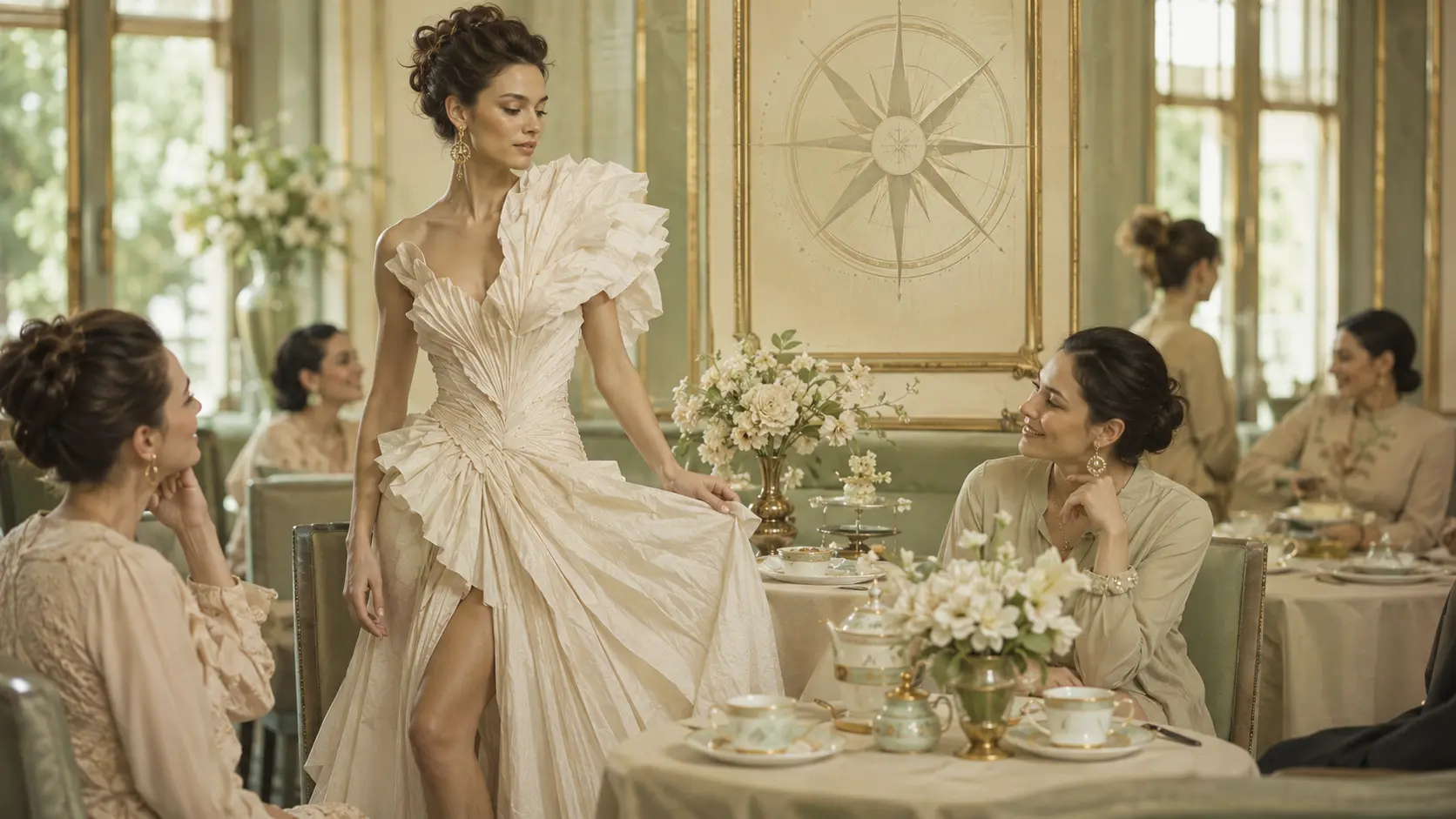
- Describe the history and purpose of informal modeling in tea rooms, luncheons, boutiques, and trunk shows.
- Apply consultative selling and the features, advantages, benefits sequence to a garment conversation.
- Use the FABRIC method to present any piece in under ninety seconds at a seated table.
- Move, stand, and speak at a seated audience's scale, using distance and touch to build interest without pressure.
- Explain how boutique economics and trunk-show orders shape what the boutique needs from you.
- Handle a table that is not interested with grace, and close a conversation toward the rack.
What Informal Modeling Is
Informal modeling is modeling without a runway. Instead of walking a line toward a bank of cameras, you move among seated guests at a luncheon, a boutique event, a charity tea, a country-club fashion afternoon, a bridal salon preview, or a trunk show, wearing the merchandise and talking about it. The audience is close enough to touch the fabric, and often does. There is no music cue and no choreographer; there is a hostess, a rack of garments, and a room of women who came for lunch and stayed to shop.
For a model over thirty-five this is the format in which age is an unqualified advantage. The customers at a tea room show are frequently your age or older. They want to see the dress on a body like theirs, and they want to ask a woman like themselves how it feels to wear. Your prior career helps as well: teachers, nurses, and sales professionals already know how to hold a small group's attention and answer questions warmly. This module turns those instincts into a repeatable method.
A Short History of Lunch and the Dress
The department-store tea room was invented to solve a social problem. In the late nineteenth century a woman dining alone in a public restaurant risked disapproval, which meant she had to go home for lunch and often did not return. Marshall Field's in Chicago opened a tea room in 1890 (Wanamaker's in Philadelphia disputes who was first), and the idea spread quickly: a shopper could rest, eat, and go back to the floor. By the 1920s Marshall Field's ran seven dining rooms seating 2,500 people.
Fashion followed the food. Historical records of St. Louis stores show a "Fashion Revue" entertaining lunch guests at Famous-Barr as early as 1915 and weekly Wednesday tea-room fashion shows at Scruggs Vandervoort Barney in 1933. When Stanley Marcus opened the Zodiac Room on the sixth floor of Neiman Marcus in Dallas in April 1953, the opening advertisement promised informal modeling every day at luncheon; guests remembered models in gowns and furs moving between tables while a pianist played. Under the direction of Helen Corbitt the room became famous, and the format it perfected, a model at your elbow while you finish your popover, is the one you will practice here.
Four Principles of the Intimate Venue
These four principles are the reason tea room modeling runs on selling logic rather than show logic. On a runway the goal is an image. At a table the goal is a decision, and decisions are made by people who feel understood and informed, not dazzled.
Consultative Selling: Where the Method Comes From
The phrase consultative selling was popularized by Mack Hanan, whose book of that title was first published in 1970. Hanan's argument was that a salesperson should stop behaving like a vendor pushing a product and start behaving like an adviser who understands the customer's situation and helps her achieve an outcome. The customer's needs come first; the product is introduced only where it serves them.
Neil Rackham's research organization, Huthwaite, spent the 1970s and 1980s observing tens of thousands of sales calls to test what actually worked. The result, published as SPIN Selling in 1988, was a questioning sequence: Situation questions establish context, Problem questions uncover difficulties, Implication questions explore what those difficulties cost, and Need-payoff questions invite the customer to state the value of a solution in her own words. Rackham's central finding was that people are more committed to conclusions they reach themselves. At a table this translates to a simple discipline: ask before you tell.
A tea room version might sound like this. "Are you dressing for a trip or for something local?" (situation). "What is the thing that always lets you down when you pack?" (problem). "So you end up carrying a steamer or wearing it wrinkled?" (implication). "If this jacket came out of the suitcase ready to wear, would that change what you pack?" (need-payoff). Only now do you describe the fabric.
Features, Advantages, Benefits: The Original Sequence
Rackham's research also gave sales training its clearest definitions of three words that are often muddled. A feature is a factual statement about the product: this jacket is a wool and silk blend. An advantage describes how the feature could be useful in general: a blend like this resists creasing. A benefit ties the feature to a need the customer has already expressed: because you said you travel every month, this jacket will come out of your suitcase ready to wear. Huthwaite found that features alone had little persuasive power, advantages helped early but faded, and benefits tied to stated needs were the statements most strongly linked to success, particularly as the decision grew larger.
| Level | Definition | Tea Room Example |
|---|---|---|
| Feature | A fact about the garment | "This is a wool and silk blend with a full lining." |
| Advantage | What the feature can do in general | "The blend resists creasing and drapes without clinging." |
| Benefit | What the feature does for this customer's stated need | "Since you said you travel monthly, it will come out of the suitcase ready to wear." |
Notice that a benefit cannot be prepared in advance. It requires the question first. That is why the model who talks the most at a tea room show is rarely the one who sells the most.
The FABRIC Method
This course extends the classic sequence into a six-step method built for the ninety seconds you typically have at a table. FABRIC keeps the researched logic of features, advantages, and benefits, then adds the three things a seated guest needs before she will stand up and walk to the rack: relevance to her, practical information, and a clear next step.
Choose one piece from your own closet. Write a FABRIC script in six lines. Time yourself presenting it to a seated friend who has been told to ask two questions and interrupt once. Under ninety seconds, with the call to action delivered, is the standard.
Working a Seated Audience
Seated guests experience you at a different angle and distance than a standing crowd. Their eye level is roughly your waist, so the details that read best are at the hip and hem: pockets, pleats, the movement of a skirt, the hand of a fabric as you gather it. The anthropologist Edward T. Hall, in The Hidden Dimension (1966), described a personal zone of roughly a foot and a half to four feet and a social zone of four to twelve feet. A tea room show is conducted at the border between the two. Approach to about four feet, pause, and let the table invite you closer with a question or a reaching hand. Stepping straight into a seated guest's personal zone from above can feel like looming; letting her draw you in feels like hospitality.
Move in a slow loop around the room so that every table gets a front, a side, and a back view without anyone needing to crane. Stop at each table for a beat before speaking. Address the whole table, then respond to the individual who engages. Keep your hands soft and visible; a hand in a pocket or on a lapel shows the garment's construction without a runway turn. When you leave a table, leave a sentence behind: the name of the piece and where it is on the rack.
Touch is not a distraction at a tea room show; it is the sales mechanism. Joann Peck and Suzanne Shu reported in the Journal of Consumer Research in 2009 that merely touching an object increased a person's sense of ownership of it, and that this perceived ownership, combined with a pleasant tactile experience, raised how much people valued it. When a guest asks to feel the sleeve, offer your arm. When a fabric is beautiful in the hand, say "feel this" and mean it.
Boutique Economics: What the Room Needs From You
To be useful to a boutique you must understand how it makes money. Independent apparel retailers traditionally price at keystone, meaning double the wholesale cost, which produces a 50 percent gross margin on the selling price. Some boutiques price higher than keystone to cover rent, staff, and unsold stock. Out of that margin comes everything: the lease, the sales team, the lunch you are modeling at, and your fee. A boutique event that costs 1,500 dollars to run needs to sell roughly 3,000 dollars of merchandise at keystone just to cover itself. Every sale you help close is measured against that arithmetic.
A trunk show changes the arithmetic in the boutique's favor. The name comes from the trunks in which a designer or sales representative once carried a collection from store to store. At a trunk show the full collection is shown, guests place orders, and the goods are produced and delivered later. The boutique commits little inventory in advance, guests see far more than the rack usually holds, and the designer is often present to speak about the pieces. Bridal boutiques rely heavily on trunk shows in the first months of the year for exactly this reason. Your job at a trunk show is not only to wear the sample but to help a guest imagine the piece in her size and color, because she cannot take it home today.
| Format | Inventory | What the Model Does |
|---|---|---|
| Tea room or luncheon show | Boutique's current stock on a rack | Moves between tables, presents pieces, sends guests to the rack |
| In-store event | Current stock plus featured pieces | Wears looks, answers fit questions, styles with the sales team |
| Trunk show | Samples only; orders placed for later delivery | Shows the sample, describes options, supports the order conversation |
Preparing With the Boutique
Arrive at least an hour before guests for a walk-through with the owner or event manager. For each garment you will wear, record the name, price, fiber content, sizes available today, colors that can be ordered, and one styling suggestion. Ask which three pieces the boutique most wants to move; those get the fullest FABRIC treatment. Learn the names of the sales staff so your call to action can send a guest to a person, not a corner. Agree on a change order that alternates weight and color so the room sees variety, and confirm where you will change and who will help with zippers and steaming.
- Garment card. One index card per look: name, price, fibers, care, sizes on hand, colors to order, styling note.
- Room map. Where the rack, the register, the changing area, and the hostess table are, so you never have to search while wearing a train.
- Three priorities. The pieces the boutique most needs to sell today, agreed with the owner.
- Kit check. Nude undergarments, dress shields, a lint roller, and blister care from your Module 9 bag, because you will be on your feet among chairs for two hours.
When a Table Is Not Interested
Not every table came to shop. Some came for the lunch, some are guests of a guest, and some are enjoying watching you without any intention of buying. Read the signals: a table that turns its chairs toward you and asks questions is open; a table that keeps its eyes on its plates and its conversation going is not. Give the second table one graceful sentence ("This is the linen shirtdress, on the rack by the window if you would like to see it later") and move on without a flicker of disappointment. Pressure is a spectacle, and spectacle is what this format has agreed to leave behind.
An objection at a table is different from disinterest; it is engagement. "It would never fit me" is an invitation to talk about how the piece is cut and what sizes are available. "I have three like that" is an invitation to show what is different. Module 13 gives you a full method for objections. For now, remember the tea room rule: answer the question she asked, briefly and truthfully, and then return the conversation to her.
Professional Standards in the Room
Because the venue is intimate, small lapses are large. Do not eat or drink while wearing merchandise. Do not sit in a sample. Do not take a phone out on the floor. Check every garment for pins, tags, and security devices before you walk out, and check the hem for the chair legs you will be walking between. Speak at conversation volume; the woman across the room will get her turn when you reach her. Say the boutique's name and the designer's name correctly, and say them often. Thank the hostess and the sales team before you leave, and send a short note the next day. Tea room clients rebook the models who made the sales staff's day easier.
Working from a real or imagined boutique, write a one-page event plan: six looks in a change order that alternates color and weight; a garment card for each; the boutique's three priority pieces; a room map; and a FABRIC script for the single piece you would present at the first table. Add two sentences on what the boutique must sell to cover an event costing 1,200 dollars at keystone pricing. Present the first-table script aloud to a seated listener and note what she asked that your script had not anticipated.
Hanan (1970), Consultative Selling; Rackham (1988), SPIN Selling, and Huthwaite International's account of the research; Peck and Shu (2009), Journal of Consumer Research; Hall (1966), The Hidden Dimension; Lost Tables, history of department store tea rooms in St. Louis; Restaurant-ing Through History on Marshall Field's tea rooms; Flashback Dallas on the Neiman Marcus Zodiac Room (1953); retail pricing guidance on keystone markup; Wikipedia's trunk show entry.
Trade Show Modeling

- Explain what an exhibitor is paying for and how a booth model contributes to measurable return.
- Apply the AIDA sequence to a thirty-second aisle encounter, and trace its origin to E. St. Elmo Lewis.
- Handle objections with the LAER sequence without arguing or over-promising.
- Learn a product briefing so it survives noise and interruption, using spaced practice and retrieval instead of rereading.
- Practice booth etiquette that exhibitors rebook: no phones, no clusters, no sitting, no unattended booth.
- Capture and qualify leads so that the conversation you started becomes a sale someone can close.
What a Booth Model Actually Does
A trade show is a temporary marketplace. Exhibitors rent floor space, build a booth, ship product and staff across the country, and spend three days trying to meet the buyers, specifiers, and decision makers who walk the aisles. A booth model (also called a promotional model, brand ambassador, or product specialist) is hired to increase the number and quality of those meetings. Sometimes the role is presentational: wearing the apparel line, demonstrating the appliance, handing out the sample. Increasingly it is conversational: greeting, qualifying, explaining, and handing a warm prospect to a salesperson.
Women with a prior career are often the strongest booth staff on a floor, because the work is closer to professional hospitality than to posing. If you have run a classroom, a clinic front desk, or a sales territory, you already know how to open a conversation with a stranger, read whether they are interested, and remember what they said. This module gives that skill a structure and a vocabulary.
Why Exhibitors Pay: The Economics of the Aisle
The Center for Exhibition Industry Research (CEIR) has studied exhibition audiences for decades, and its findings explain why exhibitors invest so heavily. Research cited across the industry from CEIR reports that a large majority of attendees, commonly stated as more than eight in ten, hold buying authority or buying influence in their organizations, and that seeing new products has been the top reason people give for attending for a quarter century. In other words, the woman who stops at your booth is likely to be a buyer, and she came specifically to discover things.
CEIR's 2017 Attendee Floor Engagement study also found a gap that matters to you. When exhibitors offered interactive product education (in that study, games built around learning the product), 67 percent of attendees took part, yet only 7 percent of exhibitors offered it. Attendees want to engage with product; most booths do not give them a way to. A trained model who can demonstrate, explain, and invite participation is the least expensive way to close that gap.
Turn foot traffic into qualified conversations, and qualified conversations into captured leads, at a cost per lead the exhibitor can justify. Everything else in this module serves that sentence.
AIDA: Where the Model Comes From
In 1898 an American advertising executive named Elias St. Elmo Lewis described the job of an advertisement in three steps: attract attention, maintain interest, create desire. He later added a fourth, get action, and the sequence was eventually condensed into the acronym AIDA. More than a century later it remains the most widely taught model of how a stranger becomes a customer, because it describes a psychological order that a good conversation follows naturally.
At a booth the sequence must compress into thirty seconds or expand into ten minutes, depending on the person. The discipline is to know which stage you are in. Most booth failures are stage errors: pitching desire before you have earned interest, or asking for action from someone who is still only curious.
Opening the Conversation
Stand at the front edge of the booth, angled toward the aisle, hands free. A closed question ("Can I help you?") invites "no thanks." An open, specific question invites a sentence: "What brings you to the show this year?" or "Are you seeing anything new in knitwear?" A demonstration in progress is the strongest opener of all, because it gives a passerby a reason to pause without committing to a conversation. If the product is apparel you are wearing, movement is the demonstration: a turn that shows the back, a sleeve pushed up to show the lining.
Qualify early and kindly. Three questions tell you whether this is a lead, a colleague, a competitor, or a student: What is your role? What are you looking for at the show? What is your timeline? A competitor is greeted warmly and given nothing confidential. A student is given a brochure and a kind word. A buyer with a timeline is walked to a salesperson. None of these people should feel sorted, even though they are.
LAER: Handling the Objection
An objection is not a rejection; it is the moment a prospect tells you what would have to be true for her to say yes. The sales training firm Carew International teaches a four-step response it calls LAER, the Bonding Process: Listen, Acknowledge, Explore, Respond. The order is the point. Most untrained staff jump to Respond, which feels like arguing.
The most common objections at a fashion or beauty trade show are price, minimums, delivery time, "I already have a supplier," and "I am just looking." Prepare a LAER response for each with the exhibitor before the doors open, and agree on the exact words for anything you are not authorized to promise: "That is a question for Marisol, and she will give you a real answer, not a booth answer."
Product Knowledge That Survives the Floor
The show floor is loud, repetitive, and physically tiring, and you may have been briefed on forty products the evening before. What separates the model who is rebooked from the one who is not is whether the briefing is still in her head at four o'clock on day two. Memory research gives you three tools.
First, expect to forget, then plan against it. Hermann Ebbinghaus first mapped the forgetting curve in the 1880s, and a careful replication published in PLOS ONE in 2015 by Jaap Murre and Joeri Dros confirmed its shape: steep loss within hours, slowing over days. A single briefing the night before a show is therefore the worst possible schedule if it is the only one.
Second, space your study. A 2006 meta-analysis in Psychological Bulletin by Nicholas Cepeda and colleagues, drawing on 839 assessments across 317 experiments, found that spreading practice across separate sessions reliably beat the same amount of practice massed into one, and that the ideal gap between sessions grew longer as the time you needed to remember grew longer. For a show, that means a first pass a week out, a second pass three days out, and a short pass each morning of the show.
Third, test yourself instead of rereading. Henry Roediger and Jeffrey Karpicke reported in Psychological Science in 2006 that students who took practice tests on a passage remembered substantially more a week later than students who reread it the same number of times, even though the rereaders felt more confident. Cover the product sheet and say the three facts aloud. Have a friend fire objections at you. Confidence from rereading is a feeling; retention from retrieval is a result.
| Method | What the Research Shows | Show-Floor Practice |
|---|---|---|
| Spaced practice | Separate sessions beat one long session (Cepeda et al., 2006) | Study a week out, three days out, and each morning |
| Retrieval practice | Testing beats rereading at a one-week delay (Roediger and Karpicke, 2006) | Cover the sheet; say the facts; run mock objections |
| Chunking to three | Forgetting is steep for unrehearsed detail (Murre and Dros, 2015) | Three facts per product: what it is, what it does, what it costs |
For each product you will represent, write one index card with three lines: what it is (one sentence), the benefit a buyer cares about (one sentence), and the one number she will ask for (price, minimum, or lead time). Then put the cards away and recite them to a listener the next day, the day after, and the morning of the show. Anything you cannot retrieve on the second day gets rewritten shorter.
Booth Etiquette Exhibitors Rebook
Exhibitor magazine's staff-training guidance is consistent with what every experienced show manager will tell you. Booth staff should not cluster together in matching shirts, because a wall of staff intimidates the quieter attendee. They should not use phones on the floor, because a bowed head reads as "closed." They should not eat in the booth, should never leave it unattended, and should wear the agreed dress code. Above all they should listen before speaking: ask what the attendee needs before describing what the exhibitor sells.
- Stand, do not sit. Seated staff look like they are waiting for the day to end. Ask for anti-fatigue mats and rotate breaks every ninety minutes.
- Face the aisle. Your body angle is a sign. Angled toward traffic with hands visible says open; turned toward a colleague says busy.
- Phone away, entirely. Not in your hand, not on the counter. If you must check it, step out of the booth.
- No food, gum, or drink in view. A water bottle stays under the counter.
- One conversation at a time. Finish with one attendee before greeting the next; a glance and a nod holds the second person for thirty seconds.
- Know the exhibitor's names and roles. Every hand-off should be to a named person with a stated specialty.
- Dress for the brand, not the party. Follow the brief. If it is apparel, wear it exactly as merchandised, and change when asked.
- Never disparage a competitor. Attendees remember the booth that was gracious, and competitors walk the aisles too.
Lead Capture: Finishing the Conversation
A conversation that is not recorded did not happen, as far as the exhibitor's return on investment is concerned. Most shows offer badge scanners that capture an attendee's registration details; many exhibitors also use a lead form on a tablet or a paper card. Whatever the tool, the model's job is the same: capture the contact, capture the context, and rate the lead.
Context is the part that most staff skip and the part that makes a lead worth following. A name and an email are data; "asked about minimums, delivery by January" is a sales call already half-prepared.
Energy, Voice, and the Long Day
A show day is a physical event. You will speak the same three facts two hundred times, stand for eight hours, and be photographed at hour seven. Protect your voice: sip water constantly, avoid shouting over music (step closer instead), and warm up in the morning with a few minutes of humming and gentle lip trills. Protect your feet with the blister care and the second pair of shoes from your Module 9 bag. Protect your face: the fatigue in a booth model's expression is visible from across the aisle, so schedule breaks and take them fully, away from the booth, where you can check your phone and sit down. Eat a real lunch. Attendees do not know that you have said your line two hundred times; the two hundred and first person deserves the first version.
Working With the Exhibitor as a Client
Treat the exhibitor like any client from Module 11. Get the brief in writing: dates, hours, dress, product list, who the sales contacts are, what you may and may not promise, and how leads are recorded. Confirm the rate, the overtime, and whether travel and parking are covered. Arrive before the show opens to walk the booth and rehearse hand-offs. At the end, ask two questions: "What could I have done more of?" and "May I be on your list for next year's show?" A booth model who asks for feedback and follow-up is, from the exhibitor's side, exactly the kind of person she has been trying to hire.
Choose a real brand you could plausibly represent. Write a two-page playbook containing: an AIDA script for a thirty-second aisle encounter; three qualifying questions; LAER responses to the five common objections; three-fact cards for four products; a lead-capture note template with rating scale; and a personal spaced-practice schedule for the seven days before the show. Rehearse the AIDA script and one objection with a partner while standing, in the shoes you would wear, and note the moment your energy drops.
Strong (1925) and later histories on E. St. Elmo Lewis's 1898 formula; Carew International, LAER: The Bonding Process; Center for Exhibition Industry Research, 2017 Attendee Floor Engagement Study and attendee buying-influence research as reported by Exhibit City News and industry summaries; Exhibitor magazine, Staff Training Primer; Murre and Dros (2015), PLOS ONE; Cepeda, Pashler, Vul, Wixted and Rohrer (2006), Psychological Bulletin; Roediger and Karpicke (2006), Psychological Science.
Public Speaking for Brand Ambassadors

- Explain what a brand ambassador is asked to say, and where speaking fits alongside modeling in that role.
- Draw specific, verifiable lessons from Lincoln at Gettysburg and Churchill in June 1940 and apply them to a brand message.
- Describe what research shows about speech anxiety and use three evidence-based methods to manage it.
- Deliver a results-first introduction using this course's SNAAP method.
- Control pace, pause, and filler words so that listeners hear confidence.
- Structure a short brand story with a dramatic arc, and distribute posture and eye contact across a room.
The Ambassador's Voice
A brand ambassador is hired to represent a company in person: at launches, in-store events, trade shows, charity galas, media appearances, and increasingly on camera for the brand's own channels. Where a model is asked to be seen, an ambassador is asked to be heard. She introduces the product from a small stage, thanks the sponsors, tells the founder's story at a boutique dinner, or answers a journalist's three questions without a script. The speaking is rarely long. It is nearly always live, and it is the part of the role that new ambassadors fear most.
If you are entering this work after a career in teaching, nursing, sales, law, ministry, or management, you have already spoken to rooms. What is new is speaking as someone else's brand, in a few minutes, with an audience that did not come to hear you. This module gives you the structure, the evidence, and the practice to do that well, and it begins with two speakers who understood brevity better than anyone.
Lincoln at Gettysburg: Clarity Over Complexity
On November 19, 1863, at the dedication of the Soldiers' National Cemetery in Gettysburg, Pennsylvania, the featured orator Edward Everett spoke for roughly two hours. President Lincoln then delivered what the program called a few appropriate remarks. His address ran about 272 words in ten sentences and took roughly two minutes. Five manuscript copies in Lincoln's hand survive, each slightly different, and the last, the Bliss copy, is the version inscribed on the Lincoln Memorial and the one usually quoted. Everett wrote to Lincoln the next day conceding that the president had come closer to the meaning of the occasion in two minutes than he had in two hours.
Three lessons carry directly to a brand ambassador. First, brevity is a form of respect: the audience at Gettysburg had been standing for hours, and Lincoln gave them something they could hold. Second, short words carry weight; the address is built largely from plain, familiar vocabulary and gains its grandeur from rhythm and structure, not from ornament. Third, structure the message in time: past (what was founded), present (what we are testing), future (what we resolve). A product story can follow the same arc: where the founder began, what the brand is doing today, and what it intends for the customer.
Abraham Lincoln
About 272 words, ten sentences, roughly two minutes, following a two-hour oration. Proof that the shortest speech of the day can be the one history keeps.
Winston Churchill
On June 4, 1940, after Dunkirk, he built a speech to the House of Commons on the repeated phrase "we shall," binding Parliament, the public, and the allies into one first-person plural.
Churchill and the Grammar of "We"
Churchill's speech of June 4, 1940 reported the Dunkirk evacuation to the House of Commons in the detailed manner of a war correspondent, including losses of men and equipment, and then turned to resolve. Its most remembered passage is a chain of clauses that each begin with the same two words: we shall fight in France, on the seas and oceans, on the beaches, on the landing grounds, in the fields and streets and hills, and we shall never surrender. The device is anaphora, repetition at the beginning of successive clauses, and its effect is to gather every listener into a single "we" that has already decided.
For a brand ambassador the lesson is grammatical. "I love this serum" makes the speaker the subject. "We built this for women who were told to expect less from their skin after fifty" makes the brand and the audience the subject together. Repetition of a short structure ("we tested, we listened, we changed the formula") gives a two-minute talk a spine that the audience can feel even if they never notice it. Churchill's preparation is the other lesson: his major speeches were written and rewritten, and their apparent spontaneity was the product of labor. Your two minutes deserve the same.
What the Research Says About Fear
The claim that people fear public speaking more than death is repeated so often that it is worth checking. Karen Kangas Dwyer and Marlina Davidson tested it in 2012 in Communication Research Reports, surveying 815 university students. Public speaking was the most commonly selected fear on the list, chosen by more than 61 percent, ahead of death. But when students were asked to rank their single greatest fear, death came first and public speaking second. The accurate summary is that speaking is the most widespread fear, not the most intense one. Most people in any room you address share it, which means your audience is on your side more than your nerves suggest.
Three approaches have consistent support. The first is preparation and rehearsal aloud, standing, in the shoes and clothes you will wear; rehearsed material is retrieved rather than composed under stress, and the memory research from Module 13 applies here in full. The second is reframing: anxiety and excitement share the same physiology (raised heart rate, alertness). Alison Wood Brooks of Harvard Business School reported in 2014 in the Journal of Experimental Psychology: General that people who said "I am excited" before public speaking, singing, or a math test performed better than those who tried to calm down, because the arousal was given a useful job rather than fought. The third is exposure: repeated, graduated speaking in low-stakes settings reduces the response over time, which is why this module's assignments ask you to speak to real listeners rather than to a mirror.
The old advice to picture the audience in their underwear has no research support and a practical cost: it takes your attention away from the people you are speaking to. Attention on the audience is the cure for self-focus. Find two friendly faces before you begin, and speak to them first.
The SNAAP Introduction: Results First
Most introductions describe process: "I am a brand ambassador and model, and I work with skincare and fashion companies on events." Nobody remembers it, because it describes what you do rather than what happens because you do it. This course's SNAAP method reverses the order and opens with the result. The signature phrase is "As a result of what I do..."
A full SNAAP introduction runs twenty to thirty seconds. The same skeleton scales to a two-minute brand talk: the result the product delivers, the customer it serves, the need she had, one story, and a turn toward the audience. Write yours in the first person plural when you are speaking for a brand and in the first person singular when you are introducing yourself.
Pace, Pause, and the Sound of Confidence
Speech-rate research complicates the folk wisdom that slower is always better. Norman Miller and colleagues reported in 1976 in the Journal of Personality and Social Psychology, across two field experiments with 449 participants, that a faster speaking rate increased persuasion and was read as a cue to credibility. The practical reading is not "talk fast." It is that a fluent, energetic pace signals competence, while the rushed, breathless pace that nerves produce signals the opposite, because it flattens the pauses that give a listener time to think. Aim for the pace of an animated conversation with a friend, and protect your pauses.
Pauses themselves carry information. Susan Brennan and Maurice Williams showed in 1995 in the Journal of Memory and Language that listeners judged a speaker as more confident after a short silent pause before an answer, and as less confident when the pause was filled with "um" or "uh" or when the answer ended with rising intonation. A silent beat reads as thought; a filled beat reads as doubt. Train the silence. When you feel a filler rising, close your mouth, breathe through your nose, and let the beat pass. Then land the sentence with a falling tone.
| Vocal Habit | What Listeners Infer | What to Practice |
|---|---|---|
| Rushed, breathless pace | Nerves, low authority | Conversational energy with full stops at sentence ends |
| Silent pause before a key point | Thought, confidence | One full breath before the number, the name, or the ask |
| "Um," "uh," "like," "so" | Uncertainty | Replace the filler with a closed-mouth breath |
| Rising tone at the end of statements | Asking permission | Let pitch fall on the final word of a statement |
| Monotone | Disengagement | Lift pitch on the benefit; lower it on the result |
Record yourself delivering your SNAAP introduction on your phone, audio only. Listen once for fillers and count them. Listen a second time for the end of each sentence and mark whether your pitch rose or fell. Re-record until you have zero fillers and every statement lands on a falling tone. Most students need four to six takes.
Storytelling Structure: Why the Arc Works
Aristotle observed in the Poetics that a whole has a beginning, a middle, and an end, and every effective brand story still obeys him. The neuroeconomist Paul Zak, writing in Cerebrum in 2015, described experiments in which viewers watched short films with and without a classic dramatic arc of rising tension and resolution. Stories with the arc held attention, measured by markers of physiological arousal, and produced a rise in oxytocin that tracked concern for the characters; viewers who showed both responses donated far more to a related charity afterward than those who did not. Flat narratives without tension produced neither response.
Melanie Green and Timothy Brock, in the Journal of Personality and Social Psychology in 2000, called the state a good story produces transportation: the listener is absorbed into the narrative world, and beliefs shift in the direction of the story with less counter-arguing than a list of claims would provoke. For a brand ambassador the implication is simple. A story about one named customer with a difficulty, a turning point, and a result will move a room further than the same facts stated as bullet points.
Posture, Stance, and the Open Body
Stand with your feet under your hips, weight even, knees soft, and your hands free of the lectern, the phone, and each other. Keep the front of your body open to the room: shoulders back and down as in Module 1, chest unguarded, arms available for gesture rather than folded. This is the posture that reads as composed, and there is a modest evidence base that it also helps the speaker feel composed. The widely publicized claims that "power posing" changes hormones or risk-taking have not survived replication, and a 2020 systematic review and meta-analysis found no reliable hormonal or behavioral effects. What has held up across a large body of studies, including Amy Cuddy's own 2018 reanalysis, is the subjective effect: expansive posture reliably increases how powerful and in control a person reports feeling. Take that for what it is. Two minutes of open, upright stance before you walk on will not change your chemistry, but it may change your sense of the room, and that is enough.
Move with purpose or not at all. Pacing reads as anxiety; a deliberate step toward the audience on a key sentence reads as emphasis. Gesture from the shoulder, at waist to chest height, and let the hands return to rest between gestures. When you hold a product, hold it toward the audience, not toward yourself, and stop speaking for a beat while they look.
Eye Contact Distributed Across the Room
Steven Beebe reported in 1974 in The Speech Teacher that increased eye contact raised a speaker's perceived credibility; it remains one of the most reliable findings in delivery research. The craft is in the distribution. Divide the room into three or five zones and give each zone a full sentence, not a sweep. Within a zone, choose one face and finish the thought with that person before you move; the people around her will feel included. Return to the friendly faces you located at the start whenever you need to steady yourself, but do not live there. At a table of eight, give every guest a sentence. On camera, the lens is the face; look into it and speak to one woman you know.
- The three-zone drill. Deliver your SNAAP introduction to three chairs with paper faces, one sentence per chair, without letting your eyes drift between sentences.
- The finish-the-thought rule. Never leave a face mid-sentence. Move on the period.
- The lens rule. On video, treat the lens as a person and hold it through the end of each sentence; glancing at the screen breaks the contact.
Speaking for a Brand Without Losing Yourself
An ambassador's credibility rests on saying only what is true. Learn the brand's claims from the brand's own approved materials, and know which ones are regulated: in the United States, cosmetics and skincare may not be described as treating or curing conditions, and "clinically proven" requires the brand to hold the study. Rules differ by country, so ask the brand which claims are approved. If you are asked a question you cannot answer, say so and offer to connect the questioner with someone who can; a warm "I do not know, and I will find out" is more persuasive than a fluent guess. Keep your own voice: the brand chose you because of how you speak, not in spite of it. Warmth, plain words, one story, and a pause before the number will serve any product you are ever asked to represent.
Choose a real product you could plausibly represent. Write a two-minute talk (about 260 to 300 words, which is roughly the length of the Gettysburg Address) that opens with a SNAAP result, uses "we" at least three times in a repeated structure, contains one customer story with a person, a difficulty, a turn, a result, and a bridge, and ends with a question to the audience. Rehearse it standing, in your event shoes, on three separate days. On the third day deliver it to at least two live listeners, record it, and count fillers, falling tones, and the number of faces you finished a sentence with. Bring the recording and the counts to your next coaching session.
American Battlefield Trust and ExplorePAhistory on the Gettysburg Address (five copies, Bliss copy, 272 words, two minutes, Everett's two hours); UK Parliament, Churchill the Orator (June 4, 1940 speech); Dwyer and Davidson (2012), Communication Research Reports; Brooks (2014), Journal of Experimental Psychology: General; Miller, Maruyama, Beaber and Valone (1976), Journal of Personality and Social Psychology; Brennan and Williams (1995), Journal of Memory and Language; Zak (2015), Cerebrum; Green and Brock (2000), Journal of Personality and Social Psychology; Beebe (1974), The Speech Teacher; British Psychological Society review of a decade of power-posing research, including the Elkjær et al. (2020) meta-analysis and Cuddy, Schultz and Fosse (2018); Aristotle, Poetics.
Bridal Shows
- Describe the size and rhythm of the bridal market and explain why a bridal booking carries unusual financial and emotional weight.
- Identify the structural elements of a gown, including boning types, built-in corsetry, train lengths, bustle styles, and veil lengths, using correct industry vocabulary.
- Apply the garment care rules and a safe technique for walking, turning, and posing in a train and heels.
- Explain how bridal fashion weeks, trunk shows, and consumer bridal shows are produced and what each one asks of a model.
- Model for the bride rather than the gown by understanding the psychology of the bride as a buyer.
- Work professionally with dressers, consultants, and designers backstage at a bridal event.
The Unique Nature of Bridal Modeling
Bridal modeling sits apart from every other category in this course. In a ready-to-wear show the audience is evaluating a collection. In a bridal show, the woman watching is evaluating her own future. She is imagining a specific morning, a specific aisle, and a specific person waiting at the end of it. The gown you are wearing is not a product to her; it is a possible memory.
That emotional charge is joined by two practical realities. First, bridal garments are among the most heavily engineered pieces of clothing you will ever wear: boned bodices, layered skirts, trains that can run several feet behind you, veils that catch on everything. Second, the money involved is significant for the client. A gown is often the single most expensive garment a woman will ever purchase, and a boutique's sample gowns are its inventory, its marketing, and its reputation, all at once. The model who understands both the emotion and the engineering becomes indispensable.
The Bridal Market by the Numbers
It helps to understand the scale of the industry you are stepping into. The Knot Worldwide's 2026 Real Weddings Study, which surveyed more than ten thousand American couples married in 2025, describes a United States wedding market worth roughly one hundred billion dollars, with about two million couples marrying that year, an average total wedding cost of thirty-four thousand dollars, and an average guest count of one hundred seventeen. The same research places the average spend on the wedding dress at about two thousand one hundred dollars, and that figure does not include alterations.
The buying timeline matters to you as much as the totals. An earlier Knot attire study found that brides begin researching their wedding attire roughly eleven months before the wedding and purchase, on average, about three months after they start looking, visiting about two and a half bridal salons along the way. Most striking for anyone working in a bridal salon or show: ninety-three percent of brides said the helpfulness of the bridal consultant was their top consideration when choosing where to shop. The human experience sells the gown. As a bridal model you are part of that human experience.
| Figure | What it tells you | Source |
|---|---|---|
| About 2 million weddings a year (US) | A large, steady, seasonal market with predictable show calendars. | The Knot 2026 Real Weddings Study |
| Average dress about $2,100 | Every sample gown you wear represents real money for the boutique and the bride. | The Knot 2026 Real Weddings Study |
| Research starts about 11 months out | Brides at a show are often early in the process and still forming a picture of what they want. | The Knot 2018 Wedding Attire Study |
| 93% rank consultant helpfulness first | Warmth and service are the actual product; you are part of the service. | The Knot 2018 Wedding Attire Study |
How a Gown Travels From Runway to Bride
Bridal fashion follows its own calendar. New York Bridal Fashion Week is held twice a year, in April for spring collections and in October for fall collections. It is an invitation-only trade event for press and retail buyers, not a consumer event. Retailers view the collections, place orders, and then wait: bridal gowns are made to order rather than mass produced, so a gown shown in October typically reaches boutique floors in the early months of the following year. Because the bride then needs months for fittings and alterations, the distance between a runway debut and a real wedding can approach a full year.
This is why bridal designers and boutiques rely so heavily on trunk shows. A trunk show is an event in which a boutique brings in a designer's fuller collection for a limited period, often including gowns that are not normally stocked, and frequently with the designer or a designer's representative in attendance. Trunk shows can carry special incentives such as pricing offers, complimentary customizations, or a gift with purchase, and they give brides earlier access to a new collection, sometimes only weeks after the fashion week presentation. Models work trunk shows as informal or in-salon models, walking among appointments so the bride can see how a gown moves before she tries it on.
The third format is the consumer bridal show or bridal expo, a ticketed event where vendors of every kind exhibit to engaged couples and where a runway show of gowns from local boutiques is usually the centerpiece. Here you are walking a stage in front of hundreds of brides, mothers, and friends. Each format asks something slightly different of you: precision for buyers at market, conversation and product knowledge at a trunk show, clarity of silhouette and warmth at scale on an expo runway.
Anatomy of the Gown: Corsetry and Boning
Most structured bridal bodices contain boning: narrow strips of material sewn into channels inside the lining that hold the bodice up, shape the waist, support the bust, and keep the designer's silhouette intact through hours of wear. In the fabric trade three families of boning are standard. Plastic boning is light and flexible and suits softer, flowing gowns that want gentle structure. Spiral steel boning is made from a coiled steel wire that bends in more than one direction, so it supports the body while still moving with it; it is a favorite for couture-influenced designs. Flat steel boning is the firmest and is used where a gown needs to stay rigid, typically at the center front and center back panels of a dramatic ball gown or a vintage-inspired corset bodice.
Many gowns also carry a built-in corset, sometimes called a corselet: a separate boned inner layer that closes with its own hooks or zipper and does the real work of holding the body before the decorative outer bodice is fastened over it. When you feel a gown "lock" around your ribcage as the dresser closes it, that is the corselet. Understanding this changes how you move. Your breath will be shallower and higher in the chest; your torso will rotate less; you will bend from the hips rather than the waist. None of that is a problem if you expect it and rehearse it.
A boned bodice does not want to be twisted, crushed, or bent at the waist. Every time you sit, reach, or turn quickly in a boned gown, you risk creasing the boning channel or pushing a bone through its casing. Move as though the bodice is a beautiful piece of furniture you are wearing, because in structural terms it is.
Trains: Lengths and Language
The train is the section of skirt that extends behind the gown along the floor. Its length is named by tradition, and the names are the vocabulary a designer, a dresser, or a boutique owner will use with you. The precise measurements vary a little from one source to another, so the table below gives the ranges used by Kleinfeld Bridal's dress guide and The Knot's train guide, two of the most widely consulted references in the American bridal trade.
| Train | Approximate length behind the gown | What it means for your walk |
|---|---|---|
| Sweep (also called brush) | The shortest train; only a few inches, under about a foot | Walk almost normally; a light sweep of the foot clears it on turns. |
| Court | About one foot, up to roughly two and a half feet | Begin using the "kick" technique on every turn. |
| Chapel | About three to four and a half feet | The most common bridal length; plan every turn and never step backward. |
| Semi-cathedral | About four to five feet | Requires a dresser or attendant to spread the train before you walk. |
| Cathedral | About six to eight feet | A very formal train; attendants carry and set it. Turns are wide, slow, and choreographed. |
| Monarch (royal) | Ten feet or more | Rare on runways; used for editorial and couture presentations with handlers. |
| Watteau | Any length; attaches at the shoulders rather than the waist | The weight pulls from the upper back, so posture and shoulder placement carry the drape. |
Notice that the same word can describe a veil, which we come to shortly, and that a "cathedral gown" and a "cathedral veil" are two different things. When a designer tells you the look is "cathedral," ask which piece she means.
Bustles: How a Train Disappears
After a ceremony the train must be lifted so the bride can move and dance. That is done with a bustle: hidden hooks, buttons, loops, or ribbons sewn into the skirt so the train can be gathered and secured. You will be bustled by a dresser at trunk shows and in-salon appointments, and sometimes on a runway during a quick change, so you need to know the three families.
American (over) bustle
Hooks or buttons on the outside of the skirt lift the train up and over the gown, creating a visible cascade of fabric at the back. The most common style and the quickest to fasten.
French (under) bustle
Internal ties or ribbons fold the train up underneath the skirt, so the back of the gown reads as a seamless line. Common on fitted and mermaid silhouettes.
Ballroom bustle
Multiple attachment points tuck the entire train beneath the skirt so the gown appears to be floor length with no train at all. Ideal for dancing and for a reception look.
Wristlet loop
A loop of fabric or ribbon sewn to the train that the wearer slips over her wrist to lift the train herself. Useful when you must move quickly between presentations without a dresser.
When a dresser is bustling you, stand still with your weight even and your hands away from the skirt. Do not "help" by lifting fabric unless asked; the attachment points are in specific places and a well-meaning tug can tear a loop free from the seam.
Veils: A Length for Every Silhouette
The veil is measured from the point where it attaches to the hair, usually a comb. Like trains, veil lengths carry traditional names, and the lengths below follow The Knot's veil guide. The exact inches differ slightly between makers, which is why you should always confirm the length with the stylist before you walk.
| Veil | Approximate length | Notes for the model |
|---|---|---|
| Birdcage | About 9 inches; netting over part of the face | Vintage feel; keep the head still so the netting does not catch on lashes. |
| Shoulder / elbow | About 20 to 25 inches | Shows the back of a gown clearly; ideal for detailed bodices. |
| Fingertip | About 42 inches; reaches the fingertips when arms are relaxed | The most versatile length and the easiest to walk in. |
| Waltz | About 60 inches; ends between knee and ankle | Moves beautifully; watch for it wrapping the arms on turns. |
| Chapel | About 90 inches; just past the gown hem | Treat it as a second train; it must be spread before you walk. |
| Cathedral | About 108 to 120 inches, sometimes longer | Requires an attendant to set it and lift it for turns. |
Two more terms will come up. A blusher is a short layer that falls forward over the face and is lifted back during a ceremony; the stylist will tell you whether to wear it forward or back. A mantilla is a lace-edged veil draped over the head and shoulders without a raised comb, so it frames the face rather than sitting behind it; keep the chin level and the expression soft.
The Sacred Rules of Garment Care
These rules are the foundation of bridal professionalism, and boutiques judge a model by them before they judge her walk. A bridal sample is white or ivory, often silk, often hand-beaded, and often the only one in the store. Damage is visible, expensive, and remembered.
- Clean hands, always. Wash before you touch a gown and again after eating, touching makeup, or handling your phone. No hand cream, no self-tanner on the day, no perfume sprayed after dressing. Ask before you touch any gown you are not wearing.
- Proper support, always both hands. Carry a gown on its hanger with one hand on the hook and the other supporting the skirt so the weight does not stress the straps or the bodice seams. Never carry a gown by the bodice alone, never sling it over an arm, and never let the hem touch the floor between rack and dressing area.
- Never drag a train. A train is lifted, gathered, or carried by an attendant. On a rehearsal floor, on gravel, on a wet lawn, on carpet with pins in it, the train is the first thing that gets ruined. If there is no attendant, use the wristlet loop or gather the train over one forearm before you take a single step off the presentation surface.
- Makeup last, makeup contained. Bridal gowns are usually stepped into rather than pulled over the head. If a gown must go over the head, a clean silk scarf or a dresser's hood over your face protects the fabric. Lipstick is applied after dressing, with a tissue held below the lip.
- Report, do not hide. If a bead comes loose, a hook pulls, or a hem catches, tell the dresser or boutique owner immediately. Every professional knows garments have accidents; what they will not forgive is discovering damage after you have gone.
- Sit rarely, and never in a boned bodice. If you must sit between walks, perch on the front edge of a chair with the skirt lifted and the train gathered to one side. Better still, stand.
Walking Safely in a Train and Heels
A bridal walk is slower and softer than a ready-to-wear runway walk, and it has one additional job: it must never let the audience worry about you. A bride who watches a model stumble in a train stops imagining herself in the gown and starts imagining herself falling in it. Bridal stylists and salon owners teach a consistent set of techniques, and the protocol below combines them with the runway fundamentals from Modules 5 and 10.
Heels deserve one more word. Bridal samples are styled with the heel height the gown was hemmed for, and you cannot change it. If the shoe is higher than you normally wear, spend the rehearsal doing slow figure-eights until the ankle feels secure, and keep the knees soft on every step.
Modeling for the Bride, Not Just the Gown
Every woman watching a bridal show is quietly asking the same question: could that be me? The most effective bridal models let a nervous, hopeful bride-to-be picture herself in the dress. That means a softer expression than editorial work, an unhurried pace, and a walk built to let fabric and silhouette read clearly. It also means a different relationship with the audience. In ready-to-wear you may look through the crowd; in bridal you may look at them, and a small, warm acknowledgment of a bride in the front row is often exactly right.
The research on brides as buyers explains why. Sociologist Sharon Boden, writing in Sociological Research Online in 2001, analyzed bridal media and described the modern "superbride" as two people at once: a rational project manager handling budgets and timelines, and an emotional dreamer immersed in romance and fantasy. Both are watching you. The project manager notices whether the gown looks well made, whether it moves, whether the boutique seems competent. The dreamer notices whether the woman in the gown looks happy, calm, and loved. Clinical psychologist Jennifer Baumgartner, writing for Psychology Today, adds that a bride's real goal is to feel like the most beautiful version of herself rather than a different person, which is why the best bridal modeling shows the gown as an enhancement of a real woman rather than a costume on a mannequin.
Finally, remember the Knot finding above: brides overwhelmingly rank the helpfulness of the people in the salon as their first consideration. When a bride approaches you after a show to ask about a gown, you are the salon. Know the designer's name, the silhouette, the fabric, and the train length, and hand her to the consultant warmly and by name.
Backstage Etiquette for Bridal Events
Bridal backstage is smaller, quieter, and more personal than a fashion week tent. The people dressing you are frequently the boutique owner, her seamstress, and her consultants, and they will be dressing real brides in these same gowns next week. Arrive with clean, dry hair as directed, a nude seamless bra and underwear, no jewelry, and no nail polish unless told otherwise. Bring the Module 9 kit items that matter most here: nude heels in two heights if you were not told the height, a silk scarf for over-the-head changes, blister pads, and a small sewing kit you will offer but not use without permission.
Learn the names of your dressers and use them. Stand where you are placed, keep your arms up during zipping and lacing, and let the dresser set every hook before you look in a mirror. Ask before sitting, and ask whether the train should be gathered or spread before you walk to the runway entrance. Small courtesies backstage are how a bridal model becomes a boutique's first call.
Pin a full bedsheet to the back of a long skirt at the waist so it trails about four feet behind you (a chapel length). In the heels you wear most for shows, walk a twenty-foot line, pause, and turn using the kick, twenty times, without once stepping on the sheet. Then repeat with the sheet pinned at the shoulders to feel how a Watteau train changes your posture. Film the last five turns and watch for a stamp instead of a sweep, a locked knee, or a backward step.
Choose one bridal gown from a designer's current collection online. Write a one-page professional brief as though a boutique had booked you to walk it: the silhouette, the likely bodice construction and boning, the train name and approximate length, the bustle style you would expect, the veil length you would pair with it and why, the heel height implied by the hem, and a plan for the walk and turn. Close with three sentences describing the bride you believe this gown was designed for and how your expression and pace would speak to her. Keep the brief in your Compass file; you will use this format every time you accept a bridal booking.
The Knot Worldwide, 2026 Real Weddings Study (couples married in 2025) and The Knot average wedding dress cost report; The Knot Worldwide, 2018 Wedding Attire Study; The Knot guides to bridal fashion week, trunk shows, wedding dress trains, and veil styles; Kleinfeld Bridal dress guide, train lengths; J. Majors Bridal, corsetry and boning in wedding dresses; Moonlight Bridal, guide to wedding dress bustle styles; Uptown Bride, how to walk in your wedding dress; Sharon Boden, "Superbrides: Wedding Consumer Culture and the Construction of Bridal Identity," Sociological Research Online (2001); Jennifer Baumgartner, Psy.D., "Avoid Wedding Dress Stress," Psychology Today.
Model Portfolio Creation
- Explain what a portfolio is for and what a casting director is actually asking of every image.
- Produce a set of agency-standard digitals that meet the published guidance of major agencies.
- Plan and sequence the seven essential portfolio photographs, including a strong opener and closer.
- Arrange a test or TFP shoot safely, with a written agreement covering images, costs, and conduct.
- Describe who owns your photographs under United States copyright law and what a usage license grants.
- Build a comp card to industry specifications and maintain an online presence that supports your book.
What a Portfolio Is Actually For
New models often imagine the portfolio as a collection of their most flattering pictures. It is not. A portfolio, or "book," is a range demonstration. A casting director looking through it is asking one question of every image: can she deliver this specific look, on command, reliably? Each photograph is evidence for or against that answer. A beautiful picture that shows the same expression, angle, and mood as the one before it adds nothing to the case, however lovely it is.
That reframing changes how you shoot, edit, and sequence. You are not trying to look your best in every frame. You are trying to prove, across ten to twenty frames, that you can be commercial and warm, editorial and severe, still and in motion, bare faced and fully styled. The portfolio also has an audience beyond casting: agencies use it to decide whether to sign you, photographers use it to decide how to shoot you, and clients use it to imagine you in their campaign. Build it for all three.
For a woman entering modeling at forty, fifty, or sixty, the portfolio has one more job. It must show the market what your face and body do now, with confidence and without apology, so that the client books the woman who will actually arrive on set.
Digitals: The Photographs Agencies Actually Ask For
Before any agency looks at your book, it will look at your digitals. Digitals, still often called "Polaroids" from the era of instant film, are raw, unretouched photographs that show exactly what you look like today. Agencies want them because a portfolio can be styled, lit, and retouched into a fiction; digitals cannot.
The major agencies publish their expectations, and they agree with each other. Ford Models' scouting page asks applicants to arrive with a clean face and absolutely no makeup, hair pulled back, in a form-fitting outfit such as skinny jeans and a tank top, because the agency wants to see you at your most natural. IMG Models' scouting program, "We Love Your Genes," states that IMG never asks for photographs in the nude or in lingerie and never requires any payment, which is a standard you should hold every agency to. Backstage's guide to digitals, drawing on agency founder Noelle McCann of TNG, describes the accepted format: soft natural light or a ring light, a white or plain light wall with nothing cluttering the frame, basic-colored fitted clothing or swimwear with no prints or logos, minimal makeup, clean natural hair, no false nails and no spray tan.
Digitals expire. Backstage's guidance is that working models refresh them about every three months, and sooner after any change in hair, weight, or skin. Send them as clean, uncompressed files, named with your name and the date. Never send retouched digitals; an agency that discovers the difference on the day of a casting will not send you again.
The Seven Essential Photographs
With digitals in hand, you build the book. Seven categories cover the range most clients need to see. You may have more than one image in some categories, but a book missing any of them has a gap a casting director will notice.
- Beauty shot. Close, minimal makeup, clean light, a direct view of the face. This is the picture that tells a beauty client whether your skin, eyes, and bone structure will carry a product.
- Full-body shot. Proportions, posture, and clean lines, usually in simple fitted clothing. It answers the fit and silhouette questions from Module 3 before anyone measures you.
- Commercial shot. Smiling, approachable, relatable, often in lifestyle styling. Commercial work is the largest market for women over thirty-five, and this image books it.
- Editorial shot. Dramatic, strong pose, high fashion. It proves you can hold an idea rather than simply hold a smile.
- Movement shot. Energy, motion, vitality: walking, turning, hair in motion. It shows a client you are not only a still object.
- Natural shot. Little or no makeup, unstyled hair, honest light. Different from digitals because it is composed and intentional, and it proves you do not need styling to be photographable.
- Closing image. Your strongest, most memorable frame. The last picture is what the viewer carries out of the room.
Sequence the book the way a magazine sequences a story. Open with a beauty or strong portrait that establishes the face. Alternate close and full length, still and moving, warm and cool, so that turning each page reveals something new. End on your closer. If a physical book, keep it to twelve to twenty images; if digital, keep the first screen to your six best. Anything weaker than your average image lowers the average, so it comes out, no matter how much it cost.
Test Shoots and TFP
Most portfolio images come from test shoots. A test is a shoot arranged to produce portfolio work rather than to fulfill a client brief. When no money changes hands and every participant takes images in exchange for time, the shoot is called TFP, time for print, a term Backstage describes as an exchange in which photographers, models, hair and makeup artists, and stylists all work without fee and all leave with usable portfolio images. An agency that signs you may instead arrange paid tests with photographers it trusts, and may bill you for them against future earnings; ask exactly how that works before agreeing.
A good test begins with research. Look at the photographer's website and published work, read reviews, and ask who else will be on set. Backstage's February 2025 guidance on TFP shoots is direct: get the commitment in writing even when there is no money involved. Your written agreement should cover the number and quality of final images each person receives, the delivery date, any costs (studio rental, wardrobe, travel), who may use the images and where, and the expected conduct on set. Red flags include a photographer who refuses to put anything in writing, who pushes toward wardrobe you did not agree to, whose communication feels boundary testing, or who mentions costs only after you arrive. You may bring a companion to any shoot; a professional will not object.
Before every test, write a one-page brief: the portfolio gap you are trying to fill (for example, "I have no movement shot and no editorial shot"), the mood, two or three visual references, the wardrobe you will bring, the hair and makeup plan, and the delivery terms you have agreed. Share it with the photographer in advance. A shoot with a stated purpose almost always produces the picture; a shoot that "sees what happens" usually produces more of what you already have.
Who Owns Your Photographs?
This is the part of portfolio building most models have never been taught, and it costs them. Under United States law as of 2026, and setting aside work-made-for-hire arrangements, the person who takes a photograph owns the copyright in it, and that protection begins automatically the moment the image exists in a fixed form, such as a file on a camera card. The United States Copyright Office states this plainly in its "Photography and Copyright" guidance: owning a physical print or a file does not mean owning the copyright, and registration is not required for the right to exist, though timely registration gives the owner stronger remedies in an infringement case.
The consequence is that, unless a written agreement says otherwise, the photographer owns the pictures of you, even at a shoot you paid for. The Professional Photographers of America explains the practical side: a client who pays for photographs purchases copies and a license to use them, not the copyright, unless the photographer transfers it in writing. What you receive from a test, therefore, is typically a license: permission to use specific images in specific ways, most often self-promotion in your book, on your comp card, on your website, and on your social accounts. It usually does not include the right to sell the images, to license them to a brand, or to alter them beyond agreed limits.
The photographer, in turn, needs something from you. A model release is your written permission for your likeness to be used for commercial purposes: advertising, promotion, or licensing to third parties. PPA advises photographers to obtain one before any such use. Read every release before signing. A release for a test should cover portfolio and self-promotional use by the photographer and the model. A release that grants perpetual, worldwide, unrestricted commercial use of your face for no fee is not a test release; it is a campaign contract without the campaign fee, and you may decline it or negotiate it. Module 11 covers usage fees in detail; the principle here is simply that your face has value, and paper decides who profits from it. Copyright and likeness rules differ outside the United States and change over time, so have a lawyer review any release you do not fully understand.
Check five things: what uses are granted (portfolio, editorial, advertising), for how long, in what territories, whether the images may be sold or licensed to others, and whether you may use the images yourself and how. If any line is blank, missing, or unclear, ask for it in writing before the shoot begins, not after.
The Comp Card
The composite card, or comp card, is the printed summary of your book, and it has changed remarkably little across New York, Los Angeles, London, and Milan for decades. The industry standard size is 5.5 by 8.5 inches (half letter), though some agencies accept 5 by 7. The front carries one full-bleed hero image and your name. The back carries three to five images showing range (commercial, editorial, full length, profile) along with your statistics and your agency's contact information. Adult statistics are height, bust, waist, hips, shoe size, hair color, and eye color; print them accurately, because they will be checked against you at fittings.
Print on 12 to 14 point cardstock in a matte or satin finish; gloss shows fingerprints under casting-room lights. A run of fifty to one hundred cards is enough for a season. Never print a home address or a personal phone number on a card; use your agency's details or a dedicated professional email. If you are freelance, a professional email and a website are sufficient. Update the card whenever your book changes meaningfully, and always when your hair changes, because a client who books from a card expects the woman on it.
Online Portfolios and Digital Presence
Your printed book now lives alongside several digital versions, and each has a different reader. The agency website page is the one clients see first; your agency controls it, and your job is to supply fresh digitals and new tearsheets so the page stays current. Models.com, the industry database founded in 2000, maintains searchable profiles with campaign, editorial, and runway credits, and casting professionals use it to verify a model's work history; once you have published work, ask your agency about your listing.
A personal website is optional for agency-represented models and close to essential for freelance ones. Keep it simple: a gallery of your best twelve to twenty images, your digitals, your statistics, a short biography, and a contact form. Instagram functions as a de facto portfolio for many clients, particularly in commercial and lifestyle work, so treat your grid with the same editing discipline as your book: consistent quality, some range, and nothing you would not want a casting director to see. Remember that everything you post online is governed by the same licenses discussed above. Posting a photographer's image without the credit and permission the agreement specifies can end a working relationship.
Editing With a Cold Eye
The hardest portfolio skill is removing pictures you love. Every few months, lay out every image and ask three questions of each: does it show something no other image shows, does it look like me today, and would I be comfortable if a client booked me from this frame alone? An image that fails any of the three is retired. Then ask a professional whose judgment you trust, ideally a booker or a photographer, to make the same cuts without knowing your favorites. Where the two edits agree, you have your book.
Watch for the three most common failures. The first is repetition, six variations of one good day. The second is age drift, a book that shows a woman five years younger than the one who arrives. The third is styling that overwhelms the model, so that the viewer remembers the hat and not the face. None of these is a flaw in you; they are simply editing problems, and editing is a skill you can practice.
The Mature Model's Book
If you are building a first portfolio in your forties, fifties, or sixties, build it for the market that will book you rather than for the market you were told about at twenty. Commercial, lifestyle, beauty, and fashion clients now cast women across the whole adult range; Module 19 documents that shift with named campaigns. Your book should therefore lean toward warm commercial and lifestyle images, a strong beauty portrait that shows your skin as it is, and at least one editorial frame proving you can hold an attitude. Silver hair, laugh lines, and a lived-in face are not obstacles to photograph around. They are the reason the client called.
Maye Musk, who signed with IMG in 2016 and became a CoverGirl at sixty-nine the following year, had modeled since fifteen, but the book that booked those jobs was one that showed her at sixty-eight, not one that pretended otherwise. Let your portfolio tell the truth beautifully. That is what the profession is.
Shoot a complete set of digitals to the specification in this module and date them. Audit your existing images against the seven essential categories and list the gaps. Plan two test shoots to fill those gaps, each with a written brief and a written agreement covering deliverables, costs, conduct, and usage. Draft your comp card front and back to standard size with accurate statistics. Finally, write the licensing terms you will ask for at every future test, in your own words, and keep them in your model bag with your release forms.
Ford Models, Get Scouted guidance on natural appearance for applicants; IMG Models, We Love Your Genes scouting program safety and age statements; Backstage, How to Take Modeling Digitals and Polaroids (2023, updated 2024), with TNG Agency founder Noelle McCann; Backstage, The Model's Guide to TFP Photo Shoots (2025); United States Copyright Office, Photography and Copyright (2019); Professional Photographers of America, Copyright FAQs on ownership, licensing, and model releases; CompCard.com, comp card sizes, layout, and agency standards; Models.com, industry database and profile system; Fashionista, Maye Musk CoverGirl announcement (2017).
Community Involvement
- Explain why community involvement belongs in a professional modeling career and what the research on volunteering does and does not show.
- Describe, with verified facts, how several well-known models built lasting philanthropic work from their platforms.
- Choose a cause that aligns with your story, values, and market using the concept of celebrity and charity fit.
- Verify an organization's tax-exempt status and evaluate its accountability before you give your time, name, or money.
- Recognize the warning signs of exploitative "opportunities" and protect your image, your boundaries, and your finances.
- Build a one-year Community Compass plan that connects giving back with the professional identity you are developing across this course.
Why Giving Back Belongs in a Modeling Curriculum
A model earns her living from visibility. That visibility is a resource, and like any resource it can be spent only on herself or invested in something larger. The models whose names have outlasted their campaigns almost all made the second choice. This module is not a lecture on virtue. It is a practical study of how professional women in this industry have turned attention into contribution, what the evidence says about the effect on the giver, and how to do it wisely.
For the woman entering or re-entering modeling at thirty-five, fifty, or sixty-five, this module carries a particular message. You arrive with a life already lived: a career, a family, a community, perhaps a loss or an illness or a recovery that taught you something. Those experiences are exactly what makes a mature model's advocacy credible. You are not choosing a cause from a list. You already know what you care about.
Models Who Made a Difference
The stories below were chosen because each one is documented and verifiable, and because together they show very different routes from the runway to real impact. Notice that every one of them grew from personal experience rather than from a publicist's suggestion.
Christy Turlington Burns: Every Mother Counts
After a complication during the birth of her daughter, Turlington Burns learned that hundreds of thousands of women die every year from preventable pregnancy-related causes. She directed the documentary No Woman, No Cry, which premiered in 2010, and founded Every Mother Counts the same year to make pregnancy and childbirth safe for every mother. She has run marathons, including the 2011 New York City Marathon, to raise awareness and funds for maternal health. The lesson: a personal experience became a documented body of work, an organization, and a decade-plus commitment.
Natalia Vodianova: Naked Heart Foundation
Vodianova founded the Naked Heart Foundation in 2004 in response to the Beslan school siege and her conviction that play is essential for children. The foundation has built more than 150 play parks and playgrounds, beginning in Nizhny Novgorod in 2006, and in 2011 launched a program supporting families raising children with disabilities, opening its first family support center that year. The lesson: a single event can crystallize into a lifelong institution if it is followed by patient, unglamorous building.
Liya Kebede: maternal health and lemlem
In 2005 the World Health Organization appointed Kebede its Goodwill Ambassador for Maternal, Newborn and Child Health, and she subsequently established the Liya Kebede Foundation to reduce maternal and child mortality in Ethiopia and beyond, funding advocacy, community education, and medical training. In 2007 she launched lemlem, a clothing line of hand-woven Ethiopian textiles created to preserve traditional weaving and employ local artisans. The lesson: philanthropy and enterprise can serve the same purpose.
Iman: advocacy across decades
Iman has served as a spokesperson for Keep a Child Alive, worked with the Children's Defense Fund and Save the Children, campaigned with the Enough Project against the trade in conflict minerals, and ended a De Beers contract over ethical concerns about diamonds. In 2019 CARE named her its first Global Advocate. She also founded IMAN Cosmetics in 1994 to serve women whose shades the industry had ignored. The lesson: a model can use her contracts, not only her charity, as instruments of her values.
Karlie Kloss: Kode With Klossy
Kloss launched Kode With Klossy in 2015, beginning with twenty scholarships she funded herself in partnership with the Flatiron School, and it grew into a free summer camp program teaching coding to girls and non-binary teenagers aged thirteen to eighteen. By 2025 it reported a community of nearly eleven thousand young people in more than one hundred countries. The lesson: a cause need not be about fashion or beauty; it can be about the interest that lives alongside your modeling career.
Lauren Hutton: conservation and a career without an expiry date
Hutton's 1973 Revlon contract was, at the time, the largest in the history of modeling, and she has appeared on the cover of American Vogue a record twenty-six times. She has been a long-standing advocate for marine conservation, particularly shark protection, and was inducted into the Women Divers Hall of Fame in 2007 as a conservationist and scuba advocate. In 2017, at seventy-three, she starred in a Calvin Klein underwear campaign, one of many later-life bookings that made her a reference point for age-positive representation. The lesson for this course's students: visibility at every age is itself a form of advocacy.
What the Research Says About Giving
You will hear that volunteering is "good for you." The accurate version is more careful and more useful. In 2013 a team led by Caroline Jenkinson published a systematic review and meta-analysis in BMC Public Health of forty studies on the health of volunteers. Pooling the observational cohort studies, they found that volunteers had about a twenty-two percent lower risk of death over the follow-up periods than non-volunteers, and they reported favorable associations with lower depression, higher life satisfaction, and greater wellbeing. The same authors were explicit that only five of the forty studies were randomized trials, that the experimental evidence did not confirm the observational findings, and that healthier people may simply volunteer more. So the accurate claim is this: volunteering is consistently associated with better wellbeing, especially in older adults, and the direction of cause is still being studied.
For your purposes the practical implication is clear either way. Regular, structured involvement with other people around a shared purpose is one of the most reliable correlates of a satisfied life, and it is also one of the few career activities in modeling that does not depend on being booked. In a profession where rejection is routine (Module 18 addresses this directly), a commitment that renews your sense of usefulness every week is a form of professional resilience.
Choosing a Cause: Alignment Before Enthusiasm
Marketing researchers Jasmina Ilicic and Stacey Baxter studied what they called "celanthropy," celebrity philanthropy, in a 2014 paper in the International Journal of Nonprofit and Voluntary Sector Marketing. They found that when the public perceives a functional fit between a public figure and a charity, for example an athlete supporting a sports-related cause, people are more likely to believe the philanthropy is authentic, to feel favorably toward both the person and the organization, and to intend to donate. Mismatched pairings did not produce the same effect.
You are not a celebrity, but the principle scales down perfectly. A cause that connects to your visible story is believed; a cause chosen because it is fashionable is doubted. Ask yourself three questions before you commit. What have I lived through that gives me standing to speak? What do I do well, apart from modeling, that an organization could actually use? And what would I still care about if no one ever photographed me doing it? The intersection of those three answers is your cause.
Alignment from experience
A survivor of breast cancer working with a screening charity. A mother of a child with a disability supporting inclusive play. A woman who rebuilt her finances mentoring others through a credit counseling nonprofit.
Alignment from skill
A former nurse volunteering at a free clinic. A retired teacher running a literacy program. A model teaching posture and presentation to women re-entering the workforce through a dress-for-success organization.
Alignment from market
A bridal model supporting a program that provides gowns to brides in financial hardship. A commercial model in the fifty-plus market advocating for older adults' health or against age discrimination.
Alignment from place
Your town's food bank, shelter, hospice, arts council, or school. Local causes give a model a local identity, which is exactly what regional clients hire.
Forms of Involvement
Models are asked to help in predictable ways, and each has a different cost and a different value. Runway charity shows and gala fashion presentations use your professional skill directly and put you in front of donors and local business owners. Hosting and emceeing draw on the public speaking work from Module 14. Mentoring young or returning models through workshops uses everything in this course. Hands-on volunteering, from sorting donations to serving meals, uses none of your professional skills and is often the most restorative. Board service, for a woman with business experience, is the deepest form of involvement and the one with the most legal responsibility. Choose a mix, but choose it on purpose.
Due Diligence: Verifying Before You Give
Every year models and other visible women are approached by "foundations," "pageants for a cause," and "charity showcases" that are either poorly run or simply commercial events wearing a charitable costume. Protecting yourself begins with two free tools and one habit.
In the United States, the Internal Revenue Service maintains the Tax Exempt Organization Search tool on its website. You can search by an organization's name or its Employer Identification Number, and the tool shows whether the organization is currently eligible to receive tax-deductible contributions, whether its exempt status has ever been automatically revoked for failing to file returns, and copies of its annual Form 990 filings and determination letters. If a group calls itself a nonprofit and does not appear in this search, or appears as revoked, do not give it your name.
Charity Navigator, an independent evaluator, rates many larger nonprofits using what it calls beacons: accountability and finance, impact and measurement, leadership and planning, and culture and compensation. The beacons combine into a score from zero to one hundred and a rating from zero to four stars, drawn from the organization's IRS filings and from information the charity submits itself. A rating is a starting point, not a verdict; many excellent small local charities are too small to be rated at all. For those, the habit that replaces a rating is simple: ask for the most recent Form 990 or annual report, ask how much of the budget reaches programs, and ask to speak to a current volunteer.
| Check | Where | What you are looking for |
|---|---|---|
| Tax-exempt status | IRS Tax Exempt Organization Search | Listed, current, eligible for deductible contributions, no revocation. |
| Financial transparency | Form 990 (via the IRS tool, Charity Navigator, or the charity itself) | Program spending, executive pay, and whether filings are up to date. |
| Accountability rating | Charity Navigator beacons | Score, star rating, and any advisories. Absence of a rating is not a red flag for small charities. |
| Event legitimacy | Written confirmation from the charity itself | That the charity knows about the event and how much of the proceeds it receives. |
| Your obligations | Any release, contract, or "participation agreement" | Image rights, exclusivity, fees, and whether you are being asked to pay. |
Protecting Yourself
Three rules protect you in every charitable setting: verify tax-exempt status, never pay to volunteer, and trust your instincts if a request feels inappropriate. Here is how each one works in practice.
- Never pay to volunteer. A legitimate charity does not charge its volunteer models a registration fee, a "training fee," or a required ticket purchase. Charity pageants that require you to sell a quota of tickets or raise a minimum amount to participate are fundraising on your back; you may choose to do it, but understand that you are the donor, not the honoree.
- Read every release as a commercial release. The image-rights principles from Modules 11 and 16 apply. A photograph taken at a charity event can be used in that organization's advertising for years. Ask for the same limits you would ask of a client: purpose, duration, and territory. Decline any release granting perpetual, worldwide, all-media rights for a cause you have known for a week.
- Keep your boundaries. Volunteering does not cancel professional standards. You are not obliged to share your phone number, to be photographed in a way you would refuse commercially, to be alone with anyone, or to work in a garment or setting that makes you uncomfortable. Anyone who uses "but it's for charity" to push past a no has told you what you need to know.
- Separate donations from appearances. If you are asked to donate money as well as time, give directly to the organization through its own website so the gift is documented and deductible, rather than handing cash to an event organizer.
- Document your work. Keep a simple log of dates, organizations, hours, and roles. It supports your professional biography, and it protects you if an organization later misrepresents your involvement.
Working a Charity Fashion Show Professionally
A charity show is still a show, and most of what you learned in Modules 5, 10, and 15 applies. The difference is that the people producing it are often volunteers with less experience than a professional show team, which means you must bring more, not less. Arrive early. Bring your full Module 9 kit, because there may be no dresser, no steamer, and no safety pins. Learn the run of show and the name of the person calling it. Offer to help the newer models with turns and timing; this is where mentoring happens naturally.
On the runway, the audience is made of donors, and the garments usually belong to local boutiques that donated their use. Treat every piece with the bridal care rules. Make eye contact with tables; these are the business owners who book regional models. After the show, stay, thank the organizers by name, and if there is a program or press photographer, make sure the organization gets its pictures before you leave. The generosity you show at a charity show is remembered by exactly the people who hire.
Why Platform-Building and Giving Back Reinforce Each Other
A consistent, authentic association with a cause gives press, clients, and audiences a reason to remember a face beyond a single campaign. That was true for every woman profiled above, and it is true for a regional model in a mid-sized city. Local media prefer to write about a person who does something; clients prefer to hire a person whose name carries a story; audiences follow a person whose posts are about more than herself. The alignment research explains why this works only when the cause is believed, and the due diligence section explains how to make sure it deserves to be.
There is one caution. If you publicize your involvement, do it in service of the organization, not as evidence of your goodness. Name the charity, describe the need, invite people to help, and put yourself in the caption rather than the headline. Audiences can tell the difference, and so can the people who work at the organization.
Draw three overlapping circles on one page and label them Experience, Skill, and Market. In each, list three things that are true of you (for example: "recovered from surgery," "twenty years in accounting," "bridal and mature commercial"). Write in the overlaps the causes that touch two or three circles at once. Choose one. Then run it through the due diligence table: find it in the IRS search, look for a Charity Navigator profile, and read its most recent annual report. Write a paragraph on what you found.
Write a one-year Community Compass plan of no more than two pages. Include: the cause and organization you have verified; the form of involvement you will begin with (from the five forms above) and the realistic number of hours per month; one skill from this course you will offer the organization; the boundaries and release terms you will insist on; how, if at all, you will speak about the work publicly; and one measurable outcome for twelve months from now (a number of hours, a workshop delivered, an amount raised, or a program completed). Add it to your Compass file beside your portfolio plan from Module 16; the two documents describe the same professional woman.
Jenkinson, Dickens, Jones, Thompson-Coon, Taylor, Rogers, Bambra, Lang and Richards, "Is volunteering a public health intervention? A systematic review and meta-analysis," BMC Public Health (2013); Ilicic and Baxter, "Fit in celebrity-charity alliances: when perceived celanthropy benefits nonprofit organisations," International Journal of Nonprofit and Voluntary Sector Marketing (2014); Internal Revenue Service, Tax Exempt Organization Search; Charity Navigator, rating system and methodology guide; Every Mother Counts, Our Story; Naked Heart Foundation and Natalia Vodianova biographical records; Liya Kebede Foundation and World Health Organization Goodwill Ambassador records; CARE, Iman named first Global Advocate (2019); Kode With Klossy program records; Women Divers Hall of Fame (2007) and Calvin Klein 2017 campaign coverage in Time and Harper's Bazaar for Lauren Hutton; PR Newswire, Christy Turlington Burns to run the 2011 New York City Marathon for Every Mother Counts.
Models and the Green-Eyed Cat
- Distinguish benign envy from malicious envy and explain, from the research, which one predicts undermining behavior and what environments make it worse.
- Apply the GRACE framework when you are the target of jealousy, gossip, or sabotage.
- Describe aesthetic labor and explain why a model is at particular risk of turning professional feedback into a verdict on her worth.
- Reframe rejection as a matching decision and list the assignment-specific factors that drive casting outcomes.
- Recognize appearance-contingent self-worth and upward social comparison in yourself and change the comparison question.
- Use the behavioral confidence self-check, the Confidence Reset Protocol, and the expansion versus contraction test as working tools.
The Competitive Reality
Modeling is a profession in which many capable women compete for a small number of bookings, in which the criteria for selection are partly visible and partly hidden, and in which the thing being selected is, to an unusual degree, the person herself. That combination produces envy the way humidity produces condensation. It is not a sign that models are unkind people. It is what happens when scarce rewards, visible status, and personal appearance are placed in the same room.
You will encounter envy in two directions. Sometimes you will be its target: the whispered comment backstage, the "helpful" correction delivered in front of the client, the booking you were told had been cancelled. And sometimes, if you are truthful with yourself, you will feel it: the sharp little drop in the stomach when a woman your age with your look walks out of the casting with the job. This module addresses both, because the same understanding protects you in either role.
What Psychology Actually Says About Envy
For most of the twentieth century psychology treated envy as a single hostile emotion. In 2009 Niels van de Ven, Marcel Zeelenberg, and Rik Pieters, at Tilburg University, published a series of studies in the journal Emotion showing that people experience two distinct kinds. They called them benign envy and malicious envy. Benign envy produces a "moving up" motivation: the envious person wants to improve her own position to reach what the other has. Malicious envy produces a "pulling down" motivation: the envious person wants to damage the other's position. The researchers found the two experiences in the Netherlands, where the language has separate words for them, and also in the United States and Spain, where it does not. The distinction is in the emotion itself, not in the vocabulary.
In modeling terms, benign envy sounds like: "She earned that booking. I want to develop what she has." Malicious envy sounds like: "She must have gotten lucky. I hope it goes badly for her." Only the second predicts sabotage. Workplace research confirms this. In 2012 Michelle Duffy and colleagues published a model in the Academy of Management Journal, tested with hospital employees and replicated with student teams, showing how envy turns into social undermining: behavior intended to hinder a colleague's success or reputation. The link ran through moral disengagement, the process by which a person persuades herself that undermining is acceptable this time, and it was strongest when people felt little identification with their coworkers and when the team's norms tolerated undermining.
Two lessons follow. First, environments that make status highly visible and that reward isolation over belonging reliably increase envy-driven behavior; a casting where women are lined up, measured aloud, and dismissed one by one is nearly a laboratory for it. Second, you cannot control another person's envy, but you can refuse to supply the moral disengagement it needs. A colleague who has been treated with warmth by you has to work much harder to convince herself that you deserve to be undermined.
| Feature | Benign envy | Malicious envy |
|---|---|---|
| Core motivation | Move up: reach what she has | Pull down: take away what she has |
| Internal sentence | "She earned it; what can I learn?" | "She got lucky; I hope it fails." |
| Typical behavior | Study, practice, ask, improve | Gossip, exclude, withhold, sabotage |
| Effect on the envier | Energizing, often productive | Corrosive, self-justifying |
| Made worse by | Believing the gap cannot be closed | Low belonging, visible status, tolerant norms |
The GRACE Framework
When you are the target of malicious envy, you need a procedure rather than a mood. GRACE gives you five moves, in order. It is deliberately slow; envy wants a reaction, and the slower you are, the less it gets.
One more note on gossip. If someone brings you a story about another model, you are being invited to become part of an undermining norm. The gracious refusal is simple: "I'd rather hear that from her." Said kindly, it ends the conversation and tells the room who you are.
When Your Appearance Becomes Your Job: Aesthetic Labor
Most people have bodies. A professional model also has a body that is part of the product being evaluated. Researchers call this aesthetic labor: work in which the worker's appearance is itself what the employer is buying. A qualitative study by Alison Fixsen, Magdalena Kossewska, and Aurore Bardey, published online in 2022 in Qualitative Health Research, interviewed nine female fashion models in depth. The models described early careers marked by strict body rules, poor dietary advice, and self-imposed food restriction, and used metaphors such as feeling like a piece of meat or a hanger for clothes to describe how they were treated. The authors concluded that the industry itself contributed to the construction of disordered eating in some participants, with attitudes formed in the teenage years persisting into adulthood.
Two cautions keep this accurate. The study was small and interpretive, and its participants entered modeling young; it describes a real pattern, not a universal one. A 2016 systematic review by Simona Zancu and Violeta Enea in Eating and Weight Disorders found only seven usable studies and did not find higher rates of full eating disorders among models than non-models, though it did find lower body weight and greater importance placed on appearance, with more partial-syndrome disordered eating. The evidence base is thin, and the literature is clear that the picture is more complex than headlines suggest.
What matters for you is the psychological mechanism, because it operates whether or not eating is involved. When your appearance is your work, the sentence "The client did not book my look" can slide, almost without noticing, into "I am not good enough." Those are completely different statements. The first is a commercial fact about a match. The second is a verdict on a human being. The whole second half of this module is about keeping them apart.
If comparison, body scrutiny, or pressure around eating and weight begins to feel distressing, persistent, or difficult to control, please talk to a physician, a licensed therapist, or a registered dietitian who understands the industry. Seeking that support is a professional decision, not a weakness, and it is one that many successful models have made.
Rejection Is a Matching Decision
A casting rejection is almost never a judgment of you as a person. It is a matching decision made under constraints you cannot see. Consider what a casting director is actually balancing when she chooses one woman from forty.
None of these constitutes a verdict on your worth. Many of them are not even about you: a model with your coloring was booked yesterday; the sample is a size you were never going to fit; the client's daughter looks like the other finalist; the shoot moved to a day you are unavailable. Learn the equation and repeat it until it is reflex: rejection equals mismatch for this assignment, not proof of personal inadequacy.
There is a practical corollary. Because rejection is matching, the useful response to it is information gathering, not self-examination. Where an agent can tell you why, ask. Was it height? Was it the look for this brand? Was the cast already full? Over a year, those answers describe your market far more accurately than any amount of wondering what is wrong with you.
Appearance-Contingent Self-Worth
Psychologists use the term contingent self-worth for self-esteem that depends on meeting a particular condition. Appearance-contingent self-worth is self-esteem that rises and falls with how you believe you look. In 2017 Katherine Adams, James Tyler, Rachel Calogero, and Jessica Lee published a study in the journal Body Image showing that appearance-contingent self-worth was associated with greater self-objectification, meaning a habit of viewing one's own body from the outside as an object to be evaluated, and with greater appearance anxiety, and that those two factors helped explain its link with lower self-esteem.
An earlier study by Heather Patrick, Clayton Neighbors, and C. Raymond Knee, published in Personality and Social Psychology Bulletin in 2004, found that women whose self-esteem was contingent and who rated their own attractiveness lower showed larger drops in positive mood and larger rises in negative mood after viewing advertising images, in part because they made mostly upward comparisons. In plain language: the more your worth depends on your appearance, the more every image and every casting can hurt you.
For a model this is an occupational hazard, because she receives appearance feedback constantly and professionally. The protection is a deliberate separation. Someone can professionally evaluate your haircut, your measurements, your walk, your skin, your posing, your wardrobe, and your photographs. None of those evaluates the value of the human being. Write the two columns side by side and keep them there.
Appearance evaluation
Can be measured, photographed, compared, and improved. Belongs to the job. Legitimate subject of feedback from agents, clients, and this course.
Human value
Not measurable, not for sale, not affected by any booking. Belongs to you. Not a legitimate subject of anyone's feedback, including your own inner critic.
Social Comparison Has No Finish Line
Models exist in an environment saturated with upward comparison. Someone will always be taller, younger, more famous, more symmetrical, thinner, curvier, more editorial, more commercial, more followed, more booked. The comparison system has no finish line, and it does not stop at the studio door: it continues on your phone.
In 2021 Sarah McComb and Jennifer Mills published an experiment in Body Image in which young women compared themselves with idealized images of Instagram models. The comparison reduced participants' confidence and increased their dissatisfaction with their appearance and weight, and the effect was partly explained by rumination and catastrophizing, the habits of replaying the comparison and imagining its worst implications. Combined with the Patrick and Adams findings above, the pattern is consistent: upward appearance comparison lowers mood, and it lowers it most for women whose self-worth depends on appearance and who dwell on the gap.
The instruction is not "never compare." Comparison is how humans locate themselves, and a professional model needs accurate information about her market. The instruction is to change what the comparison is for. Comparison is useful for information. It becomes destructive when it becomes identity measurement.
Change the Comparison Question
Envy and comparison both begin with a question, and the question you ask determines whether the emotion becomes analysis or corrosion. The destructive question is: why don't I look like her? It has no useful answer, because you do not, and cannot, and the question quietly assumes that you should. Replace it with a set of professional questions.
The goal is to convert envy into analysis. That is not a consolation; it is one of the most valuable cognitive skills a working professional can own, and it is the exact skill that distinguishes the model who improves every year from the one who simply hurts.
Difference Is a Professional Asset
If ten models walk into a casting trying to resemble the same ideal, they become interchangeable, and interchangeable is the most dangerous thing a model can be. The interesting model understands what makes her visually memorable. Maybe it is a gap between the teeth, a strong nose, freckles, very short hair, silver hair, a shaved head, curls, unusual eyes, strong shoulders, extreme height, petite proportions, a scar, a powerful jaw, androgyny, an unusual walk, an intense expression, or an infectious smile. For the women in this course, it is very often something that a twenty-year-old cannot have at all: a face with a life in it.
The question becomes: what do I possess that another model cannot duplicate? Answer it in writing. That answer is the beginning of a professional identity, and it is the thing you build your portfolio, your casting wardrobe, and your market around. It is also the most reliable antidote to comparison, because you cannot be behind someone in a race she is not running.
What Confidence Actually Is
Confidence is not believing you are the most beautiful person in the room. That belief is inherently unstable, because another attractive woman can walk in and destroy it, and in this industry one always does. Real confidence is a different sentence: I know what I bring into the room. Not: I must be better looking than everyone else. The first kind of confidence survives comparison. The second cannot.
Notice that the first kind is built from knowledge, and knowledge is what this course has been giving you: how your body interacts with garments, how color interacts with your complexion, how your face is framed, how you walk, how you negotiate, how you speak. A woman who knows those things about herself does not need the room to reassure her. She has already done the work the reassurance would substitute for.
A sentence widely attributed to Eleanor Roosevelt, and traced by researchers to a 1940 Reader's Digest item without a confirmed original source, holds that no one can make you feel inferior without your consent. Whoever first polished the phrase, the idea is sound: the feeling of inferiority requires your participation. Confidence is the practice of withholding it.
The Behavioral Confidence Self-Check
Asking "Are you confident?" produces a useless answer, because everyone says yes and everyone means something different. Confidence is better measured by behavior. Read the ten statements below and mark, truthfully, each one you can currently say yes to. Return to the list every three months; the number that changes is your progress, and the items that stay unmarked are your curriculum.
- 1. I can enter a room without monitoring everyone else.
- 2. I can wear something unusual without needing reassurance.
- 3. I can receive criticism without converting it into self-rejection.
- 4. I can describe my strongest visual assets.
- 5. I can describe another woman's strengths without reducing my own.
- 6. I can make a clothing choice without asking what everyone else thinks.
- 7. I can separate a bad photograph from my identity.
- 8. I can identify an area for improvement without shaming myself.
- 9. I can walk away from a trend that does not suit me.
- 10. I can appreciate another model without trying to become her.
Those statements are much closer to real confidence than any feeling. Notice how many of them are about comparison and criticism, which is why they belong in this module rather than in a chapter on style.
The Confidence Reset Protocol
You will still compare. The protocol below is a five-step tool for the moment you catch yourself doing it, whether in a casting line, backstage, or scrolling at midnight. It takes under a minute and moves you from emotional comparison back to professional presence.
Expansion or Contraction
Everything in this module comes down to one distinction, and it connects this chapter to the philosophy of the whole course. Clothing, presentation, and presence can be used in two opposite ways. One shrinks a woman; the other enlarges her. Neither bold clothing nor quiet clothing automatically means confidence. A woman in an understated black suit may be extraordinarily confident. A woman in an enormous couture gown may be terrified.
| Contraction | Expansion |
|---|---|
| Hide | Express |
| Camouflage | Explore |
| Apologize | Communicate |
| Copy | Celebrate |
| Conform | Experiment |
| Disappear | Differentiate |
| Seek permission | Choose |
The question that tells you which column you are in is not "Is this outfit bold?" It is: Did you choose the clothing, or did fear choose it for you? Ask it before castings, before events, before you post a photograph, and before you decide how to treat the woman who just got the job you wanted. Envy, comparison, and self-doubt all live in the left column. Grace lives in the right.
When the Green-Eyed Cat Is Yours
This module opened with envy aimed at you. It closes with envy you feel, because that is the harder conversation and the more important one. Feeling benign envy is not a moral failure; the Tilburg research suggests it can be one of the most productive emotions a professional has, provided it is turned toward moving up rather than pulling down. The practice is to catch the emotion early, run the Reset Protocol, and then, within the day, do one concrete thing that closes the gap: rehearse the walk, book the test shoot, update the portfolio, ask the agent the question.
If you notice the other kind, the wish for a colleague's failure, treat it as information about fear rather than as a fact about her or you. Ask what you are afraid of losing, and then check that fear against the matching equation and the two columns above. Very often the fear dissolves under examination, because it was built on the belief that her success took something that was yours. It did not. There was never a fixed quantity of worth in the room.
For seven days, each time you notice a comparison (in person or online), write four lines: what triggered it, which of the six comparison questions you asked instead, what you learned, and what you returned your attention to. At the end of the week, read the entries and mark which comparisons produced information and which produced only feeling. Most students find that by day five the entries get shorter and the return comes faster.
Complete the behavioral confidence self-check and record your score and the date. Write your answer, in one paragraph, to the question "What do I possess that another model cannot duplicate?" Then write five personal grounding statements: short, true sentences you can say to yourself in a casting line or backstage (for example, "I know what I bring into this room," "Rejection is a match, not a verdict," "Her strength does not eliminate mine"). Add a one-page GRACE plan describing how you will respond if you are the target of undermining on a job. Place all of it in your Compass file. These pages are the part of the course you will reread most often.
Van de Ven, Zeelenberg and Pieters, "Leveling up and down: the experiences of benign and malicious envy," Emotion (2009); Duffy, Scott, Shaw, Tepper and Aquino, "A social context model of envy and social undermining," Academy of Management Journal (2012); Fixsen, Kossewska and Bardey, "I'm Skinny, I'm Worth More: Fashion Models' Experiences of Aesthetic Labor and Its Impact on Body Image and Eating Behaviors," Qualitative Health Research (online 2022); Zancu and Enea, "Eating disorders among fashion models: a systematic review of the literature," Eating and Weight Disorders (2016); Adams, Tyler, Calogero and Lee, "Exploring the relationship between appearance-contingent self-worth and self-esteem," Body Image (2017); Patrick, Neighbors and Knee, "Appearance-related social comparisons: the role of contingent self-esteem and self-perceptions of attractiveness," Personality and Social Psychology Bulletin (2004); McComb and Mills, "Young women's body image following upwards comparison to Instagram models," Body Image (2021); Quote Investigator, on the attribution of "No one can make you feel inferior without your consent" (Reader's Digest, 1940); The Model's Compass, Fashion Identity, Personal Style, Confidence and Presence source document.
Modeling Styles and Job Opportunities

- Trace the history of the modeling profession from Charles Frederick Worth's house to the supermodel era.
- Describe the major categories of modeling work and what each client is actually buying.
- Cite verified evidence that the over-fifty market and the demand for mature models are growing, with named campaigns and agencies.
- Explain the requirements of fit modeling, parts modeling, e-commerce, and content creation work.
- Apply advertising disclosure rules to influencer and user-generated content.
- Design a portfolio career that combines several categories around your specific strengths.
A Short History of the Profession
The profession you are entering is about one hundred seventy years old. Charles Frederick Worth, the English-born couturier working in Paris, is generally credited as the first designer to show his clothes on living women rather than on wooden forms. He met his future wife, Marie Vernet, while she was modeling shawls at the draper where they both worked, and the couple opened their own house in 1858. Marie wore Worth's designs for clients through the 1870s and then trained the house's other models. Worth's real innovation was to make the arrangement permanent: several trained house mannequins on staff rather than a seamstress pressed into service when a client visited.
By the first decade of the twentieth century most Paris couture houses kept a cabine of mannequins, and by mid-century a major house employed fourteen to eighteen of them to present collections in the salon. The business side arrived in America first. John Robert Powers opened the first American model agency in New York in 1923; Eileen and Jerry Ford founded Ford Models in 1946; the first French agency did not open until 1959. Through most of that period modeling carried what the Encyclopedia of Clothing and Fashion calls dubious status and poor pay. The rise of the supermodel in the early 1990s changed that, and by the end of the century models were established as celebrities in their own right, followed by a swing toward slighter, waiflike bodies that defined the late 1990s.
Two things are worth noticing in that history. First, the profession was created by a working woman in her thirties and forties who was married, employed, and training others. Second, every era has redefined what a model looks like. The current redefinition, which you will read about below, is the widest yet.
The Categories of Modeling Work
Clients do not hire "a model." They hire a solution to a specific problem: showing a garment, selling a product, proving a fit, or lending credibility to a message. Each category below is a different problem, with its own requirements, rates, and typical age range. Very few models work in only one.
| Category | What the client is buying | Typical requirements |
|---|---|---|
| Editorial and high fashion | An image that sells an idea in a magazine or a designer campaign | Strong bone structure, expressive range, often sample-size measurements; age range has widened for campaigns |
| Runway | A garment seen in motion for buyers and press | Walk, height, sample size for most shows; specialty and mature casting is growing (Module 10) |
| Commercial and lifestyle | A relatable person a customer identifies with | Warmth, expression, natural acting; the widest age range and the largest volume of work |
| E-commerce and catalog | Many garments shown clearly and consistently | Stamina, repeatable posing, brand-standard sizing, reliability |
| Fit | A living dress form with consistent measurements and useful feedback | Exact, stable measurements; articulate observations about ease and movement |
| Parts | Hands, feet, legs, hair, or eyes for close-up product work | Immaculate condition of the specific feature; often no face required |
| Fitness | An athletic body in motion for sport and wellness brands | Visible fitness, movement skill, safety awareness |
| Curve and plus | Representation of the majority of actual customers | Confidence, fit knowledge in the brand's size range |
| Promotional, trade show, tea room, bridal | Live presentation and selling (Modules 12, 13, 15) | Speaking, product knowledge, stamina, hospitality |
| Influencer and UGC | Trust, audience, and self-produced content | Consistency, production skill, disclosure compliance |
| Mature and silver | Credible representation of the customer with the most money | Everything above, plus the poise this course has built |
The Numbers Behind the Work
Honest planning starts with honest data. The United States Bureau of Labor Statistics counted about 4,200 model jobs in 2025, with median pay of 23.30 dollars an hour, and projects employment to decline by about 2 percent from 2025 to 2035, with roughly 700 openings a year. The Bureau also notes that most models work part time with irregular hours, that periods without work are common, and that no formal education is required. Two things soften that picture. The BLS count captures employees, and most modeling is freelance work through agencies, which the count largely misses. And rates vary enormously by category and usage: industry guidance published by Photogenics Media places day rates anywhere from about 150 dollars for small local work to several thousand for campaigns, with usage rights the largest single factor in the difference, exactly as Module 11 taught.
The practical conclusion is not that modeling is a poor career. It is that modeling is rarely a single career. The women who work steadily build a portfolio career: several categories, several income streams, and often a related profession (styling, coaching, speaking, sales) that draws on the same skills.
The Mature Model: An Editorial Series
Eleven frames of one silver-haired model in white and black, in movement and stillness. This series exists to make one point: the market for a woman over fifty is not a consolation category. It is an editorial one.
The Silver Market: Why Your Age Is an Asset
The strongest structural change in the industry favors the women this course was written for. The State of Fashion 2025 report, published by The Business of Fashion and McKinsey and Company, devotes a section to what it calls silver spenders. Consumers over fifty account for 49 percent of global fashion spending while making up only 26 percent of the population, and the report expects people aged fifty and older to drive 48 percent of the industry's incremental spending growth in 2025. In the United States, people fifty-five and older held 72 percent of the nation's wealth in 2024. Yet the same report finds that about 60 percent of fashion executives still concentrate on Gen Z and millennial shoppers, roughly twice the attention paid to older generations.
That gap between who spends and who is targeted is your opportunity. Brands that want the customer with the most money need faces that customer trusts, and a sixty-year-old woman does not fully trust a twenty-two-year-old to tell her how a coat will look. The evidence that brands are responding is not anecdotal; it is a sequence of named, dated bookings.
Céline, Spring 2015: Joan Didion at 80
The house's spring 2015 campaign, photographed by Juergen Teller and revealed in January 2015, featured the eighty-year-old writer in black, sunglasses, and a pendant. It became one of the most discussed fashion images of the decade and showed luxury houses that an older woman could carry a campaign on presence alone.
Calvin Klein, Spring 2017: Lauren Hutton at 73
Calvin Klein's spring 2017 underwear campaign, directed and cast by Sofia Coppola and published in April 2017, featured Lauren Hutton at seventy-three alongside Rashida Jones, Kirsten Dunst, and Chase Sui Wonders. An underwear campaign is the category most associated with youth, which is what made the casting significant.
CoverGirl, September 2017: Maye Musk at 69
Maye Musk, who had modeled since fifteen and signed with IMG in 2016, was announced as a CoverGirl on September 27, 2017, at sixty-nine, the brand's oldest ambassador at the time. Earlier that month she had walked at New York Fashion Week. A dietitian with two master's degrees, she is also a model of the portfolio career described above.
IMG Models, 2019: Iris Apfel at 97
The interior designer and style icon signed with IMG Models at ninety-seven, reported by CNN in early 2019. IMG is one of the largest agencies in the world, and its decision to represent a woman near one hundred signaled that the mature category had moved from novelty to business.
Loewe, Spring/Summer 2024 pre-collection: Maggie Smith at 88
In October 2023, Loewe unveiled a campaign photographed by Juergen Teller featuring Dame Maggie Smith at eighty-eight. CNN's coverage placed it alongside Judi Dench's British Vogue cover at eighty-five in 2020 and Apo Whang-Od's Vogue Philippines cover at 106 in 2023 as part of a documented pattern rather than a one-off.
Storm Management, 2020: Grece Ghanem
A Montreal personal trainer with a master's degree in microbiology, Ghanem began posting outfits on Instagram in 2015 at her daughter's suggestion. Storm Management, the London agency that discovered Kate Moss, signed her in 2020. By early 2024, at fifty-nine and with 1.5 million followers, she had worked with By Terry, Missoma, Club Monaco, and Mango. She is the clearest case study of the influencer route into modeling after fifty.
Grey Model Agency, London
Founded by art agent and curator Rebecca Valentine, Grey represents models primarily aged thirty-five and over and describes beauty as undefined by age or size. Its published client list includes Carhartt WIP with Salomon, Jessica McCormack, and The Bicester Collection, and it works across China, Seoul, Australia, the United States, Mexico, and Milan. Dedicated mature agencies now exist in most major markets; Grey is simply one of the best documented.
Read these bookings as a working model, not as a fan. Every one of them rewarded a woman who arrived with a fully developed identity: Didion's severity, Hutton's ease, Musk's polish, Apfel's maximalism, Smith's wit, Ghanem's athletic elegance. None of them was booked for looking younger than she was. That is the lesson of Module 8 applied to the marketplace.
Fit Modeling
Fit modeling is the least visible and, hour for hour, one of the best paid categories. A fit model is a living dress form: she wears prototype garments during the sampling process so that designers and pattern makers can judge and correct the fit before production. The work requires two things. The first is exact, stable measurements in the brand's sample size, which differs by market; one contemporary label profiled by the style site You Look Fab fits on a size 8, while designer brands often fit on a size 2 or 4. Fit models guard their measurements carefully, because a change of half an inch at the bust or waist can end a contract.
The second requirement is articulate feedback. A good fit model can say whether a jacket allows her to swing her arms, whether a waistband rides up when she sits, and where a sleeve binds, in the vocabulary of ease, rise, and grain you learned in Module 3. That knowledge is why experienced fit models can command 200 dollars an hour or more. For a woman with a stable body and a precise mind, fit modeling is one of the few categories in which being an ordinary, consistent size is the qualification rather than the obstacle, and brands that serve mature customers increasingly need fit models who share those customers' proportions.
Parts Modeling
Parts models are booked for hands, feet, legs, hair, lips, or eyes in close-up product work: jewelry, cosmetics, skincare, watches, beverages, and technology. Backstage's January 2024 survey of the field names specialist agencies such as Parts Models in New York, founded in 1986, and Body Parts Models in Los Angeles, founded in 2001, along with several newer firms. Agencies look for smooth, even skin, well-shaped nails, and meticulous grooming; submissions usually consist of simple photographs of the hands palm up and palm down. Polish and false nails are discouraged because clients want a neutral canvas.
Because parts work rarely shows the face, the same model can shoot several campaigns for competing brands, sometimes in one day, without conflict. It is also age flexible: a mature woman's hands are exactly what a client selling to mature customers wants to see holding the product. The discipline is daily care, gloves for housework, sun protection, and no risky activities before a booking, which makes parts modeling a natural fit for the skin and hair protocols from Module 2.
E-Commerce and Catalog
Online retail created the highest volume category in modeling. An e-commerce booking asks you to show garment after garment against a neutral background in consistent light, often dozens of looks in a day, with a small repertoire of poses the brand can repeat across its site. Clients value stamina, reliability, quick changes, and the ability to hit the same mark and expression on the fortieth look as on the first. The Bureau of Labor Statistics describes modeling schedules as demanding, and e-commerce is where that description is most literal.
Rates are usually day rates rather than usage-heavy fees, because the images serve product pages rather than campaigns, and they vary by market. The category is unusually open to mature models for a simple reason: brands sell to women of every age, and product photography that shows a garment on a fifty-five-year-old body tells a fifty-five-year-old customer what she needs to know. If you build the casting uniform, the posing vocabulary from Module 7, and the garment-handling discipline from Modules 9 and 15, e-commerce can become the steady income around which a portfolio career is arranged.
Influencer and UGC Work
Two related categories now sit beside traditional modeling. An influencer is booked for her audience: a brand pays for access to the people who trust her. A UGC creator (user-generated content) is booked for her production: she makes photographs and short videos in the natural, unpolished style of a customer, and the brand runs them on its own channels, often without her ever posting them herself. UGC requires no large following, which makes it accessible, and it rewards the camera awareness, styling judgment, and speaking skills this course has built across Modules 7, 8, and 14.
Both categories are advertising, and advertising law applies. The United States Federal Trade Commission updated its Endorsement Guides on June 29, 2023, for the first time in over a decade. The Guides require that any material connection between an endorser and a brand, including payment, free product, or a business relationship, be disclosed clearly and conspicuously, a phrase the FTC now formally defines. The updates extend the definition of endorsement to social media tags and warn that a platform's built-in disclosure tool may not be adequate on its own. In practice, "ad" or "paid partnership" belongs in the caption where a viewer will see it without clicking, and it belongs on every post, not only the first. These are United States rules as of 2026; other countries have their own advertising regulators, and a brand's legal team or your agency should confirm what applies to each campaign.
Grece Ghanem's route is instructive here: she posted for five years before an agency signed her, built an audience with a consistent point of view, and kept her training career throughout. If you pursue this category, treat it as the same profession with the same standards. Rates vary widely and are negotiated per deliverable and per usage, which is why the negotiation research in Module 11 matters as much in a direct-message inquiry as in an agency contract.
Building a Career From Several Categories
Put the categories together and a realistic plan appears. A woman of fifty-two with stable measurements, a warm face, good hands, and the speaking skills from Module 14 might hold a fit contract with a regional brand, take commercial and e-commerce bookings through her agency, work bridal and trade shows in season, and produce UGC for two or three brands she uses. No single stream would support her; together they form a career that is diversified, resilient, and interesting.
Design yours around what you specifically bring, which is the question this whole course has been asking. Use the assessments from Module 8 to name your visual identity, Module 11 to price it, Module 16 to document it, Module 17 to align it with a cause, and Module 18 to protect it from the comparison that will meet you in every waiting room.
List the eleven categories from this module's table. For each, rate your current suitability from one to five and write one sentence explaining the rating in terms of your measurements, face, skills, and life. Choose three categories to pursue in the next twelve months and one to explore. For each of the three, name one agency or client type that books it in your market (verify it exists and check its submission requirements), the portfolio images from Module 16 it requires, and the first action you will take this month. Keep this map in your Compass file and revise it every six months.
The Course, Looking Back
You began in Module 1 with etiquette and poise, learning that presence is built from posture, eye contact, and the small courtesies that research links to first impressions. Module 2 taught you the science of skin and hair, and how to care for both without false promises. Modules 3 and 4, Garment Intelligence and Color Intelligence, gave you the two most important sentences in the course: your body is not supposed to fit the clothes, and color analysis is a measurement, not a myth. Module 5 put you on the runway for the first time.
Part Two turned understanding into skill. Module 6 taught face geometry and makeup as a language. Module 7 taught the camera. Module 8, the hinge of the whole program, asked who the woman wearing all of it is, and gave you the tools to answer. Module 9 packed the bag that lets you arrive prepared, and Module 10 completed your runway education. Part Three made you a businesswoman: contracts and negotiation in Module 11, consultative selling in the tea room in Module 12, trade shows in Module 13, and public speaking in Module 14.
Part Four is mastery. Module 15 took you into bridal, the most emotional room in fashion. Module 16 built the book that proves what you can do. Module 17 connected your visibility to service. Module 18 named the green-eyed cat, envy and comparison, and gave you GRACE and the Confidence Reset Protocol to meet it. And this module has shown you the marketplace, its history, and the evidence that it is finally casting women who look like you.
Every one of these nineteen modules points toward the same underlying skill: the ability to walk into a room, present yourself with intention, and be seen as you actually are. Modeling was the vehicle. The destination was always a woman who knows what she brings into the room and no longer needs anyone else's permission to bring it.
Encyclopedia of Clothing and Fashion, Fashion Models, on Worth, Marie Vernet, the cabine, and agency history; United States Bureau of Labor Statistics, Occupational Outlook Handbook, Models (2025 data); The Business of Fashion and McKinsey and Company, The State of Fashion 2025, silver spenders section; Fashionista (January 2015) on Joan Didion for Céline; Time (April 2017) on Lauren Hutton for Calvin Klein; Fashionista (September 2017) on Maye Musk for CoverGirl; CNN (2019) on Iris Apfel signing with IMG; CNN (October 2023) on Maggie Smith for Loewe; Highsnobiety (January 2024) and Storm Management on Grece Ghanem; Grey Model Agency, London; You Look Fab, Behind the Seams: The Fit Model; Backstage (January 2024), Hand Modeling Agencies; Photogenics Media on model day rates and usage; United States Federal Trade Commission, updated Endorsement Guides press release (June 29, 2023).